

In Brief
- The concept of Green AI centers on minimizing energy consumption, carbon footprints, water usage, and e-waste, even as we maximize AI effectiveness.
- The rapid increase in data center energy consumption driven by AI technologies is leading to higher operational costs, greater infrastructure demands, and increased pressure to comply with evolving environmental regulations.
- Approximately 80-90% of the AI energy consumption occurs in inference, requiring attention beyond model training efficiency to real-time usage optimization.
- Model creation and training, infrastructure and orchestration require optimization at all layers to ensure sustainability and carbon considerations.
- Enterprises need to guarantee that they have mechanisms in place to track model lineage, supplier information, carbon emissions reporting, and systems capable of meeting requirements of global standards, including CSRD, TCFD, and ISSB.
- Firms that embed Green AI capabilities from the outset enjoy reduced costs, scalability, compliance, and resilience.
Green AI is an approach to artificial intelligence that prioritizes computational efficiency, aiming to reduce the environmental footprint, such as high energy consumption and carbon emissions of developing and running AI systems. It balances technological innovation with sustainability.
The concept operates along two main tracks:
Green in AI: Making the technology intrinsically more energy-efficient. Instead of mindlessly scaling up data and compute power to chase incremental accuracy, developers focus on resource-efficient model training, smaller model architectures, and using hardware that requires less power.
Green by AI: Using AI itself to solve environmental problems. Machine learning and predictive analytics are used to optimize smart grids, manage natural resources, improve waste management, and forecast renewable energy production
Green AI applications include minimizing energy consumption, reducing carbon footprints, lowering water consumption, and decreasing e-waste. The reduction applies to everything from model training and deployment to infrastructure management and equipment disposal.
Current artificial intelligence requires enormous computational resources, which consume vast amounts of electricity. According to the report from the International Energy Agency (IEA), in 2024, data centers used approximately 415 TWh of electricity, accounting for 1.5% of the total global consumption. This number is estimated to almost double by 2030 due to the growing number of AI-enabled servers.
With the increased adoption of AI systems, sustainability is now more about creating solutions that do not harm the environment. However, organizations have to deal with high costs, the unreliability of energy resources, and stringent regulations. Therefore, their main concern is creating an efficient AI solution without damaging the environment significantly.
It’s not just about the environment anymore. Businesses face real challenges when it comes to operations, costs, and meeting regulatory standards.
- To start with, we have an issue with the availability of power. Since more space is required by the AI infrastructure, some locations are experiencing shortages of power supply. The US authorities have started limiting data center approvals in particular regions because power will run low in the coming years.
- Then comes the expense associated with the processing of AI operations. Despite the reduction in expenses involved in the processing itself, the total expenditure is still on the increase. The reason is that companies are increasingly utilizing AI technology.
- Finally, we have government regulation. The authorities have become stricter regarding sustainability, requiring companies to monitor emissions resulting from their IT and AI processes.
In the previous years, we have developed numerous compliance-based software products for the healthcare industry, fintech, etc. Interestingly, at the moment, the situation with the emerging Green AI is absolutely similar to what was observed ten years ago regarding HIPAA and PCI compliance. Firms that embed sustainability into their business models from the start incur significantly lower costs than those who try to retrofit it later.
A Practical Guide to Green AI Adoption for Enterprises
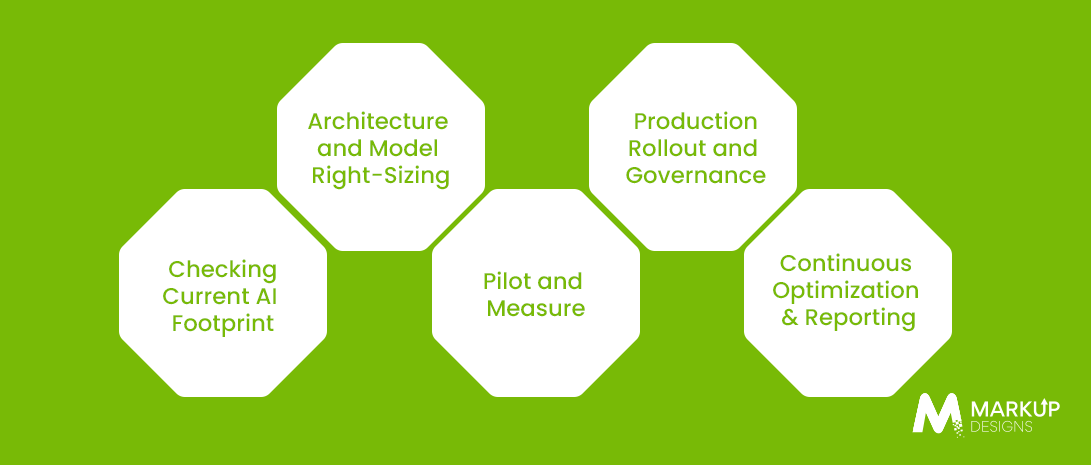
Based on our experience with applications of artificial intelligence in healthcare, fintech, and logistics, for example, it became clear that green AI applications are most effective when based on a five-step process. This approach helps organizations achieve their sustainability goals and succeed at what they do.
Phase 1: Checking Current AI Footprint (Weeks 1–4)
Firstly, to implement a sustainable strategy in relation to AI, one should understand where one stands. Companies should have a clear perspective on AI system utilization and resource consumption before doing anything else.
It is important to analyze the current AI tasks, usage rates, and computing capacity. Moreover, measuring energy consumption and analyzing the carbon footprint related to host locations are vital. It is necessary to identify the AI systems that require ESG disclosures as well as evaluate risks regarding regulations, consumer expectations, procurement, or sustainability commitments.
After completing this phase, organizations will have the base rate illustrating their environmental footprint from the use of AI systems.
Phase 2: Architecture and Model Right-Sizing (Weeks 4–10)
Engineering judgment really counts here. Typically, decisions include:
- Replacing big foundation models with distilled ones.
- Shifting inference from training GPUs to inference accelerators.
- Moving non-time-sensitive tasks to carbon-aware regional scheduling.
- Choosing whether to build or buy the orchestration layer.
Phase 3: Pilot and Measure (Weeks 10–18)
Identify two or three major cost centres and high-emission activities, and compare their efficiency between existing and green architecture. Measure cost, energy consumption, and any changes in model accuracy across both architectures. This will enable us to conduct a credible internal case study before embarking on the change process.
Phase 4: Production Rollout and Governance (Months 5–9)
With any implementation of Green AI solutions, appropriate monitoring and control systems should be established. It will be necessary to track different model versions, monitor their performance, and energy efficiency. At the same time, a set of procedures aimed at handling possible issues with optimization should be established.
The importance of strong corporate governance cannot be overstated in this situation. A cross-functional team consisting of representatives of engineering, legal, and sustainability departments would be quite helpful in this case.
Phase 5: Continuous Optimization and Reporting (Ongoing)
Business organizations must constantly monitor the effectiveness and performance efficiency of their AI solutions. Organizations must monitor the energy consumption in each function, discard inefficient AI models, and look for innovative AI solutions and technologies that can help improve efficiency without consuming additional energy.
Such constant review not only allows organizations to remain sustainable and save money but also helps gain information that can directly be used in annual sustainability and ESG reporting.
Read: Also: Future of AI in Digital Transformation in the Next Decade
Green AI vs Traditional AI: Understanding the Key Difference

While traditional artificial intelligence concentrates on improving performance and speed, it is not concerned about the cost of computing and energy usage. However, as artificial intelligence develops into a bigger and more complex system, it requires substantial amounts of electricity and other resources. That is why it is crucial to manage these consequences throughout its entire life cycle.
In contrast, Green AI takes a new approach by combining the optimization of efficiency and sustainability with meeting business goals. In this way, the technology is able to minimize resource and energy consumption and limit greenhouse gas emissions.
The application of Green AI to business enterprises is not only important for sustainability. It also reduces costs, maximizes the utilization of resources, contributes to the attainment of ESG targets, and makes compliance with environmental regulations easier. With an increased investment in AI technology by organizations, the adoption of Green AI is essential.
Key Factors Driving Green AI Adoption in 2026

In 2026, Green AI adoption is being driven by more than environmental concern; it has become a core business and operational imperative.
Compute economics has flipped
AI training centers require enormous quantities of electricity, since they require electricity comparable to that which would be used to run ten thousand of houses. As AI capabilities scale rapidly, energy demands are projected to grow, as current systems already consume multiples of what was needed just a few years ago. For most organizations, electricity has become more of a challenge than the hardware.
Regulatory exposure is widening
The regulatory environment concerning sustainability is becoming increasingly stringent worldwide. Organizations must submit reports on their energy usage and carbon footprint, which now also include the environmental effects of their IT systems and use of AI.
Procurement and tender requirements
Procurement standards are also evolving. Today, most government contracts, health-care procurement deals, and major firm RFPs include sustainability clauses. This implies that companies are now evaluating their vendors’ environmental performance.
Core Technologies Enabling Green AI Solutions

Sustainable AI begins with good design decisions, rather than just with the selection of the model. An efficiently designed tech stack reduces energy consumption, improves efficiency, and saves money. An effective Green AI stack must therefore be designed with compatibility across all layers, from model selection to infrastructure.
Model Layer
The model layer focuses on selecting and optimizing AI models that deliver high performance with minimal computational resources. It uses techniques like model compression, quantization, pruning, and knowledge distillation to make models smaller, faster, and more energy-efficient without significantly reducing accuracy.
Training Layer
The training layer involves building and improving AI models in an efficient way by reducing the time, cost, and energy required for training. Instead of training from scratch, it often uses pre-trained models and fine-tunes them for specific tasks, helping save resources while maintaining strong performance.
Inference Layer
The inference layer is where trained AI models are used in real-world applications to process requests and generate outputs. It focuses on making predictions efficiently using techniques like batching, caching, and optimized hardware, ensuring fast responses with lower energy consumption.
Orchestration Layer
The orchestration layer manages and coordinates AI workloads across systems to ensure optimal performance and sustainability. It dynamically distributes tasks, balances resources, and can shift workloads to more energy-efficient or low-carbon environments to reduce waste and improve efficiency.
Infrastructure Layer
The infrastructure layer refers to the underlying physical and cloud systems that support AI operations, including servers, data centers, storage, and networking. It emphasizes energy-efficient hardware, renewable-powered data centers, and scalable cloud environments designed to reduce environmental impact while maintaining high computing capacity.
Know the Complete Costing of Green AI for Enterprises
The AI development cost associated with the implementation of Green AI depends on different parameters such as organization size, nature of workload, existing infrastructure, and sustainability objectives. While upfront investment in optimization, monitoring tools, and efficient hardware can be significant, the long-term savings from reduced energy consumption and lower cloud spend typically outweigh initial costs.
| Cost Component | Estimated Cost (USD) |
| AI Sustainability Assessment & Audit | $10,000 – $50,000 |
| AI Model Optimization & Fine-Tuning | $20,000 – $150,000 |
| Energy Monitoring & Carbon Tracking Tools | $5,000 – $50,000 per year |
| Cloud & Infrastructure Optimization | $15,000 – $100,000 |
| Sustainable Data Center & Hardware Upgrades | $50,000 – $500,000+ |
| AI Governance & Compliance Framework Setup | $20,000 – $100,000 |
| ESG Reporting & Sustainability Integration | $10,000 – $75,000 |
| Ongoing Monitoring & Maintenance | $1,000 – $20,000 per month |
How to Meet Green AI Compliance Requirements
We protect cloud communications through network security systems that involve traffic monitoring, firewall management, and intrusion detection. Additionally, we prevent any potential threats, keep you safe online, and enhance your entire security strategy.
Disclosure alignment: Ensure that there is consistency through linkage of all the measurable KPIs for energy and carbon into respective standards such as the SEC Climate Rule, CSRD ESRS E1, TCFD, ISSB IFRS S2, and SDR of the UK. There needs to be alignment on KPIs between the engineers and the disclosure function teams.
Model and data lineage: There is a centralized registry that tracks every AI model used in production along with its training data, compute and carbon emissions, and evaluation data, and the infrastructure on which it runs for inference purposes. The purpose of this registry is to make sure that there is compliance with all EU AI Act standards.
Vendor due diligence: Vendor due diligence relates to the process of validating whether providers of cloud and inference can provide granular, audit-proof information regarding their energy consumption and carbon emissions in accordance with workloads, and not annual estimates only. Large vendors such as AWS, Azure, and GCP offer this level of transparency.
Independent validation: Third-party audits for scope two emissions have already become routine for public corporations, while for scope three, they are gaining popularity as well. Such processes should be incorporated in systems as early as possible for the sake of transparency.
Mistakes in Green AI Implementation
Here are the common mistakes enterprises make when trying to adopt Green AI without the right expertise:
- Many firms tend to begin by investing in better computing resources before attempting to reduce demand. Usually, you get higher efficiency gains through improving your models and getting rid of inefficiencies.
- Yet another challenge that can arise is related to how businesses regard Green AI technology. Many organizations consider it nothing more than a sustainability initiative. As such, in cases where Green AI is solely taken care of by the sustainability department, technical issues could get ignored.
- It is also a frequent error when people place too much emphasis on training emissions. In reality, in many companies, the expense involved is due to inference, which is 80% to 90% of all costs.
- Additionally, some teams base their calculations on global average emissions figures, which may lead to erroneous assumptions. In reality, the same operation can have significantly varying levels of environmental impact depending on the power grid it relies upon.
- .Some teams depend on global average emissions data, which can be pretty misleading. The same task can have very different carbon footprints based on where it runs, because each area has a unique grid intensity.
- Also, hardware lifecycle gets ignored quite a bit. With quick refresh cycles for AI infrastructure, failing to plan for reuse, retirement, and responsible disposal increases both emissions and e-waste risk.
- Many organizations skip establishing a proper baseline. If you don’t have a clear starting point, proving any improvement later is tough, especially during audits.
How Markup Designs Can Help You Build High-Performance Green AI Systems
Our experts at Markup Designs help organizations develop their Green AI ecosystems that are highly effective and compliant with all the necessary regulations. We prioritize optimizing model architecture, reducing extra computation, and improving inference efficiency to reduce costs and improve performance, along with minimizing your carbon footprint.
In addition, we provide full transparency, monitoring, and audit reports in the process to keep your systems updated on the latest compliance standards. Our team collaborates with you throughout the process and concentrates on energy-efficient approaches and continuous optimization. Hence, we provide scalable and sustainable AI solutions.
Build Smarter, Greener AI Systems Today
Sustainable AI isn’t just a future goal; it’s a current need for companies that want to be competitive, compliant, and cost-effective. We assist you in creating and putting Green AI systems into action. These systems lower environmental impact while boosting performance and scalability.

Conclusion
Green AI is transforming the way businesses utilize AI. The AI adoption is no longer limited to the performance aspect alone; rather, sustainability is just as important. Companies must be keen on efficiency, cost, regulations, and environmental considerations in one go. This entails a complete makeover of the entire AI process.
Businesses that adapt to Green AI will experience competitive advantages. Not only will they lower their carbon footprint, but operate more efficiently and comply with emerging regulations. With an appropriate strategy, companies will be able to maximize their gains from Green AI without harming the environment.
FAQs
1. What is Green AI?
Green AI refers to the development and deployment of artificial intelligence systems that are optimized to reduce energy consumption, carbon emissions, and overall resource usage while maintaining performance.
2. Why is Green AI important for businesses?
It helps organizations reduce operational costs, meet sustainability goals, and comply with increasing environmental regulations, all while improving system efficiency.
3. What is the difference between traditional AI and Green AI?
Traditional AI focuses mainly on accuracy and performance, while Green AI also prioritizes energy efficiency, sustainability, and responsible resource usage.
4. Where do most AI emissions come from?
In most enterprise systems, the majority of energy consumption—often 80–90%—comes from inference workloads rather than training.
5. How can companies start adopting Green AI?
The first step is measuring the current AI footprint, followed by optimizing models, improving infrastructure efficiency, and setting up governance and monitoring systems.
6. Does Green AI reduce performance?
No. When implemented correctly, Green AI improves efficiency without compromising accuracy, latency, or reliability.
Here at Markup Designs, we’ve observed that Green AI technology has gone down the same path that security and compliance have before it, from a nice-to-have feature into something that is a necessity. Organizations that embed Green AI practices early will be far better positioned than those who treat it as an afterthought, or worse, a reporting exercise.
Discuss Your Project NowAjit Kumar Jha
VP - Business Operations
Related Posts

Enterprise AI Agents: Practical Use Cases Driving Business...

LLM-as-a-Judge Explained: Improving Enterprise AI Governance and Evaluation

Enterprise AI Outsourcing: How to Choose the Right...
Insights Are Valuable & Execution is Priceless
You’ve read about the digital future. Now, let’s build the infrastructure to take you there. Move your strategy from the page to the product.
Design Your Solution Now
Contact Us
Schedule The Appointment At Your Convenience Date And Time.
30 Min
Web Conference
Time Zone
Indian standard time (08:30pm)

Thanks For Getting In Touch!
You’ve Taken The First Step Toward Transforming Your Digital Presence. Our Experts Will Reach Out Shortly To Take It Forward.
Launch Your Dream Project
Provide a brief overview of your project, and our specialists will evaluate your requirements. We will connect with you to explore how the right digital solutions can help you launch faster.