
In Brief
- Dubai is rapidly becoming a global leader in enterprise AI adoption, driven by strong government initiatives, advanced digital infrastructure, and large-scale AI integration across industries.
- Enterprises in sectors like banking, healthcare, retail, logistics, and real estate are using AI to automate operations, improve customer experiences, enhance decision-making, and increase efficiency.
- Key AI trends in Dubai include autonomous AI systems, AI-powered smart city infrastructure, region-specific Arabic language models, advanced personalization, and low-code AI platforms.
- Despite the opportunities, businesses still face challenges such as poor data quality, legacy system integration, high implementation costs, talent shortages, and security and compliance concerns.
- Companies that adopt AI strategically can unlock major benefits, including operational efficiency, innovation, competitive advantage, personalized customer engagement, and new revenue opportunities.
- Successful enterprise AI adoption requires clear business goals, scalable infrastructure, strong governance, skilled talent, continuous optimization, and the right AI technology partner to drive long-term transformation.
Dubai has always positioned itself as a city of the future. Over the past decade, this vision has accelerated into a full-scale digital transformation, with artificial intelligence emerging as one of its most powerful drivers. What was once considered an experimental technology is now deeply embedded in how businesses operate, compete, and grow.
Today, enterprises across Dubai are not just exploring AI, they are actively integrating it into their core operations. From banking and healthcare to logistics and retail, AI is reshaping industries by enabling smarter decision-making, automating complex processes, and delivering highly personalized customer experiences.
This shift marks a significant change in how businesses operate. AI is no longer just a tool for gaining a competitive edge; it is becoming a core part of everyday business functions. From improving efficiency to enabling faster, data-backed decisions, AI is now deeply integrated into how organizations grow and adapt. Businesses are increasingly relying on it to streamline operations, enhance customer experiences, and respond more effectively to changing market demands.
In this blog, we will explore what enterprise AI adoption truly means, why Dubai is leading this transformation, the key trends shaping adoption, the challenges businesses face, and the opportunities that lie ahead.
What is Enterprise AI Adoption?
AI Adoption refers to how large enterprises systematically integrate artificial intelligence into their core business functions. It is not limited to isolated use cases but involves embedding AI across departments, digital systems, and operational workflows to drive consistent, organization-wide impact.
Unlike basic AI usage, where a company might implement a chatbot or a recommendation engine, enterprise AI adoption is holistic. It connects data, algorithms, and infrastructure to create a unified, intelligent ecosystem that supports business goals.
For example, an enterprise in Dubai might use AI to:
- Automate customer service through intelligent chatbots
- Detect fraudulent transactions in real time
- Forecast demand and optimize inventory
- Enhance employee productivity through AI-powered tools
To achieve this, organizations must build a strong foundation that includes data infrastructure, machine learning models, and scalable computing resources. The goal is to create systems that not only automate tasks but also learn, adapt, and improve over time.
Why is Dubai Leading in Enterprise AI Adoption?
Dubai is rapidly emerging as a global leader in enterprise AI adoption. By early 2026, UAE recorded an impressive 70.1% AI diffusion rate across workplaces, which is far surpassing the global average of 17.8%. This momentum is driven by strong government direction, widespread use of generative AI technologies, and significant investments in advanced digital infrastructure.
Several factors are powering Dubai’s leadership in AI:
- Strong Government Vision and Strategic Direction
UAE has made artificial intelligence central to its long-term economic diversification plans. Under the National Strategy 2031, the government aims for AI to contribute around 14% to the country’s GDP by 2030. Initiatives like the “Dubai Universal Blueprint for Artificial Intelligence” are focused on embedding AI across public services while positioning Dubai as a global center for AI governance and regulation. - Rapid Adoption and Scaled Implementation
Dubai has moved decisively beyond pilot programs, embracing AI at an enterprise level. More than 60% of professionals in UAE now incorporate AI into their daily workflows. Real-world implementations are already visible, from AI-powered crime prevention systems used by Dubai Police to intelligent energy optimization by DEWA. - Supportive Regulatory and Investment Environment
Dubai offers a business-friendly ecosystem that encourages AI innovation. Regulatory sandboxes, such as those established by the Dubai International Financial Centre (DIFC), allow organizations to test and refine AI solutions within a controlled framework, minimizing compliance risks.
Read: Also: How AI Innovations Are Transforming Dubai Businesses
What are the Major Challenges in AI Adoption By Organizations?
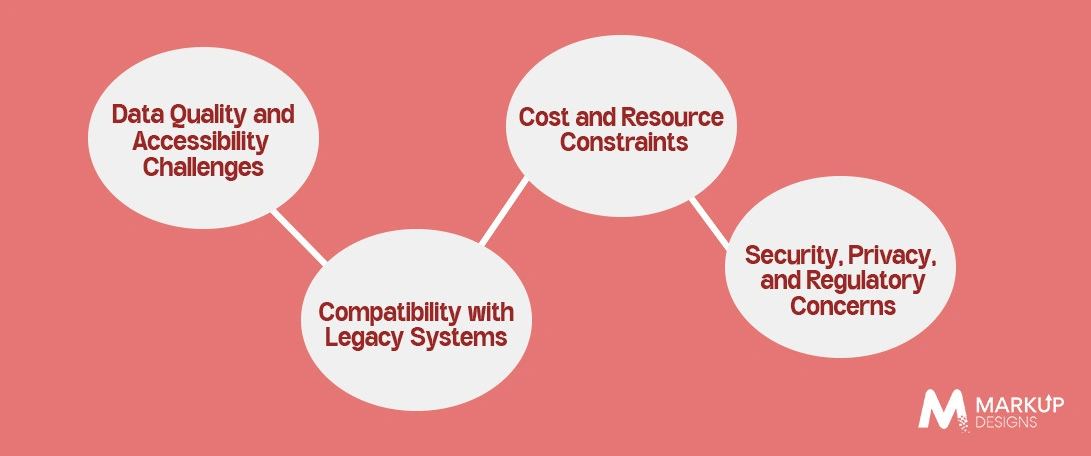
Despite its transformative potential, adopting AI at an enterprise level is full of challenges. Many organizations face obstacles that can slow down or even hinder their AI initiatives.
- Data Quality and Accessibility Challenges
Poor data quality remains a critical barrier to effective AI adoption. When data is fragmented, incomplete, or inconsistent, it directly impacts the accuracy and reliability of AI models. To address this, organizations need to establish robust data governance practices, implement thorough data cleansing processes, and adopt centralized storage solutions. - Compatibility with Legacy Systems
Integrating AI with existing legacy infrastructure can be complex, especially when older systems are not built to support modern technologies. Instead of complete system overhauls, businesses can take a phased modernization approach. - Cost and Resource Constraints
Implementing AI solutions often involves substantial upfront and ongoing investments, including infrastructure setup, advanced tools, skilled talent, and maintenance. This can be both time-intensive and expensive for many organizations. To manage these challenges, businesses can consider AI integration services that provide specialized expertise. - Security, Privacy, and Regulatory Concerns
AI systems frequently process sensitive organizational and customer data, making security and compliance a top priority. Without proper safeguards, businesses risk data breaches and regulatory violations. To mitigate these risks, enterprises should adopt strong cybersecurity measures.
Key Industries Driving AI Adoption in Dubai
AI adoption in Dubai is not limited to a single sector. Instead, it spans multiple industries, each leveraging AI in unique ways to improve efficiency and deliver value.
Banking and Financial Services
The financial sector has been one of the earliest adopters of AI. Banks and financial institutions are using AI to detect fraud, assess risk, and provide personalized financial services. AI algorithms can analyze vast amounts of transaction data in real time, identifying suspicious patterns and preventing fraud before it occurs.
Healthcare
In healthcare, AI is transforming patient care by enabling predictive diagnostics and personalized treatment plans. Hospitals and clinics are using AI-powered mobile app to analyze medical data, improve diagnosis accuracy, and enhance patient outcomes.
Retail and E-commerce
Retailers in Dubai are leveraging AI to deliver highly personalized shopping experiences. From product recommendations to dynamic pricing and demand forecasting, AI helps businesses understand customer behavior and optimize their operations.
Real Estate and Smart Cities
Dubai’s vision of becoming a smart city relies heavily on AI. Real estate companies are using AI to analyze market trends, predict property values, and optimize urban planning. AI also plays a key role in managing smart infrastructure and improving sustainability.
Logistics and Transportation
AI is revolutionizing logistics by optimizing routes, reducing delivery times, and improving supply chain efficiency. In a global trade hub like Dubai, these advancements are critical for maintaining competitiveness.
Read Also: Future of AI in Digital Transformation in the Next Decade
Trends in AI Adoption in Dubai
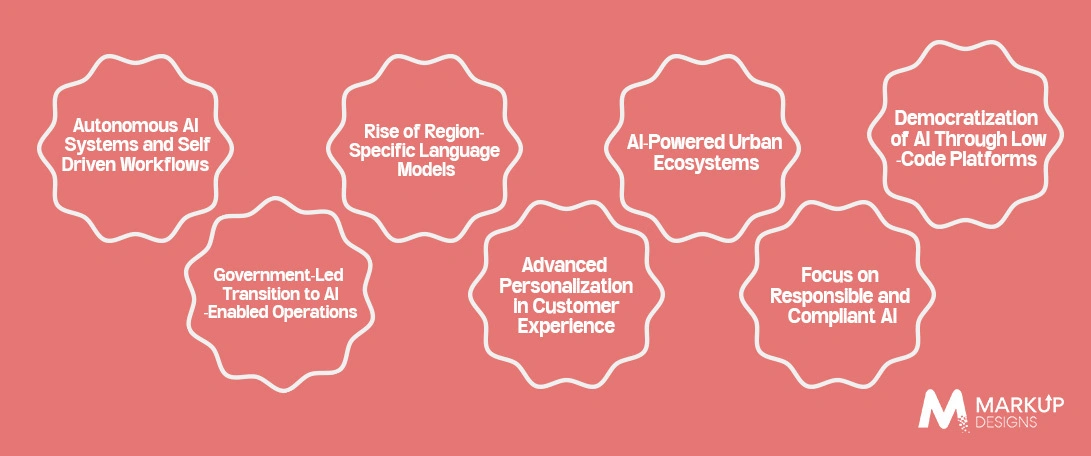
As AI continues to evolve, several key trends are shaping how enterprises in Dubai adopt and implement this technology.
Autonomous AI Systems and Self-Driven Workflows
Enterprises are moving beyond conventional generative models and embracing intelligent AI agents that can independently manage tasks. This shift is a key driver of artificial intelligence in UAE. Many AI companies in Dubai are actively building such solutions to help organizations improve efficiency and operational agility.
Government-Led Transition to AI-Enabled Operations
UAE is accelerating AI adoption through strong public-sector initiatives, with plans to shift nearly half of government functions to AI-powered systems within a short timeframe. This proactive approach is creating a highly supportive environment for businesses to integrate AI into their operations.
Rise of Region-Specific Language Models
There is a growing emphasis on developing AI solutions tailored to the Arabic language. Businesses are investing in specialized language models that can accurately interpret regional dialects, cultural context, and industry-specific terminology to deliver more relevant outputs.
Advanced Personalization in Customer Experience
Companies across industries such as retail, fintech, and services are leveraging AI to create highly individualized customer journeys. Instead of relying on broad audience segmentation, businesses are delivering real-time, personalized interactions based on user behavior and preferences.
AI-Powered Urban Ecosystems
Artificial intelligence is becoming a core component of smart city infrastructure, particularly in places like Dubai. From optimizing traffic systems to managing energy usage, AI-driven solutions are increasing efficiency and driving demand for interconnected IoT-based technologies.
Focus on Responsible and Compliant AI
Enterprises are prioritizing the development of AI systems that are ethical, transparent, and compliant with regulatory standards. There is increasing attention on governance frameworks to ensure responsible AI deployment in line with both local and global guidelines.
Democratization of AI Through Low-Code Platforms
The adoption of low-code and no-code platforms is enabling non-technical professionals to build and deploy AI-driven solutions. This shift is reducing dependency on specialized development teams and making AI more accessible across different business functions.
Read: Also: How AI Innovations Are Transforming Dubai Businesses
Opportunities for Businesses Adopting AI in Dubai
While challenges exist, the opportunities presented by AI far outweigh the risks. Businesses that successfully adopt AI can unlock significant value and gain a competitive edge.
Enhanced Customer Experience
AI enables businesses to deliver personalized experiences at scale, improving customer satisfaction and loyalty.
Operational Efficiency
By automating processes and optimizing workflows, AI reduces costs and increases efficiency across the organization.
Innovation and New Revenue Streams
AI opens the door to new products, services, and business models, allowing companies to diversify their offerings and generate additional revenue.
Competitive Advantage
Early adopters of AI are better positioned to outperform competitors, adapt to market changes, and drive long-term growth.
Global Market Positioning
Dubai’s focus on AI provides businesses with the opportunity to establish themselves as leaders in a global market.
Read: Also: Why Dubai is Becoming the AI Capital of the Middle East in 2026
Real-World Use Cases of AI in Dubai Enterprise.
- Government services are becoming more efficient through AI-powered automation.
- Airports are using AI to enhance passenger experience and streamline operations.
- In banking, AI-driven mobile apps offer real-time insights and personalized financial advice.
- Retailers are leveraging AI to create seamless omnichannel customer experiences.
- In healthcare, AI is improving diagnostics, patient monitoring, and treatment planning.
- AI in smart mobility and on-demand services is optimizing route planning, traffic flow, and user experience.
- AI is strengthening cybersecurity by detecting threats, preventing fraud, and enabling real-time risk monitoring.
- AI in enterprise solutions is streamlining operations, improving decision-making, and driving overall business efficiency.
These use cases show that AI is a practical tool delivering measurable business results, not just a concept.
Best Practices for AI Adoption
To fully realize the benefits of AI Innovations, businesses need a structured and strategic approach. Below are concise, easy-to-read explanations of each best practice.
Start with Clear Business Objectives
AI initiatives should always begin with clearly defined business goals, such as improving efficiency, reducing costs, or enhancing customer experience. This ensures that AI is solving real problems rather than being used as a trend. Clear objectives also make it easier to measure success and ROI.
Build a Strong Data Foundation
High-quality data is essential for accurate AI outcomes. Businesses must ensure their data is clean, structured, and accessible across systems. Establishing strong data governance helps maintain consistency and reliability over time.
Begin with a Minimum Viable Product (MVP)
Starting with an MVP allows businesses to test AI solutions on a smaller scale before full deployment. This reduces risk, saves cost, and provides insights for improvement. It also helps validate the effectiveness of the AI use case early on.
Invest in Talent and Training
Successful AI adoption requires skilled professionals and trained teams. Companies should hire AI experts while also upskilling existing employees. A well-trained workforce ensures smoother implementation and better utilization of AI tools.
Choose the Right Technology Partners
Partnering with experienced AI providers helps accelerate implementation and reduce complexity. The right partners bring technical expertise, industry knowledge, and scalable solutions. This ensures long-term success and continuous innovation.
Focus on Scalability from the Outset
AI solutions should be designed to scale across the organization from the beginning. This involves using flexible infrastructure and cloud-based systems. Planning for scalability avoids challenges when expanding AI initiatives.
Ensure Strong Governance and Compliance
AI systems must follow strict data privacy, security, and ethical standards. Establishing governance frameworks ensures transparency and compliance with regulations. This builds trust and reduces potential risks.
Encourage Cross-Department Collaboration
AI adoption should involve multiple teams, not just IT. Collaboration across departments ensures better alignment with business needs. It also helps identify more practical and impactful AI use cases.
Continuously Monitor and Optimize AI Systems
AI models require regular monitoring and updates to maintain accuracy. Businesses should continuously evaluate performance and refine systems. This ensures long-term effectiveness and adaptability.
Foster a Culture of Innovation and Experimentation
Organizations should encourage a mindset of innovation and continuous learning. Employees must feel comfortable experimenting with AI tools and ideas. A strong innovation culture supports faster and more effective AI adoption.
Partner with Markup Designs for Enterprise AI Adoption
At Markup Designs, we help enterprises accelerate AI adoption through a strategic, business-focused approach that goes beyond technology implementation. We work closely with organisations to identify high-impact AI opportunities that align with operational goals, customer expectations, and long-term growth strategies.
Our team designs and develops scalable AI solutions that integrate seamlessly with existing enterprise systems, ensuring minimal disruption and maximum efficiency. From AI strategy consulting and data engineering to model development, deployment, and continuous optimisation, we manage the complete AI transformation journey with precision and transparency.
We focus on building secure, future-ready AI ecosystems that enhance automation, improve decision-making, and unlock actionable business insights. By combining advanced technologies with industry expertise, we help enterprises streamline operations, increase productivity, and maintain a competitive edge in an increasingly digital business environment.
At Markup Designs, we also prioritise responsible AI adoption by ensuring data security, compliance, and ethical implementation practices across every stage of development. Our goal is to help enterprises confidently embrace AI innovation while driving measurable and sustainable business outcomes.
The Future of Enterprise AI in Dubai
The future of AI in Dubai is incredibly promising. As technology continues to advance, AI will become an integral part of every business function. The rise of hyperautomation, combined with the integration of AI, IoT, and smart city technologies, will redefine how enterprises operate.
Dubai’s commitment to innovation ensures that it will remain at the forefront of this transformation. Businesses that embrace AI today will be well-positioned to thrive in Dubai.
FAQs
1. What is enterprise AI adoption?
Enterprise AI adoption refers to integrating artificial intelligence across business operations at scale to improve efficiency, decision-making, and customer experiences.
2. Why is Dubai focusing heavily on AI?
Dubai aims to become a global AI hub through government initiatives, strong infrastructure, and investments in innovation, making AI a key part of its economic growth strategy.
3. Which industries benefit the most from AI in Dubai?
Industries such as banking, healthcare, retail, logistics, and real estate are seeing significant benefits from AI adoption.
4. Is AI adoption expensive for enterprises?
While initial implementation can be costly, AI delivers long-term ROI through automation, efficiency, and new revenue opportunities.
5. What are the biggest challenges in AI adoption?
Common challenges include poor data quality, lack of skilled talent, high costs, integration with legacy systems, and security concerns.
6. How can businesses start with AI adoption?
Businesses should begin with clear goals, build a strong data foundation, and start with small-scale AI projects before scaling.
7. Is AI replacing human jobs in enterprises?
AI is more about augmenting human capabilities rather than replacing jobs. It helps employees work more efficiently and focus on strategic tasks.
Conclusion: Turning AI Potential into Business Reality
Enterprise AI adoption in Dubai represents a significant shift in how businesses operate and compete. It is not just about technology; it is about transformation. From improving efficiency and enhancing customer experiences to driving innovation and growth, AI offers immense potential for organizations willing to embrace it.
However, success requires more than just implementation. It demands a clear strategy, the right resources, and a commitment to continuous learning and adaptation.
As Dubai continues its journey toward becoming a global AI hub, the message for enterprises is clear: the time to adopt AI is now. Those who act decisively will not only keep pace with change but lead it.
Author's Perspective
Enterprise AI adoption in Dubai is not just a technological trend—it is a defining shift in how businesses will operate in the future. From my perspective, the organizations that will truly succeed are not the ones that adopt AI the fastest, but the ones that adopt it the smartest.
The key lies in balancing innovation with strategy. AI should not be treated as a standalone solution but as an integrated part of business growth. Companies must focus on building strong data ecosystems, fostering a culture of learning, and aligning AI initiatives with long-term goals.
Dubai has already laid the foundation to become a global leader in AI. The opportunity now lies with enterprises to leverage this ecosystem and turn AI potential into measurable business outcomes.
Discuss Your Project NowAjit Kumar Jha
VP - Business Operations
Related Posts
How to Build Production-Ready Applications with AI Coding...
Cost, Benefits & Business Impact: Generative AI vs....
Enterprise AI Agents: Practical Use Cases Driving Business...
Insights Are Valuable & Execution is Priceless
You’ve read about the digital future. Now, let’s build the infrastructure to take you there. Move your strategy from the page to the product.
Design Your Solution Now
Contact Us
Schedule The Appointment At Your Convenience Date And Time.
30 Min
Web Conference
Time Zone
Indian standard time (08:30pm)

Thanks For Getting In Touch!
You’ve Taken The First Step Toward Transforming Your Digital Presence. Our Experts Will Reach Out Shortly To Take It Forward.
Launch Your Dream Project
Provide a brief overview of your project, and our specialists will evaluate your requirements. We will connect with you to explore how the right digital solutions can help you launch faster.