
The Future of AI in Digital Transformation: Trends That Will Define the Next Decade
The terminology, Artificial Intelligence, is no longer a simple concept; it has been the main engine powering the transformation of every core industry. Modern businesses can harness the power of AI to manage their complex operations so that it will be easier to identify new revenue opportunities.
In the future, AI is going to evolve far beyond experimentation, embedding itself into the core fabric of enterprise strategy and everyday operations. Organizations that once utilized AI in isolated use cases will scale it across entire value chains, making it less of a competitive advantage and more of a competitive necessity.
From intelligent automation and predictive analytics to autonomous systems and seamless human-AI collaboration, the trends shaping AI’s role in digital transformation are both profound and imminent. For businesses aiming to stay relevant and future-ready, understanding these shifts isn’t optional; it’s imperative.
Know the Evolution of AI Businesses
The journey of AI in business has evolved significantly over the past decade. Initially, AI adoption was limited to specific use cases such as data analysis and customer support chatbots. Today, AI has become deeply integrated into core business functions.
Modern enterprises are transitioning from AI-enabled to AI-driven organizations. This means AI is no longer just a supporting tool; it is becoming central to decision-making, operations, and innovation.
Businesses are now investing in:
- AI-powered analytics platforms
- Intelligent automation systems
- Machine learning-driven customer insights
- AI-based cybersecurity solutions
In the future, we will see the rise of AI-native companies, such as organizations built entirely around AI capabilities. These businesses will operate faster, make smarter decisions, and scale more efficiently than traditional enterprises.
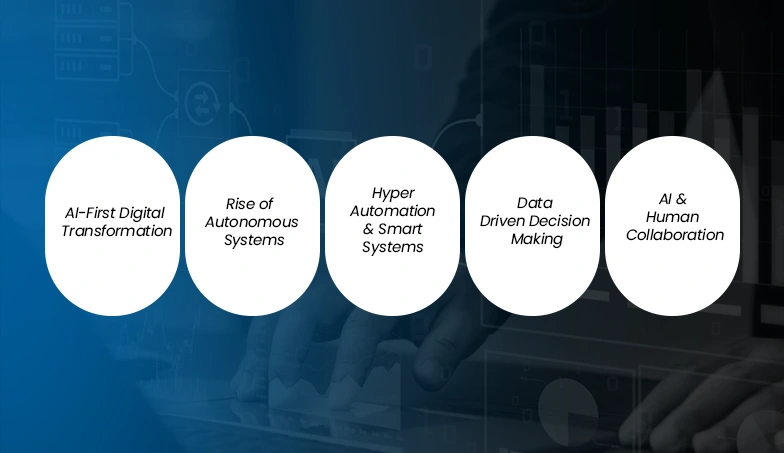
AI-First Digital Transformation
Digital transformation strategies are increasingly becoming AI-first rather than technology-first. This shift means businesses are designing processes, systems, and workflows with AI at the core from the beginning.
An AI-first approach enables:
- Predictive decision-making instead of reactive responses
- Real-time personalization of customer experiences
- Intelligent process optimization
- Scalable automation across departments
For example, instead of simply digitizing existing processes, companies are redesigning workflows to allow AI systems to analyze data, identify patterns, and take action automatically. This approach significantly improves efficiency and reduces operational costs while enhancing business agility.
Rise of Autonomous Systems
One of the most transformative trends in AI is the rise of autonomous systems. These systems can perform tasks, make decisions, and adapt to changing environments with minimal human intervention.
Examples include:
- Autonomous supply chain management systems
- Self-optimizing manufacturing processes
- AI-driven logistics and route optimization
- Intelligent financial systems for fraud detection and risk assessment
In industries such as manufacturing, logistics, and healthcare, autonomous systems will reduce human dependency on repetitive and complex tasks. Over the next decade, businesses will increasingly rely on AI systems that can:
- Learn continuously from data
- Make independent decisions
- Improve performance over time
This will lead to faster operations, reduced errors, and improved productivity.
Hyper-Automation & Smart Systems
Hyper-automation goes beyond traditional automation by combining AI, machine learning, robotic process automation (RPA), and advanced analytics to automate complex business processes end-to-end.
Smart systems powered by hyper-automation can:
- Handle repetitive tasks with minimal supervision
- Analyze large datasets in real time
- Trigger automated workflows based on insights
- Continuously improve through machine learning
Key areas where hyper-automation is gaining traction include:
- Finance and accounting
- Human resources
- Customer service
- IT operations
Businesses adopting hyper-automation are seeing significant improvements in efficiency, accuracy, and scalability. It also allows employees to focus on strategic tasks rather than routine work.
Data-Driven Decision Making
Data is the foundation of AI-driven digital transformation. Organizations are increasingly relying on AI to turn raw data into actionable insights. AI-powered analytics enable businesses to:
- Predict market trends
- Understand customer behavior
- Optimize pricing strategies
- Improve operational efficiency
In the future, decision-making will become more data-driven and predictive rather than intuition-based.
Advanced AI systems will provide:
- Real-time insights
- Scenario analysis
- Automated recommendations
This shift will empower business leaders to make faster and more informed decisions, reducing risks and improving outcomes.
AI & Human Collaboration
Contrary to common concerns, AI is not replacing humans; it is enhancing human capabilities. The future of work will be defined by collaboration between humans and AI systems.
AI will handle:
- Data analysis
- Repetitive tasks
- Pattern recognition
Humans will focus on:
- Strategic thinking
- Creativity
- Emotional intelligence
- Decision-making in complex scenarios
This collaboration will create a more efficient and productive workforce. Organizations that successfully integrate AI with human expertise will gain a significant competitive advantage. Training and upskilling employees to work alongside AI will become a key priority for businesses.
The Core Challenges in AI Adoption
As AI adoption grows, ethical concerns and challenges are becoming more prominent. Businesses must ensure that AI systems are:
- Transparent
- Fair and unbiased
- Secure
- Compliant with regulations
Key challenges include:
- Data privacy concerns
- Algorithmic bias
- Lack of explainability
- Cybersecurity risks
Organizations will need to establish strong governance frameworks for AI, including:
- Ethical guidelines
- Data protection policies
- Regular audits of AI systems
Building trust in AI will be critical for long-term success. Companies that prioritize ethical AI practices will not only avoid risks but also strengthen their brand reputation.
Remote & Hybrid Working Models of AI
AI is playing a crucial role in enabling remote and digital-first work environments. Businesses are leveraging AI to maintain productivity, collaboration, and efficiency in distributed teams. AI-powered tools support:
- Virtual collaboration
- Intelligent scheduling
- Automated workflows
- Performance monitoring
In the future, remote work will become smoother with AI-driven solutions that:
- Enhance communication
- Improve employee engagement
- Provide real-time productivity insights
Digital-first work models will allow businesses to access global talent, reduce operational costs, and remain flexible in changing market conditions.
Future Opportunities and Challenges Businesses Will Face
The future of AI in digital transformation presents both opportunities and challenges.
Opportunities:
- Increased operational efficiency
- Enhanced customer experiences
- New business models and revenue streams
- Faster innovation cycles
Challenges:
- High implementation costs
- Talent shortages in AI expertise
- Integration with legacy systems
- Managing data quality and security
Businesses that proactively address these challenges will be better positioned to leverage AI for growth.
Preparing Your Business for the Future with AI
To successfully adopt AI, businesses need a structured and strategic approach. Key steps include:
1. Define Clear Objectives
The first step in any AI initiative is to clearly define what you want to achieve. AI should not be implemented for the sake of innovation alone; it must solve specific business problems or unlock measurable value.
Start by identifying high-impact areas such as customer experience, operational efficiency, cost reduction, or revenue growth. Map these goals to real use cases, for example, predictive maintenance in manufacturing, fraud detection in finance, or personalized recommendations in retail.
2. Build a Strong Data Foundation
AI systems are only as good as the data they rely on. A strong data foundation is critical to ensure accurate insights and reliable outcomes. Businesses need to focus on collecting high-quality, relevant, and consistent data from multiple sources. This includes cleaning and organizing data, eliminating duplicates, and ensuring proper labeling for machine learning models.
3. Invest in the Right Technology
Choosing the right AI technologies and platforms is essential for long-term success. Businesses should evaluate tools based on scalability, compatibility with existing systems, and ease of integration. This includes selecting:
- Machine learning platforms for predictive analytics
- Automation tools for process optimization
- AI-powered analytics dashboards for real-time insights
4. Start Small and Scale
Rather than implementing AI across the entire organization at once, businesses should begin with pilot projects. These smaller initiatives allow teams to test concepts, measure results, and identify potential challenges before scaling. Choose manageable use cases, have clear outcomes, and offer quick wins. This helps build confidence among stakeholders and demonstrates the value of AI early in the process.
5. Upskill Your Workforce
AI adoption is not just a technological shift—it is also a workforce transformation. Employees need to be equipped with the skills required to work alongside AI systems effectively. Organizations should invest in training programs focused on:
- Data literacy
- AI and machine learning fundamentals
- Tools and platforms relevant to their roles
6. Establish Governance
As AI becomes more deeply integrated into business operations, establishing strong governance frameworks is essential to ensure systems are used responsibly, ethically, and securely. Organizations must implement clear ethical guidelines to minimize bias and promote fairness in AI-driven outcomes, while also enforcing robust data privacy policies to protect sensitive information.
It is equally important to continuously monitor and audit AI systems to ensure they perform as intended and remain aligned with business objectives. Transparency and accountability play a central role in this process, as businesses must explain and justify AI-driven decisions to stakeholders.
How to Stay Competitive in a Digital World With AI?
AI is rapidly becoming a key differentiator in the digital economy. Businesses that fail to adopt AI risk falling behind competitors who leverage its capabilities.
To stay competitive, organizations must:
- Continuously innovate with AI
- Monitor industry trends and advancements
- Invest in research and development
- Foster a culture of data-driven decision-making
Agility and adaptability will be critical as technology continues to evolve.
Companies that embrace AI as a core part of their strategy will be better equipped to respond to market changes and customer demands.
Conclusion
The future of AI in digital transformation is both exciting and transformative. Over the next decade, AI will redefine how businesses operate, compete, and grow. From autonomous systems and hyper-automation to human-AI collaboration and ethical governance, the trends shaping AI will drive the next wave of innovation.
However, success with AI requires more than just technology—it demands a strategic vision, strong data foundations, and a commitment to continuous improvement.
Businesses that take proactive steps today will be better prepared to lead in the AI-driven future.
Ready to transform your business with AI?
Start by identifying your key opportunities, building a solid AI strategy, and partnering with experts who can help you implement scalable and future-ready solutions. The time to act is now—because the future of digital transformation is powered by AI.
Author's Perspective
From a business standpoint, the future of AI in digital transformation is not just about adopting new technologies, it is about redefining how organizations think, operate, and grow. Many enterprises today are still approaching AI as a tool or add-on capability. However, over the next decade, the real winners will be those who embed AI deeply into their business DNA.
One key observation is that AI success is no longer determined by technology alone. It depends heavily on data maturity, leadership vision, and organizational readiness. Businesses that invest in building a strong data culture and align AI initiatives with clear business outcomes are seeing significantly higher returns compared to those experimenting without direction
Discuss Your Project NowDeepak Tripathi
Product Manager
Related Posts

Digital Transformation for Government Services in Kuwait: Key...

Why Businesses in Oman Need Digital Transformation Services

Digital Transformation in Financial Services: Trends, Benefits &...
Insights Are Valuable & Execution is Priceless
You’ve read about the digital future. Now, let’s build the infrastructure to take you there. Move your strategy from the page to the product.
Design Your Solution Now
Contact Us
Schedule The Appointment At Your Convenience Date And Time.
30 Min
Web Conference
Time Zone
Indian standard time (08:30pm)

Thanks For Getting In Touch!
You’ve Taken The First Step Toward Transforming Your Digital Presence. Our Experts Will Reach Out Shortly To Take It Forward.
Launch Your Dream Project
Provide a brief overview of your project, and our specialists will evaluate your requirements. We will connect with you to explore how the right digital solutions can help you launch faster.