
In Brief
- Enterprise AI modeling makes it possible for companies to design their own intelligent systems to automate operations, make analyses and better decisions, and deliver enhanced digital experiences according to their unique requirements.
- Customized AI models allow enterprises to have increased flexibility, precision, scalability, and control because they can adapt their unique processes and requirements to the power of AI.
- The process of AI modeling entails the setting of objectives, gathering and preparation of the required data, choosing the appropriate model, training, testing, deployment, and improvement of AI-based solutions.
- Enterprise AI implementation calls for proper tools, data management, scalable architecture, security procedures, MLOps practices, and performance monitoring.
- Enterprise AI models are used in such sectors as healthcare, financial services, retail, manufacturing, and logistics.
Artificial intelligence has evolved from an emerging technology into a transformative capability that is driving innovation across modern enterprises. The use of AI models to automate mundane processes and facilitate intelligent decision-making in businesses is becoming increasingly common. Still, each business has its own objectives, organizational structure, and requirements, making it necessary for enterprises to develop a customized AI model.
The development of a custom AI development company to create intelligent solutions that meet its requirements in the most efficient, scalable, and performant manner possible. These solutions can support predictive analytics, intelligent automation, customer support, and other AI-driven capabilities.
In this blog post, we will discuss enterprise AI model development, its main types, the development process, important tools, strategies, challenges, costs, and implementation.
What is Enterprise AI Model Development?
Enterprise AI model development is associated with the designing, developing, training, and implementation of AI models tailored to meet business requirements. As opposed to generic AI models, the development of enterprise AI models takes place through consideration of the enterprise data, workflows, security, and goals.
Enterprise AI models are helpful in the analysis of large data sets, automation of complicated processes, forecasting of future trends and events, and decision-making. These models are designed to work within the existing enterprise systems to increase productivity and create a better customer experience.
The development process starts with the collection and preparation of data from the enterprise, the choice of the right AI algorithm, training of the model, checking its accuracy, and continuous improvement of its performance after its deployment. Enterprises can use various AI models such as machine learning, deep learning, natural language processing, and generative AI models.
With the proper strategy and technological base, enterprise AI model development allows companies to create scalable, intelligent systems that help them innovate and grow.
Why Enterprises Need Custom AI Models
Since companies produce vast amounts of data daily, the use of conventional software is sometimes insufficient when it comes to managing sophisticated decision-making and automation needs. The customization of artificial intelligence models allows companies to turn raw data into valuable information and develop solutions that align with business goals.
Compared to off-the-shelf AI solutions, custom artificial intelligence models reflect the specifics of a company’s processes and challenges as well as the industry it operates in.
Key reasons enterprises invest in custom AI models include:
- Decision Making: The AI models analyze data sets and give information that enables businesses to make quick and better decisions.
- Process Automation: Businesses can automate repetitive processes, save manual effort, and become more efficient.
- Customer Engagement: AI-driven recommendations and chatbots enable businesses to provide a better customer experience.
- Scalability: Custom AI models can be scalable according to the changing needs of the business.
- Competitive Edge: The AI models give businesses an advantage over their competitors in a tech-enabled business world.
Organizations can use custom AI models to develop intelligent systems that will make the organization more productive, save costs and lead to sustainable growth.
Key Types of Enterprise AI Models
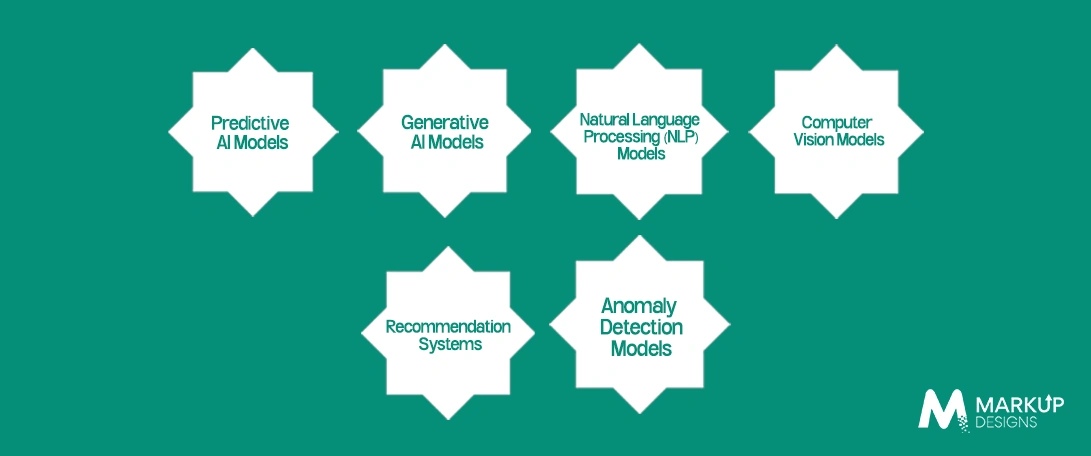
There are various types of enterprise AI models, based on the objectives, data, and operational requirements of the company. Choosing the proper type of AI model allows organizations to get higher accuracy and the most benefit from their AI technology.
Predictive AI Models
These models make use of historical data to predict outcomes and recognize trends. Predictive models can be used in demand forecasting, risk analysis, sales prediction, and preventive maintenance.
Generative AI Models
Generative AI models generate various types of content, including text, images, software code, and reports. They are used in AI assistants, content creation, document automation, and work process optimization.
Natural Language Processing (NLP) Models
The NLP models allow machines to interpret and understand human language. They are widely used in chatbots, voice assistants, sentiment analysis, and document processing.
Computer Vision Models
Computer vision models allow AI models to perceive and interpret visual information. They are widely used in quality inspections, security surveillance, medical imaging, and retail analytics.
Recommendation Systems
Recommendation models are based on analyzing user behavior and preferences in order to recommend relevant items. They are widely applied in e-commerce, entertainment, and other digital businesses.
Anomaly Detection Models
Anomaly detection models identify anomalous patterns and activities within huge volumes of data. They are often used in fraud detection, cybersecurity analysis, equipment maintenance, and risk management.
Enterprise AI Model Development Process
The implementation of an AI model within an enterprise is a complex process that involves understanding the business context, gathering high-quality data, using advanced technology and constantly optimizing solutions. A comprehensive approach in development ensures that an AI solution will deliver accurate results and be helpful for businesses.
1. Determine Business Goals
Understanding the problem, desired results and use cases that businesses want to solve with AI helps to determine the areas that will benefit the most from implementing AI.
2. Gather and Prepare the Data
All AI models require data as an input. Businesses gather data that will help them to achieve their goals from various internal resources and prepare it for training.
3. Choose an Appropriate AI Model Approach
Depending on the goals and available data, the appropriate AI technique, algorithms and architecture are chosen.
4. Train and Test the AI Model
In this phase, the AI model is trained on the prepared dataset and then tested for accuracy and reliability in practical conditions.
5. Deployment of the AI Model in Enterprise Systems
After validation, the AI model is implemented into enterprise systems. Correct deployment of the model ensures its successful implementation within businesses.
6. Monitoring and Continuous Improvement
AI models need constant monitoring to ensure their effectiveness. Businesses regularly check their results and improve models accordingly.
Ready to transform your business operations with intelligent AI solutions?
Partner with experienced AI developers to build secure, scalable, and enterprise-ready AI models that support your business goals and drive innovation.

Essential Tools and Technologies for AI Model Development
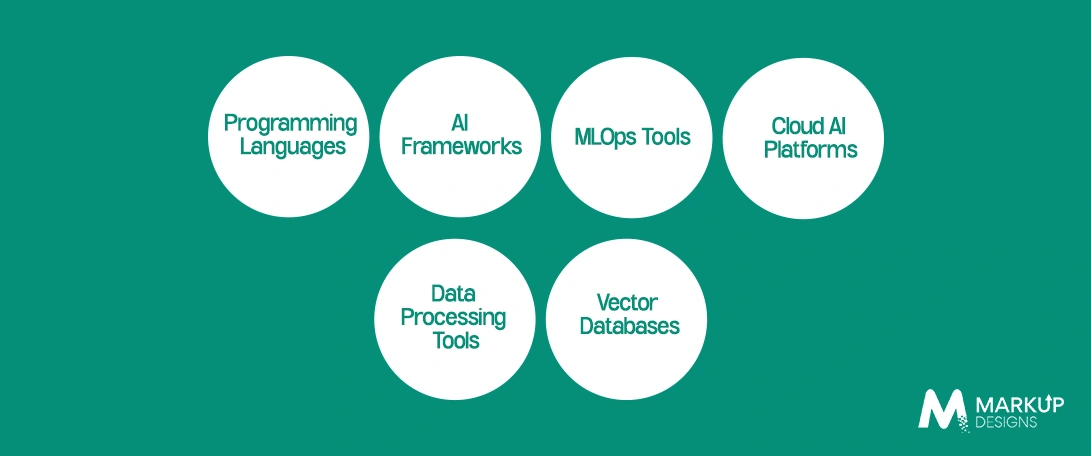
The development of an effective AI model for an enterprise business depends on the right choice of programming languages, development frameworks, data platforms, cloud computing capabilities, and deployment tools. These technologies can be helpful to businesses for developing, training, deploying, and managing the model.
Programming Languages
Popular programming languages include Python, R, Java, and Scala, which are widely used in the development of AI models. The usage of Python is particularly preferred by businesses due to its rich libraries and great community support.
AI Frameworks
Frameworks such as TensorFlow, PyTorch, Keras, and Scikit-learn can help businesses in the development and training of AI models. With their help, developers are able to simplify their tasks and develop efficient models.
MLOps Tools
MLOps platforms are helpful to businesses to manage the complete lifecycle of their AI models, including their development, testing, deployment, and monitoring.
Cloud AI Platforms
AWS, Microsoft Azure, and Google Cloud are examples of cloud platforms that have computing power and AI capabilities to develop AI models.
Data Processing Tools
Tools such as Apache Spark, Hadoop, and contemporary data warehouses are useful for managing and processing large amounts of data for AI training.
Vector Databases
Vector databases are necessary for advanced AI use cases, especially for generative AI applications. They can be used in AI assistants, recommendation engines, and enterprise search.
Proven Strategies for Successful Enterprise AI Development
Successful enterprise AI implementation requires more than just selecting the right technology. Businesses need a clear strategy that focuses on objectives, data quality, security, and continuous improvement.
1. Begin with Realistic AI Applications
Businesses should find specific applications where AI can bring value. Using real-life cases will allow enterprises to reap more benefits from the implementation process.
2. Establish Good Data Management Practices
In order to build good models, businesses should concentrate on proper data management and security. This step must be taken before implementing AI.
3. Adopt Scalable AI Architecture
AI architecture needs to be scalable to meet future demands of enterprises. This way, enterprises can add more functionality to their AI systems in the future.
4. Emphasize AI Security and Governance
Business AI solutions can process confidential data. The use of security techniques, access controls, and governance policies is beneficial for this purpose.
5. Use MLOps Principles
With MLOps, companies can continuously monitor, test, and improve their AI algorithms to ensure consistency in performance after deployment.
6. Evaluate Business Impact
The performance of the AI solution must be measured through appropriate metrics such as efficiency gains, costs reduction, customers’ satisfaction, and revenues increase.
Read Also: Hire AI Consultants: What Businesses Should Evaluate Before Hiring
Common Challenges in Enterprise AI Model Development and How to Overcome Them
While AI provides various business advantages, there are some obstacles in creating enterprise AI models. Knowledge about these obstacles can help companies make better decisions in the process.
| Challenge | Impact | Solution |
| Poor Data Quality | Reduces AI model accuracy and reliability | Implement strong data management and data cleaning processes |
| Data Security Risks | Increases the risk of sensitive information exposure | Use encryption, access controls, and robust security frameworks |
| Integration Difficulties | Slows AI adoption across existing systems | Use scalable APIs and flexible system architectures |
| High Development Costs | Increases overall project investment | Plan resources, infrastructure, and AI objectives effectively |
| Lack of Skilled Professionals | Delays AI development and deployment | Partner with experienced AI developers and specialists |
| Model Performance Issues | Leads to inaccurate predictions over time | Continuously monitor, evaluate, and retrain AI models |
In addition to these obstacles, organizations must be wary of issues concerning transparency, compliance, and responsibility of AI systems. The right approach to development, along with planning, allows firms to conquer these obstacles and implement AI effectively.
Enterprise AI Model Use Cases Across Industries
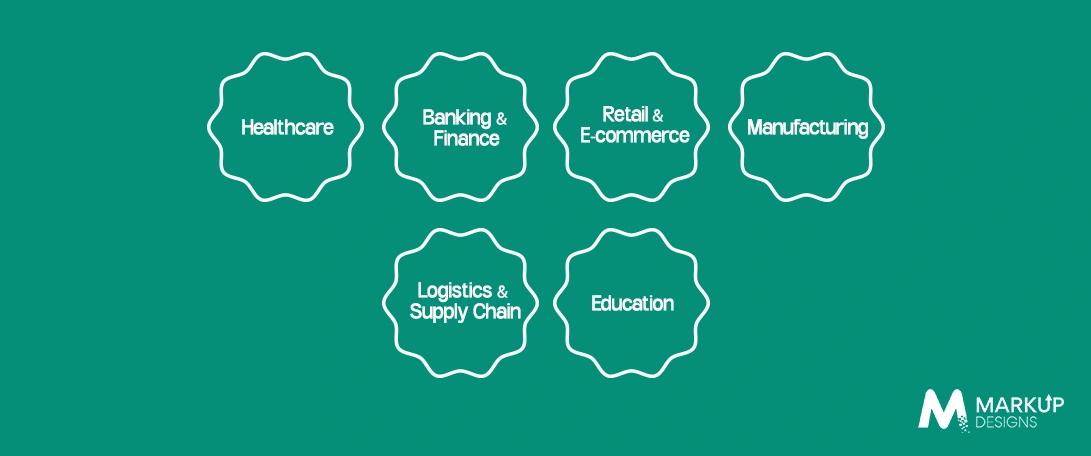
Enterprise AI models have brought about a revolution in various industries where efficiency, automation, and smart decision-making have been achieved. The use of AI in solving organizational issues is widespread in several companies.
Healthcare
AI models enable healthcare organizations with solutions in medical image analysis, patient monitoring, drug discovery, and predictive healthcare insights. They facilitate faster diagnoses and efficient healthcare services.
Banking & Finance
Financial institutions leverage the power of AI in fraud detection, risk assessment, automated customer services, credit scoring, and personalized financial advice.
Retail & E-commerce
AI models assist retailers in analyzing consumer behaviors, optimizing their inventory levels, recommending products to customers, and enhancing their experience.
Manufacturing
Manufacturers benefit from AI with regard to predictive maintenance, quality control, production optimization, and supply chain enhancements. They lead to reduced downtime and increased efficiency in operations.
Logistics & Supply Chain
AI solutions help the logistics and supply chain businesses with route optimization, demand forecasting, warehouse automation, and shipment tracking.
Education
Educational institutions benefit from the use of AI models in personalized learning, automated assessments, performance analyses, and intelligent assistants.
Enterprise AI Model Development Cost and Key Cost Factors
The cost of developing an AI model for an enterprise depends on several factors, such as the complexity of the AI solution, data requirements, technology stack, expertise of the development team, and the way the solution will be deployed. Each company has its own goals that could vary the amount of investment needed to develop an AI model.
To create an effective plan for AI project development, it is important to know the main factors that influence the cost of the project.
Factors Affecting the Price of Enterprise AI Model Development
1. Type and Complexity of the AI Model
The complexity of the AI model is one of the key factors influencing the development cost. A simple predictive AI model does not take much effort, whereas a complicated one such as a generative AI model, AI agent, or deep learning model, needs more attention.
2. Data Collection and Preparation
Data quality plays a vital role in achieving AI accuracy. Cost can vary according to data acquisition, cleaning, labeling, storage needs, and management of data.
3. Development Team Expertise
AI engineers, data scientists, machine learning specialists, and software developers will affect the costs because experienced professionals will develop dependable and scalable solutions based on artificial intelligence.
4. Technology Infrastructure
The training and deployment of AI algorithms often require significant computing power. Aspects such as cloud computing, storage technologies, GPUs, and other AI platforms are responsible for the infrastructure costs.
5. Integration Needs
Integration with current enterprise-level systems, applications, databases, and third-party platforms may influence development time and costs.
6. Maintenance and Optimization
Artificial intelligence models require constant monitoring and updates to perform accurately and effectively.
A general estimate of enterprise AI model development may include:
| AI Solution Type | Estimated Cost Range |
| Basic AI Model | $20,000 – $50,000 |
| Mid-Level Enterprise AI Solution | $50,000 – $150,000 |
| Advanced AI Platform | $150,000+ |
Investing in enterprise AI model development should be viewed as a long-term strategy rather than a one-time expense. A well-developed AI solution can help businesses improve efficiency, automate operations, and create measurable business value.
Why Choose Markup Designs for Enterprise AI Model Development?
The success of an AI model for any enterprise involves the right mix of skills and experience in technology, strategy, and the specific industry. Markup Designs helps enterprises build enterprise AI models that are both secure and scalable and meet the objectives of the enterprises. The main aim of our AI development process is to provide a practical solution to enterprises.
Reasons for Businesses to Partner with Markup Designs:
- Complete Set of AI Development Services: From AI consultations, model development, deployment, and optimization – we take care of all aspects of AI development.
- Expert Team of AI Developers: Our developers have experience working with cutting-edge AI tools, frameworks, and cloud platforms.
- AI Models for Business: We know about business problems and develop models that solve real business problems.
- Enterprise Scalability and Security: The solutions are built thinking about enterprise performance, scalability, and security.
- Continual Monitoring and Optimization: We assist businesses in monitoring, optimizing, and maintaining their AI models.
If you need predictive analysis, generative AI, automation with AI, or custom enterprise AI models – we can help you with this.
Ready to build an AI solution that drives smarter business decisions?
Connect with Markup Designs today and explore how enterprise AI model development can help your organization improve efficiency, automate processes, and unlock new growth opportunities.

Conclusion
The process of enterprise AI model development has become one of the most critical strategies for companies to enhance their efficiency and automation and receive more valuable insights about their operations. With the help of custom AI models, organizations may develop products that will perfectly fit their needs, requirements, etc.
Each step of the process of enterprise software development, such as the choice of model type and development tools, application of correct strategies, and handling potential challenges, is extremely significant in order to create a solution that will meet the expectations and needs of companies.
By paying attention to high-quality data, security measures, optimization, and scalability, organizations may obtain the best results from the implementation of enterprise AI models.
With the further improvement of AI technologies, enterprises that implement intelligent solutions will be able to differentiate themselves in the market and provide their customers with better services.
FAQs
1. What is enterprise AI model development?
Enterprise AI model development is the process of creating, training, and deploying AI models designed specifically to solve business challenges and improve enterprise operations.
2. How long does it take to develop an enterprise AI model?
The development timeline depends on the complexity of the AI model, data availability, integration requirements, and business goals. It can range from a few months to over a year for advanced AI systems.
3. How much does enterprise AI model development cost?
The cost depends on factors such as model complexity, infrastructure needs, data requirements, development team expertise, and maintenance requirements.
4. What technologies are used for enterprise AI development?
Common technologies include Python, TensorFlow, PyTorch, cloud AI platforms, MLOps tools, data processing frameworks, and vector databases.
5. What industries can benefit from enterprise AI models?
Industries such as healthcare, finance, retail, manufacturing, logistics, education, and insurance use AI models to improve efficiency and decision-making.
Author's Perspective
By now, you must have a clear understanding of how enterprise AI model development works, why businesses are investing in custom AI solutions, and what steps are required to build successful AI models. From choosing the right technology and development process to managing security, costs, and continuous improvements, every factor plays an important role in achieving AI success.
As AI adoption continues to grow, enterprises that strategically implement AI models can improve efficiency, create better customer experiences, and unlock new opportunities. Choosing the right technology partner can help businesses turn their AI goals into scalable and impactful solutions.
Discuss Your Project NowJupinder Singh Arora
Founder and CEO
Related Posts
How AI is Revolutionising Industrial Automation in Australia

How UK Enterprises Can Build an Effective AI...

AI Voice Agent for Real Estate: Features, Benefits,...
Insights Are Valuable & Execution is Priceless
You’ve read about the digital future. Now, let’s build the infrastructure to take you there. Move your strategy from the page to the product.
Design Your Solution Now
Contact Us
Schedule The Appointment At Your Convenience Date And Time.
30 Min
Web Conference
Time Zone
Indian standard time (08:30pm)

Thanks For Getting In Touch!
You’ve Taken The First Step Toward Transforming Your Digital Presence. Our Experts Will Reach Out Shortly To Take It Forward.
Launch Your Dream Project
Provide a brief overview of your project, and our specialists will evaluate your requirements. We will connect with you to explore how the right digital solutions can help you launch faster.