
In Brief
- Design a scalable AI architecture that integrates seamlessly with existing enterprise systems and data.
- Develop an AI strategy that aligns with business objectives, complies with governance policies, and enables organisations to measure AI ROI.
- Prioritise data security, governance, and responsible AI practices.
- Choose the models to use, methods of deployment, and other necessary technologies according to the requirements of the organization.
- Be sure to track and adjust AI models to achieve their highest efficiency.
Generative AI has quickly changed from being an upcoming technology to being one enabling a business to operate efficiently. Companies across industries are adopting AI technologies to improve operations, enhance customer experiences, and increase profitability. Generative AI powers virtual assistants, content generation, software development, and many other enterprise use cases. Nevertheless, successful implementation needs more than just deploying a large language model (LLM).
Businesses need a well-planned integration strategy, secure architecture, reliable infrastructure, and robust governance to ensure AI delivers measurable business outcomes.
Enterprise generative AI integration involves connecting AI models with existing applications, enterprise data, cloud platforms, and business processes while maintaining security, compliance, and performance. Organisations must carefully evaluate deployment models, select the right technology stack, establish responsible AI practices, and create scalable architectures that support future growth. This guide explores the essential components of enterprise generative AI integration, including architecture design, implementation strategies, best practices, common challenges, and how businesses can successfully deploy AI solutions that generate long-term value.
Generative AI Integration and Enterprise Adoption Trends
Generative AI has emerged as a fundamental aspect of enterprise digital transformation strategy for companies. Businesses have progressed from pilot projects to full-scale operational deployments that yield productivity gains, automation of monotonous processes, customer engagement, and speedy innovation. As systems become more sophisticated, the technology is being integrated into the workflows and services of enterprises for competitive excellence.
Enterprise AI Adoption Surge
Companies across many professional areas, such as healthcare, finance, trade, industry, logistics, and business services, are using generative AI to facilitate operational efficiency and fast decision-making. Among the usual applications of the technology in the corporate environment are intelligent customer support, document processing, software implementation assistance, enterprise search, knowledge management, personal recommendations, and task automation.
Common Generative AI Integration Services for Enterprises
Every enterprise has its own objectives, technologies in use, and regulations. Enterprises can use integration services to ensure the implementation of Generative AI in a manner that allows for seamless integration with the existing software and operations.
AI Strategy and Integration Consulting
The provision of AI consulting services starts with the evaluation of business challenges, detection of usable cases, and evaluation of readiness for AI implementation.
This helps organisations prioritise projects that deliver measurable business value while minimising deployment risks.
API and Middleware Development
APIs and middleware provide means to facilitate interaction with AI systems and backend applications, including customer relationship management (CRM), enterprise resource planning (ERP), human resource management system (HRMS), eCommerce systems, and customer service support systems. Well-planned system integration enables efficient data exchange without disrupting existing operations.
RAG Pipeline Architecture and Retrieval Systems
Retrieval Augmented Generation (RAG) refers to a combination of large language models and enterprise knowledge bases to provide precise and timely answers. Rather than relying solely on the model’s pre-trained knowledge, AI fetches relevant information on business matters from internal documents, databases, and knowledge bases before producing responses.
Model Fine-Tuning and Optimisation
Fine-tuning improves AI performance by adapting foundation models to industry-specific data and business requirements. Optimisation facilitates the increased quality of generated answers, shorter duration of response, lower costs of operations, and better efficiency of the overall interactive model.
AI Agent and Multi-Agent Orchestration
AI agents can independently perform tasks, interact with enterprise systems, and collaborate with other AI agents to complete complex workflows. Multi-agent orchestration enables organisations to automate business operations that require planning, reasoning, decision-making, and cross-functional coordination.
Custom Interface and Application Development
Numerous businesses need custom AI-driven applications efficiently rather than standalone AI tools. The AI development service consists of intelligent dashboards, workforce assistants, AI chatbots, platforms for document automation, internal knowledge portals, and business applications relevant for industries that are incorporated directly into the everyday business processes.
Security, Compliance, and Data Governance Integration
Strong security measures are essential to protect sensitive data and ensure regulatory compliance. The integration services include identity and access management, data encryption, audit logging, governance frameworks, responsible AI policies, and compliance with regulations (for instance, GDPR, HIPAA).
Key Approaches to Generative AI Integration
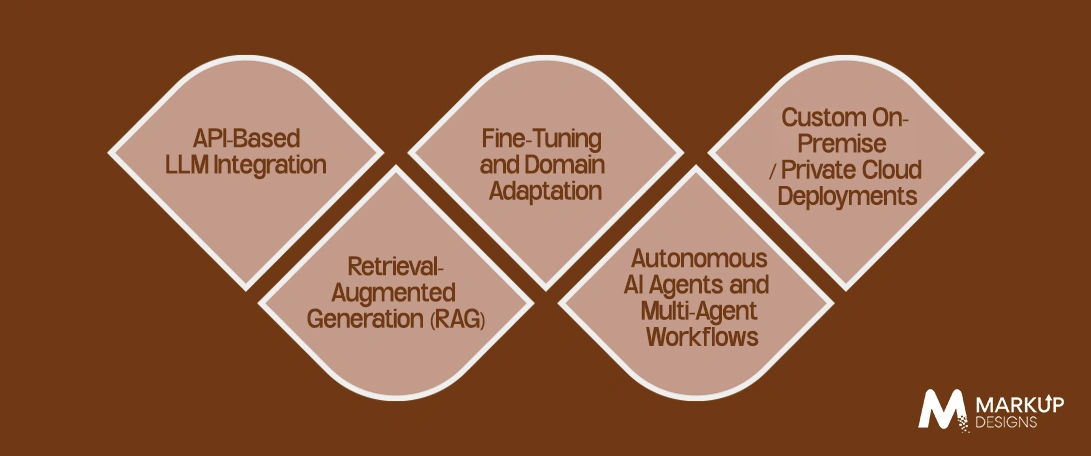
What approach to integration has to be utilized depends on business goals, type of data, scalability requirements, the infrastructure in place, and budget. As a result, many organizations apply combinations of several approaches that allow them to develop a flexible and future-ready AI ecosystem.
API Based LLM Integration
API based integration connects enterprise applications with hosted large language models through secure APIs. This approach offers faster implementation, lower infrastructure costs, automatic model updates, and easy scalability, making it suitable for many business applications.
Retrieval Augmented Generation (RAG)
Through RAG, AI systems access pertinent business data to generate responses. This approach facilitates accurate information generation while avoiding hallucinations, ensuring responses are based on the latest business knowledge, which proves especially useful for customer support and knowledge management.
Fine-tuning and Domain Adaptation
Fine-tuning is used to adapt generic models to organisation-led datasets to boost performance in specific tasks. Domain adaptation involves training AI to comprehend in-house language, documents, and processes, which leads to superior answers.
Autonomous AI Agents and Multi-Agent Workflows
This category of AI software executes specific tasks with little human involvement by processing data and deciding upon actions. Multi-agent workflows rely on several knowledgeable AI agents and allow for complete automation of complicated business operations.
Custom On-Premise or Private Cloud Deployments
Companies dealing with sensitive data tend to introduce generative AI in their own private cloud or use it on their premises to have better control over processes, data safety and governmental compliance, as well as to customize a model according to their needs.
Enterprise Systems for Implementing Generative AI
The integration of Generative AI solutions with enterprise systems leads to maximal positive results since data from such systems is already used in business processes. The integration allows the automation of business processes, improvement of decision-making, and provision of context-specific responses using generative AI functionality.
Enterprise Resource Planning (ERP)
The integration of generative AI and ERP systems improves business efficiency by automating procurement, inventory management, finance, HR, and operational reporting. . The employees get quicker access to business information and can do their routine tasks with less effort.
Customer Relationship Management (CRM)
AI-powered CRM ensures customized interaction with customers through the automation of processes of lead qualification, sales, customer service, and recommendations based on customer behavior and experience.
Knowledge Management and Document Repositories
AI technologies can search through the company instructions, internal documents, manuals, and internal knowledge databases to get detailed information and reduce employees’ search time.
Data Warehouses and Lakehouses
Integrating AI with enterprise data platforms allows businesses to analyse structured and unstructured data, generate insights, and support informed business decisions.
Communication and Collaboration Platforms
AI assistants integrated with workplace tools can summarise meetings, answer employee queries, automate documentation, and improve collaboration across teams.
Enterprise Use Cases of Generative AI Integration
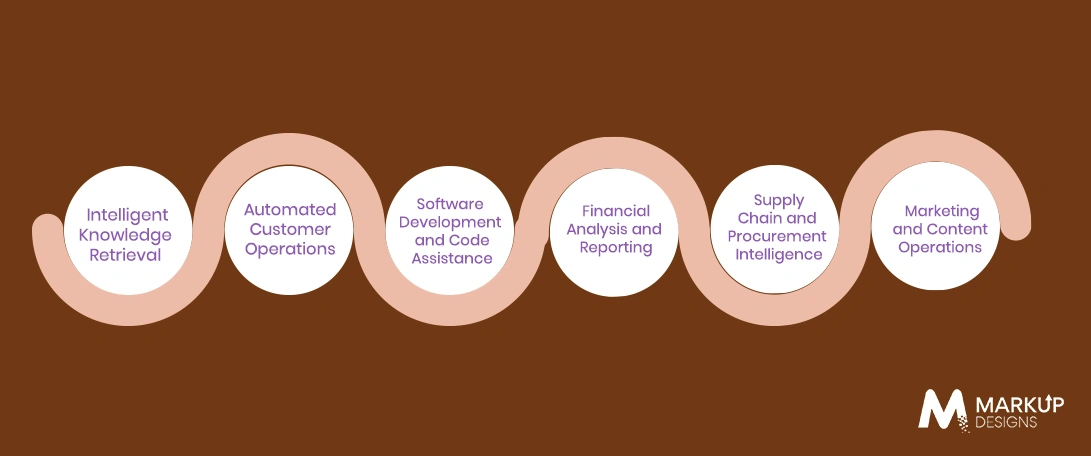
Generative Artificial Intelligence is changing how businesses operate by increasing efficiency, cutting down on manual work, and enhancing decision-making.
Intelligent Knowledge Retrieval
Employees can now locate essential information in the firm’s documents almost instantaneously, thus saving on time and improving productivity.
Automating Customer Operations
AI-powered chatbots and virtual assistants help in responding to customers, resolving tickets, and providing sharp customer service 24/7.
Software Development and Code Assistance
Developers now rely on AI to assist in writing code, explaining logic, finding bugs, writing documentation, and hastening software release.
Financial Analysis and Reporting
With the help of AI, the process of producing financial reports, analyzing expenses, making forecasts, and complying with norms has become much simpler.
Supply Chain and Procurement Intelligence
With AI, companies can make inventory plans, analyze vendors, and conduct procurement and forecasting.
Marketing and Content Operations
Marketers now make use of AI when producing content, planning campaigns, segmenting customers, and achieving personal communication on a large scale.
Generative AI Integration Across Industries
Companies across different sectors use generative AI to make their operations more efficient and enhance customer experiences.
Healthcare and Life Sciences
Facilitates clinical documentation, medical knowledge search, patient engagement, research assistance, and regulatory compliance.
Banking, Financial Services, and Insurance (BFSI)
Improves fraud detection, customer support, financial accounting, document processing, and risk identification.
Retail and E-Commerce
Makes shopping experiences more personalized, improves product recommendations, customer service, and inventory management.
Manufacturing and Logistics
Enhances production planning, predictive maintenance, quality assurance, and supply chain procedures.
Telecommunications and IT Services
Automates technical assistance, network processes, IT service management, as well as enterprise knowledge assistance.
Enterprise Generative AI Integration Architecture Explained
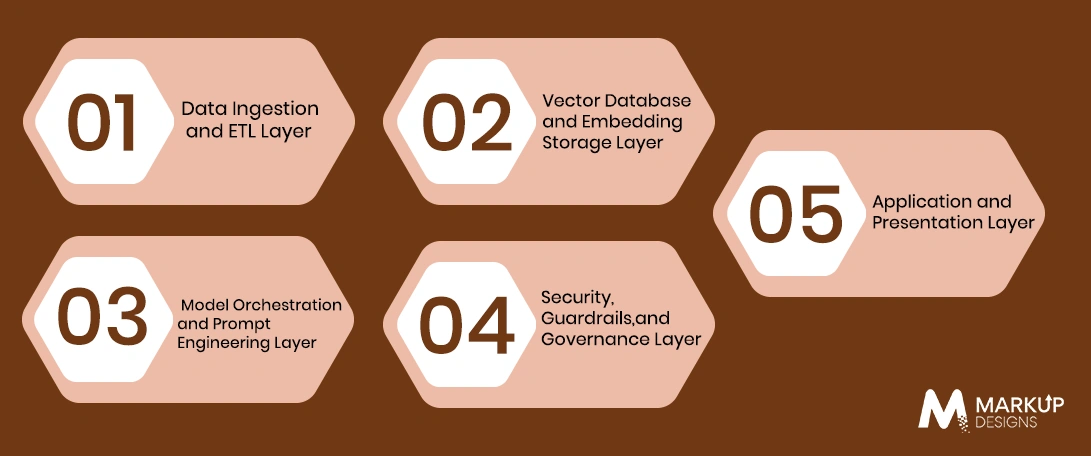
A properly designed architecture allows generative AI to be scalable, reliable and safe and also to integrate easily into other enterprise systems.
Data Collection and ETL Layer
Collects, cleans, and prepares data from different enterprise sources.
Vector Database and Embedding Storage Layer
Saves vector embeddings that allow fast semantic search and better information retrieval in AI applications.
Model Orchestration and Prompt Engineering Layer
Controls prompts, model selection, and response generation to ensure consistent AI results.
Security, Guardrails, and Governance Layer
Implements access restrictions, data protection, content filtering, as well as monitoring and compliance policies.
Application and Presentation Layer
Provides the user interface where employees and customers interact with AI through chatbots, dashboards, web portals, or enterprise applications.
Overcoming Generative AI Integration Challenges
Enterprise AI is highly valuable, but organisations have to solve a number of technical and operational challenges for successful implementation.
Data Quality and Silo Restrictions
Inaccurate or siloed data results in poor AI performance and inaccurate responses . The enterprise data needs to be consolidated and effectively governed for better performance.
Hallucinations and Model Reliability
The use of retrieval-augmented generation (RAG) technology, validation processes, and human oversight helps to minimise cases of erroneous AI answers.
Latency and Performance Bottlenecks
Using the right architecture, caching technologies, and the optimisation of models will facilitate faster reply times and enhanced user experience.
Cost Control and Token Optimisation
The monitoring of API usage, the selection of proper models, and optimisation of prompts allow managing operational expenses.
Security, Privacy, and Regulatory Compliance
Security is ensured through the use of encryption, access control policies, tracking of changes, and compliance procedures.
Change Management and User Adoption
Employee training, clear governance, and gradual implementation encourage successful AI adoption across the organisation.
A Framework for Successful Generative AI Integration
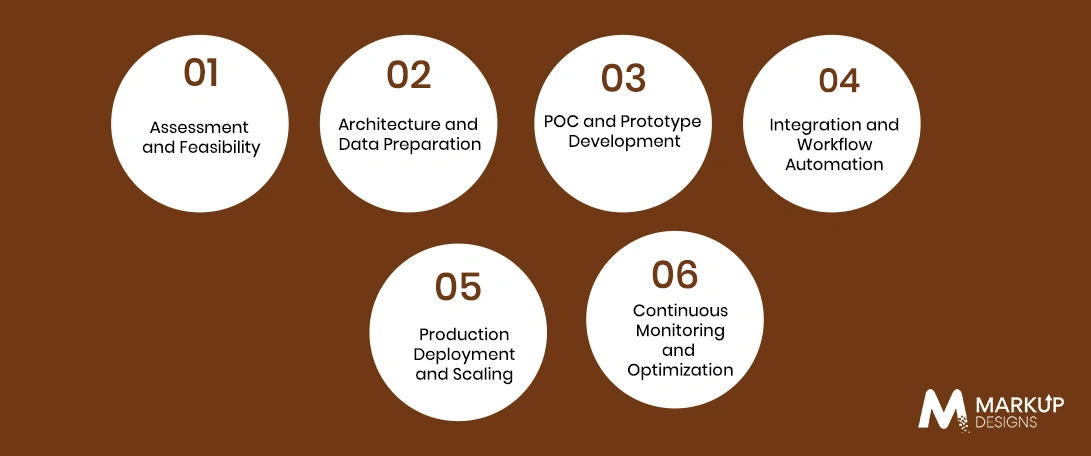
A structured implementation approach helps enterprises reduce risk while achieving measurable business outcomes.
Phase 1: Assessment and Feasibility
Identify business objectives, evaluate AI readiness, and prioritise high-value use cases.
Phase 2: Architecture and Data Preparation
Design the integration architecture, prepare enterprise data, and establish governance policies.
Phase 3: POC and Prototype Development
Develop a proof of concept to validate technical feasibility and business value before full deployment.
Phase 4: Integration and Workflow Automation
Connect AI with enterprise systems and automate key business processes.
Phase 5: Production Deployment and Scaling
Deploy the solution securely, monitor performance, and expand AI capabilities across the organisation.
Phase 6: Continuous Monitoring and Optimisation
Continuously improve model accuracy, optimise costs, monitor security, and update AI systems to meet evolving business needs.
Generative AI Integration Costs
The cost of integrating generative AI depends on the project’s complexity, deployment model, infrastructure, security requirements, and the level of customisation. While simple API based implementations are relatively affordable, enterprise-wide AI platforms require greater investment in architecture, governance, and ongoing optimisation.
Key Cost Drivers
Model Selection (API vs. Open Source vs. Proprietary)
The choice between hosted APIs, open source models, or proprietary foundation models significantly impacts licensing, infrastructure, and maintenance costs.
Data Pipeline Complexity
Integrating AI with multiple enterprise systems, databases, and knowledge repositories requires robust data pipelines, increasing development effort and implementation costs.
Infrastructure and Hosting Requirements
Cloud deployments, private cloud environments, and on-premises infrastructure each have different hosting, storage, and computing costs depending on performance and scalability needs.
Security and Compliance Overhead
Industries with strict regulatory requirements require additional investment in encryption, governance, identity management, audit logging, and compliance controls.
Expected Business Outcomes from Generative AI Integration
When implemented strategically, generative AI delivers measurable improvements across enterprise operations.
Operational Efficiency Gains
Automates repetitive tasks, reduces manual effort, and improves workforce productivity.
Faster Decision Making
Provides instant access to business insights, helping leaders make informed decisions more quickly.
Scalable Customer Experiences
Delivers personalised support, faster response times, and consistent customer interactions across multiple channels.
Revenue Growth and New Business Models
Creates opportunities for AI-powered products, premium services, process innovation, and improved operational profitability.
Choosing the Right Generative AI Integration Partner
Selecting the right technology partner is essential for building secure, scalable, and future-ready AI solutions.
Core Capabilities to Look For
Look for an AI integration partner with proven enterprise experience, expertise in LLMs and RAG architecture, cloud and data engineering capabilities, strong security and compliance practices, custom AI development expertise, and end-to-end support from strategy to deployment and optimisation.
Why Choose Markup Designs for Enterprise Generative AI Integration?
At Markup Designs, we help enterprises successfully integrate generative AI into existing business ecosystems through secure, scalable, and outcome-driven solutions. Our team combines AI engineering expertise with cloud, data, and enterprise application development to build solutions that align with your business objectives.
Enterprise Grade AI Engineering Excellence
We design enterprise AI architectures using modern LLMs, RAG pipelines, AI agents, and secure cloud infrastructure to deliver reliable and high-performing AI solutions.
End-to-End Delivery Capabilities
From AI strategy and architecture design to integration, deployment, governance, and continuous optimisation, we manage the complete implementation lifecycle.
Proven Expertise Across Industries
Our experience across healthcare, finance, retail, manufacturing, logistics, and enterprise software enables us to develop AI solutions that address industry-specific challenges while supporting long-term business growth.
Ready to Integrate Generative AI into Your Enterprise?
Transform your business with secure, scalable, and intelligent AI solutions that automate operations, enhance productivity, and accelerate innovation.

Conclusion
Generative AI is reshaping the way enterprises operate by enabling intelligent automation, faster decision-making, and highly personalised customer experiences. However, achieving long-term success requires more than implementing an AI model. Businesses need a well-planned integration strategy, scalable architecture, secure data governance, and continuous optimisation to maximise value.
Whether you are building AI-powered assistants, implementing RAG-based knowledge systems, or deploying autonomous AI agents, partnering with the right technology expert is essential. At Markup Designs, we help enterprises design, integrate, and scale secure generative AI solutions that align with business objectives, ensuring measurable ROI and sustainable digital transformation.
FAQs
1. What is generative AI integration?
Generative AI integration is the process of connecting AI models with enterprise applications, data sources, and business workflows to automate tasks and improve decision-making.
2. How long does it take to integrate generative AI into enterprise systems?
Implementation timelines vary by project scope, but most enterprise integrations take 6 to 24 weeks, depending on complexity and customisation.
3. What is the difference between fine-tuning and RAG integration?
Fine-tuning trains a model using domain-specific data, while RAG retrieves relevant enterprise information during inference without retraining the model.
4. How much does enterprise generative AI integration cost?
Costs depend on factors such as model selection, infrastructure, integrations, security requirements, and project scope. A detailed assessment provides the most accurate estimate.
5. How do you ensure data security during generative AI integration?
Security is maintained through encryption, access controls, secure APIs, governance frameworks, audit logging, compliance standards, and continuous monitoring of AI systems.
Author's Perspective
As AI adoption accelerates, enterprises are moving beyond experimentation towards business-critical AI implementations. In my experience, the organisations that achieve the greatest success are those that prioritise strategy, data quality, governance, and scalable architecture from the outset. Generative AI is not simply another technology investment; it is a long-term business capability that, when integrated effectively, can transform operations, improve customer experiences, and create lasting competitive advantage.
Discuss Your Project NowGaurav Goyal
Global Sales- VP
Related Posts
How AI is Revolutionising Industrial Automation in Australia
How UK Enterprises Can Build an Effective AI...

AI Voice Agent for Real Estate: Features, Benefits,...
Insights Are Valuable & Execution is Priceless
You’ve read about the digital future. Now, let’s build the infrastructure to take you there. Move your strategy from the page to the product.
Design Your Solution Now
Contact Us
Schedule The Appointment At Your Convenience Date And Time.
30 Min
Web Conference
Time Zone
Indian standard time (08:30pm)

Thanks For Getting In Touch!
You’ve Taken The First Step Toward Transforming Your Digital Presence. Our Experts Will Reach Out Shortly To Take It Forward.
Launch Your Dream Project
Provide a brief overview of your project, and our specialists will evaluate your requirements. We will connect with you to explore how the right digital solutions can help you launch faster.