

In Brief
- To overcome inefficiencies in your day-to-day tasks, investing in a customized WMS will enable you to enhance inventory accuracy, automate warehouse processes, and support highly scalable logistics operations across Australia.
- The system in question must offer cutting-edge features, such as real-time inventory monitoring, barcode and RFID scanning, order management, AI-backed insights, as well as smooth ERP and e-commerce integration.
- You need to use state-of-the-art technology and cloud-based frameworks, APIs that comply with security standards, IoT connectivity, and data analytics for the most advantageous development of your warehouse operations.
- This process is more likely to be successful if you cooperate with a reliable warehouse management software development company and follow a structured rollout strategy that includes business analysis, warehouse process mapping, all phases of development, testing, launch, and post-launch support.
The warehousing and logistics industry of Australia is changing rapidly in 2026 with the growth of e-commerce, omnichannel retail, and customer demands for quick and error-free deliveries. Hence, the pressure on businesses is growing, as they need to manage inventory across multiple warehouses, improve order accuracy, cut costs, and ensure supply chain visibility. Traditional methods of warehouse management and old-time systems are unable to function now due to the complexity of logistics processes; thus, a powerful Warehouse Management System (WMS) is being considered as a strategic solution, rather than an upgrade.
The development of a customized Warehouse Management System helps Australian enterprises with optimization of warehouse activities, as it allows for real-time inventory monitoring, smart automation, and integration of RFID and barcode technologies. No matter whether you work in retail, manufacturing, healthcare, third-party logistics, or wholesale distribution, a customized WMS can fit any workflow and augment productivity while scaling with the enterprise as it grows.
The blog below explains how to develop a Warehouse Management System in Australia in 2026, its advantages, vital features, the production process, technologies, and good practices for successful implementation.
Warehouse Management System Development in Australia Explained
The warehouse and logistics industry in Australia is changing at a rapid pace, so companies must be able to manage stock in different locations, deliver orders much faster, and keep track of warehouse operations without incurring unnecessary costs.
Manual processes and legacy warehouse systems often struggle to meet these demands, making Warehouse Management System (WMS) development a strategic investment for businesses looking to improve efficiency and remain competitive.
A custom Warehouse Management System helps organisations streamline inventory management, automate warehouse operations, reduce fulfilment errors, and integrate seamlessly with existing business systems. Whether managing a single warehouse or multiple distribution centres across Australia, a tailored WMS provides the flexibility and scalability needed to support long-term business growth.
Key Drivers Behind WMS Adoption in Australia
Regional Geography and Logistics Pressures
Australia’s extensive geography creates significant challenges when it comes to warehousing and distribution. Many businesses operate across several cities and regions, meaning they need to have good inventory visibility and efficiently coordinate their inventories. A Warehouse Management System is an effective tool for real-time inventory tracking and centralized warehouse management.
Growing Ecommerce and Customer Expectations
The growth of online shopping has resulted in higher demand for quicker order processing and correct deliveries. A Warehouse Management System helps companies automatically manage their inventories, order fulfilment, and warehouse processes.
Rising Operational Costs
When companies manage their warehouses manually, they incur additional labor costs and decrease profits. With the use of a warehouse management system, however, companies can lower their costs and increase the efficiency of their employees by automating the process of inventory management, picking products, and eventually shipping them.
Benefits of Implementing a Warehouse Management System
- Fewer picking and packing errors through automated inventory management and barcode scanning.
- Faster order fulfilment with streamlined warehouse workflows and real-time inventory updates.
- Lower operating and labour costs by reducing manual processes and improving workforce productivity.
- Better customer satisfaction through accurate orders, faster deliveries, and improved inventory availability.
- Improved inventory visibility across one or multiple warehouse locations.
Australian WMS Market Growth
The demand for warehouse management systems is growing as Australian companies spend more on digital supply chain solutions. According to industry estimates, the Australian warehouse management systems market is expected to reach a size of USD 118.3 million by 2030 as the need for intelligent warehouse operations, inventory visibility, and scalable logistics technology increases.
Building a Warehouse Management System in Australia
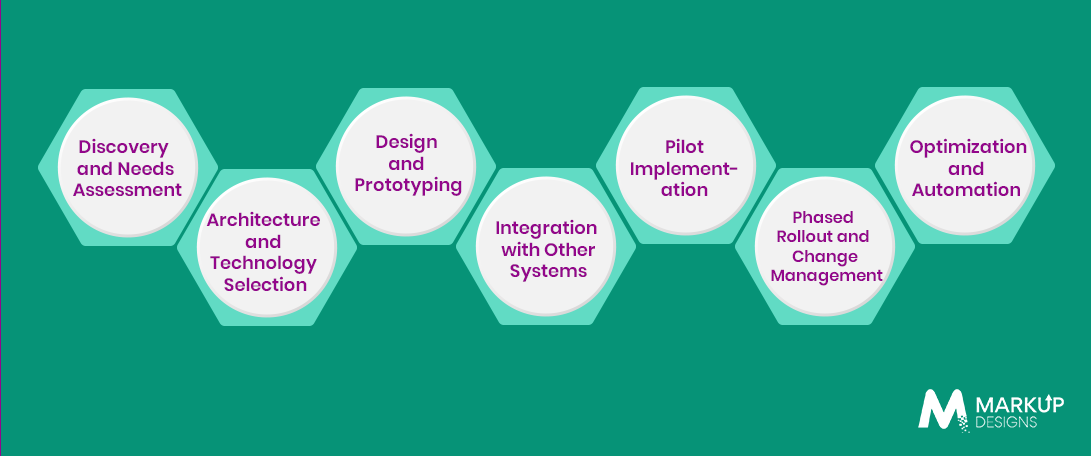
Developing a Warehouse Management System requires careful planning to ensure it aligns with business objectives, warehouse operations, and future growth. Following a structured development process helps minimise implementation risks while ensuring the system delivers measurable operational improvements.
Step 1: Discovery and Needs Assessment
The first stage of the warehouse management system construction focuses on gaining an understanding of warehouse operations and identifying the operational challenges, defining business objectives, and gathering the requirements of the stakeholders. The phase also determines the scope of the project, workflows in the warehouse, and the key performance indicators of the system.
Step 2: Architecture and Technology Selection
Once the requirements are defined, the team selects the best architecture and technology stack based on scalability, security and integration requirements, and long-term business needs. Companies may choose between the cloud, on-premises, and hybrid deployments depending on their operational requirements.
Phase 3: Design and Prototyping
At this point, designers and software developers create designs of the website and interfaces of all web applications in order to approve the concept and ensure the usability of the application and its interfaces.
Phase 4: Integration with Other Systems
A Warehouse Management System must work seamlessly with other business applications, including ERP systems, Transportation Management Systems (TMS), ecommerce applications, barcode scanners, and RFID technologies. All these integrations allow transferring data efficiently and making the whole process more effective.
Phase 5: Pilot Implementation
Right before launching the application to all warehouses of your company, it is advisable to test it at one warehouse only. Such pilot implementation will help a business to check whether everything is functioning properly, and whether there are any rough edges left.
Phase 6: Phased Rollout and Change Management
When testing and piloting the application is completed, it is possible to implement it in several warehouses in stages. The company should carry out training and change management activities.
Phase 7: Optimisation and Automation
After the launch of the Warehouse Management System, a business should make continuous improvements to the application, which will ensure its long-term earning capacity in the future.
Warehouse Management System Implementation Timeline
| Phase | Estimated Timeline |
| Discovery and Planning | 2 to 3 Weeks |
| Architecture and Technology Selection | 2 to 4 Weeks |
| UI/UX Design and Prototyping | 3 to 4 Weeks |
| Development and System Integration | 10 to 14 Weeks |
| Testing and Pilot Deployment | 3 to 4 Weeks |
| Phased Rollout and Training | 2 to 4 Weeks |
| Optimisation and Support | Ongoing |
Key Features of Warehouse Management Systems
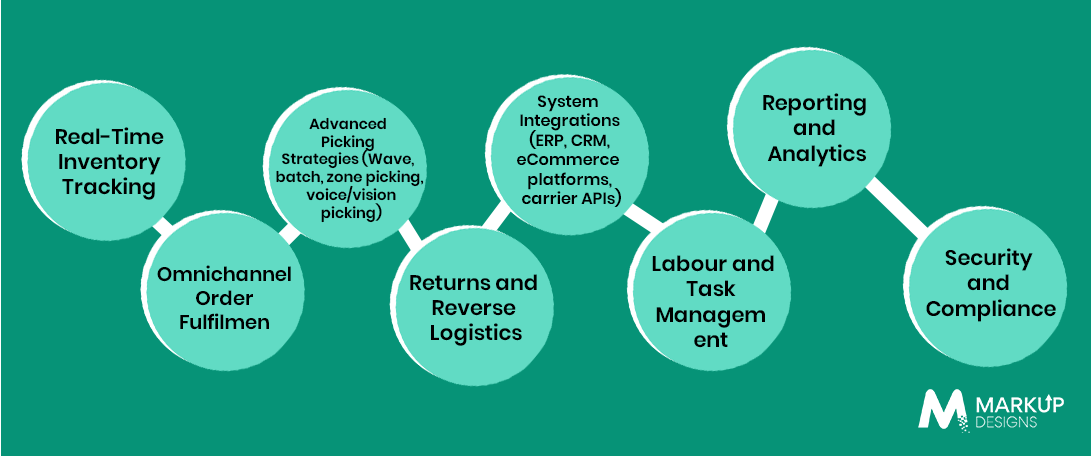
A successful Warehouse Management System (WMS) is the basis that allows companies to manage inventory, optimize warehouse activities, and improve order accuracy. The capabilities of a WMS depend on the industry and warehouse size; however, the following functions are the basis of modern WMS.
Real-Time Inventory Monitoring
Real-Time Inventory Monitoring ensures that businesses have a complete understanding of stock movement in the warehouse. It helps companies control inventory levels, see the location of goods, and receive up-to-date information each time goods are shipped, transferred, or received.
Omnichannel Order Processing
Omnichannel order processing allows companies to sell across different channels like websites, online marketplaces, and traditional stores, which makes order processing complicated. The WMS enables companies to centralize order processing and synchronize the inventory so that the entire operation is completed more quickly.
Advanced Picking Techniques
Efficient picking processes are key to increasing the productivity of warehouses. Innovative Warehouse Management Systems offer different types of picking, allowing to choose the best one for a company.
- Wave Picking: Groups orders into scheduled picking waves.
- Batch Picking: Picks multiple similar orders in a single trip.
- Zone Picking: Assigns warehouse staff to dedicated storage zones.
- Voice and Vision Picking: Guides employees through picking tasks using voice commands or smart wearable devices to improve speed and accuracy.
Returns and Reverse Logistics
Handling returns efficiently is just as important as managing outbound orders. A WMS simplifies reverse logistics by tracking returned products, updating inventory automatically, and supporting inspection, restocking, or replacement workflows.
System Integrations
A Warehouse Management System delivers greater value when connected with existing business platforms. Common integrations include:
- Enterprise Resource Planning (ERP)
- Customer Relationship Management (CRM)
- Ecommerce platforms
- Carrier and shipping APIs
- Barcode scanners and RFID systems
These integrations create a connected warehouse ecosystem while reducing manual data entry.
Labour and Task Management
Managing warehouse staff effectively improves productivity and operational efficiency. A WMS helps allocate tasks, monitor workforce performance, balance workloads, and track task completion in real time.
Reporting and Analytics
Comprehensive dashboards and reporting tools provide insights into inventory levels, warehouse performance, order fulfilment, employee productivity, and operational KPIs. These insights help businesses identify inefficiencies and make informed operational decisions.
Security and Compliance
Warehouse Management Systems include security features such as role-based access control, audit logs, encrypted data storage, and regular backups. These capabilities help protect business information while supporting compliance with organisational and industry requirements.
Which WMS Features Do You Really Need?
The right Warehouse Management System depends on the scale and complexity of your warehouse operations. Smaller businesses often require core inventory and order management capabilities, while larger organisations benefit from advanced automation, analytics, and enterprise integrations.
| Feature | SMEs | Mid Market Businesses | Enterprise Businesses |
| Inventory Management | Real-time stock visibility and inventory control | Multi-location inventory management | Enterprise-wide inventory visibility across multiple warehouses |
| Order Fulfilment | Basic order processing and shipping | Omnichannel order management | High volume, automated fulfilment workflows |
| Barcode & RFID | Barcode scanning | Barcode with selective RFID support | Enterprise RFID and automated tracking |
| Picking Strategies | Standard picking | Batch, wave, and zone picking | Intelligent picking with voice or vision support |
| System Integrations | Ecommerce platform integration | ERP, CRM, accounting, and shipping systems | Enterprise ERP, TMS, OMS, CRM, and third party integrations |
| Labour Management | Basic workforce tracking | Task allocation and productivity monitoring | Workforce planning and advanced labour analytics |
| Reporting | Standard inventory reports | Custom dashboards and KPI tracking | Advanced analytics and operational forecasting |
| Security | User authentication and access control | Audit logs and role-based permissions | Enterprise security, compliance, and governance controls |
Types of Warehouse Management Systems for Australia
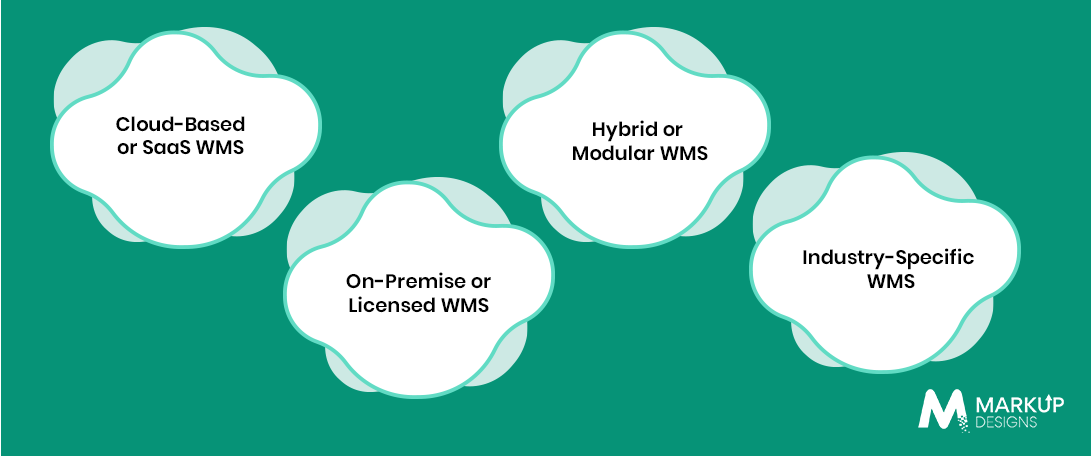
Choosing the correct deployment model is crucial to ensure long-term scalability, operational efficiency, and cost-effectiveness. Australian companies can select from different Warehouse Management System types based on their requirements.
1. Cloud-based or SaaS WMS
Cloud-based Warehouse Management Systems are offered by a service provider and accessed via the internet. They involve little initial infrastructure costs, provide automatic updates, and allow the scalability of businesses as they expand. This model is perfect for start-ups, SMEs, and companies that want a quicker installation process.
2. On-Premise or Licensed WMS
The on-premise Warehouse Management System is installed in the company’s infrastructure. This provides full control over system configuration, security, and data management and is usually used by companies with strict compliance rules and highly personalized business systems.
3. Hybrid or Modular WMS
Hybrid solutions make use of the flexibility and the infrastructure of the cloud, allowing a seamless combination of the advantages of both models. Modular systems also give users the ability to implement only the features that they need at the moment and later add new ones.
4. Industry-Specific WMS
Certain industries require specialised warehouse functionality. Industry-specific Warehouse Management Systems are designed to support sector-specific workflows, compliance requirements, and inventory management processes for industries such as retail, manufacturing, healthcare, pharmacy management software development, food and beverage, and third-party logistics (3PL).
Common Challenges When Implementing a WMS (and How to Avoid Them)
Implementing a Warehouse Management System requires careful planning and collaboration across teams. Addressing common implementation challenges early helps businesses reduce risks and improve adoption.
Over Customisation
Excessive customisation can increase development costs, delay implementation, and make future upgrades more complex.
How to avoid it: Prioritise essential business requirements and customise only where it delivers measurable operational value.
Skipping the Pilot Phase
Deploying a WMS across all warehouse locations without proper testing can lead to workflow disruptions and unexpected operational issues.
How to avoid it: Begin with a pilot deployment in a single warehouse to validate workflows, gather user feedback, and resolve issues before full rollout.
Weak Change Management
Employees may be reluctant to adopt new warehouse processes without adequate communication and training.
How to avoid it: Develop a structured change management plan that includes employee training, documentation, ongoing support, and stakeholder engagement.
Poor Data Quality
Migrating outdated or inaccurate inventory data can reduce system effectiveness and impact warehouse performance.
How to avoid it: Clean, verify, and standardise inventory data before migration to ensure accurate reporting and smooth implementation.
Ignoring Mobile and User Experience
Warehouse staff depend on handheld devices for daily operations. Complicated interfaces can slow workflows and increase operational errors.
How to avoid it: Design mobile-friendly interfaces with intuitive navigation, simple workflows, and efficient barcode scanning capabilities to improve productivity and user adoption.
Cost Considerations and the Build vs Buy Decision
The cost of developing a Warehouse Management System depends on several factors, including business size, warehouse complexity, required features, third-party integrations, deployment model, and the level of customisation. While some businesses opt for ready-made WMS platforms to reduce upfront investment, others choose custom development to gain greater flexibility, scalability, and long-term value.
Build vs Buy: Which Option Is Right for Your Business?
| Criteria | Build a Custom WMS | Buy an Off-the-Shelf WMS |
| Time to Market | Longer development timeline | Faster deployment |
| Scalability | Fully scalable as business grows | Limited by vendor capabilities and licensing |
| Customisation | Built around your warehouse workflows | Limited customisation options |
| System Control | Full ownership of features, data, and roadmap | Dependent on the software provider |
| Integration | Seamless integration with existing business systems | Integration options may be limited or require additional costs |
| Long Term Cost | Higher initial investment with greater long-term ROI | Lower upfront cost but recurring subscription and licensing fees |
| Best Fit | Businesses with unique workflows, multiple warehouses, or growth plans | Small businesses with standard warehouse operations and limited requirements |
How Much Does Warehouse Management System Development Cost?
The investment required for Warehouse Management System development varies based on the project’s scope and technical complexity.
| Solution Complexity | Estimated Development Cost |
| Basic WMS | $35,000 to $70,000 |
| Mid-Level WMS with Integrations | $70,000 to $150,000 |
| Enterprise Warehouse Management System | $150,000 to $400,000+ |
Factors influencing development costs include:
- Number of warehouse locations
- Inventory and order volumes
- Custom workflows and automation
- ERP, CRM, and ecommerce integrations
- Barcode and RFID capabilities
- User roles and security requirements
- Cloud infrastructure and deployment model
- Ongoing maintenance and support
While off-the-shelf solutions may offer a quicker implementation path, organisations with specialised warehouse operations often benefit from a custom Warehouse Management System that aligns with their processes and supports future business growth.
Why Choose Markup Designs for Your Warehouse Management Software Development
Building a Warehouse Management System requires more than technical expertise. It demands a thorough understanding of warehouse operations, supply chain processes, and the operational challenges faced by businesses across different industries. At Markup Designs, we develop scalable, secure, and high-performance Warehouse Management Systems that help organisations improve inventory accuracy, optimise warehouse operations, and support long-term business growth.
Retail and Ecommerce
We develop Warehouse Management Systems that streamline inventory management, support omnichannel fulfilment, automate order processing, and integrate seamlessly with ecommerce platforms to improve operational efficiency and customer satisfaction.
FMCG, Grocery, and Cold Chain
Our solutions help businesses manage high inventory turnover, batch tracking, expiry management, and temperature-sensitive products while maintaining complete visibility across warehouse operations.
Healthcare and Pharmaceutical
We build secure warehouse management solutions that support inventory traceability, regulatory compliance, batch and serial number tracking, and accurate stock management for medical supplies and pharmaceutical products.
Read Also: Telehealth Software Development in Australia: Features and Costs
Manufacturing and Spare Parts
Our Warehouse Management Systems help manufacturers improve raw material tracking, warehouse automation, production inventory management, and spare parts distribution while integrating with existing ERP platforms.
3PL and Logistics Providers
We develop custom WMS solutions for third-party logistics providers, enabling efficient warehouse operations, multi-client inventory management, shipment tracking, and real-time visibility across the supply chain.
With expertise in custom software development, cloud technologies, enterprise integrations, and modern warehouse solutions, Markup Designs delivers Warehouse Management Systems designed to meet today’s operational demands while supporting tomorrow’s business growth.
Build a Smarter Warehouse Management System for Your Business
Transform your warehouse operations with a custom Warehouse Management System designed to improve inventory accuracy, automate workflows, and support long-term business growth across Australia.

Conclusion
As Australia’s logistics and supply chain landscape continues to evolve, businesses need intelligent warehouse solutions that can adapt to increasing order volumes, complex inventory management, and growing customer expectations. A custom Warehouse Management System provides the visibility, automation, and operational control required to streamline warehouse processes, reduce fulfilment errors, and improve overall efficiency.
Whether you’re managing a single warehouse or a nationwide distribution network, choosing the right development approach, technology stack, and implementation strategy is essential for long-term success. At Markup Designs, we combine industry expertise with modern technologies to develop scalable, secure, and feature-rich Warehouse Management Systems tailored to your operational requirements. Our solutions are designed to help businesses optimise warehouse performance, improve supply chain visibility, and confidently prepare for future growth.
FAQ
1. What is a Warehouse Management System (WMS)?
A Warehouse Management System is software that helps businesses manage warehouse operations, including inventory tracking, order fulfilment, picking, packing, shipping, and reporting from a central platform.
2. How long does it take to build a Warehouse Management System?
The development timeline depends on project complexity, required features, and integrations. A custom Warehouse Management System typically takes 4 to 8 months, while enterprise implementations may require additional time.
3. How much does Warehouse Management System development cost in Australia?
The cost generally ranges from $35,000 for a basic solution to $400,000+ for an enterprise grade Warehouse Management System with advanced integrations, automation, and custom features.
4. Should I build a custom WMS or buy an off-the-shelf solution?
Businesses with standard warehouse operations may find an off-the-shelf solution sufficient. However, organisations with unique workflows, multiple warehouse locations, or long term growth plans often benefit from a custom Warehouse Management System that offers greater flexibility, scalability, and integration capabilities.
5. Which industries benefit most from Warehouse Management Systems?
Warehouse Management Systems are widely used across retail, ecommerce, manufacturing, healthcare, pharmaceuticals, FMCG, wholesale distribution, food and beverage, and third party logistics (3PL), helping businesses improve inventory control and operational efficiency.
6. Can a Warehouse Management System integrate with existing business software?
Yes. Modern Warehouse Management Systems can integrate with ERP, CRM, ecommerce platforms, accounting software, barcode scanners, RFID systems, transportation management systems, and carrier APIs to streamline warehouse operations and ensure real-time data synchronisation.
Author's Perspective
Warehouse operations are no longer limited to storing and moving inventory. Modern businesses require intelligent systems that provide real-time visibility, automate warehouse workflows, and integrate seamlessly with broader supply chain operations. Throughout my experience in warehouse management software development, I have seen how the right technology can help organisations reduce operational inefficiencies, improve inventory accuracy, and build more resilient logistics processes.
At Markup Designs, we develop custom Warehouse Management Systems that align with each organisation’s operational goals, whether it involves streamlining order fulfilment, integrating enterprise platforms, or supporting multi-warehouse environments. By combining scalable technologies with practical business understanding, we help organisations build future-ready warehouse solutions that deliver measurable operational improvements and long-term business value.
Discuss Your Project NowJupinder Singh Arora
Founder and CEO
Related Posts

How Much Does Custom Accounting Software Development Cost...

How Much Does It Cost to Develop Property...

How to Build an Insurance Portal with CRM,...
Insights Are Valuable & Execution is Priceless
You’ve read about the digital future. Now, let’s build the infrastructure to take you there. Move your strategy from the page to the product.
Design Your Solution Now
Contact Us
Schedule The Appointment At Your Convenience Date And Time.
30 Min
Web Conference
Time Zone
Indian standard time (08:30pm)

Thanks For Getting In Touch!
You’ve Taken The First Step Toward Transforming Your Digital Presence. Our Experts Will Reach Out Shortly To Take It Forward.
Launch Your Dream Project
Provide a brief overview of your project, and our specialists will evaluate your requirements. We will connect with you to explore how the right digital solutions can help you launch faster.