
In Brief
- AI development cost in 2026 typically ranges from $10,000 to $400,000+, depending on complexity, data needs, infrastructure, and level of customization.
- Key cost drivers include project scope, data collection and labeling, model complexity, cloud infrastructure, technology stack, and team expertise.
- AI solutions are categorized into basic, pre-built, mid-level, advanced, and custom systems, each with different timelines and budget requirements.
- Industries like healthcare, fintech, logistics, and e-commerce influence pricing due to compliance needs, integration depth, and use-case complexity.
- Overall AI investment is shifting from one-time development to ongoing costs like maintenance, MLOps, inference usage, and system scaling.
AI development has emerged as a crucial driver of digital transformation for businesses across industries. Companies are increasing their investment in AI to improve productivity, automate operations, and improve customer experience, ranging from chatbots and recommendation systems to complex machine learning models.
AI solution pricing is not fixed and is determined by a variety of criteria, including project complexity, data needs, technology stack, team expertise, and development timeline.
In this blog, we will cover the entire pricing structure for AI development and the important aspects that determine ultimate cost. This will allow you to make more informed decisions before launching your AI project and avoid unexpected costs during development.
What Drives AI Development Costs in 2026?
AI development costs in 2026 are primarily determined by the project’s complexity and scope. Simple AI solutions, such as chatbots or simple automation tools, demand fewer resources, whereas complex systems, such as generative AI or real-time predictive models, necessitate extensive development effort, longer timeframes, and specialized skills, dramatically raising overall costs.
Another important factor is data. AI systems are strongly reliant on high-quality data for training, which includes collecting, cleaning, labeling, and processing. If companies lack ready-to-use datasets, they must devote more time and resources to developing structured data pipelines, which has a direct influence on the overall budget.
Infrastructure and team expertise are other important factors. High-performance computing, cloud services, and scalable architecture raise operating expenses. Hiring talented AI engineers, data scientists, and ML professionals with extensive experience also raises development costs.
Why Should You Invest in Artificial Intelligence Development in 2026?
Artificial Intelligence has become a core driver of business performance. What was once considered experimental technology is now central to operational efficiency, smarter decision-making, and long-term competitive advantage. Here are some other reasons to invest in AI-powered solutions in 2026.
- The global AI infrastructure market was valued at USD 58.78 billion in 2025 and is expected to increase from USD 75.40 billion in 2026 to nearly USD 497.98 billion by 2034, reflecting a 26.60% CAGR.
- According to Statista, the worldwide artificial intelligence market is projected to reach approximately US$1.68 trillion by 2031, growing at a 37.0% compound annual rate.
- A recent UNCTAD report forecasts extraordinary growth in the artificial intelligence sector. The global AI market is expected to expand from $189 billion in 2023 to $4.8 trillion by 2033, marking a 25-fold increase within just 10 years.
- Meanwhile, findings from McKinsey & Company reveal that 88% of organizations now use AI regularly in at least one business function, up from 78% last year, highlighting the rapid acceleration of AI adoption across industries.
Key Components That Define AI Development Cost
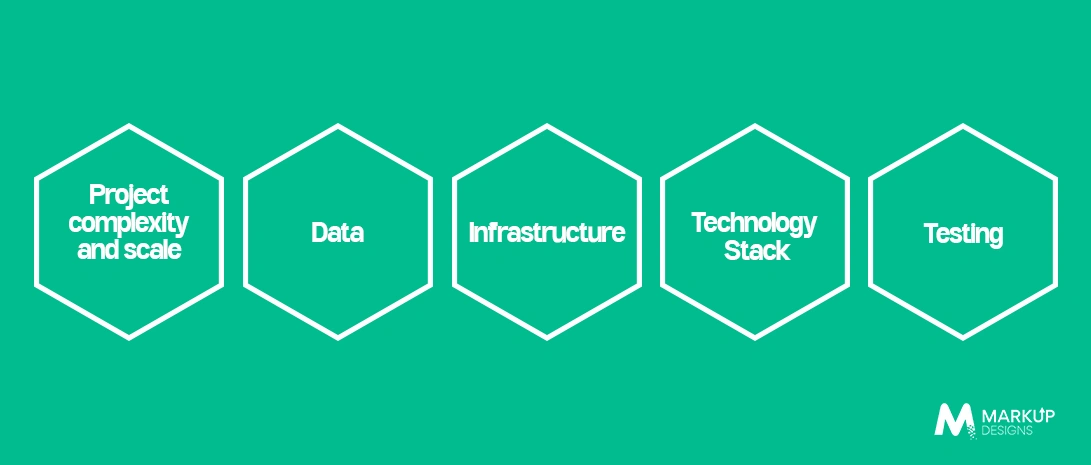
When developing a budget for an AI solution, it is critical to recognize that its structure is far more complex than first estimations. The cost of AI and IoT development is broken down into the components shown below.
Factors impacting AI development cost
1. Project complexity and scale
The total cost increases with the number of features and integrations you desire. For example, launching a simple AI chatbot typically costs between $15,000 and $20,000, whereas a sophisticated generative model requires months of work and a $60,000+ investment. Larger and more complicated models necessitate significant computing power, lengthy data preparation, and specialist skills, all of which raise the cost.
2. Data: collection, processing, and annotation
Data is the fuel for artificial intelligence. Its preparation consists of collecting, cleaning, structuring, labeling, balancing, and augmentation. Open datasets can help, but when a project requires something unique, organizations frequently choose to create and identify their data from scratch.
3. Infrastructure: cloud services and computing resources
Modern AI development requires a lot of processing power whether using generative models or deep neural networks. This implies that you should budget for more than simply standard cloud hosting. Planning for scalability, ongoing monitoring, safe data storage, and technical assistance is also necessary. The overall cost of AI may increase if any of these are overlooked.
4. Technology Stack: tools, licensing, and software
The biggest budget surprise may come from licensing and tools. Many open-source, free frameworks are available, like PyTorch and TensorFlow, and they are effective for startups. However, teams frequently purchase platforms or libraries for more complex projects in order to obtain additional features or better support. You must always consider the benefits and drawbacks of both commercial and open-source software, including support, speed, and cost.
5. Testing: launch, support, and maintenance
AI solutions are not one-time offerings. Sustainable outcomes require regular model testing and retraining, debugging, security checks (e.g., utilizing DAST tools), and adaptation to new data and market situations. Maintenance and compliance expenses are even greater in sectors like health, insurance, logistics, and others with strict regulations.
Complete Breakdown of AI Development Costs
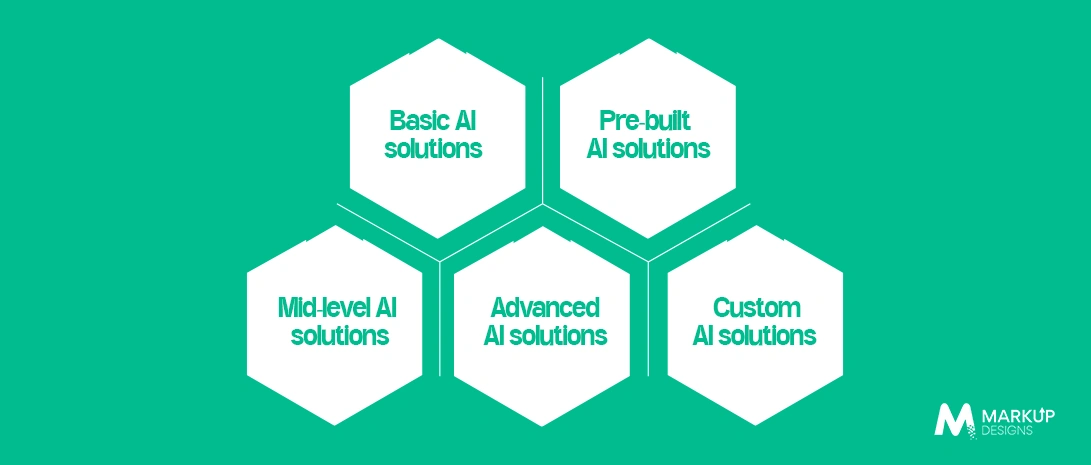
1. Basic AI solutions
This group includes simple tools that use ready-made models or have limited options for customization.
Examples:
- Chatbots and voice assistants for customer support.
- Simple ML models for spam filtering, text processing, and auto-fill.
- Basic recommendation and analytics systems.
Cost range: $20,000 to $50,000
Timeframe: 1-2 months
2. Pre-built AI solutions
Pre-built solutions enable rapid deployment, limited configuration, and standard functionality, making the cost of implementing AI relatively manageable and suitable for MVPs.
Examples:
- SaaS chatbots for quick customer engagement
- Plug-and-play analytics tools for SMEs
- Subscription-based AI APIs for marketing or HR tasks
- Standardized AI services with limited customization
Cost range: $10,000 to $40,000
Timeframe: a few weeks
3. Mid-level AI solutions
Projects with more complex logic and partial model customization, requiring serious data preparation and training on niche datasets.
Examples:
- Natural language processing (NLP) systems for tone analysis, AI detection and automatic translation.
- Computer vision for image recognition and classification.
- Personalized recommendations on medium-complexity platforms
Cost range: $50,000 to $150,000
Timeframe: 2-4 months
4. Advanced AI solutions
A class of complex solutions with deep learning, generative models, and integration of multiple AI modules.
Examples:
- Generative artificial intelligence (e.g., for image or text generation).
- Real-time systems for video and audio processing.
- Complex predictive models and recommendation systems with high accuracy.
Cost range: $150,000 and above
Timeframe: 4-6 months and above
5. Custom AI solutions
Custom solutions are created for unique business tasks and customer infrastructure. They are more expensive to develop but provide maximum flexibility, scalability, and competitive advantages.
Examples:
- Medical diagnosis systems tailored to specific healthcare workflows
- Financial risk analytics and forecasting engines
- AI integration in complex industrial or telecom systems
- Security and compliance solutions for regulated sectors
- AI developed for niche industries or proprietary data
Cost range: $100,000 and above
Timeframe: 6 months and above
What Businesses Should Evaluate Before Hiring AI Consultants
Planning to hire AI consultants? Learn how to evaluate expertise, industry experience, costs, engagement models, and red flags before choosing the right AI consulting partner for your business.

Why AI Development Cost Varies Across Industries
It is also important to understand the unique details and differences of each industry. For example:
E-commerce and retail frequently use AI for personalization and automation, making costs more predictable and manageable.
Manufacturing and logistics are centered on process optimization, which may include integration with IoT and complicated analytical models.
Healthcare and real estate necessitate tight adherence to rules, a high level of security, and explainable models, which greatly raise expenses.
Cost of AI Development Explained Through Use Cases
Now that you understand what drives the budget, you can approach things more practically. Most teams don’t begin with “build AI,” but with a use case. And this is where the cost of developing AI becomes easier to estimate.
Different use cases require significantly different degrees of work, data, and infrastructure. That is why the cost of building AI apps varies so much even within the same organization.
Here’s a typical breakdown.
| Use Cases | Estimated Cost | Common Applications |
| AI Chatbots & Virtual Assistants | $40,000 – $100,000 | Customer support, FAQ automation, Basic assistants |
| Generative AI Applications | $80,000 – $250,000+ | Writing tools, Code generation, AI copilots |
| Recommendation Systems | $60,000 – $180,000 | Product/content suggestions, User predictions |
| Computer Vision Solutions | $100,000 – $300,000+ | Image recognition, Object detection, Video analysis |
| Predictive Analytics & Forecasting | $70,000 – $200,000 | Demand forecasting, Risk analysis, Sales predictions |
How to Estimate AI Development Cost Step by Step
Assume you’re in a meeting, with a whiteboard open, attempting to estimate the cost of building AI. This is when most teams either underestimate or overcomplicate the situation. The trick is not to guess a number, but to divide the problem into layers that mirror how AI systems are built.
When you address this systematically, your AI creation cost estimation becomes much more realistic and acceptable.
- Start with Use Case Complexity: The cost of developing AI applications depends heavily on what you’re building. A single-task AI chatbot costs far less than a multi-workflow assistant or a full automation platform. The more features, real-time requirements, and user interaction involved, the higher the overall AI development cost estimate.
- Check Data Readiness: AI runs on pipelines, not just datasets. If your data is scattered, unstructured, or requires labeling, this stage can consume a large share of the cost of implementing AI. Clean, centralized data reduces both time and overall artificial intelligence cost significantly.
- Choose the Right Model Strategy: Your technical approach directly affects the AI model development cost. Using APIs keeps upfront costs lower but adds usage-based expenses. Fine-tuning existing models offers balance. Building from scratch requires more computation, experimentation, and increases the total AI cost.
- Plan Infrastructure Early: Infrastructure costs grow with usage. Training requires compute-heavy environments, while real-time systems demand scalable inference setups. The more frequently your system runs, the higher the ongoing cost of implementing artificial intelligence.
- Consider Integration Depth: AI rarely stands alone. Connecting with CRMs, ERPs, or internal systems requires engineering effort. The deeper the integration, the more it increases the cost of AI development.
- Factor in Scale and Lifecycle: Usage volume matters. High request frequency, large output volumes, or rapid growth directly affect the long-term AI implementation costs for businesses. Add monitoring, retraining, and custom MLOps tools to maintain performance, and you get a more complete picture of the real cost.
Key Trends Influencing Cost to Build AI in 2026
If you’re considering an AI project right now, the cost discussion has transformed. It is no longer just about the resources required to develop the system. It’s about how the system performs once it’s operational. The cost of developing AI in 2026 is determined by consumption trends, infrastructure options, and the maturity of your setup.
Here are the trends that are actually influencing the cost of AI development today.
- When your system goes live, every request is routed through compute. This is where the money begins to accumulate. A chatbot that handles thousands of requests each day or a real-time technology that runs continuously can quickly escalate costs beyond what you anticipated at the outset.
- AI-as-a-Service makes starting easy but scaling expensive. Plugging into existing APIs allows you to get started quickly without requiring a significant upfront expenditure. However, when usage rises, so does your bill. What begins tiny can grow faster than anticipated.
- Most teams no longer construct models from scratch. They are adopting current ones. It saves time, decreases training expenses, and provides adequate control for the majority of real-world use cases.
- MLOps is no longer an option. Getting a model to work once is one thing. Another challenge is maintaining manufacturing reliability.
- Compliance is becoming part of the build, rather than an afterthought. When sensitive data is involved, audit logs, bias checks, and explainability become important considerations. These are no longer optional features; they are expected.
- Teams are carefully considering where workloads will run. Some relocate components to the edge, while others combine cloud deployments or optimize inference. It can lower long-term costs, but it typically adds complexity early on.
Markup Designs: Your AI Development Growth Partner
Markup Designs is a reliable technological partner for companies trying to create scalable, future-ready AI solutions. With a strong team of 350+ specialists, the company focuses on developing AI-powered applications that address real-world business difficulties, improve automation, and improve decision-making.
Markup Designs provides end-to-end AI development services targeted to specific industry demands, including machine learning models and predictive analytics, as well as AI-driven automation solutions. The organization takes an agile development methodology, which ensures faster delivery, transparency, and continuous improvement throughout the project’s lifecycle.
Its expertise covers healthcare, financial, retail, logistics, and corporate solutions, making it an adaptable partner for AI transformation. Markup Designs prioritizes innovation, security, and performance, ensuring that every AI solution is scalable, efficient, and aligned with corporate objectives.
By combining technological experience with industry insights, the company enables organizations to deploy AI in a practical and cost-effective manner.
Ready to Build Your AI Solution?
Turn your AI idea into a scalable product with expert guidance from Markup Designs. We build intelligent, cost-effective AI solutions tailored to your business needs and growth goals.

Conclusion
AI development is no longer just an advanced technology trend; it has become a core part of modern business growth. Understanding the cost factors behind AI development helps businesses plan better and avoid unexpected expenses. From data requirements and model complexity to infrastructure and team expertise, every element plays a role in determining the final pricing.
Investing in AI can deliver long-term benefits such as automation, improved efficiency, better customer experience, and data-driven decision-making. However, success depends on choosing the right development partner and strategy.
A well-planned AI solution not only reduces operational costs but also creates new opportunities for innovation and scalability. As AI continues to evolve, businesses that invest wisely today will have a stronger competitive advantage in the future.
FAQs
1. What factors affect AI development cost the most?
AI development cost mainly depends on data complexity, model type, required features, and the expertise of the development team. More advanced and customized solutions generally require higher investment.
2. How long does it take to build an AI solution?
The development timeline usually ranges from 2 to 6 months. It can vary based on project size, complexity, and the level of AI integration required.
3. Is AI development expensive for startups?
Not always. Startups can begin with MVP-based AI solutions that are cost-effective and scalable. This approach helps reduce initial investment while validating the idea.
4. Which industries benefit most from AI?
Industries like healthcare, fintech, retail, logistics, and e-commerce benefit greatly from AI. It helps them improve automation, decision-making, and customer experience.
5. Do AI solutions require ongoing maintenance?
Yes, AI systems need regular updates and monitoring to maintain accuracy and performance. Continuous improvement ensures the model stays relevant and effective over time.
Author's Perspective
From an industry perspective, AI development is evolving rapidly and becoming more accessible to businesses of all sizes. However, cost transparency remains one of the biggest challenges for decision-makers. In my experience, successful AI projects are those that start with a clear scope, realistic expectations, and the right technical partner. Companies that invest time in proper planning and cost analysis achieve better ROI and long-term scalability. AI is not just a technology investment, it is a strategic business decision.
Discuss Your Project NowGaurav Goyal
Global Sales- VP
Related Posts
How AI is Revolutionising Industrial Automation in Australia

How UK Enterprises Can Build an Effective AI...

AI Voice Agent for Real Estate: Features, Benefits,...
Insights Are Valuable & Execution is Priceless
You’ve read about the digital future. Now, let’s build the infrastructure to take you there. Move your strategy from the page to the product.
Design Your Solution Now
Contact Us
Schedule The Appointment At Your Convenience Date And Time.
30 Min
Web Conference
Time Zone
Indian standard time (08:30pm)

Thanks For Getting In Touch!
You’ve Taken The First Step Toward Transforming Your Digital Presence. Our Experts Will Reach Out Shortly To Take It Forward.
Launch Your Dream Project
Provide a brief overview of your project, and our specialists will evaluate your requirements. We will connect with you to explore how the right digital solutions can help you launch faster.