
In Brief
- IoT application development now involves hardware, firmware, cloud infrastructure, connectivity, security, analytics, and mobile/web applications working together as one ecosystem.
- Development costs are rising in 2026 due to increasing demand for AI-powered automation, real-time monitoring, edge computing, and scalable cloud architecture.
- Hardware engineering, firmware optimization, and cloud infrastructure remain some of the biggest cost drivers in modern IoT projects.
- Businesses often underestimate long-term operational expenses such as maintenance, OTA updates, cloud scaling, cybersecurity monitoring, and technical support.
- Security and compliance requirements in industries like healthcare, manufacturing, and logistics significantly increase overall development complexity and budgeting needs.
- Starting with an MVP, using scalable architecture, and prioritizing security early helps businesses reduce technical debt and avoid costly rebuilds later.
The Internet of Things (IoT) has evolved from an experimental innovation into a critical operational technology across industries such as healthcare, manufacturing, logistics, retail, agriculture, automotive, and smart infrastructure. Businesses are increasingly investing in connected ecosystems to automate operations, monitor assets in real time, improve efficiency, reduce downtime, and unlock predictive intelligence.
However, one of the biggest misconceptions around IoT development is assuming the primary expense comes only from mobile applications or hardware devices. In reality, IoT development involves a much larger ecosystem that combines hardware engineering, firmware programming, cloud infrastructure, connectivity management, cybersecurity, analytics, and continuous maintenance.
A successful IoT ecosystem is not a one-time software product. It is a continuously operating distributed infrastructure that requires long-term scalability, reliability, and operational management.
What Is an IoT Application?
An IoT (Internet of Things) application is a connected digital ecosystem that allows physical devices to communicate with software platforms, cloud infrastructure, and users through internet connectivity, sensors, and embedded technologies.
Unlike traditional software applications, IoT systems are not limited to screens and user interfaces. They combine physical hardware, real-time data transmission, cloud computing, automation systems, and analytics engines into one integrated environment.
In simple terms, an IoT application allows devices to:
- Collect data from the physical world
- Send that data through internet-connected networks
- Process and analyze information in real time
- Trigger automated actions or alerts
- Allow users to monitor and control devices remotely
For example:
- A smart thermostat can automatically adjust room temperature based on usage patterns.
- A fleet tracking system can monitor vehicle movement in real time.
- A healthcare wearable can continuously send patient health data to doctors and monitoring platforms.
An IoT ecosystem is not a single application. It is a combination of multiple interconnected layers working together continuously.
Core Layers of an IoT Ecosystem
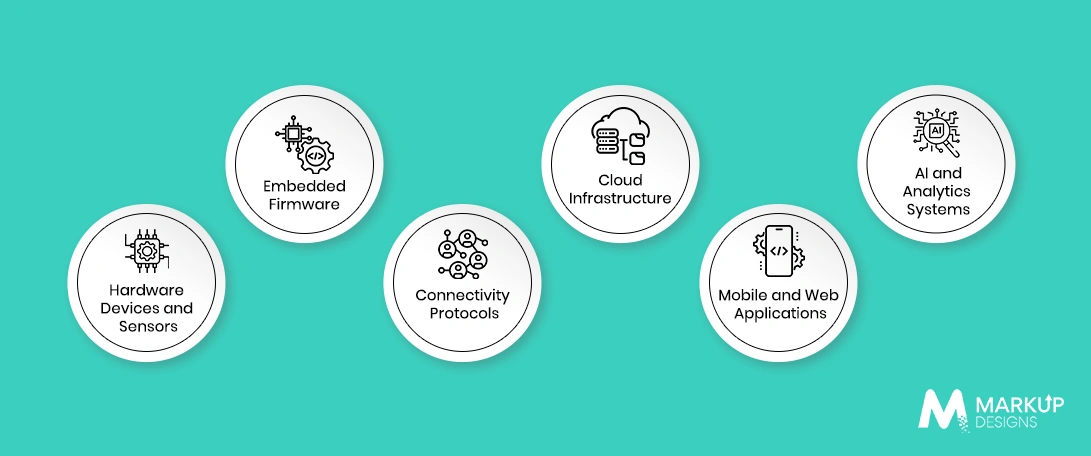
Layer 1- Hardware Devices and Sensors
The hardware layer forms the physical foundation of every IoT system.
This includes:
- Sensors
- Smart appliances
- GPS trackers
- Wearables
- Cameras
- Industrial machines
- Smart meters
These devices collect real-world information such as:
- Temperature
- Motion
- Location
- Humidity
- Pressure
- Health metrics
- Energy consumption
The accuracy and reliability of the hardware directly affect the overall performance of the IoT system.
Layer 2- Embedded Firmware
Firmware is embedded software running directly inside IoT devices.
It acts as the operational brain of the hardware and controls how devices:
- Collect data
- Process information
- Communicate with servers
- Manage power consumption
- Execute commands
- Receive updates
Firmware is critical because it ensures that hardware components function correctly and communicate reliably with the rest of the ecosystem.
For example:
- A smart camera uses firmware to process motion detection.
- A wearable fitness tracker uses firmware to monitor health metrics and battery optimization.
Poor firmware optimization can cause:
- Device crashes
- Battery drain
- Connectivity failures
- Security vulnerabilities
Layer 3- Connectivity Protocols
Connectivity protocols allow IoT devices to transmit and receive data over networks.
Different IoT systems use different communication technologies depending on:
- Range requirements
- Power consumption
- Network speed
- Deployment environment
- Data volume
Common IoT connectivity technologies include:
- Wi-Fi
- Bluetooth Low Energy (BLE)
- Zigbee
- LoRaWAN
- NB-IoT
- Cellular networks
- 5G
For example:
- Smart home devices commonly use Wi-Fi or Bluetooth.
- Industrial systems may rely on LoRaWAN or 5G for long-range communication.
- Fleet tracking systems often use cellular IoT networks.
Reliable connectivity is essential because IoT systems depend on continuous communication between devices and cloud platforms.
Layer 4- Cloud Infrastructure
Cloud infrastructure acts as the operational backbone of the IoT ecosystem.
It handles:
- Data storage
- Device communication
- Real-time event processing
- Automation workflows
- Security systems
- Analytics processing
Popular cloud platforms used in IoT development include:
- AWS IoT Core
- Microsoft Azure IoT
- Google Cloud IoT
The cloud layer allows businesses to:
- Monitor devices remotely
- Scale infrastructure
- Process massive amounts of sensor data
- Trigger automated actions in real time
For example:
- A logistics platform can monitor thousands of vehicles simultaneously through cloud dashboards.
- A smart factory can analyze equipment performance data in real time.
Layer 5- Mobile and Web Applications
Mobile and web applications provide the user interface of the IoT system.
These applications allow users to:
- Monitor connected devices
- View analytics
- Receive alerts
- Control hardware remotely
- Manage automation settings
Examples include:
- Smart home control apps
- Fleet management dashboards
- Healthcare monitoring portals
- Industrial monitoring systems
The usability and responsiveness of these applications directly affect user experience and operational efficiency.
Modern IoT platforms often support:
- Real-time monitoring
- Push notifications
- Automation controls
- Multi-user access
- Live analytics dashboards
Layer 6- AI and Analytics Systems
AI and analytics systems convert raw IoT data into meaningful insights and automated actions.
This layer helps businesses:
- Detect patterns
- Predict failures
- Automate operations
- Improve decision-making
- Optimize performance
AI-powered IoT systems can support:
- Predictive maintenance
- Demand forecasting
- Behavioral analysis
- Anomaly detection
- Smart automation
For example:
- Industrial IoT systems can predict machine failures before breakdowns occur.
- Smart retail systems can analyze customer behavior patterns.
- Healthcare platforms can identify abnormal patient readings automatically.
As IoT ecosystems scale, analytics and AI become increasingly important for handling large volumes of real-time data efficiently.
How These Layers Work Together
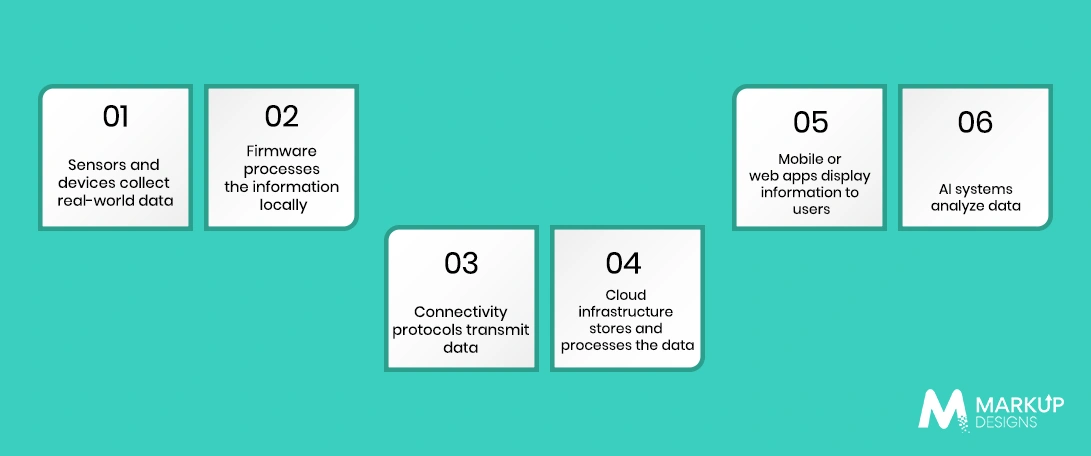
All IoT layers work together as one connected ecosystem.
The process generally follows this flow:
- Sensors and devices collect real-world data
- Firmware processes the information locally
- Connectivity protocols transmit data to cloud platforms
- Cloud infrastructure stores and processes the data
- Mobile or web apps display information to users
- AI systems analyze data and trigger automation or predictions
This continuous flow of real-time data is what makes IoT systems powerful, scalable, and capable of automating complex operations across industries.
Key Factors That Influence IoT App Development Cost
| Project Scope | Cost Range | Key Characteristics |
| Simple lot Application | $40,000 – $100,000 | Limited number of connected devices, simple data collection, basic control panel, and data logging. |
| Mid-Range Solution | $100,000 – $300,000 | Real-time data, cloud storage, standard mobile app integration, moderate features, linking 10-50 intelligent devices. |
| Advanced/Enterprise | $300,000 – $500,000 | Custom dashboards, AI/ML features, multi-device synchronization, high-volume data processing, tailored industrial loT solutions. |

Developing an IoT application is far more complex than building a standard mobile app or website. An IoT ecosystem combines hardware devices, embedded software, cloud infrastructure, communication networks, analytics systems, and security layers into one continuously operating environment.
Because so many technologies work together at the same time, IoT development costs can vary significantly depending on the complexity of the project, the number of connected devices, the industry requirements, and long-term operational goals.
Many businesses initially assume the highest cost comes from sensors or app development alone. In reality, the largest expenses usually come from infrastructure scalability, cloud operations, cybersecurity, testing, maintenance, and long-term device management.
Below are the major factors that influence IoT app development cost in 2026.
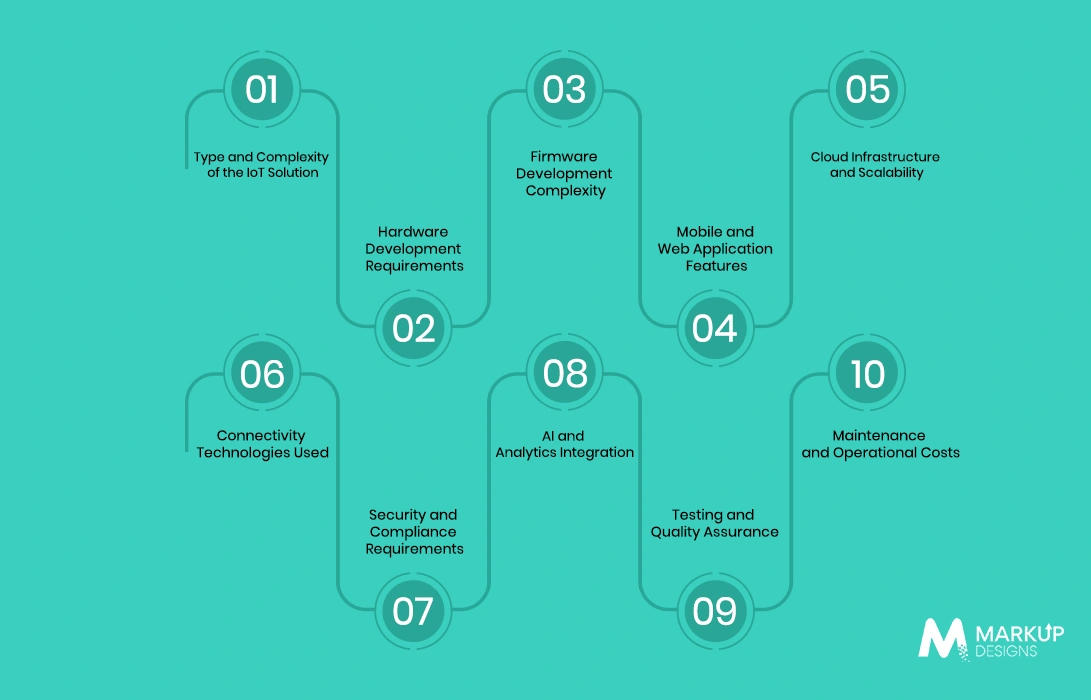
1. Type and Complexity of the IoT Solution
The type of IoT application being developed is one of the biggest factors affecting the total project budget.
Different industries require different levels of:
- Infrastructure
- Security
- Real-time processing
- Scalability
- Connectivity
- Compliance
- Reliability
For example, a simple smart home application is far less complex than an industrial automation system or a connected healthcare platform.
The more advanced the operational environment becomes, the higher the development cost.
Smart Home IoT Applications
Smart home IoT systems are designed for residential automation and convenience.
Examples include:
- Smart lighting systems
- Smart thermostats
- Security cameras
- Smart locks
- Home automation platforms
These applications usually require moderate infrastructure and relatively simple device communication systems.
However, costs increase when businesses introduce:
- AI-based automation
- Real-time video streaming
- Voice assistant integrations
- Multi-device synchronization
Estimated Development Cost:
$35,000 – $400,000 depending on complexity and scalability.
Industrial IoT (IIoT)
Industrial IoT systems are among the most expensive IoT solutions because they operate in large-scale industrial environments where reliability is critical.
Examples include:
- Factory automation systems
- Equipment monitoring
- Predictive maintenance platforms
- Industrial telemetry systems
Industrial IoT projects often require:
- Real-time monitoring
- Edge computing
- Machine integrations
- Large-scale device management
- Advanced analytics dashboards
These systems must also operate reliably in difficult conditions, such as:
- Heat
- Dust
- Continuous usage cycles
- Connectivity interruptions
Estimated Development Cost:
$20,000 – $500,000+, depending on deployment scale.
Healthcare IoT Applications
Healthcare IoT systems require advanced security and strict compliance because they manage sensitive patient data and connected medical devices.
Examples include:
- Patient monitoring systems
- Connected medical devices
- Wearable diagnostics
- Remote healthcare platforms
Healthcare IoT development becomes expensive because businesses must invest heavily in:
- Data encryption
- Compliance systems
- Secure cloud infrastructure
- Real-time monitoring
- Reliable uptime
Even small system failures can create serious operational and legal risks.
Estimated Development Cost:
$45,000 – $800,000+, depending on security and compliance requirements.
Automotive IoT Applications
Automotive IoT focuses on connected vehicles, telematics, and fleet operations.
Examples include:
- Fleet management systems
- Connected vehicle platforms
- Vehicle diagnostics
- Driver monitoring systems
These applications require:
- GPS integrations
- Real-time tracking
- Large-scale telemetry processing
- Cloud analytics systems
- High-speed connectivity
Fleet-based systems operating across multiple regions also increase infrastructure and connectivity costs.
Estimated Development Cost:
$40,000 – $600,000+, depending on deployment complexity.
2. Hardware Development Requirements
Hardware development is one of the most expensive and unpredictable parts of IoT projects because it involves designing and manufacturing physical devices.
Hardware development typically includes:
- Sensor integration
- PCB design
- Device prototyping
- Product testing
- Manufacturing
- Certifications
Unlike software bugs, hardware problems often require redesigns or manufacturing changes, which significantly increase costs.
Businesses frequently underestimate:
- Prototype failures
- Battery optimization challenges
- Hardware durability testing
- Environmental testing
- Manufacturing defects
A single hardware flaw affecting thousands of devices can create major replacement and support expenses.
Estimated Hardware Development Cost:
$10,000 – $1M+ depending on complexity and manufacturing scale.
3. Firmware Development Complexity
Firmware is embedded software running directly inside IoT devices.
It controls how devices:
- Collect data
- Communicate with the cloud
- Process information
- Manage power consumption
- Receive updates
Firmware development becomes more expensive when projects require:
- Real-time processing
- Low-power optimization
- Edge computing
- Security encryption
- Offline functionality
Poorly optimized firmware can lead to:
- Device crashes
- Battery drain
- Connectivity failures
- Security vulnerabilities
Because firmware development requires specialized embedded engineers, costs are usually higher than traditional software development.
Estimated Firmware Development Cost:
$10,000 – $30,000+
4. Mobile and Web Application Features
Most IoT systems require mobile apps or web dashboards that allow users to monitor and manage connected devices.
Common features include:
- Device onboarding
- Real-time monitoring
- Push notifications
- Remote controls
- Analytics dashboards
- User management
- Automation settings
Simple monitoring apps are relatively affordable.
However, enterprise-grade dashboards with:
- Live analytics
- Multi-user access
- Workflow automation
- AI-based recommendations
- Third-party integrations
can significantly increase frontend and backend development costs.
Native iOS and Android development also increases the budget compared to cross-platform solutions.
Estimated Mobile and Web App Development Cost:
$10,000 – $150,000+
Read Also: Mobile App Development: Complete Guide for Businesses
5. Cloud Infrastructure and Scalability
Cloud infrastructure acts as the operational backbone of an IoT ecosystem.
It manages:
- Device communication
- Data storage
- Real-time analytics
- Event processing
- Automation systems
- Security monitoring
- Server scaling
Popular IoT cloud platforms include:
- AWS IoT Core
- Microsoft Azure IoT
- Google Cloud IoT
As device numbers grow, infrastructure costs increase rapidly.
Businesses often underestimate long-term cloud expenses, such as:
- API requests
- Device messaging
- Data storage
- Auto-scaling servers
- Security monitoring
Poor scalability planning can eventually lead to:
- System downtime
- Delayed communication
- Expensive infrastructure rebuilds
Enterprise IoT systems may spend thousands of dollars every month on cloud operations alone.
6. Connectivity Technologies Used
IoT devices rely on communication networks to send and receive data.
The connectivity technology chosen directly affects:
- Device performance
- Battery life
- Operational costs
- Network stability
- Deployment range
Common connectivity options include:
- Wi-Fi
- Bluetooth Low Energy (BLE)
- Cellular IoT
- LoRaWAN
- NB-IoT
- 5G
Each option comes with different cost implications.
For example:
- Wi-Fi is affordable but limited in range.
- Cellular IoT supports remote deployments but increases telecom costs.
- 5G enables ultra-fast communication but requires advanced infrastructure.
Connectivity costs may also include:
- Data charges
- SIM management
- Roaming fees
- Gateway infrastructure
7. Security and Compliance Requirements
Security is no longer optional in IoT development.
Weak IoT security can result in:
- Data breaches
- Device hijacking
- Operational shutdowns
- Compliance violations
- Financial losses
Modern IoT systems require:
- Device authentication
- End-to-end encryption
- Secure APIs
- Secure firmware updates
- Cloud security monitoring
Industries such as healthcare, finance, and industrial automation require even stricter compliance standards.
Fixing security vulnerabilities after deployment is usually far more expensive than building a secure architecture from the beginning.
8. AI and Analytics Integration
Modern IoT platforms increasingly use AI and analytics systems to automate operations and generate intelligent insights.
AI-powered IoT features may include:
- Predictive maintenance
- Demand forecasting
- Behavioral analysis
- Pattern recognition
- Anomaly detection
AI integration increases costs because businesses must also invest in:
- Data engineering
- Machine learning infrastructure
- Model training
- Continuous optimization
The more intelligent the system becomes, the more infrastructure and processing power it requires.
9. Testing and Quality Assurance
Testing IoT systems is more complicated than traditional software testing because businesses must validate both hardware and software together.
IoT testing includes:
- Functional testing
- Connectivity testing
- Security testing
- Performance testing
- Environmental testing
Devices must also be tested under real-world conditions, such as:
- Weak internet signals
- Connectivity interruptions
- Power fluctuations
- Extreme temperatures
Since even a small firmware issue can affect thousands of connected devices simultaneously, extensive testing is critical.
Skipping QA to reduce costs often creates much larger operational expenses later.
How to Choose the Right IoT Development Company
Choosing the right IoT development company is important because successful IoT solutions require strong technical expertise, secure infrastructure, scalability, cloud integration, and industry-specific experience.
10. Maintenance and Operational Costs
One of the biggest budgeting mistakes businesses make is focusing only on development costs while ignoring long-term operational expenses.
IoT systems require continuous maintenance after deployment.
Ongoing operational costs may include:
- Firmware updates
- Cloud maintenance
- Security patches
- Infrastructure scaling
- Device monitoring
- Technical support
As device deployments grow, maintenance complexity increases significantly.
In many cases, yearly maintenance expenses can reach 10–30% of the original development budget.
A successful IoT product is not just about launching the system. It is about maintaining reliability, security, scalability, and operational stability over the long term.
Strategies to Reduce IoT Development Costs
Reducing IoT development costs does not mean sacrificing quality or choosing the cheapest possible development approach. The real goal is to reduce unnecessary complexity, avoid technical debt, improve operational efficiency, and build scalable systems that remain sustainable over the long term.
Many IoT projects become expensive not because of innovation itself, but because of poor planning, overengineering, weak infrastructure decisions, and underestimated operational requirements.
Businesses can significantly optimize IoT development budgets by following the strategies below.
1. Start with a Minimum Viable Product (MVP)
One of the most effective ways to reduce IoT development costs is to begin with a Minimum Viable Product (MVP) instead of building a fully featured ecosystem immediately.
An MVP focuses only on the core functionality required to validate the product idea and test how the system performs in real-world conditions.
For example:
- A smart logistics platform may initially launch with GPS tracking and basic alerts before introducing AI-based route optimization.
- A healthcare wearable may first focus on monitoring one or two health metrics before expanding into advanced diagnostics.
Building an MVP helps businesses validate:
- Market demand
- Device reliability
- Connectivity stability
- User adoption
- Operational feasibility
This approach reduces the risk of investing heavily in features that users may not actually need during the early stages.
It also allows businesses to:
- Identify technical limitations earlier
- Improve products based on real user feedback
- Reduce development waste
- Accelerate time-to-market
Instead of spending large budgets upfront, businesses can scale gradually based on actual product performance and customer demand.
2. Use Existing Cloud IoT Platforms
Building cloud infrastructure completely from scratch can dramatically increase development costs, deployment complexity, and long-term maintenance requirements.
Instead of creating custom infrastructure for every function, businesses can use established IoT cloud platforms such as:
- AWS IoT Core
- Microsoft Azure IoT
- Google Cloud IoT
These platforms already provide:
- Device management tools
- Secure communication systems
- Cloud scalability
- Data processing services
- Authentication layers
- Monitoring systems
Using prebuilt cloud services helps businesses reduce:
- Infrastructure setup costs
- Security implementation complexity
- Deployment timelines
- Maintenance burden
- Scalability risks
For example, setting up secure device communication manually can take months of engineering effort. Using cloud-native IoT services allows businesses to deploy much faster with lower operational risk.
Cloud platforms also improve long-term reliability because infrastructure scaling, uptime management, and security updates are handled more efficiently.
3. Standardize Hardware Components
Custom hardware development can quickly become one of the most expensive areas of an IoT project.
While fully customized devices may appear attractive initially, they often create:
- Higher manufacturing costs
- More prototype failures
- Longer testing cycles
- Increased maintenance complexity
- Difficult scalability challenges
Using standardized and proven hardware components helps businesses:
- Reduce prototyping costs
- Simplify manufacturing
- Improve hardware reliability
- Accelerate production timelines
- Reduce long-term maintenance issues
Standardization also makes future upgrades, replacements, and large-scale deployments much easier to manage.
Businesses that prioritize reliable and scalable hardware early usually avoid expensive redesigns later.
For example:
Using widely tested sensors, chipsets, and communication modules is often more cost-effective than designing highly customized hardware from the ground up.
4. Avoid Overengineering
One of the most common mistakes in IoT development is building infrastructure far beyond actual business requirements.
Many startups and growing businesses attempt to build enterprise-grade systems before validating:
- Product-market fit
- Device demand
- User adoption
- Operational scale
This creates unnecessary:
- Infrastructure costs
- Development complexity
- Maintenance burden
- Deployment delays
For example:
A startup building infrastructure capable of supporting one million devices before acquiring its first few hundred users is often wasting resources.
IoT architecture should match realistic business growth stages rather than hypothetical future scale.
Businesses should focus on:
- Solving immediate operational problems
- Building modular systems
- Scaling gradually
- Expanding infrastructure only when necessary
A flexible and scalable architecture is important, but excessive early complexity usually increases costs without delivering meaningful operational value.
5. Prioritize Security Early
Treating cybersecurity as a later-stage feature is one of the most expensive mistakes businesses make in IoT development.
Weak security architecture can eventually lead to:
- Data breaches
- Device hijacking
- Compliance violations
- Operational shutdowns
- Expensive infrastructure rebuilds
Integrating security during the early development phase is significantly more cost-effective than fixing vulnerabilities after deployment.
Security-first development helps businesses reduce:
- Remediation costs
- Compliance failures
- Operational disruptions
- Legal exposure
- Reputation damage
Early security implementation typically includes:
- Device authentication
- End-to-end encryption
- Secure APIs
- Firmware protection
- Access control systems
As IoT ecosystems scale, every connected device becomes a potential attack point. Businesses that ignore security initially often face higher operational costs exponentially later.
6. Use Agile Development Methodologies
Agile development helps IoT teams build systems incrementally instead of relying on rigid long-term development cycles.
Rather than spending months building large systems without testing, agile development focuses on:
- Smaller development cycles
- Continuous testing
- Frequent improvements
- Faster iteration
This approach allows businesses to:
- Detect technical problems earlier
- Improve resource allocation
- Reduce development waste
- Adapt to changing requirements faster
- Improve collaboration between hardware and software teams
IoT projects often evolve during development because real-world device behavior, connectivity issues, and operational requirements can change unexpectedly.
Agile methodologies provide flexibility to improve systems continuously without requiring expensive full-scale rebuilds.
Continuous iteration also improves:
- Product stability
- Infrastructure scalability
- User experience
- Operational reliability
7. Use Open-Source Tools and Reusable Frameworks
Developing every IoT component from scratch significantly increases development time and engineering costs.
Using open-source tools, reusable libraries, and existing frameworks helps businesses accelerate development while reducing operational complexity.
Businesses can reuse:
- Communication protocols
- Device libraries
- Analytics frameworks
- Cloud integrations
- Security modules
- Monitoring systems
According to industry estimates, using reusable development frameworks and open-source tools can reduce IoT development costs by approximately 15–20% while also improving deployment speed.
This approach allows development teams to focus more on:
- Product innovation
- User experience
- Business functionality
Instead of rebuilding standard infrastructure repeatedly.
However, businesses should still carefully evaluate the reliability, security, and long-term support of third-party tools before integrating them into production systems.
8. Focus on Long-Term Scalability Instead of Short-Term Savings
Many businesses attempt to reduce initial costs by making short-term infrastructure decisions that later create expensive operational problems.
For example:
- Choosing unreliable hardware
- Ignoring scalability planning
- Using a weak security architecture
- Skipping proper testing
may reduce upfront spending temporarily, but often results in:
- Frequent system failures
- Higher maintenance costs
- Infrastructure rebuilds
- Poor operational performance
The most cost-effective IoT systems are not necessarily the cheapest to build initially. They are the systems designed for long-term scalability, reliability, maintainability, and operational stability.
Smart planning during the early stages usually saves businesses significantly more money over the full lifecycle of the IoT ecosystem.
Partner with Markup Designs for Scalable IoT Development
Building a successful IoT ecosystem requires far more than simply connecting devices to the internet. Modern IoT solutions demand a strategic combination of hardware integration, firmware engineering, cloud infrastructure, cybersecurity, analytics, and scalable application development working together seamlessly.
At Markup Designs, we help businesses transform complex IoT ideas into scalable, secure, and operationally efficient digital ecosystems tailored for real-world performance.
Our IoT development expertise covers:
- IoT consulting and architecture planning
- Embedded firmware development
- Cloud-native IoT infrastructure
- Mobile and web IoT applications
- Real-time monitoring dashboards
- AI-powered analytics integration
- Device communication and connectivity systems
- IoT security implementation
- Scalable infrastructure optimization
Whether you are building a smart home platform, industrial monitoring system, healthcare IoT solution, logistics tracking platform, or connected enterprise ecosystem, our team focuses on developing reliable and future-ready solutions designed for long-term scalability and operational resilience.
With the growing complexity of IoT infrastructure in 2026, choosing the right development and architecture partner is critical for avoiding technical debt, operational bottlenecks, and expensive infrastructure rebuilds later.
If you are planning to build an IoT ecosystem that is secure, scalable, and designed for sustainable growth, partnering with the right technology team can significantly reduce long-term risk while accelerating deployment success
Build Smarter IoT Ecosystems for the Future
From hardware integration and cloud infrastructure to mobile applications and analytics, we help businesses develop IoT solutions built for long-term growth.
Final Thoughts
IoT application development is expensive because it combines multiple engineering disciplines into one continuously connected ecosystem. Unlike traditional software projects, IoT systems involve hardware engineering, firmware development, cloud infrastructure, connectivity management, cybersecurity, analytics, and long-term operational maintenance working together simultaneously.
The biggest financial mistake businesses make is underestimating operational complexity. Many companies focus only on the initial launch cost while ignoring the long-term expenses associated with infrastructure scaling, device management, security monitoring, firmware updates, cloud operations, and ongoing maintenance.
As IoT ecosystems grow, even small architectural mistakes can become extremely expensive. Poor scalability planning, weak security implementation, unreliable hardware decisions, or insufficient testing can eventually lead to operational failures, infrastructure rebuilds, and rising maintenance costs.
The most successful IoT investments are not necessarily the cheapest ones. They are the systems designed from the beginning for scalability, reliability, maintainability, security, and long-term operational resilience.
A properly architected IoT ecosystem becomes a long-term business advantage that improves automation, operational visibility, efficiency, and decision-making. On the other hand, poorly planned infrastructure quickly turns into an ongoing operational liability that becomes increasingly difficult and expensive to manage over time.
FAQ’s
1. Is IoT development only expensive because of hardware?
No. Hardware is only one part of the cost. Cloud infrastructure, firmware development, security systems, analytics, maintenance, and connectivity management often become larger long-term expenses than the devices themselves.
2. Why do IoT projects usually exceed the initial budget?
Most businesses underestimate operational complexity. Costs related to cloud scaling, OTA updates, cybersecurity, testing, compliance, and device maintenance are often ignored during early planning stages.
4. Can startups afford IoT application development?
Yes, but only if they start with a focused MVP instead of building a full ecosystem immediately. Trying to launch enterprise-grade infrastructure too early usually burns budget unnecessarily.
5. Which part of IoT development takes the most time?
Hardware prototyping, firmware optimization, and large-scale testing usually consume the most time because physical devices require multiple real-world validations before deployment.
6. Is cross-platform mobile development suitable for IoT apps?
It depends on the complexity of the system. Cross-platform frameworks reduce initial costs, but highly complex IoT applications often move to native development later for better performance and device synchronization.
7. Why is IoT security such a major expense?
Because a security failure in IoT not only exposes data, it can shut down operations, compromise connected devices, and create massive compliance risks. Security must cover devices, APIs, firmware, cloud systems, and user access simultaneously.
8. What happens if cloud infrastructure is not designed for scaling?
Poor scalability planning can cause server overloads, delayed device communication, downtime, and expensive infrastructure rebuilds once device numbers grow rapidly.
9. Is building custom hardware always necessary?
No. Many businesses waste money building custom hardware when standardized and proven components could achieve the same functionality at lower risk and lower maintenance cost.
10. Why is IoT testing more complicated than normal software testing?
Because businesses must test hardware behavior, firmware stability, cloud systems, network reliability, connectivity interruptions, and real-world environmental conditions together, not separately.
11. What is the biggest mistake businesses make in IoT development?
Treating IoT like a standard mobile app project. IoT systems are long-term operational ecosystems that require continuous infrastructure management, security monitoring, maintenance, and scalability planning.
Author's Perspective
IoT development is one of the few technology sectors where businesses consistently underestimate operational complexity. Many organizations still approach IoT projects as standard mobile or software development initiatives, which is a major strategic mistake.
The reality is that IoT ecosystems combine multiple engineering disciplines into one continuously operating infrastructure. Hardware reliability, cloud scalability, firmware optimization, connectivity management, cybersecurity, and long-term maintenance all directly affect the financial success of the product.
The companies that succeed in IoT are usually not the ones spending the least. They are the businesses that invest early in scalable architecture, security-first infrastructure, and realistic deployment strategies.
One of the biggest industry problems today is overengineering during the early stages and underestimating long-term operational costs after deployment. Businesses often focus heavily on launch budgets while ignoring maintenance, infrastructure scaling, firmware support, and device lifecycle management.
In 2026 and beyond, successful IoT products will be defined less by novelty and more by operational resilience, scalability, security, and long-term maintainability.
Discuss Your Project NowAjit Kumar Jha
VP - Business Operations
Related Posts
How to Hire Mobile App Developers in the...

How Much Does It Cost to Build a...
How to Build a Secure Payment Gateway Integration...
Insights Are Valuable & Execution is Priceless
You’ve read about the digital future. Now, let’s build the infrastructure to take you there. Move your strategy from the page to the product.
Design Your Solution Now
Contact Us
Schedule The Appointment At Your Convenience Date And Time.
30 Min
Web Conference
Time Zone
Indian standard time (08:30pm)

Thanks For Getting In Touch!
You’ve Taken The First Step Toward Transforming Your Digital Presence. Our Experts Will Reach Out Shortly To Take It Forward.
Launch Your Dream Project
Provide a brief overview of your project, and our specialists will evaluate your requirements. We will connect with you to explore how the right digital solutions can help you launch faster.