
In Brief
- Artificial intelligence has revolutionized customer service by improving its speed, effectiveness, and customization using chatbots and AI agents.
- It ensures that organizations can offer customer support round the clock and even offer instant solutions and improve customer experience.
- The AI agents use the intent of customers, are integrated with organizational systems, and also make use of data to ensure effective solutions.
- Some of the advantages include efficiency, reduced costs, increased personalization, and improved customer experience.
- However, organizations need to consider several challenges, such as data security and also the human factor.
- Conclusively, the use of AI in customer service improves interactions but requires balance.
The customer service sphere has gone through various changes over time, and AI has played a significant role in such transformations. For example, Sephora employed chatbots equipped with AI to provide guidance for its clients as well as suggest personalized products, which led 30% increase in
People expect immediate responses nowadays. This is what AI agents do best. In other words, AI agents provide customers with uninterrupted services, answering all their questions and creating customized experiences. What distinguishes AI agents from automation is the fact that while automation only helps companies to react fast, AI agents let them interact with customers.
Using AI technology in customer relations has become quite common because it lets businesses serve their customers better. In fact, there are many examples where companies gained significant advantages thanks to implementing AI technology in customer service, and one such company was Wendy’s.
In this blog, we will discuss the significance of AI agents in customer services, how AI agents operate, their features, challenges faced while integrating AI into customer services, and the future of AI in this domain.
The Growing Importance of AI Agents in Customer Support
It is undeniable that the expectations of consumers have grown today. Consumers demand fast responses to their queries, which must be customized to meet their needs. The old ways of waiting on the phone do not work anymore; consumers want quick assistance, irrespective of what day and time it is. That is where artificial intelligence can help.
In addition to that, the Grandview Research study suggests that the global market valuation of AI bots will reach a mark of $183.0 billion by 2033, driven by growing demand for round-the-clock support, advancements in natural language processing, widespread sector adoption, and broader digital transformation .
There is one more strong argument why many organizations today are turning to AI: it simply reduces costs. Artificial intelligence can take care of numerous customer questions at the same time as well as manage routine operations. This way, business expands its customer base and hires no extra employees while operating without any additional expenses.
Role of AI Agents in Customer Handling
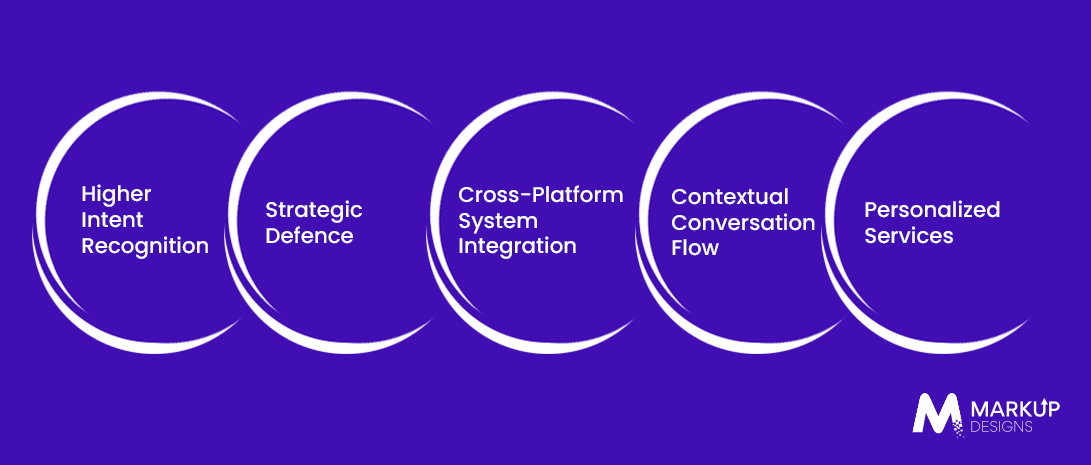
The development of AI agents has ensured the delivery of a full package of services to the customers by meeting their needs through the intelligent use of natural language processing and integration of the system.
Higher Intent Recognition
As soon as the customers initiate communication with the organization through whichever medium, the artificial intelligence agents begin analyzing the message far more deeply. It does so by looking at not only what is being said by the customer but also how much of assistance they require.
Strategic Defence Capabilities Gathering
In other words, to ensure that the right information is collected by the agent from the client, it is important to know which information to search for. Rather than offering generic answers, the agent collects specific information to address the issue or the query raised by the customer.
Cross-Platform System Integration
AI bots have the ability to communicate with other applications within the business environment, including customer relationship management, inventory management, order management, and knowledge base management. By working together with the other applications, they will be able to obtain information and respond immediately to the customer’s query.
Contextual Conversation Flow
AI agents keep track of all previous conversations and customer history across multiple sources. This means every interaction feels continuous, customers can pick up exactly where they left off without having to explain their issue all over again
Personalized Services
Based on data, previous purchases, and the behavior of the customer, the agents offer customized services. Companies can enjoy offering better services to their customers and, thereby, building relationships with their customers.
Key Characteristics of an AI Agent for Customer Service
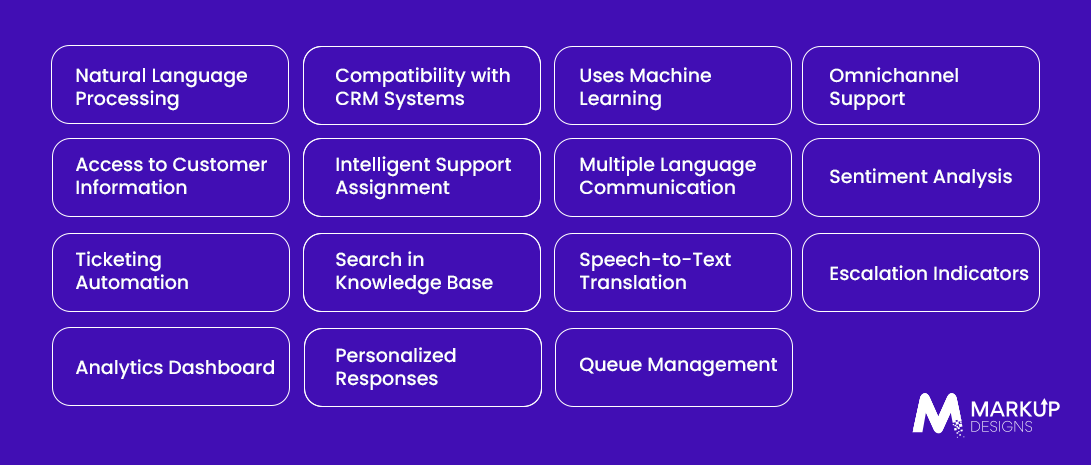
With the increasing use of automation among many businesses, artificial intelligence agents have proven invaluable in transforming the customer service experience. Because of their easy-to-use attributes, these AI agents have made work easier for people and increased efficiency in business operations. Below are some of the advantages of using AI automation in customer service.
Natural Language Processing: Can interpret customer inquiries and statements using normal language for a more natural conversation experience.
Compatibility with CRM Systems: Seamlessly integrates with your current CRM software, such as Salesforce and HubSpot, for efficient handling of customer data.
Uses Machine Learning: Constantly learns from past experiences to improve the accuracy of responses generated for customers.
Omnichannel Support: Offers customer support through various channels like chats, emails, telephone calls, and social media.
Access to Customer Information: Retrieves all information regarding the customer, their purchase history, and the history of support provided in real time.
Intelligent Support Assignment: Assigns customer support requests to the best support personnel automatically based on their nature.
Multiple Language Communication: Enables businesses to communicate with their customers in several languages.
Sentiment Analysis: An AI agent detects emotional states like dissatisfaction, satisfaction, or confusion from customers and tailors responses to their emotional states.
Ticketing Automation: Automatically generates and sorts out support tickets in order to ensure issues are tracked and resolved effectively.
Search in Knowledge Base: Searches through corporate documents and FAQ’s to answer queries of the customers correctly.
Speech-to-Text Translation: Translates spoken conversations to text form, comprehending different accents and languages.
Escalation Indicators: Identify scenarios in which human interaction is necessary and automatically route the conversation to the right person.
Analytics Dashboard: Helps you understand your customer interactions and performance through data about their responses and resolutions.
Personalized Responses: Offers customized responses according to your brand personality but also addresses the specific concerns of the customer.
Queue Management: Manages and prioritizes support queries depending upon their priority and importance for your business.
How Enterprises Need to Prepare for AI Co-Workers
Explore how enterprises can prepare for AI co-workers with a strategic AI readiness roadmap. Explore AI governance, workforce transformation, human-AI collaboration, and AI-native workplace strategies that will be capable of executing multiple complex workflows.
Challenges and Solutions in AI-Powered Customer Service
1. Understanding Customer Emotions Remains a Challenge
The Problem
Emotion recognition becomes an issue for AI-powered customer support infrastructure. These systems may lack the ability to properly identify certain emotions, including frustration, impatience, or even dissatisfaction. This will lead customers to feel ignored or misunderstood because the answers they get would appear vague and off-point in instances of complaining or other emotionally intense queries.
The Solution
A good way to solve this problem would be to make sure that queries requiring a high level of emotional intelligence are escalated to actual human beings. Additionally, sentiment analysis tools could be improved to provide the necessary feedback for accurate emotion detection. However, these systems would have to be constantly upgraded.
2. Customer Data Security and Privacy Concerns
The Problem
With increased awareness of their rights to privacy, consumers are giving due importance to protecting their sensitive data. AI-driven customer service platforms that do not have adequate security mechanisms could end up leaking consumer data and not complying with laws and regulations. This results in severe legal action being taken against the company, as well as a loss of trust on the part of the consumers.
The Solution
What companies need to do to prevent this problem is to adopt best practices for securing sensitive consumer data. AI-powered applications need to incorporate compliance mechanisms right from the start and must also practice transparency towards their consumers by informing them of what happens to their personal data.
3. Generic Responses Reduce Customer Engagement
The Problem
The customers feel as if they are being disregarded and not taken into consideration because the answers that they receive are standardized. If the answer to the query is the same for all customers and does not take any of the customer’s history into account, it indicates a significant failure in the communication with the customer.
The Solution
Personalization based on customers’ preferences, previous conversations and purchases can be achieved by using links to databases and CRM systems. It would allow the AI customer service agent to provide personalized answers.
Top Use Cases of AI Agents in Customer Support
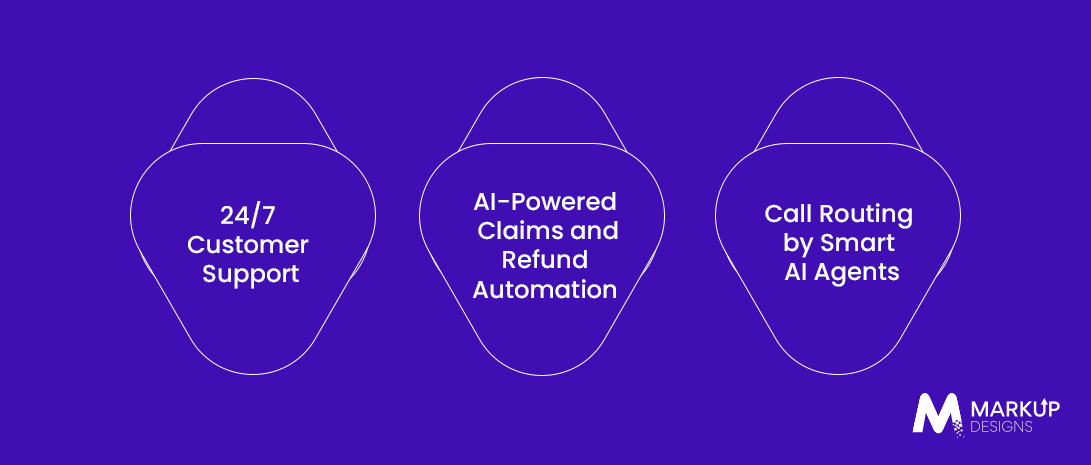
AI-powered agents can assist organizations in growing without spending too much money on providing services like chat support, background automation, and calling, without compromising customer satisfaction. This is how AI agents have been deployed by different organizations for various advantages.
1. 24/7 Customer Support
AI agents can enable organizations to offer customer support services round-the-clock without needing to ensure the availability of a customer support team at all times. These agents can instantly respond to routine inquiries from customers, help track orders, manage returns, and provide details about the organization’s products or services.
One of the best examples of the use of AI agents for customer support purposes is the use by H&M. H&M has employed an AI chatbot on its website and mobile applications. Through the AI chatbot, customers get help with various queries like order tracking, product availability, and even return policies.
2. AI-Powered Claims and Refund Automation
When AI agents work together with automation, they take care of such tedious tasks as claim verification, refund processing, and invoicing, which allows the staff to focus on the more serious cases and process refunds at a much faster pace. Customer service departments are increasingly implementing the use of AI agents not only for interaction with customers but also to automate processes that go on in the background.
As an example, consider Lufthansa, one of the leading European airlines, which recently introduced an AI agent that processed flight compensation applications. When a passenger’s flight is delayed or canceled, they can file a claim online. The system then verifies eligibility, processes the application, and issues payment automatically.
3. Call Routing by Smart AI Agents
Rather than directing customers to browse through complicated menu structures or to wait for long hours on hold, AI agents analyze what people have to say, and they take necessary actions. This helps in quick problem solving and avoids irritations on the customers’ side. Implementation of the AI agent in customer service in terms of smart routing is not only an efficient method; it maintains the customer satisfaction level.
For an instance, Vodafone integrated an AI-powered voice system in its call center that identifies customer intent and routes callers directly to the right team, whether tech support, billing, or account management
Approach to Deploy AI Agents in Customer Support

Implementation of AI systems in your customer care team increases efficiency while working to increase customer satisfaction and decrease costs in general. Nevertheless, this process is complicated by the fact that there should be some preparation and steps taken to get the desired results.
Establishing Clear Objectives
It is crucial to lay down the objectives that will be met by using this AI technology. These may include setting objectives like faster responses, higher chances of solving problems on the spot, or making the conversation more personalized. These objectives will serve as your benchmarks for measuring success.
Select the Right AI Tools
It becomes necessary to utilize AI technologies that are well-suited to your organization. This involves analyzing aspects like language skills, conversation abilities, and multichannel capabilities. It would be advantageous to use AI technologies that have proven their worth and yielded positive outcomes for other organizations.
Integration with Other Tools
Enable your AI agents to communicate with CRM systems, help desks, and other communication platforms. This will make it possible for them to gain access to real-time information about the customers. Moreover, it will enable them to assist in all their communications. This way, you will be relieved from manual repetitive work.
Train the AI Model
It is important to feed the artificial intelligence model with essential information such as frequently asked questions and previous customer experiences. The machine should continue being trained to increase its accuracy and contextual understanding abilities. Continue training is critical to ensure that the AI continues to improve the customers’ experience.
Testing and Improvement
Start out by testing your system on a small scale to determine how well it performs. Receive criticism from the customers and employees regarding any aspects that can be made better. After that, optimize the workflow processes, language skills, and response techniques.
Establish Human Escalation Procedures:
Make sure that there are defined criteria for handing off complex customer requests to human representatives. It will preserve the level of service delivery and ensure the personal approach where needed.
Monitor Performance and Make Adjustments
You must monitor various factors such as response times, customer satisfaction, and issue resolution rate. With this information, you will be able to identify the areas in which you have performed poorly. You can then make adjustments to enhance your performance.
How is Markup Designs Redefining the Future of AI-Powered Customer Service?
We have been focusing on enabling our customers to look forward to the future through the use of smart AI agents, which enable businesses to offer smart services to their customers. We aim to develop a software system that enables businesses to react promptly as well as understand the intent behind each interaction with their customers. This ensures that our agents can fit within the systems of businesses without hassle.
On the other hand, another crucial but important thing we consider is to make our AI customer support agents scalable and adaptable. Using innovation and the successful implementation, we enable our clients to become more efficient, deliver quality services, and forge stronger relationships with their clients.
Conclusion
The customer service industry has advanced due to the integration of artificial intelligence. These involve the speed, efficiency, and personalization that are involved. It involves using intelligent systems to communicate with customers, answering queries instantly, and being able to communicate without any hassle within the existing processes. There are some problems with this model, but they can be handled appropriately with effective management. Overall, artificial intelligence has completely transformed customer service.
FAQs
1. What are AI agents in customer service?
AI agents are intelligent systems that help businesses handle customer queries, provide support, and deliver personalized responses using automation and data analysis.
2. How do AI agents improve customer experience?
They provide instant replies, 24/7 support, personalized recommendations, and faster issue resolution, which improves overall customer satisfaction.
3. Can AI agents replace human customer support?
No, AI agents are designed to assist and support human teams. Complex or sensitive issues are still handled by human agents when needed.
4. What are the main benefits of using AI in customer service?
Key benefits include faster response times, reduced operational costs, improved efficiency, and better personalization.
5. What challenges come with AI in customer service?
Common challenges include data privacy concerns, integration with existing systems, and ensuring natural, human-like interactions.
Author's Perspective
In my opinion, the introduction of AI goes well beyond simply improving the technology; instead, it represents a completely new business strategy for dealing with customers. The secret to harnessing the full potential of AI in serving customers lies in balancing human interaction and machine intelligence. It is through this balanced approach that businesses will be able to get the upper hand over their competitors.
Discuss Your Project NowGaurav Goyal
Global Sales- VP
Related Posts
How AI is Revolutionising Industrial Automation in Australia
How UK Enterprises Can Build an Effective AI...

AI Voice Agent for Real Estate: Features, Benefits,...
Insights Are Valuable & Execution is Priceless
You’ve read about the digital future. Now, let’s build the infrastructure to take you there. Move your strategy from the page to the product.
Design Your Solution Now
Contact Us
Schedule The Appointment At Your Convenience Date And Time.
30 Min
Web Conference
Time Zone
Indian standard time (08:30pm)

Thanks For Getting In Touch!
You’ve Taken The First Step Toward Transforming Your Digital Presence. Our Experts Will Reach Out Shortly To Take It Forward.
Launch Your Dream Project
Provide a brief overview of your project, and our specialists will evaluate your requirements. We will connect with you to explore how the right digital solutions can help you launch faster.