
In Brief
- AI automation is the driving force behind digital transformation in the United Arab Emirates, enabling faster decisions, smarter operations, and improved customer experiences.
- Unlike traditional automation, AI systems learn from data, adapt to changes, and provide predictive insights that help businesses stay competitive.
- Strong government initiatives, including the National AI Strategy 2031, are accelerating AI adoption and positioning the UAE as a global leader in digital innovation.
- Despite benefits, challenges such as high initial costs, system integration, data privacy, and skill gaps must be addressed for successful implementation.
- Businesses that invest early in AI automation, build strong data foundations, and focus on strategic adoption will lead the future of the UAE’s digital economy.
The world is changing fast. Businesses that used to take weeks to process data can now do it in seconds. Customer service that once needed a room full of agents can now run around the clock with smart tools. And decisions that used to depend on gut feeling now rely on real-time data. This shift is what we call digital transformation, and it is happening everywhere.
But in UAE, this change is not just happening. It is happening at full speed.
UAE has always been a country that thinks ahead. From building one of the world’s most iconic skylines to launching the Arab world’s first mission to Mars, the country has never shied away from bold moves. And today, that same forward-thinking energy is driving the digital transformation of its economy.
At the heart of this transformation is something called AI automation. It is the technology that makes businesses smarter, faster, and more efficient. It is what helps a bank detect fraud in real time, helps a hospital manage patient records without errors, and helps a retailer know exactly what products will sell next month before the month even begins.
This blog takes a deep look at how AI automation is shaping digital transformation in UAE, why it matters for businesses, and what the future looks like for one of the world’s most ambitious digital economies.
Understanding AI Automation In Digital Transformation
In simple terms, digital transformation is when a business moves away from old, manual ways of working and starts using technology to do things better and faster. It is not just about buying new software or building a website. It is about completely changing how a business operates, how it serves customers, and how it makes decisions.
In UAE, businesses across every major industry are going through this kind of transformation. The industries leading this shift include:
- Finance and banking, which were among the first to adopt digital tools.
- Retail and ecommerce, which grew rapidly as consumers moved online.
- Healthcare, which is going through one of the most significant digital overhauls in its history.
- Logistics, which uses technology to move goods faster and smarter than ever before.
AI Automation
AI automation means using AI Innovation to carry out tasks that would otherwise need a human. But it goes well beyond basic automation.
The key difference between the two is simple:
- Traditional automation follows fixed rules. It does the same thing every time. If something unexpected happens, it does not know how to respond.
- AI automation learns. It adapts. It finds patterns in data, makes predictions, and improves itself over time.
In businesses across UAE, AI automation shows up in many forms:
- Customer support chatbots that answer questions in multiple languages at any hour of the day.
- Data systems that process thousands of transactions in seconds and flag anything suspicious.
- Demand forecasting tools that predict what products will sell weeks in advance.
- Smart email systems that send the right message to the right person at the right time, automatically
The difference between automation and AI automation is the ability to think. Basic automation does what it is told. AI automation figures out what needs to be done. And for UAE businesses competing on a global scale, that difference is enormous.
Why AI Automation is Essential for Digital Transformation
As businesses accelerate their digital transformation initiatives, the volume of data generated across operations, customer interactions, and digital platforms continues to grow rapidly. However, collecting data alone is not enough. Without AI automation, organizations often struggle to process information efficiently, resulting in slower decision-making, operational bottlenecks, and missed opportunities.
Here is why AI automation is so important for UAE businesses going through digital transformation:
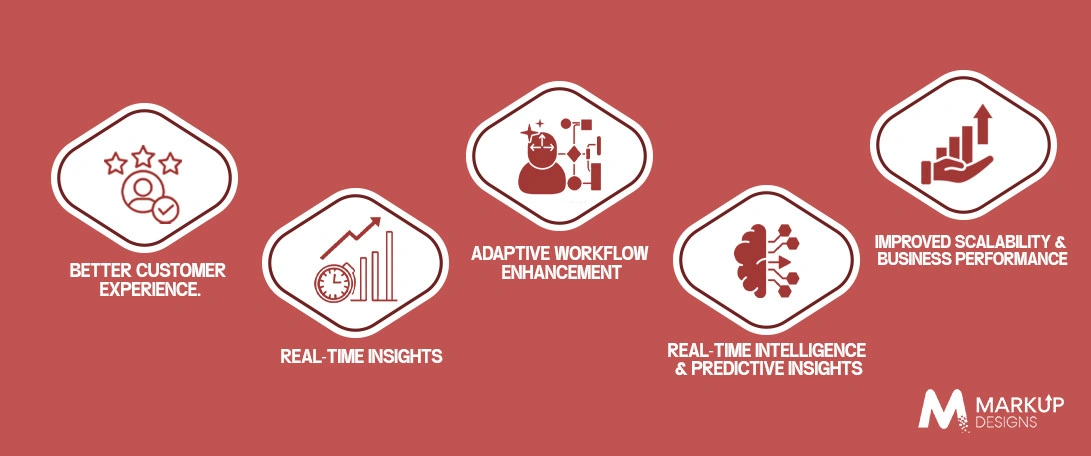
- Better customer experience. A customer asking a question at midnight gets an instant answer. A shopper sees recommendations based on what they actually like. A patient gets a smooth, hassle-free booking experience.
- Real-time insights. Business leaders get a live view of performance so they can make decisions today based on what is happening today, not what happened last month.
- Adaptive Workflow Enhancement: Modern AI-driven automation goes beyond rule-based processes by identifying patterns, managing complex scenarios, and continuously refining operations for improved performance over time.
- Real-Time Intelligence & Predictive Insights: AI technologies process large volumes of business data instantly, enabling organizations to uncover trends, anticipate risks, strengthen fraud prevention, and make faster, more informed strategic decisions.
- Improved Scalability & Business Performance: With AI-powered systems, businesses can efficiently manage growing workloads and peak operational demands without significantly increasing costs, while also minimizing human errors and boosting overall productivity.
These benefits explain why so many UAE businesses are actively investing in AI automation as the engine behind their digital transformation.
Read: Also: How AI Is Transforming UAE Businesses in 2026
Challenges in Implementing AI Automation
AI automation brings enormous benefits, but it comes with real challenges that UAE businesses need to plan for:
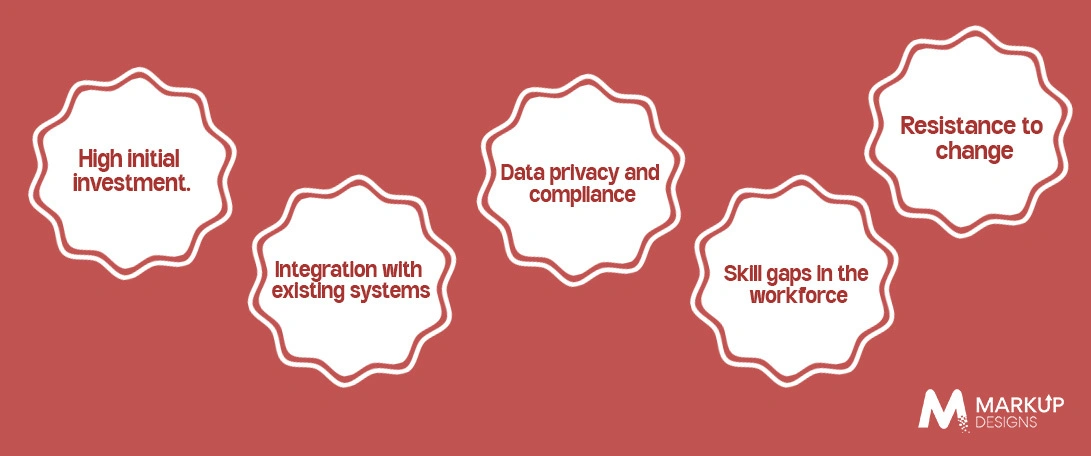
- High initial investment. Setting up AI systems, integrating them with existing technology, and training staff costs money. For smaller businesses, this can feel like a significant hurdle.
- Integration with existing systems. Many established businesses still rely on older software and processes. Getting AI tools to work smoothly with legacy systems often requires expert support.
- Data privacy and compliance. AI depends on data, and that data often includes sensitive customer and business information. Storing, processing, and using it in compliance with UAE regulations and international standards is a responsibility businesses cannot ignore.
- Skill gaps in the workforce. AI automation requires people who understand technology, data, and digital processes. Finding and developing that talent takes time and investment.
- Resistance to change. When employees hear that AI tools are coming, some worry about their jobs. Managing that change thoughtfully, being clear about how AI will support rather than replace people, and investing in reskilling are all critical parts of a successful adoption journey.
Key Applications of AI Automation in UAE Businesses
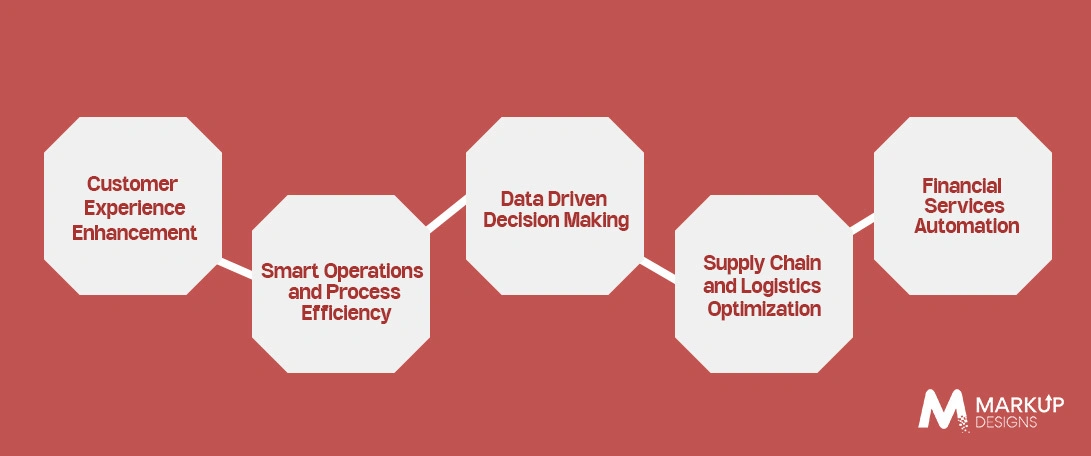
Customer Experience Enhancement
Customer expectations have changed. People want instant support, personalized experiences, and interactions that feel natural. Here is how AI automation is delivering that:
- AI-powered chatbots provide 24/7 support in multiple languages, handling thousands of queries at the same time
- Virtual assistants escalate complex issues to human agents when personal attention is needed
- Personalized recommendation engines study browsing history, past purchases, and shopping behavior to show each customer exactly what they are most likely to want
- For UAE businesses serving a diverse, multilingual customer base, this always-on, personalized service is a competitive necessity
Smart Operations and Process Efficiency
Inside every business, there are dozens of tasks that are repetitive and time-consuming. AI automation handles these, so human teams can focus on work that actually needs thinking. Examples include:
- Filling in and processing forms and invoices automatically
- Sorting and updating records without manual input
- Monitoring workflow across departments and identifying where delays are happening
- Suggesting process improvements based on real operational data
Data Driven Decision Making
Data is only valuable if you can understand it. AI automation turns raw data into clear, actionable insights. Here is what that looks like in practice:
- A retail chain sees in real time which products are selling and which are not, across all stores
- A logistics company spots a delivery delay before it becomes a crisis
- A bank detects unusual transaction patterns the moment they happen
- Predictive analytics tools tell business leaders not just what is happening now, but what is likely to happen next
Supply Chain and Logistics Optimization
The UAE is a global trade and logistics hub. Managing the movement of goods efficiently is both critical and complex. AI automation helps in the following ways:
- Demand forecasting tools help companies plan supply months.
- Smart inventory systems track stock levels in real time and trigger reorders automatically.
- Route optimization tools calculate the fastest and most cost-effective delivery paths.
- Real-time tracking reduces delays and improves visibility across the entire supply chain.
Financial Services Automation
The UAE’s financial sector has been one of the fastest adopters of AI automation. Key applications include:
- Fraud detection systems that analyze millions of transactions in real time and flag suspicious activity instantly
- Risk assessment tools that process far more data points than any human analyst could handle
- Automated customer onboarding that reduces the process from days of paperwork to minutes
- Automated reporting that gives institutions instant visibility into performance without requiring manual compilation
Cost of Implementing AI Automation in UAE
| AI Automation Type | Estimated Cost (AED) | Key Inclusions |
| Basic Automation (Chatbots, Email Automation) | AED 30,000 – AED 75,000 | Rule-based chatbot, basic integrations, simple workflows |
| AI-Enabled Customer Support | AED 75,000 – AED 220,000 | NLP chatbot, CRM integration, multilingual support |
| Predictive Analytics Systems | AED 150,000 – AED 440,000 | Data modeling, forecasting tools, dashboards |
| AI-Powered Operations Automation | AED 300,000 – AED 735,000+ | Process automation, workflow intelligence, ERP integration |
| Enterprise AI Transformation | AED 735,000 – AED 1,850,000+ | End-to-end AI ecosystem, custom models, enterprise-grade security |
Industry Specific Use Cases in UAE
Banking and Financial Services
- Smart chatbots handle routine queries about account balances, transfers, and loans around the clock.
- AI systems monitor transactions for suspicious activity in the background and generate compliance reports automatically.
- Major banks like Emirates NBD have deployed AI tools that handle a significant portion of customer interactions without human involvement.
Retail and Ecommerce
- Personalized recommendation engines keep customers engaged and increase purchase likelihood.
- Dynamic pricing tools adjust prices in real time based on demand, competition, and inventory levels.
- Smart inventory systems ensure popular products stay in stock while slow-moving items do not pile up in warehouses.
Healthcare
- Emirates Health Services uses AI for early cancer detection, heart rate monitoring, and diabetes management.
- Digital systems give authorized doctors instant access to patient records that used to be scattered across physical files.
- Appointment booking, billing, and administrative tasks that consumed hours of staff time are now handled automatically.
- The result is better patient care, fewer errors, and a system that can serve more people with the same resources.
Real Estate and Construction
- AI tools analyze property trends and predict which areas are likely to see price increases.
- Investment opportunity identification happens faster and more accurately than traditional research methods.
- Smart building management systems use sensors and automation to control energy usage, security, and maintenance.
- Buildings become more efficient and more sustainable as a result.
Read: Also: Why Dubai is Becoming the AI Capital of the Middle East in 2026
Best Practices for AI Automation Adoption
The businesses that get the most out of AI automation are not always the ones with the biggest budgets. They are the ones with the clearest strategy. Here is what the most successful adopters do:
- Clear business goals. Identify the specific challenges you want to solve before choosing any tools. A clear goal makes it easier to pick the right solution and measure success.
- Focus on high-impact areas. Start with processes where improvements will be most visible and most valuable. You do not need to automate everything at once.
- Choose the right technology partner. Work with partners who have experience in your industry and a proven track record. Not all providers understand the specific needs of UAE businesses.
- Invest in workforce development. Make sure your teams understand how to use AI tools effectively and how their roles will evolve as automation takes on more routine tasks.
- Ensure data quality and governance. AI is only as good as the data it works with. Get your data clean, organized, and properly managed before building AI systems on top of it.
Read: Also: Why Dubai is Becoming the AI Capital of the Middle East in 2026
Role of UAE Government in Promoting AI Adoption
The UAE government has not just supported AI adoption. It has actively led it. Here is a timeline of key moves:
- In 2017, the UAE became the first country in the world to appoint a Minister of State for Artificial Intelligence
- In 2019, the UAE Cabinet adopted the National Artificial Intelligence Strategy 2031, targeting global AI leadership across healthcare, education, transport, energy, and space.
- In 2023, the strategy was updated to sharpen the UAE’s ambitions further
- In April 2025, the UAE Cabinet set a target of delivering 50% of federal government services through autonomous AI by 2028
- Abu Dhabi committed AED 13 billion through the Digital Strategy 2025 to 2027 to become the world’s first fully AI-native government by 2027
- Dubai launched the AI Infrastructure Empowerment Platform, the Dubai AI Acceleration Taskforce, and the Unicorn 30 Programme to accelerate private and public sector adoption
- The Mohamed Bin Zayed University of Artificial Intelligence in Abu Dhabi became the world’s first graduate-level AI research institution
- The UAE reported a world-leading 97% usage of AI tools among government organizations in 2025
Future of AI Automation
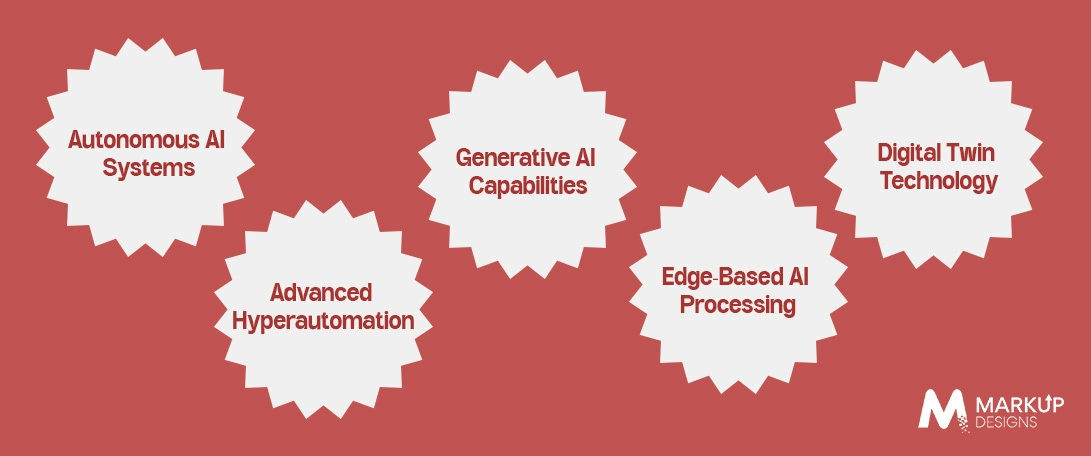
- Autonomous AI Systems: AI is evolving beyond traditional conversational tools into intelligent systems capable of independently managing workflows, making operational decisions, and completing complex business tasks with minimal human intervention.
- Advanced Hyperautomation: The integration of AI, Robotic Process Automation (RPA), and IoT technologies is driving the rise of highly connected and self-improving operational environments, enabling smarter manufacturing, logistics, and enterprise processes.
- Generative AI Capabilities: Modern AI solutions are no longer limited to data analysis. They can now create content, develop code, assist with product design, and support strategic planning through advanced forecasting and predictive intelligence.
- Edge-Based AI Processing: Businesses are increasingly adopting Edge AI, where data processing happens directly on local devices instead of centralized cloud infrastructure. This improves response times, strengthens data security, and enhances efficiency in industrial operations.
- Digital Twin Technology: Organizations are leveraging digital replicas of physical assets and systems to monitor performance, simulate operations, and optimize processes in real time, helping reduce downtime, improve productivity, and support predictive maintenance strategies.
Read: Also: Future of Artificial Intelligence in UAE Economy in 2026
FAQ
1. What is AI automation in simple terms?
AI automation means using smart technology to carry out tasks that would normally require a human. Unlike basic automation that follows fixed rules, AI automation can:
- Learn from data and improve over time
- Adapt to new and unexpected situations
- Power everything from customer service chatbots to real-time fraud detection in banks
2. How does AI help in digital transformation?
AI turns the data generated by digital systems into useful insights and actions. It helps businesses by:
- Processing information faster than any human team could
- Making better, data-backed decisions
- Serving customers more effectively through personalization and automation
- Handling repetitive work so people can focus on higher-value tasks
3. Is AI automation expensive for businesses in UAE?
The initial investment can be significant, but there are a few things worth knowing:
- Costs have been coming down steadily as the technology matures
- The UAE government offers programs to support smaller businesses in adopting digital and AI tools
- When evaluated against the efficiency gains and cost savings AI delivers, the return on investment is usually clear and often faster than expected.
4. Which industries benefit the most from AI automation in UAE?
The sectors seeing the biggest impact right now include:
- Banking and financial services
- Retail and ecommerce
- Healthcare
- Logistics and supply chain
- Real estate and construction
However, no industry is untouched. From education to energy to manufacturing, smart automation tools are changing how businesses in every sector operate across the UAE.
Conclusion
Digital transformation is no longer optional for businesses that want to stay competitive. And in UAE, where the pace of change is faster than almost anywhere else in the world, the pressure to transform is real and urgent.
AI automation is the engine behind the most successful digital transformations happening in the UAE today. It is what helps businesses:
- Serve more customers without proportionally growing their costs
- Turn raw data into decisions that drive real growth
- Make operations smoother, faster, and more reliable
- Build a competitive edge that is hard for others to close
The businesses that act now, that invest thoughtfully in AI automation, build the right skills, choose the right partners, and commit to continuous improvement, will be the ones that define what success looks like in the UAE’s digital economy over the next decade.
Author's Perspective
AI automation in the UAE is no longer a futuristic concept. It is already shaping how businesses operate daily. What stands out is not just the speed of adoption, but the intent behind it. The UAE is not experimenting with AI at the edges. It is embedding it deeply into its economic and operational fabric.
From a business perspective, the opportunity is significant, but so is the responsibility. Companies need to move beyond surface-level adoption and focus on meaningful integration. This means investing in the right talent, building strong data foundations, and choosing partners who understand both technology and business context.
Discuss Your Project NowGaurav Goyal
Global Sales- VP
Related Posts

Why Businesses in Oman Need Digital Transformation Services

Digital Transformation in Financial Services: Trends, Benefits &...
How to Build Production-Ready Applications with AI Coding...
Insights Are Valuable & Execution is Priceless
You’ve read about the digital future. Now, let’s build the infrastructure to take you there. Move your strategy from the page to the product.
Design Your Solution Now
Contact Us
Schedule The Appointment At Your Convenience Date And Time.
30 Min
Web Conference
Time Zone
Indian standard time (08:30pm)

Thanks For Getting In Touch!
You’ve Taken The First Step Toward Transforming Your Digital Presence. Our Experts Will Reach Out Shortly To Take It Forward.
Launch Your Dream Project
Provide a brief overview of your project, and our specialists will evaluate your requirements. We will connect with you to explore how the right digital solutions can help you launch faster.