
How AI Is Transforming UAE Businesses in 2026
In Brief
- Artificial intelligence in UAE is rapidly transforming industries and becoming a core part of business operations.
- Businesses are investing in enterprise AI solutions in Dubai to improve efficiency and scalability.
- AI adoption is driven by government initiatives, smart city programs, and economic diversification goals.
- Key challenges include legacy system integration, poor data readiness, and rising AI implementation costs.
- Industries like retail, fintech, real estate, and logistics are seeing major AI-driven improvements.
- AI is enhancing customer experience through personalization, automation, and predictive insights.
According to a recent market study, artificial intelligence market size in UAE was valued at USD 3.47 billion in 2023 and is projected to grow at a CAGR of 43.9% between 2024 and 2030. The major driving factors for this change are deep learning, rising penetration of NLP, and machine learning.
The Middle East’s digital ecosystem is undergoing a powerful transformation. While UAE has long been recognized for its iconic skylines and world-class infrastructure, it is now building a different kind of architecture, one that exists beyond the visible: Artificial Intelligence.
Rather than simply adopting new technologies, UAE is actively advancing enterprise AI development as a core pillar of its future. This shift is becoming a key driver of economic diversification and operational efficiency for businesses across the region.
The region’s move toward artificial intelligence is not accidental. It reflects a deliberate and well-structured national vision. The appointment of the world’s first Minister of State for Artificial Intelligence, along with the launch of UAE Artificial Intelligence Strategy 2031, underscores how central AI is to the country’s long-term ambitions, much like oil once was.
For businesses operating in this environment, AI adoption goes far beyond basic automation or chatbots. It involves building intelligent, enterprise-grade solutions designed to address complex challenges.
The Rise of AI-Driven Digital Transformation in UAE
UAE government is playing a major role in accelerating the adoption of artificial intelligence through well-defined national policies and smart city programs. As a result, businesses are embracing AI to upgrade their operations, streamline workflows, and create more meaningful customer interactions. This growing reliance on intelligent technologies is enabling organizations to stay relevant and competitive in an ever-changing digital environment.
Across UAE, companies are turning to AI to process vast amounts of data, uncover valuable insights, and anticipate future trends. By partnering with experienced providers, businesses can develop tailored AI solutions that fit their specific objectives and operational needs.
Reasons UAE Is Investing in AI
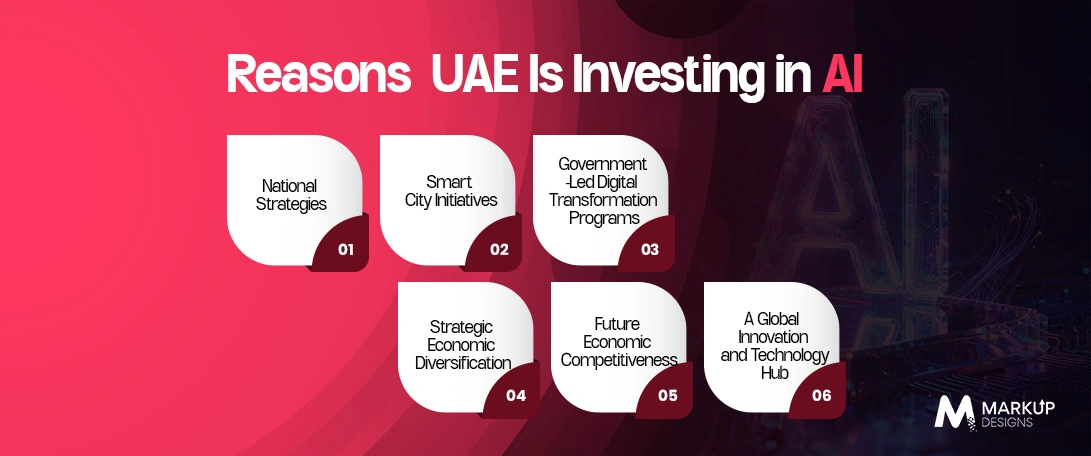
UAE’s aggressive investment in artificial intelligence is not a short-term technology trend, it is a carefully planned national transformation strategy aimed at reshaping the country’s economic future. With a strong vision to move beyond oil dependency, UAE is positioning AI as a foundational pillar of its next growth phase.
National Strategies like UAE AI Strategy 2031
UAE AI Strategy 2031 is one of the world’s first comprehensive national AI frameworks. It focuses on integrating AI across all major sectors, including education, transport, healthcare, and government services. The strategy aims to enhance productivity, reduce operational costs, and improve the quality of life through intelligent systems.
Smart City Initiatives in Dubai and Abu Dhabi
Cities like Dubai and Abu Dhabi are at the forefront of AI-driven urban transformation. Through smart city initiatives, AI is being used to optimize traffic management, improve energy efficiency, enhance public safety, and automate municipal services. These cities are integrating IoT, predictive analytics, and AI-powered platforms to create seamless, connected urban environments.
Government-Led Digital Transformation Programs
UAE government has launched multiple digital transformation initiatives aimed at making public services more accessible. AI plays a central role in automating administrative processes, enabling real-time decision-making, and reducing dependency on manual workflows.
A Global Innovation and Technology Hub
Beyond infrastructure and governance, UAE is actively building itself as a global hub for innovation, research, and emerging technologies. It is attracting multinational tech companies, startups, and AI researchers by offering a business-friendly ecosystem, world-class infrastructure, and strategic funding initiatives.
Strategic Economic Diversification
At a broader level, AI is a critical tool for UAE’s economic diversification strategy. By embedding AI across industries such as healthcare, finance, logistics, and energy, the country is reducing its reliance on traditional oil revenues. This shift is enabling the creation of new knowledge-based industries and sustainable economic growth.
Building Future Economic Competitiveness
Ultimately, UAE’s investment in AI is about securing long-term global competitiveness. By adopting advanced technologies early and at scale, the country is positioning itself as a leader in the fourth industrial revolution. This proactive approach ensures that businesses operating in UAE benefit from a highly advanced, innovation-driven ecosystem.
Core Challenges in Adopting AI
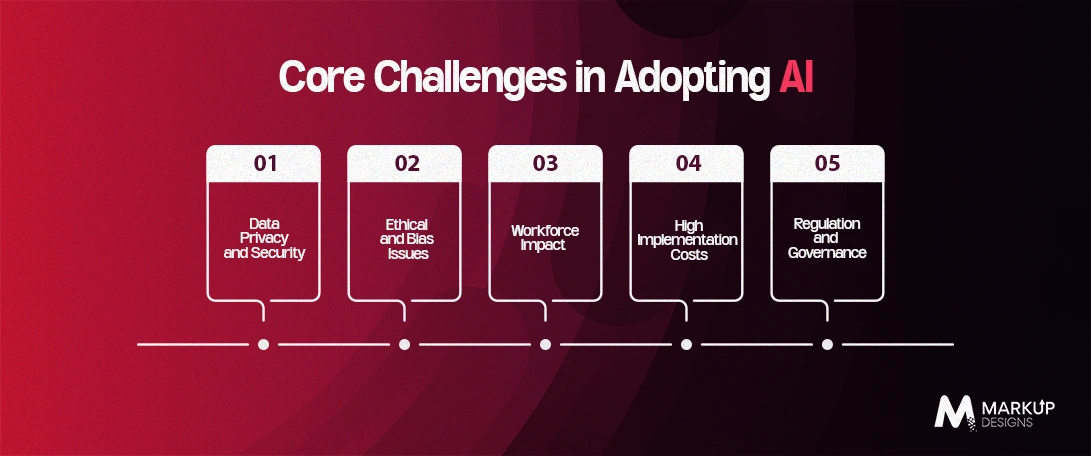
As AI adoption grows across UAE, businesses are increasingly integrating AI into their daily operations. However, scaling AI solutions comes with several technical and operational challenges that organizations must address for long-term success.
1. Data Privacy and Security
AI systems depend on large volumes of data, making data protection critical. Businesses must use strong security measures like encryption and real-time monitoring to prevent breaches. This is especially important in sectors handling sensitive customer and financial data.
2. Ethical and Bias Issues
AI can reflect biases present in its training data. In a diverse market like UAE, ensuring fair and inclusive decision-making is essential. Organizations need to regularly review and improve data quality to reduce bias.
3. Workforce Impact
Automation is changing job roles. While new opportunities are created, some traditional roles may decline, making upskilling important. Companies must invest in training programs to prepare employees for future roles.
4. High Implementation Costs
AI adoption requires investment in technology, talent, and maintenance, which can be challenging for small and medium businesses. Proper planning and phased implementation can help manage these costs effectively.
5. Regulation and Governance
As AI evolves quickly, clear policies are needed to ensure responsible use, data transparency, and accountability. A balanced approach is required to support innovation while maintaining compliance.
Benefits of AI for Businesses
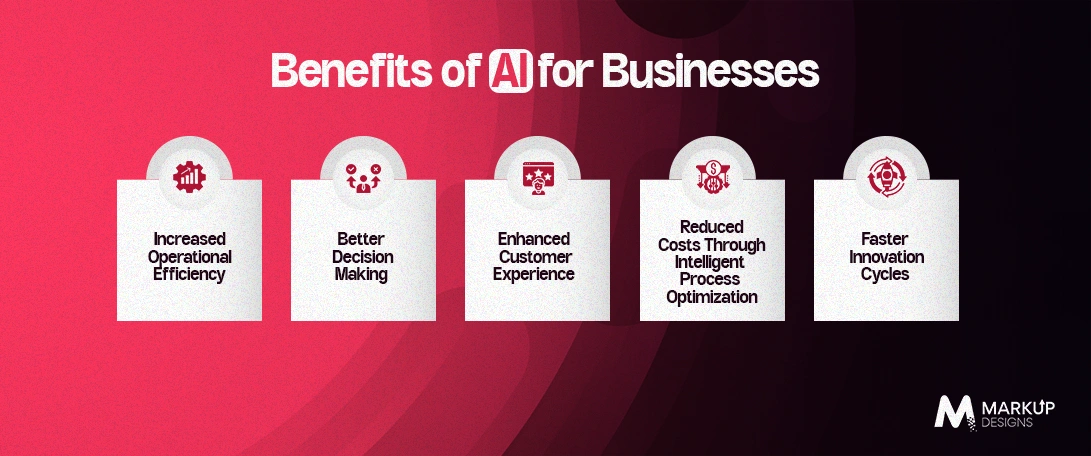
Artificial intelligence is no longer just a supporting technology; it has become a core business enabler across UAE. Organizations are using AI to streamline operations, improve decision-making, and create more personalized customer experiences. Below is a deeper look at how AI is delivering measurable value across different business functions.
Increased Operational Efficiency
AI helps businesses automate repetitive and time-consuming tasks such as data entry, invoice processing, customer queries, and workflow approvals. This reduces manual workload, minimizes human errors, and allows employees to focus on higher-value strategic activities.
Better Decision-Making
With AI-powered predictive analytics, businesses can analyze large volumes of historical and real-time data to forecast trends, customer behavior, and market demand. This enables leaders to make faster, data-driven decisions instead of relying on guesswork.
Enhanced Customer Experience
AI enables businesses to deliver highly personalized customer experiences by analyzing user behavior, preferences, and interaction history. From personalized product recommendations in e-commerce to intelligent chatbots in customer support, AI ensures that customers receive relevant and timely engagement.
Reduced Costs Through Intelligent Process Optimization
AI-driven systems help organizations identify inefficiencies in workflows and optimize resource usage. By automating manual tasks, reducing operational errors, and improving supply chain efficiency, businesses can significantly cut costs.
Faster Innovation Cycles
AI accelerates innovation by enabling faster development, testing, and deployment of digital solutions. Businesses can use AI to analyze market gaps, prototype new features, and optimize product performance in real time. This leads to shorter product development cycles and allows companies to bring new services to market.
How is AI Shaping Industries in UAE?
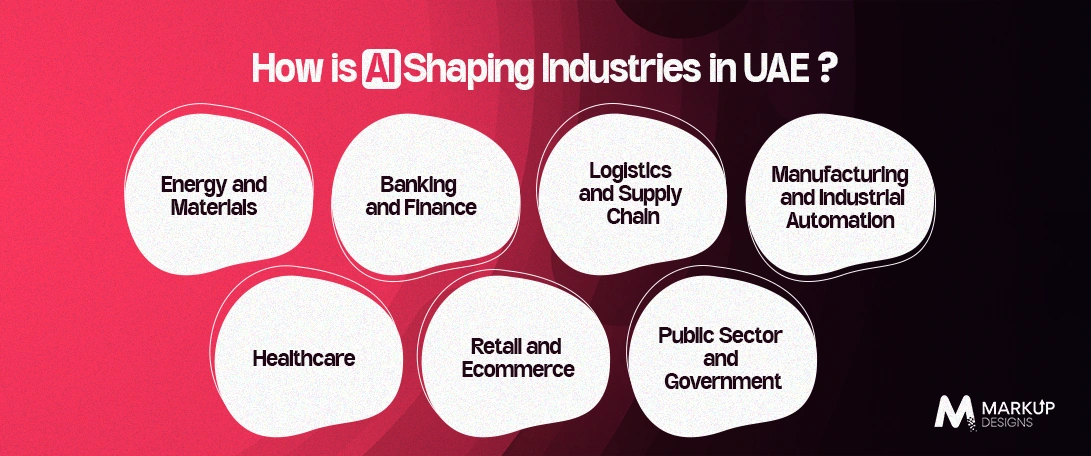
Artificial Intelligence is transforming industries across UAE by improving efficiency, automating tasks, and enabling faster decision-making. From retail to logistics, it has become a key part of digital transformation strategies. This shift is helping businesses operate smarter and respond quickly to market demands.
Energy and Materials
Organizations across UAE are using artificial intelligence to improve equipment reliability, forecast energy consumption, monitor emissions, and streamline material supply chains. From ADNOC’s use of intelligent systems for operational insights to advanced asset management in utility services, enterprises are focusing on AI.
Banking and Finance
Artificial intelligence is reshaping how financial institutions manage compliance, detect fraudulent activities, and serve customers. Common applications include credit risk assessment, document processing, and virtual banking assistants. Banks in UAE are also adopting AI for continuous transaction monitoring.
Logistics and Supply Chain
In the logistics sector, AI is being used to optimize route planning, maintain vehicles proactively, and manage inventory more effectively. Leading logistics companies in UAE are combining AI with connected device data to lower fuel consumption.
Manufacturing and Industrial Automation
Artificial intelligence is becoming essential in areas such as equipment maintenance, quality inspection, energy management, and automated processes. Manufacturers in UAE are leveraging these capabilities to minimize downtime, improve product quality, and enable real-time monitoring.
Healthcare
AI is widely used in healthcare for analyzing medical images, improving patient triage, and optimizing hospital workflows. Healthcare providers are also applying AI to evaluate electronic health records, anticipate disease progression, and tailor treatment plans, supporting the region’s vision of technology-driven care delivery.
Retail and Ecommerce
Retail businesses are using artificial intelligence to adjust pricing strategies, deliver personalized recommendations, and better understand customer segments. In UAE, retailers are also adopting AI for visual search, demand prediction, and more efficient supply planning, leading to stronger customer engagement and higher conversion rates.
Public Sector and Government
Government initiatives such as UAE Strategy for AI 2031, along with investments in talent development and smart city projects, are driving widespread AI adoption in the public sector. Authorities are implementing AI in digital identity systems, traffic control, and citizen service platforms, setting strong examples.
AI Technologies Driving Digital Transformation in 2026
Artificial Intelligence is changing how businesses operate across UAE and GCC region. From automating tasks to improving customer experiences, it helps organizations become more efficient. In 2026, many businesses are investing in enterprise solutions in Dubai to speed up digital transformation and stay competitive.
Predictive Analytics and Data Intelligence
Businesses use advanced data analysis to understand trends and predict customer behavior. This helps improve decision-making, optimize operations, and reduce risks.
Marketing Automation
Companies are automating marketing efforts by targeting the right audience and personalizing communication. This improves lead generation, customer engagement, and overall campaign performance.
Hyperautomation and Intelligent Workflows
Businesses are combining automation tools with workflow systems to streamline operations. This helps improve efficiency across finance, compliance, customer service, and daily business processes.
Role of AI in Smart Cities and Government Initiatives
Artificial Intelligence is helping UAE build smarter cities, improve public services, and strengthen digital infrastructure. Through government-led innovation programs and smart city initiatives, AI is becoming a major part of the country’s long-term growth strategy.
Dubai’s Smart City Transformation
Dubai is using AI technologies to create a smarter and more connected urban environment. Smart systems are improving transportation, public services, and city management while supporting sustainability and economic growth.
AI-Powered Public Services
Government organizations in UAE are using AI chatbots and automated systems to deliver faster and more efficient public services. These technologies improve user experiences and reduce service delays.
AI in Traffic Management and Urban Planning
AI-powered traffic systems help reduce congestion, improve road safety, and optimize transportation networks. Urban planning authorities also use AI to support smarter infrastructure and city development decisions.
Government-Backed AI Innovation Programs
UAE government is actively investing in AI innovation through national AI strategies, research initiatives, and digital transformation programs. These efforts encourage AI adoption across industries and businesses.
UAE’s Vision to Become a Global AI Leader
UAE aims to become a global hub for Artificial Intelligence by integrating AI into business operations, government services, and smart city development. Continuous investments in AI are helping the country build a future-ready digital economy.
Step-by-Step Approach to Implement AI
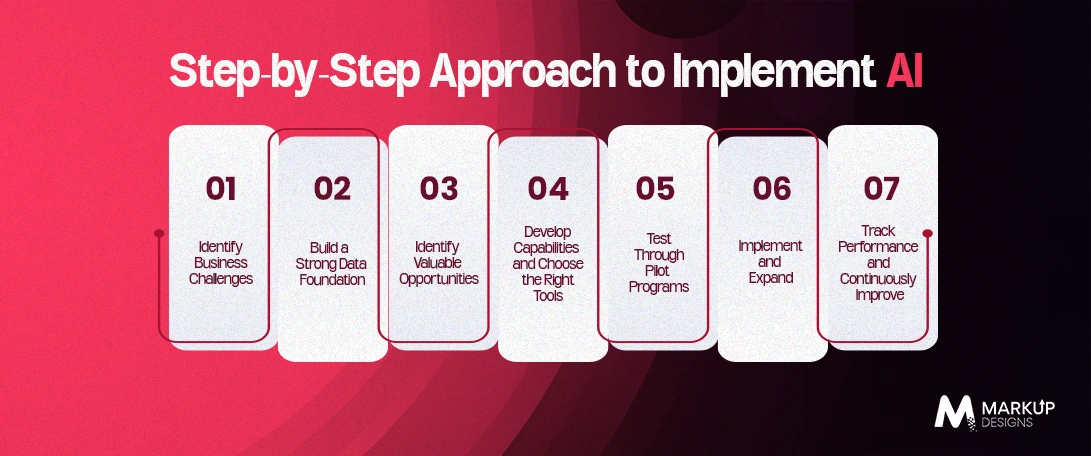
Implementing AI successfully requires a clear plan, the right data, and continuous improvement. Businesses in UAE are adopting AI to improve efficiency, automate tasks, and support better decision-making. A structured approach helps avoid common challenges and ensures better results.
Step 1: Identify Business Challenges
Start by defining the problem you want to solve, such as improving customer service or operations. Clear goals help measure the success of AI implementation.
Step 2: Build a Strong Data Foundation
Ensure your data is accurate, secure, and machine-readable before using AI. Good data quality leads to better performance and insights.
Step 3: Identify Valuable Opportunities
Begin by selecting initiatives that can deliver strong results in a short time. Focus on areas where implementation is simple, but impact is high, such as automated customer support or document processing. Give priority to tasks that are repetitive, time-consuming, and heavily dependent on manual effort.
Step 4: Develop Capabilities and Choose the Right Tools
Assess whether it is more effective to build custom AI solutions or adopt existing platforms offered by technology providers. Establish clear ownership by forming a dedicated team or collaborating with experienced external partners to lead data science and AI initiatives.
Step 5: Test Through Pilot Programs
Start with a proof of concept in a controlled environment to evaluate feasibility and performance before wider adoption. At the same time, train your workforce so they can effectively use the new systems and ensure smoother implementation.
Step 6: Implement and Expand
Introduce AI into core business processes in a phased and secure manner. Once the initial deployment proves successful, extend the solution to additional teams and functions across the organization.
Step 7: Track Performance and Continuously Improve
Measure outcomes consistently using defined performance indicators to understand the value being generated. Keep improving the system by updating models with fresh data, ensuring accuracy, reliability, and fairness over time.
Future of AI in UAE
UAE is moving toward a future powered by autonomous systems, AI-driven governance, and highly personalized digital ecosystems. Continuous government investment and enterprise adoption are making AI central to industries like healthcare, finance, and smart cities in Dubai and Abu Dhabi. This is positioning UAE as a global leader in AI-led innovation and digital transformation.
UAE is also expected to see rapid growth in AI-powered startups and research ecosystems, supported by strong funding and innovation-friendly policies. As global companies expand their presence in the region, collaboration between government, enterprises, and tech innovators will further accelerate AI adoption. This will strengthen UAE’s position as a global AI innovation hub.
Read Also: Future of AI in Digital Transformation Trends in the Next Decade
Collaborate With Us to Enhance Your AI Transformation
At Markup Designs, we help organizations unlock the real value of artificial intelligence by combining intelligent automation, data-led insights, and scalable solutions. Our approach is focused on simplifying operations, enhancing customer experiences, and supporting sustainable business growth.
We collaborate closely with your team to understand operational challenges, identify areas where automation can create meaningful impact, and implement AI solutions aligned with your business objectives. From improving workflows and leveraging predictive insights to strengthening customer engagement, we build systems that drive efficiency and enable faster, more informed decision-making.
FAQs
1. What is the role of artificial intelligence in UAE businesses?
Artificial Intelligence helps businesses automate processes, improve decision-making, enhance customer experience, and drive digital transformation across industries.
2.Why are companies investing in enterprise AI solutions in Dubai?
Companies invest in enterprise AI solutions in Dubai to improve efficiency, reduce operational costs, and gain a competitive advantage in the digital economy.
3. Which industries benefit the most from AI in UAE?
Industries such as retail, banking, real estate, healthcare, and logistics benefit significantly from AI through automation, analytics, and improved customer engagement.
4. What are the main challenges in AI adoption?
Common challenges include data quality issues, integration with legacy systems, a lack of skilled professionals, and managing AI costs.
5. How can businesses successfully implement AI?
Businesses can follow a structured approach that includes identifying problems, preparing data, starting with pilot projects, and continuously optimizing AI systems.
6. What are machine learning solutions in UAE used for?
Machine learning solutions in UAE are used for predictive analytics, fraud detection, customer behavior analysis, and business forecasting.
7. How does AI improve customer experience?
AI improves customer experience by providing faster responses, personalized interactions, predictive recommendations, and automated support systems.
Conclusion
Artificial Intelligence is no longer an emerging trend but a business necessity in UAE. From improving operational efficiency to transforming customer experiences, AI is reshaping how organizations operate and compete. With increasing investments in AI technologies, government support, and industry adoption, UAE is positioning itself as a global leader in digital innovation. Businesses that embrace AI today will be better equipped to scale, innovate, and succeed in the future.

Author's Perspective
AI adoption in UAE is moving beyond experimentation and becoming a strategic priority for businesses. What stands out is the strong alignment between government initiatives and private sector innovation, which is accelerating AI growth across industries. However, success with AI depends not just on technology but on proper implementation, data readiness, and long-term vision. Businesses that focus on practical use cases and partner with the right AI app development experts in Dubai will unlock real value.
Discuss Your Project NowAjit Kumar Jha
VP - Business Operations
Related Posts

Digital Transformation in Financial Services: Trends, Benefits &...

IoT in Banking: Transforming Financial Services Through Connected...

Digital Transformation for Australian Enterprises: Strategy, Technology &...
Insights Are Valuable & Execution is Priceless
You’ve read about the digital future. Now, let’s build the infrastructure to take you there. Move your strategy from the page to the product.
Design Your Solution Now
Contact Us
Schedule The Appointment At Your Convenience Date And Time.
30 Min
Web Conference
Time Zone
Indian standard time (08:30pm)

Thanks For Getting In Touch!
You’ve Taken The First Step Toward Transforming Your Digital Presence. Our Experts Will Reach Out Shortly To Take It Forward.
Launch Your Dream Project
Provide a brief overview of your project, and our specialists will evaluate your requirements. We will connect with you to explore how the right digital solutions can help you launch faster.