
In Brief
- AI integration for an enterprise involves aligning the capabilities of AI technology with existing software systems, data, processes, and IT infrastructure to enhance automation, make decisions, improve the experience of customers, and boost efficiency.
- A good AI integration roadmap should involve business objectives and valuable use cases, assessing data readiness, technology selection, scalable architecture design, development, integration, and deployment.
- Having a strong foundation of data, secure architecture, APIs, governance, and MLOps/LLMOps is important in designing and developing AI solutions that are robust, scalable, secure, and manageable.
- An enterprise must start with pilot programs, validate AI performance and security, and scale up successful implementations gradually with human oversight in case of critical decisions.
- Monitoring and optimizing continuously are very important since there are always changes in data, users, and business conditions. Such an approach can help an enterprise gain measurable ROI.
AI is no longer just being tested; it has entered mainstream business operations. Companies are applying AI solutions to help them perform repetitive tasks, enhance customer experience, process large amounts of data, make decisions, and develop digital products. But to reap benefits from the implementation of AI in their operations, organizations cannot just add AI to a product they already have.
Integration of AI into enterprise processes means aligning AI capabilities with data, applications, workflows, and technology of a company. An integration strategy, good data, the correct technology stack, architecture, governance, and monitoring are all crucial to this process.
But the problem with the integration of AI is that no two enterprises are alike: they use different technologies, systems, processes, data environments, and have unique objectives. What might work in retail will not necessarily work in banking or manufacturing. Therefore, having an AI integration strategy is critical.
In this blog, we will discuss the important steps of enterprise AI implementation, starting from setting business goals and data preparation through to AI design and deployment.
What is Enterprise AI Integration?
AI integration services for enterprises are the practice of incorporating the capabilities of AI within the existing applications and systems of the enterprise.
AI is not used as an isolated technology but is integrated within other technologies, including CRM systems, ERP systems, customer service software, data warehouses, supply chain platforms, and internal business applications.
For instance, in a retail firm, the predictive AI capabilities can be incorporated into the inventory management system to forecast the demand for the goods. In banks, AI can be used to predict potential fraud from transactional systems.
Why Enterprises Need an AI Integration Roadmap
Without a roadmap, companies could end up in disconnected AI experiments. Various units would use different tools, duplicate efforts, create data silos, or develop solutions that wouldn’t scale past the proof-of-concept stage. A roadmap would provide a structured way to take an AI idea from conception to implementation.
It helps businesses:
- Connect AI initiatives with clear business objectives
- Find and focus on use cases with maximum value
- Assess the readiness of their current data for AI usage
- Select appropriate technologies and architecture
- Combine AI with their existing enterprise infrastructure
- Manage security, governance, deployment, and optimization
An AI roadmap allows enterprise leaders to be aware of the requirements at each step. Instead of merely thinking, “Where can we apply AI?” they should be thinking, “What business challenge do we face, what data and technologies do we need, and how can we measure our success?”
This shift from technology-first thinking to business-first AI planning can make enterprise AI investments more practical and sustainable.
Read Also: Building Reliable AI Applications with Retrieval-Augmented Generation
Enterprise AI Integration Roadmap
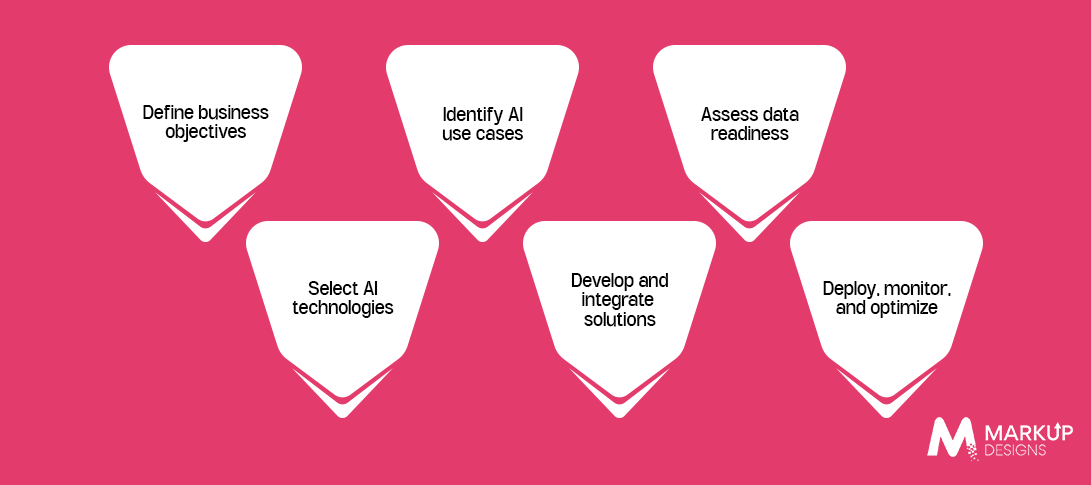
The path to success through enterprise artificial intelligence is marked by many interlinked stages. Every stage lays down the groundwork for the next stage.
The roadmap typically includes:
- Define business objectives
- Identify AI use cases
- Assess data readiness
- Select AI technologies
- Develop and integrate solutions
- Deploy, monitor, and optimize
These stages should never be seen as entirely independent from one another. Security, governance, scalability, and performance considerations should be taken into account during the whole process.
Define Business Goals and AI Strategy
Firstly, there is a need to determine the objective behind introducing AI within the business organization. It is always advisable to begin with the needs of the business and not from the technology angle, which would make for expensive AI implementation without much value.
AI can be useful for creating value in business through increased income, efficiency, productivity, customer experience, and even risk management.
Some possible uses of AI include:
- Customer support automation
- Predictive maintenance
- Fraud detection
- Sales forecasting
- Recommendations
- Document processing
Use cases should be prioritized based on business value, feasibility, data availability, implementation complexity, and expected ROI after identification of potential use cases.
It is also recommended for the enterprise to identify its key performance indicators (KPIs) before development. The KPIs can range from reduced processing time to improved conversion rates.
This will make sure that AI becomes a business capability and not yet another technological investment.
Assess Enterprise Data Readiness
AI is reliant on data, which makes data readiness one of the most critical phases during enterprise AI implementation.
The data may exist in databases, clouds, applications, spreadsheets, documents, and legacy systems. In addition, some data might be outdated, duplicated, or difficult to reach.
When preparing for the AI application, companies need to assess:
- Quality and structure of the data
- Availability of the data
- Sources of structured and unstructured data
- Infrastructure to store and process the data
- The preparation of the data for AI
- Data security and privacy
For real-time decision-making, streaming and event-driven data processing capabilities are necessary. Also, companies need to make sure that their data is secure and protected. Therefore, it is necessary to have guidelines concerning who has access to the data and what it can be used for. A strong data foundation improves AI performance while reducing integration problems later in the development process.
Select the Right AI Technology and Models
No single type of AI technology will work for all enterprises in the same way. The choice of technology depends on the nature of the business problem, the data available, the needed accuracy level, budget constraints, existing infrastructure, and scaling needs. Enterprises can deploy traditional machine learning algorithms in prediction applications, generative AI for content/knowledge management applications, computer vision in image analysis, and AI agents for workflows.
The other decision that businesses have to make in their AI deployment journey is to select whether to create a model internally, deploy a pre-built model, fine-tune a model, integrate a third-party AI API, or deploy a hybrid solution that makes use of different models. In generative AI projects, considerations such as model performance, contextualization, data privacy, response quality, integration capability, and operational costs should be considered.
The technology that businesses adopt must align with their desired business goal. Adopting the latest or the most sophisticated technology is not synonymous to adopting the best technology.
Design the Enterprise AI Architecture
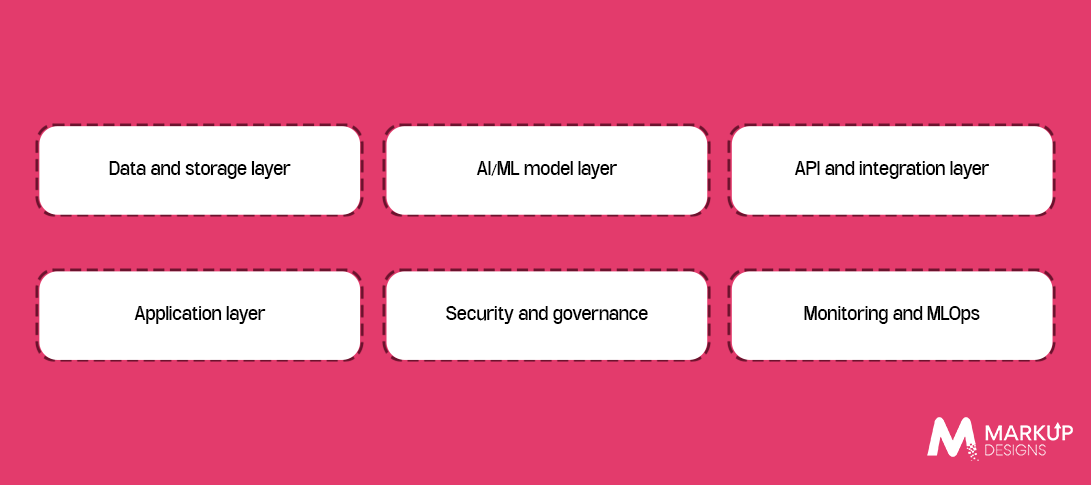
An effective enterprise AI architecture bridges AI components with enterprise systems but maintains the security, scalability, and manageability of the solution. The following layers should be included in an enterprise AI architecture:
AI/ML Model Layer
This layer holds machine learning models, generative AI models, predictive models, and/or AI agents responsible for data processing and insight/prediction/generation.
API and Integration Layer
APIs bridge AI services to enterprise applications, databases, CRM, ERP, and any other business systems, allowing for seamless data and workflow integration.
Application Layer
This layer includes employee, customer, or business team interactions with AI via mobile applications, web platforms, dashboards, chatbots, and enterprise systems.
Security and Governance
Access control, encryption, data privacy, compliance policies, audit trails, and responsible AI will keep your enterprise systems and data secure.
Monitoring and MLOps
Monitoring components will help you monitor model performance, health of the system, data drift, usage, and costs, whereas MLOps is responsible for model deployments and continuous improvement.
Read Also: Is Your Business Ready for AI Adoption? AI Readiness Assessment Guide
Build and Integrate the AI Solution
Once the strategy, data, technology, and architecture are developed, development and integration can take place.
Development may include creating AI models, using third-party models, developing APIs, designing AI-enabled interfaces, and incorporating AI capabilities into workflows.
For example, a company may link its AI assistant with the knowledge management system and customer service system. Thus, workers will be able to get answers to their questions without browsing through different systems manually.
AI may be integrated with:
- CRM and ERP systems
- Supply chain systems
- Customer service systems
- Business intelligence systems
- Knowledge bases of enterprises
- Internal workflow systems
Human interaction should also be taken into account when integrating AI. When dealing with important business processes, AI may suggest a particular course of action, allowing workers to review and accept the decision.
Such an approach may enhance confidence and engage people in decision-making when necessary.
Establish AI Security, Governance, and Compliance
Enterprise AI systems deal with sensitive business and customer data; the importance of security and governance cannot be understated or overlooked until the end.
Controls should be put in place for data access, identity management, encryption, model security, audit logging, and secure API communication.
With enterprise generative AI integration, there are additional points to consider:
- Securing confidential information
- Model access control
- Management of prompts and inputs
- Avoiding harmful and false outputs
- Avoiding unapproved data exposure
- Monitoring of AI utilization
There are additional points for governance that relate to:
- Explainability
- Bias Management
- Human oversight
- Documentation of models
- Compliance
Effective governance ensures that companies understand the decision-making processes of AI, who is responsible for making decisions, what data is used, and how performance is monitored.
Test, Deploy, and Scale AI
Before an AI solution becomes live, it must undergo extensive testing. When considering enterprise AI testing, the focus should be on more than just simple application functionality.
Organizations need to test:
- Accuracy of the model
- Performance of the application
- Integration capabilities
- Security aspects
- Data management
- Quality of response
- Scalability of the solution
- User experience
Pilot implementation may be one of the ways to verify the potential benefits of the AI solution before rolling out on a larger scale.
After the success of the pilot, the AI solution can be introduced into the production environment incrementally.
The incremental deployment of AI solutions mitigates risks and provides time for learning based on practical experience. Moreover, it allows an enterprise to find unforeseen expenses, integration problems, and difficulties with adoption by users.
Move Your AI Solution From Pilot to Production
Build secure, scalable AI solutions that integrate with your existing enterprise systems and are ready for long-term growth.

Monitor, Optimize, and Continuously Improve AI
Deployment of AI in an enterprise is not considered the end of the integration process; rather, monitoring of the AI should be carried out continuously post-deployment.
Data can change, user behavior can be altered, and even the performance of the model can be affected by several factors. This calls for continuous monitoring.
Below are some areas that should be monitored in the case of AI:
- Accuracy of the model
- Response quality
- Latency
- Data drift
- Model drift
- Consumption of infrastructure
- Operating cost of AI
- User feedback
Enterprise uses of MLOps and LLMOps help enterprises manage AI models by carrying out processes such as versioning, testing, deployment, monitoring, and retraining of AI models.
Continuous improvement becomes necessary to maintain the relevance of the AI system.
Read Also: How Businesses Can Successfully Adopt Generative AI: Strategy, Use Cases & ROI
Enterprise AI Integration Architecture
The simplified process for AI integration in enterprises may be presented as follows:
Enterprise Data Sources – Data Platform — AI Models – AI APIs/Services – Enterprise Applications — Users
In this entire process, it is crucial to ensure that there are continuous processes for security, governance, monitoring, and management.
For instance, customer data can be brought to the data platform from CRM and transaction systems. The AI models perform the analysis and give predictions/recommendations via API, which will then be used in business applications by employees/customers.
The described architecture allows AI to be integrated with the existing enterprise business processes rather than being a separate application.
How to Prioritize AI Use Cases
AI should not be deployed across all processes at once. It would be best to begin implementing AI with use cases where learning can happen quickly, and results can be generated soon after.
One way that can be considered here is to evaluate the use cases in terms of their business value and ease of implementation.
| AI Use Case | Impact | Complexity | Priority |
| Customer support automation | High | Low | High |
| Fraud detection | High | Medium | High |
| Demand forecasting | High | Medium | High |
| Predictive maintenance | High | High | Medium |
| Experimental AI feature | Low | High | Low |
A starting point could be a scenario in which the problem faced by the business is well-defined, sufficient data is available, integration of the use case is feasible, and it is measurable.
Such success in the early-stage projects will lay the foundation for future enterprise-level AI applications.
Common Challenges in Enterprise AI Integration
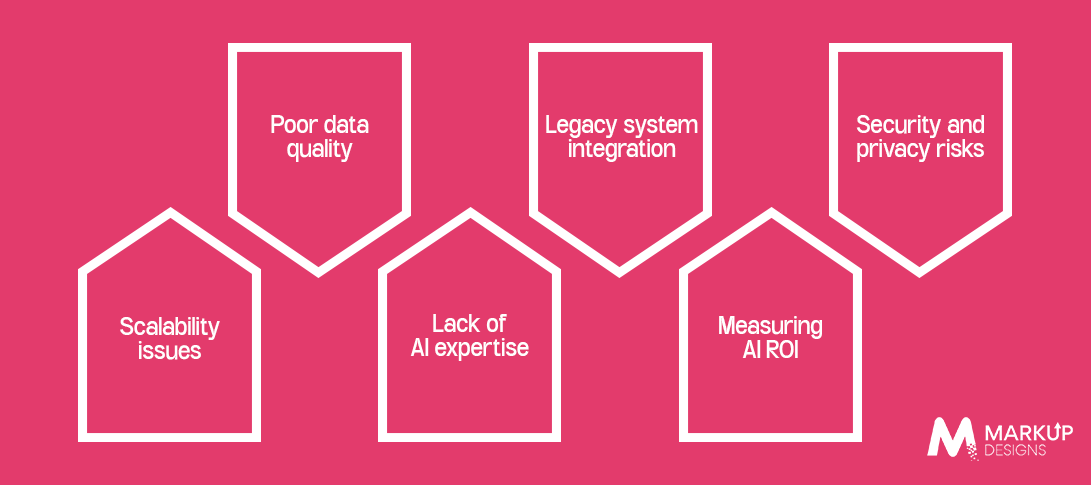
Despite the numerous opportunities to create business value through AI implementation in the company, there are also several obstacles that need to be addressed.
Poor data quality
Data can be inconsistent and incomplete, thus causing poor model behavior.
Legacy system integration
The legacy systems used by enterprises might have no advanced APIs or integration capability at all.
Security and privacy risks
The data being processed in the AI system could be sensitive and require correct access, storage, and usage management.
Scalability issues
A solution that works fine in a pilot case does not necessarily work with thousands of users.
Lack of AI expertise
Enterprises might require specialists in different fields from AI to cloud services, security, data engineering, and software development.
Measuring AI ROI
Absence of clear business KPIs makes it hard to evaluate the business value created through AI.
Best Practices for Enterprise AI Integration
Some guiding principles may assist organizations in building effective AI-based solutions:
- Business-first approach: Understanding of the problem and the solution comes before choosing a technology.
- Layering begins with the data: Availability, consistency, protection, and management of data should be ensured.
- Start small, then scale: Valuable use cases have to be validated before deployment at the enterprise level.
- Design for integration: Design using APIs and modularity in order to integrate AI solution into existing ones.
- Security must be considered: Security mechanisms related to identity, access, privacy, and monitoring are needed.
- Deploy MLOps and LLMOps: Create processes for management of models in their full life cycle.
- Involve humans in the process: Apply human supervision when decision-making is highly critical and sensitive.
- Continuous Measurement: Measurement of technical and business metrics is required.
These approaches enable organizations to create effective and easily manageable AI-based solutions.
Enterprise AI Integration Timeline
The enterprise AI implementation timeline will depend on various factors within the organization’s structure, including data preparedness, use case complexity, and need for integration. The basic roadmap will be as follows:
| Phase | Typical Focus |
| Weeks 1–4 | Strategy, business goals, and use-case assessment |
| Weeks 4–8 | Data readiness and architecture planning |
| Weeks 8–16 | AI development and system integration |
| Weeks 16–20 | Testing and pilot deployment |
| 20+ weeks | Production rollout, scaling, and optimization |
These timeframes are only for planning purposes. An AI API integration might take much shorter time, while an organization-wide change process for AI might take much longer.
Plan Your Enterprise AI Journey
Take your AI initiative from strategy to scalable deployment with the right technology, architecture, integration, and implementation approach.

Conclusion
AI adoption in an enterprise organization is not a single implementation activity but rather a process that includes business strategy, data, AI technology, enterprise architecture, security, governance, deployment, and optimization.
The well-tested approach of effective integration begins with setting clear business objectives and identifying corresponding AI use cases. On the basis of that, organizations will be able to enhance their data management capabilities, pick the appropriate technologies, design scalable architectures, deploy AI solutions, and ensure proper security and governance.
Staged deployment can help to avoid potential risks, while continuous monitoring will help to guarantee the necessary performance of AI solutions after deployment.
What should be kept in mind is the idea that the goal of integrating AI into an enterprise organization is not to follow the trend but rather to solve some business issues.
FAQs
1. What does enterprise AI integration mean?
Enterprise AI integration is the process of linking AI functionalities to existing enterprise apps, data, processes, and IT systems to drive business benefits.
2. What are the key elements of enterprise AI integration?
Key elements include business goal definition, data readiness assessment, technology selection, architecture design, development and integration of the solution, governance structure, implementation, testing, and monitoring of AI functionalities.
3. How long does enterprise AI integration take?
It depends on various factors such as use case complexity, data readiness, existing IT infrastructure, integration needs, and scale of deployment. A limited pilot project might take a few weeks, whereas enterprise-wide initiatives may take several months or more.
4. What technology solutions are available for enterprise AI integrations?
Enterprises have access to machine learning, generative AI, large language models, natural language processing, computer vision, AI agents, API, cloud technology, data pipelines, MLOps, and LLMOps technology.
5. How can enterprises ensure the security of their AI integrations?
Enterprises can use identity and access management, encryption, secure API, data governance, audit logging, model monitoring, privacy controls, and human oversight.
Author's Perspective
Enterprise AI adoption is not about using the newest AI model; it is about solving the right business problems with reliable data, secure architecture, and measurable goals. A structured roadmap helps enterprises move from strategy and implementation to deployment and continuous optimization. By focusing on practical use cases, scalable infrastructure, governance, and improvement, businesses can build AI capabilities that grow with their needs and prepare for intelligent workflows, AI agents, and real-time decision-making.
Discuss Your Project NowGaurav Goyal
Global Sales- VP
Related Posts

How Artificial Intelligence Is Changing Mobile Game Development
How to Build Production-Ready Applications with AI Coding...
Cost, Benefits & Business Impact: Generative AI vs....
Insights Are Valuable & Execution is Priceless
You’ve read about the digital future. Now, let’s build the infrastructure to take you there. Move your strategy from the page to the product.
Design Your Solution Now
Contact Us
Schedule The Appointment At Your Convenience Date And Time.
30 Min
Web Conference
Time Zone
Indian standard time (08:30pm)

Thanks For Getting In Touch!
You’ve Taken The First Step Toward Transforming Your Digital Presence. Our Experts Will Reach Out Shortly To Take It Forward.
Launch Your Dream Project
Provide a brief overview of your project, and our specialists will evaluate your requirements. We will connect with you to explore how the right digital solutions can help you launch faster.