

In Brief
- Generative AI is changing the way companies work by automating tasks that rely on knowledge, boosting productivity, and helping companies make choices based on data.
- Companies are implementing generative AI so that they can boost customer satisfaction, speed up innovation processes, and improve workflows.
- To be successful, companies should create a detailed approach, attract high-quality data, implement proper governance, and build a scalable AI system.
- Generative AI has useful applications in areas like customer service, software development, marketing, finance, and product development.
- Companies that choose to use generative AI responsibly will be able to thrive in the future.
Over the years, artificial intelligence has gone from being a revolutionary invention to an essential tool for businesses, with generative AI at the forefront. Companies in multiple fields are applying it to carry out repetitive actions, speed up the creation of various content, enhance software development, improve the means of communication with customers, as well as gain insightful knowledge from company data. In the course of further development, companies do not ask themselves whether to adopt the technology but rather how. Therefore, the implementation of the solution should be the right one to ensure the good performance of the developments.
Taking advantage of related technologies goes beyond adopting AI technologies. It includes having a clear plan of action, establishing a set of use cases for the technology, developing governance and security frameworks, and putting in place a mechanism for continuous monitoring of technology performance. The blog post addresses the rapid growth of generative AI, major advantages of the tool for businesses, as well as some solutions that have already been implemented in various industries.
The Market Momentum Behind Generative AI Adoption
Generative AI is now a high-priority issue for companies keen to find innovative solutions to boost business efficiency, optimize customer service, and innovate. Initially starting as pilot projects, generative AI is gradually becoming a component of daily operations in enterprises seeking tangible profits. With growing competitive pressure, firms utilizing generative AI get competitive advantages.
Nonetheless, successful implementation of generative AI solutions does not come down to simply opting for appropriate technology. Organizations have to work on data quality, privacy-related issues, compliance, and workforce preparedness while designing effective AI strategies in line with long-term goals.
Current Enterprise AI Adoption
Businesses across various industries are employing generative AI capabilities for customer service, software engineering, operations, marketing, and finance. The progress of businesses in implementing AI technologies is driven by their recognition of the sheer benefits deriving from AI in relation to productivity enhancement and making informed decisions.
Why Businesses Are Moving Beyond AI Experimentation
Early AI projects focused on exploring the ability of AI while now businesses adopt generative AI in production settings. The prospect of reaching positive business outcomes, better performance of models, and increased availability of the technology made businesses continue using AI solutions.
Common Adoption Barriers
Although it has potential, businesses run into difficulties, for example, poor data quality, security risk, regulatory compliance issues, integration with old IT systems, and low skills in AI. Overcoming these barriers is critical for good implementation.
Importance of Governance and Scalability
Good governance of AI guarantees secure use, data protection, transparency, and compliance with regulations. On the other hand, scalable infrastructure guarantees that businesses can successfully expand AI projects without problems.
The Business Benefits of Generative AI
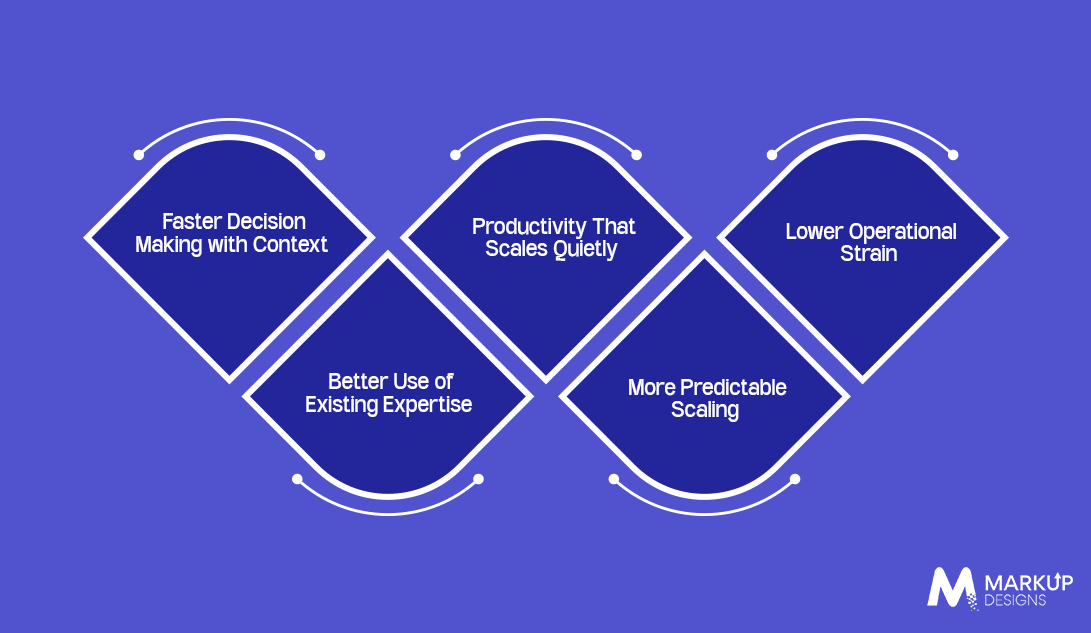
Generative AI provides value other than just automation, which makes the organization better in decision-making, better in the efficiency of operations, and better in working with customers. When aligned with business goals, generative AI becomes a long-term facilitator of innovation and growth.
Faster Decision Making with Context
Generative AI processes very large amounts of structured and unstructured information and produces contextual insights to help organizational leaders go faster in decision-making.
Productivity That Scales Quietly
Automation of boring and time-consuming processes makes it possible for employees to put more effort into strategic operations.
Lower Operational Strain
AI enhances process efficiency through a decrease in manual actions in different tasks such as documentation or reporting.
Better Use of Existing Expertise
Generative AI collects the expertise of the company’s employees and makes it more accessible, allowing employees of all levels to easily find necessary information and utilize internal knowledge more efficiently.
More Predictable Scaling
Standardized AI-based processes help companies expand their operations without increasing the number of people engaged and without adding complexity to the business processes.
Use Cases of Generative AI for Businesses
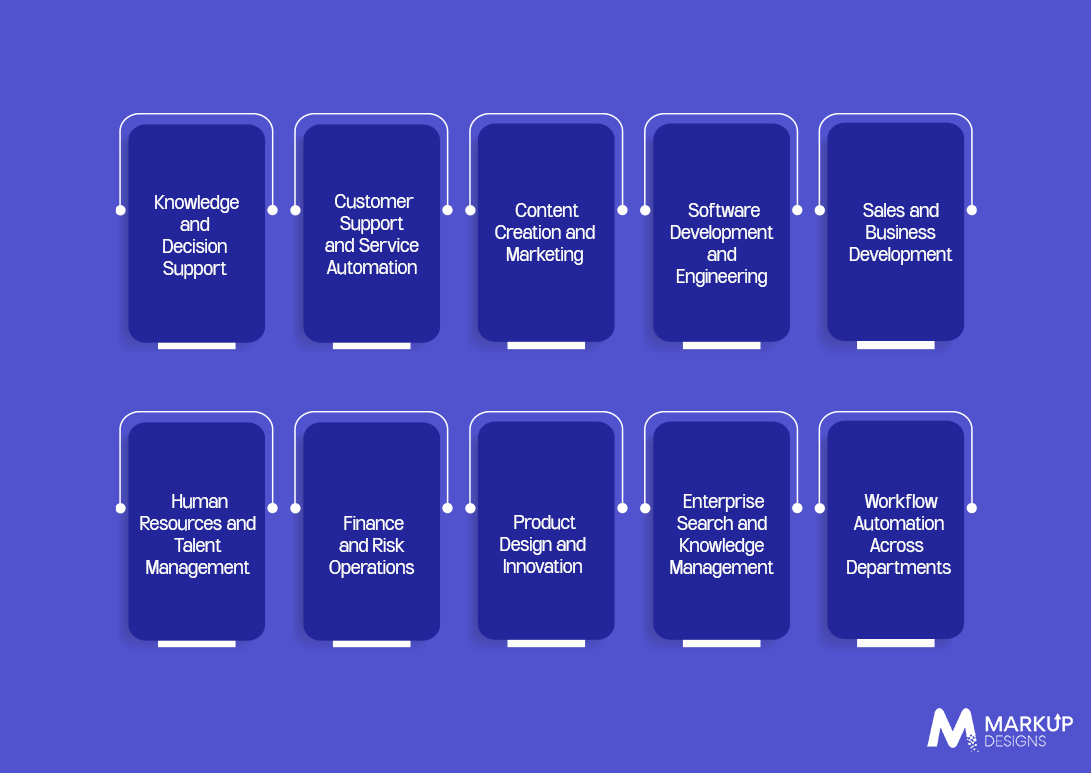
Generative AI can be used in various business areas for automation of knowledge-intensive tasks, enhancement of cooperation between departments, and acceleration of innovative processes.
Knowledge and Decision Support
Generative AI can summarize documents and analyze company data to make better suggestions and offer recommendations.
Customer Support and Service Automation
AI-powered virtual assistants and chatbots enable fast resolution of customers’ requests and provision of personalized help any time of the day.
Content Creation and Marketing
Generative AI can facilitate the creation of blogs, social media content, emails, product descriptions, etc.
Software Development and Engineering
Generative AI helps programmers to write code automatically.
Sales and Business Development
Generative AI assists with email writing, bid formulation, and sales processes.
Human Resource Management and Talent Acquisition
HR departments are using artificial intelligence to facilitate hiring, onboarding, creating the employee handbook, training documents, and communicating information.
Accounting and Risk Management
Artificial intelligence can help create financial statements, provide information analysis and fraud detection, forecasting and risk management.
Product Design and Innovation
Businesses utilize generative AI in order to get new ideas for product design and to produce product ideas and variants.
Enterprise Search and Knowledge Management
Artificial intelligence allows employees to receive information from the enterprise documents and other sources within the company.
Workflow Automation Across Departments
Generative AI helps replace manual work in various areas, from purchases and contracts to operations and management.
Real World Examples of Generative AI in Business
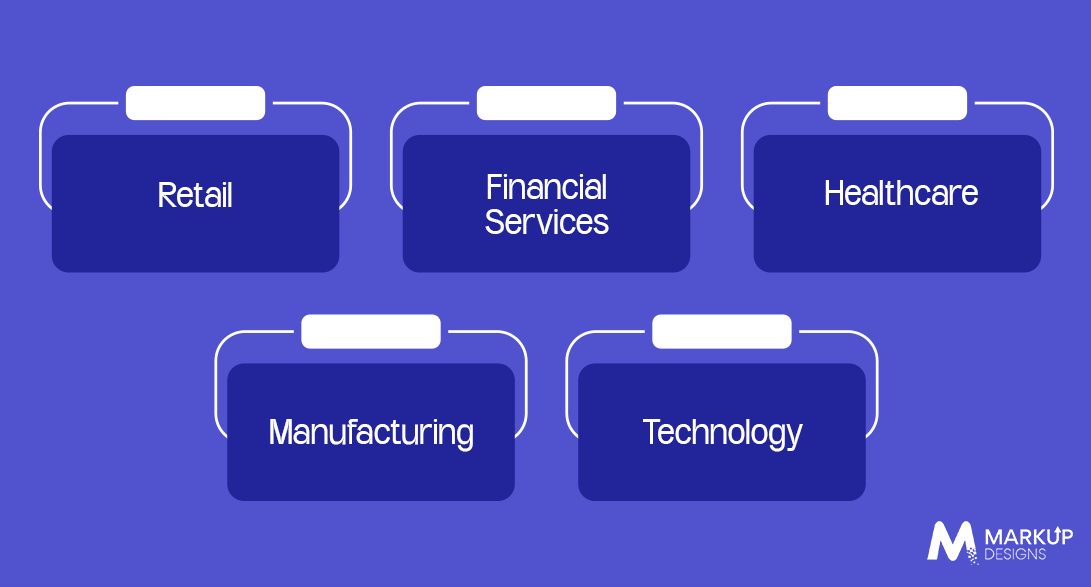
Big companies from many industries implement generative AI in their processes to get better results and meet the needs of their customers.
Retail Industry
Retailers apply AI technology to generate reviews for the products and use them for communication with customers and advertising.
Finance Sector
Financial corporations are adopting generative AI in their operations in order to detect fraud, provide assistance for customers, and produce financial reports.
Healthcare Sector
Healthcare representatives apply AI in their job to facilitate the processes of medical documentation and communication with patients.
Manufacturing
In the manufacturing sector, generative AI is applied to improve production planning, maintenance recommendations, and quality management and assurance processes.
Technology
The technology industry relies on AI to improve software development processes, automate technical support services, enhance innovations in technology-related products, and boost knowledge management practices.
How Different Industries are Applying Generative AI
Generative AI has become a game-changer in various industries by providing solutions to different problems and improving operations.
Healthcare
Generative AI helps engage patients, document clinical information, provide diagnostic support, and manage medical knowledge.
Banking and financial services
Businesses in banking and financial services apply generative AI to enhance customer support services, perform financial analysis, develop compliance documents, and monitor fraud.
Retail and e-commerce
Generative AI technology makes it possible for businesses in the retail and e-commerce industries to improve product search, provide individualised shopping experiences, manage inventories, and perform marketing functions.
Manufacturing
Generative AI helps businesses optimise productivity processes and improve efficiency through predictive maintenance and quality control.
Logistics and Supply Chain
Enhances route planning, inventory management, demand forecasting, shipment tracking, and logistics documentation.
Education
Creates personalized learning content, automates testing, and provides assistance to educators to increase student engagement.
Media and Entertainment
Supports content creation, script writing, video shooting, localization and personalizing the audience.
Real Estate
Processes property recommendations, automated listings, marketing analysis, customer communication, and document creation.
Framework to Implement Generative AI in Business
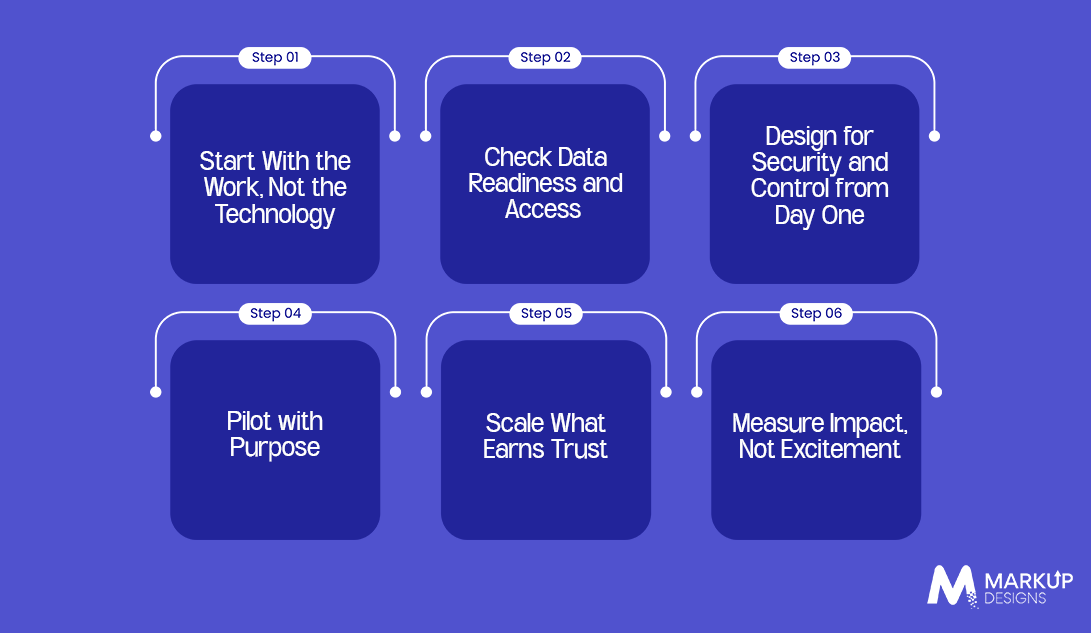
Generative AI will be successful only if a business has a proper strategy rather than relying on technology alone. Organizations should aim to resolve real operational issues and come up with a secure way of using AI while acquiring measurable results.
Step 1: Start With the Work, Not the Technology
Understand the process and detect process bottlenecks, as well as knowledge work, to find time-consuming activities. Identify business cases where generative AI can improve performance.
Step 2: Check Data Readiness and Access
Generative AI works best with good data, so it is worth checking whether the company has reliable and accessible data.
Ensure that your company has the right data of good quality and is accessible, and establish relevant procedural restrictions to keep the data accurate and safe.
Step 3: Design for Security and Control from Day One
Ensure that security is incorporated in its AI development plan from the very beginning through the incorporation of role-based access, human oversight, practices for logging, tracing operations, and defining governance to secure the responsible usage of AI.
Step 4: Pilot with Purpose
Start with a small number of good use cases to see how everything works. Set metrics, complete a survey among users, and assess the potential of focusing more attention on the implementation of AI in your organization.
Step 5: Scale What Earns Trust
If it was successful, standardise AI tools. Define who owns the tools and define new practices in governance to use AI in your organization.
Step 6: Measure Impact, Not Excitement
Measure how the implementation of AI helped to achieve business goals, enhance productivity, finish processes faster, and improve process efficiency of the processes.
Designing Secure, Scalable, and Trusted Generative AI Systems
As generative AI is integrated into the day-to-day working of organisations, they must create solutions that are safe, compliant, and capable of scaling appropriately.
Security
Safeguard important business information through the use of strict access controls, strong encryption, and constant surveillance to reduce security risks.
Governance
Create proper AI policies, guidelines, and monitoring mechanisms for the accountable development and use of AI technology.
Enterprise Regulations
Apply appropriate role-based authorization, provide audit trails, and develop a system of approvals to ensure transparency and operational control.
Compliance
Make sure that AI solutions comply with industry regulations and privacy laws, but don’t forget to observe ethical data processing principles.
Responsible AI Usage
Encourage fairness and accountability to avoid bias and increase transparency in AI operations.
Choosing the Right Generative AI Model for Your Business Needs
The kind of AI model chosen must correspond to the company’s strategic goals, data scope, and complexity of operations.
Understanding different model types helps organisations implement solutions that align with their long-term goals.
Large Language Models (LLMs)
LLMs generate human-like text, answer questions, create content, and support conversational AI applications across various business functions.
Retrieval Augmented Generation (RAG)
RAG combines language models with enterprise knowledge sources to deliver more accurate, context-aware, and up-to-date responses.
Domain-Specific Models
These models are trained for specialised industries or business functions, delivering greater accuracy for sector-specific tasks.
Fine-tuned Models
Fine-tuning customises pre-trained AI models using business-specific data, improving performance for targeted use cases.
Multi-Model Architectures
Businesses can combine multiple AI models to perform complex tasks, optimise workflows, and improve overall system performance.
Factors to Consider Before Selecting a Model
When evaluating a generative AI model, consider business objectives, data sensitivity, infrastructure readiness, implementation costs, scalability requirements, and regulatory compliance to ensure the solution delivers long-term value.
What the Future of Generative AI Means for Businesses
Generative AI is evolving from a productivity tool into a strategic business capability that will shape how organisations operate, innovate, and compete.
From Tools to Infrastructure
AI will become an integral part of enterprise technology ecosystems rather than a standalone solution.
Stronger Governance
Businesses will invest more in AI governance to improve transparency, security, and regulatory compliance.
Greater Reusability
Reusable AI models and workflows will enable faster deployment across multiple business functions.
Clear Ownership
Cross-functional collaboration and defined ownership will become essential for managing enterprise AI initiatives successfully.
Sustainable Growth Through AI
Organisations that adopt AI responsibly will improve efficiency, accelerate innovation, and create long-term competitive advantages.
Make Generative AI a Long-Term Capability
Transform your business with secure, scalable, and intelligent generative AI solutions. Partner with Markup Designs to identify the right opportunities, implement enterprise-ready AI, and achieve measurable business outcomes.

How Markup Designs Helps Businesses Build and Scale Generative AI
At Markup Designs, we help organisations turn generative AI into a practical business advantage. Our team works closely with you to identify high-value AI opportunities, develop enterprise-ready solutions, and integrate them seamlessly into your existing workflows.
From AI consulting and use case discovery to secure application development, model integration, governance, and ongoing optimisation, we deliver scalable AI solutions tailored to your business goals. Whether you’re launching your first AI initiative or expanding enterprise-wide adoption, we provide the expertise needed to maximise long-term ROI.
Read Also: Enterprise Generative AI Integration: Architecture, Strategy, and Best Practices
Conclusion
Generative AI is rapidly becoming a strategic business capability, helping organisations improve productivity, enhance decision-making, automate complex workflows, and drive innovation. However, long-term success depends on adopting AI with a clear strategy, secure governance, scalable infrastructure, and well-defined business objectives. By implementing generative AI responsibly and focusing on measurable outcomes, businesses can unlock sustainable growth, strengthen their competitive advantage, and maximise the return on their AI investments.
FAQs
1. What is generative AI, and how is it used in business?
Generative AI is a type of artificial intelligence that creates content, generates insights, automates tasks, and supports decision-making using large datasets. Businesses use it to improve efficiency, enhance customer experiences, and streamline operations.
2. How can generative AI transform business processes?
Generative AI automates repetitive tasks, accelerates content creation, improves data analysis, enhances customer support, and enables faster, more informed business decisions.
3. What are the top generative AI solutions for business transformation?
Popular solutions include AI-powered chatbots, enterprise search, document automation, content generation, code assistants, workflow automation, and AI-driven knowledge management systems.
4. How does generative AI impact business efficiency and growth?
Generative AI reduces manual effort, improves productivity, accelerates innovation, enhances customer engagement, and helps businesses achieve better operational and financial outcomes.
5. How can Markup Designs help implement generative AI for business transformation?
Markup Designs provides end-to-end generative AI services, including AI consulting, strategy development, enterprise AI solutions, secure implementation, system integration, governance, and continuous support to help businesses adopt AI with confidence.
Author's Perspective
Generative AI is no longer an emerging technology reserved for early adopters. It is becoming a strategic capability that enables businesses to improve efficiency, make informed decisions, and accelerate innovation. However, successful adoption depends on more than implementing AI tools. Organisations need a clear strategy, trusted governance, and a scalable approach that aligns technology with real business objectives. By investing in responsible AI today, businesses can unlock sustainable growth and remain competitive in an increasingly AI-driven future.
Discuss Your Project NowJupinder Singh Arora
Founder and CEO
Related Posts

How Artificial Intelligence Is Changing Mobile Game Development
How to Build Production-Ready Applications with AI Coding...
Cost, Benefits & Business Impact: Generative AI vs....
Insights Are Valuable & Execution is Priceless
You’ve read about the digital future. Now, let’s build the infrastructure to take you there. Move your strategy from the page to the product.
Design Your Solution Now
Contact Us
Schedule The Appointment At Your Convenience Date And Time.
30 Min
Web Conference
Time Zone
Indian standard time (08:30pm)

Thanks For Getting In Touch!
You’ve Taken The First Step Toward Transforming Your Digital Presence. Our Experts Will Reach Out Shortly To Take It Forward.
Launch Your Dream Project
Provide a brief overview of your project, and our specialists will evaluate your requirements. We will connect with you to explore how the right digital solutions can help you launch faster.