
In Brief
- Enterprise AI integration involves connecting AI technologies with the current applications, databases, and workflows to help enterprises in the Middle East automate operations, make decisions, and increase efficiency.
- Some of the key drivers for enterprise AI adoption in the GCC region include AI initiatives by the government, investments in cloud and data center infrastructure, desire for efficiency, data-driven decision-making, and upgrading of current systems.
- The process of integration of AI in businesses entails having a good alignment with business objectives, good data architecture, good and safe infrastructure, AI governance, and development of AI expertise. The seven-stage approach to integration entails strategy, architecture, orchestration, system integration, regional considerations, testing, and continuous improvement.
- Challenges faced include data silos, legacy systems, data sovereignty, regulatory issues, shortage of AI professionals, Arabic language requirements, infrastructure costs, and scalability. Enterprises need to determine their data readiness, security, infrastructure compatibility, workforce readiness, and regional requirements.
- Selecting the best AI integration partner for success is vital. Markup Designs assists enterprises with their AI integration needs by offering custom AI development, AI agents & chatbots, workflow automation, cloud & data engineering, and optimization services to create highly secure and scalable AI solutions.
Artificial intelligence (AI) technology is growing to be a major driver in the business transformation processes taking place within the Middle East region. Businesses from such nations as the UAE, Saudi Arabia, Qatar, and other GCC member states are adopting the technology in order to enhance their processes, automate workflows, and increase the level of efficiency in making business decisions. However, incorporating AI technology within a company is only the starting point.
The process of enterprise AI integration enables companies to combine various intelligent technologies with the company’s applications, databases, and workflows in order to apply AI in several departments of the business, rather than in single projects.
This blog aims to address why Middle Eastern companies are focusing on enterprise AI integration, what strategies they use in the adoption of this approach, and what steps should be taken in order to implement AI into a business using a seven-step framework.
Understanding Enterprise AI Integration in the Middle East
Enterprise AI integration means incorporating AI technologies into the software, applications, databases, and business processes of the enterprise. Unlike utilizing AI separately, enterprises incorporate AI within their activities in order to increase the level of efficiency, automate mundane operations, and make decision-making more effective.
Integration of AI into enterprises is currently becoming crucial in the Middle Eastern region, as organizations are transitioning to digital-first operations. Enterprises are looking for AI-based solutions in such areas as customer support, financial analysis, supply chain optimization, predictive maintenance, and internal process automation.
For example, a financial company can integrate AI into its banking processes to detect fraud, and a healthcare company can employ AI to facilitate patient data analysis and administration.
Integration of AI requires not only the selection of appropriate AI models. To make integration possible, organizations should have appropriate infrastructure, data pipelines, system connections, and governance.
Why Middle East Enterprises Are Prioritizing AI Integration
Adoption of AI technology is steadily gaining momentum in the Middle East region due to investments being made in digital transformation by both governments and enterprises. Companies in the region are no longer viewing AI as just a budding technology. The aim now is to determine how best it can be adopted into companies’ systems to increase productivity and save costs.
Some key factors driving this shift include:
- AI initiatives by the government: Strategies such as the UAE National Strategy for Artificial Intelligence 2031 and Saudi Arabia’s National Strategy for Data and AI have encouraged organizations to engage in AI innovation.
- Investment in AI infrastructure: Investments in data centers, cloud infrastructure, and computing are making it easier to adopt AI in enterprises.
- Demand for operational efficiency: AI has been adopted by enterprises to automate routine processes to make them more efficient.
- Decision-making through the use of big data: AI enables organizations to process huge amounts of data, recognize patterns, and gain insight.
- Modernization of existing systems: Organizational integration of AI with ERP, CRM, and other enterprise systems.
As these priorities grow, enterprises need a clear integration strategy that connects AI investments with measurable business outcomes.
Core Strategic Priorities for Successful Enterprise AI Integration
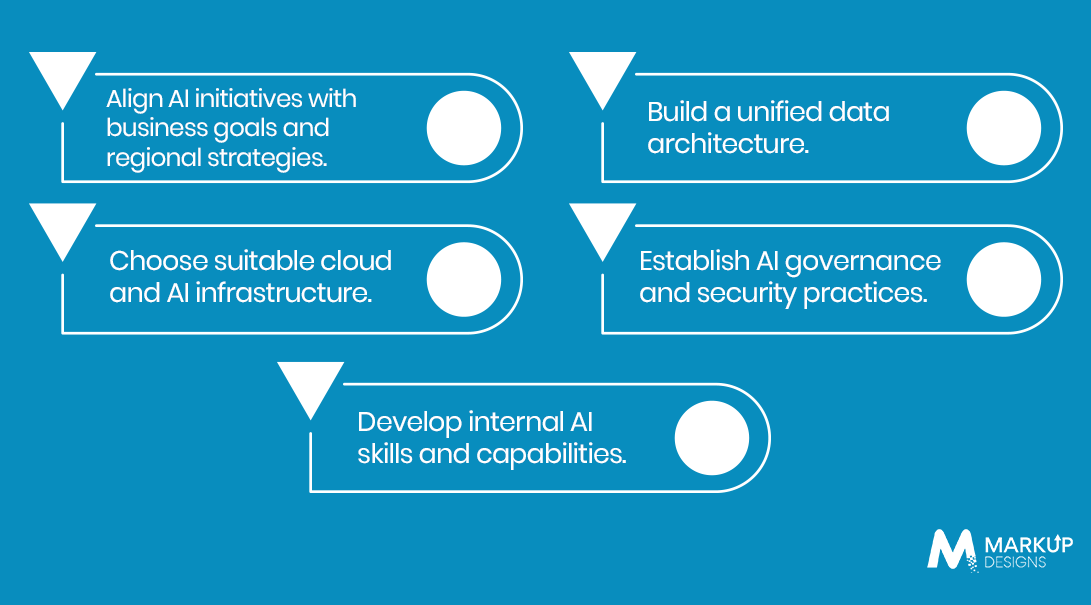
The implementation of enterprise AI solutions cannot be successful merely by deploying technological solutions. Enterprises need a coherent strategy that links the capabilities of AI solutions to their business objectives, existing technology stack, and regional requirements. These are the key aspects that enterprises in the Middle East need to consider before embarking on any AI implementation journey.
Align AI initiatives with business goals and regional strategies.
Identify key challenges faced by the businesses and then choose appropriate AI use cases that will result in productivity gains, better customer experience, and increased efficiency.
Build a unified data architecture.
Structuring data from the business across departments and having solid data pipelines for delivering accurate AI outcomes and good information flow.
Choose suitable cloud and AI infrastructure.
Determining whether the organization should opt for public, private, hybrid, or sovereign cloud based on data sensitivity and scalability.
Establish AI governance and security practices.
Determining access rights, data protection policies, model monitoring, and human oversight to make sure that AI solutions are used responsibly.
Develop internal AI skills and capabilities.
Investing in human capital so that employees can manage and monitor AI-based systems efficiently.
A Seven-Stage Framework for Enterprise AI Integration in the Middle East
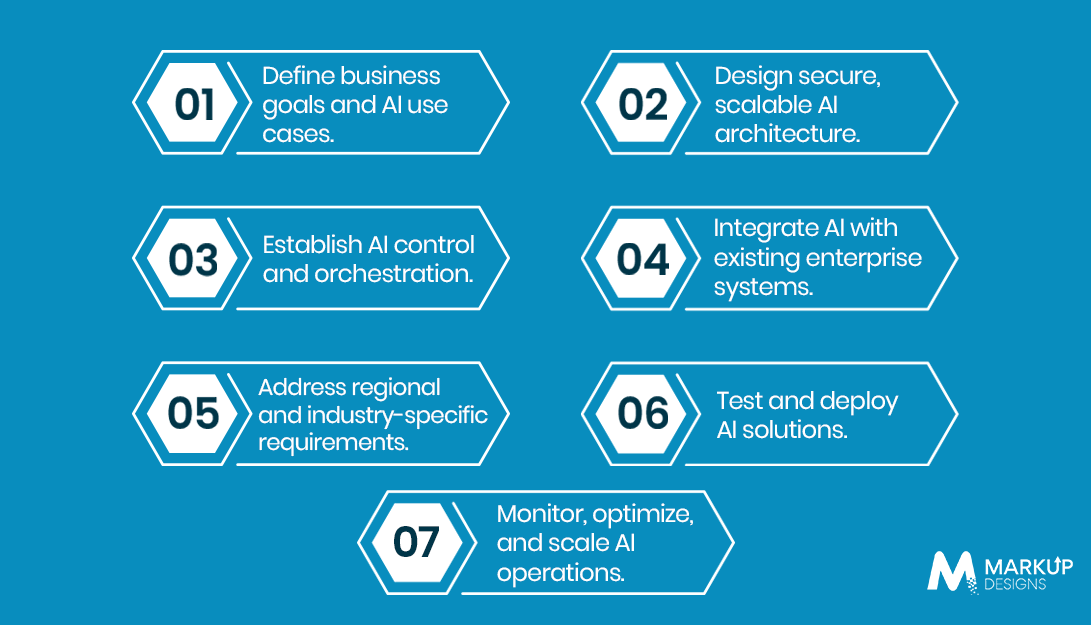
Integrating artificial intelligence into any business enterprise needs to be approached systematically. Companies should have knowledge about their existing system, have prepared their data, implement security mechanisms, and plan for growth in the future. A step-by-step approach makes it easier for organizations to minimize risks related to the introduction of AI into their processes.
Here are seven stages enterprises can follow:
Stage 1: Define business goals and AI use cases.
Firstly, companies should identify those problems that may be solved using AI. Setting goals and choosing appropriate use cases, taking into account regional digital strategies and issues of data sovereignty, is crucial at this stage.
Stage 2: Design secure, scalable AI architecture.
This stage requires choosing appropriate AI models, cloud environments, databases, and compute infrastructure. This should be done in a manner that supports scalability and ensures security.
Stage 3: Establish AI control and orchestration.
Implement a centralized layer that would manage AI models, workflows, permissions, and communications between the systems. The approach enables the enterprise to gain better control over AI activities and monitor their efficiency.
Stage 4: Integrate AI with existing enterprise systems.
Integrate AI systems with existing enterprise resource planning (ERP), customer relationship management (CRM), human resource management system (HRMS), and other software through APIs and middleware. It enables the AI system to gather business-related information and work with existing processes.
Stage 5: Address regional and industry-specific requirements.
It is important to consider regional specifics, Arabic language capabilities, data residency issues, and industry-related needs. Financial institutions, for example, require special compliance with banking regulations.
Stage 6: Test and deploy AI solutions.
First, conduct experiments on an internal controlled basis to test AI solutions for their accuracy, safety, and performance metrics. Following successful validation against the desired criteria, deploy these solutions department-wide.
Stage 7: Monitor, optimize, and scale AI operations.
Following deployment, scale up AI solutions to the rest of the business operations. Monitor the model’s performance and update the system accordingly.
Major Challenges in Enterprise AI Integration Across the Middle East
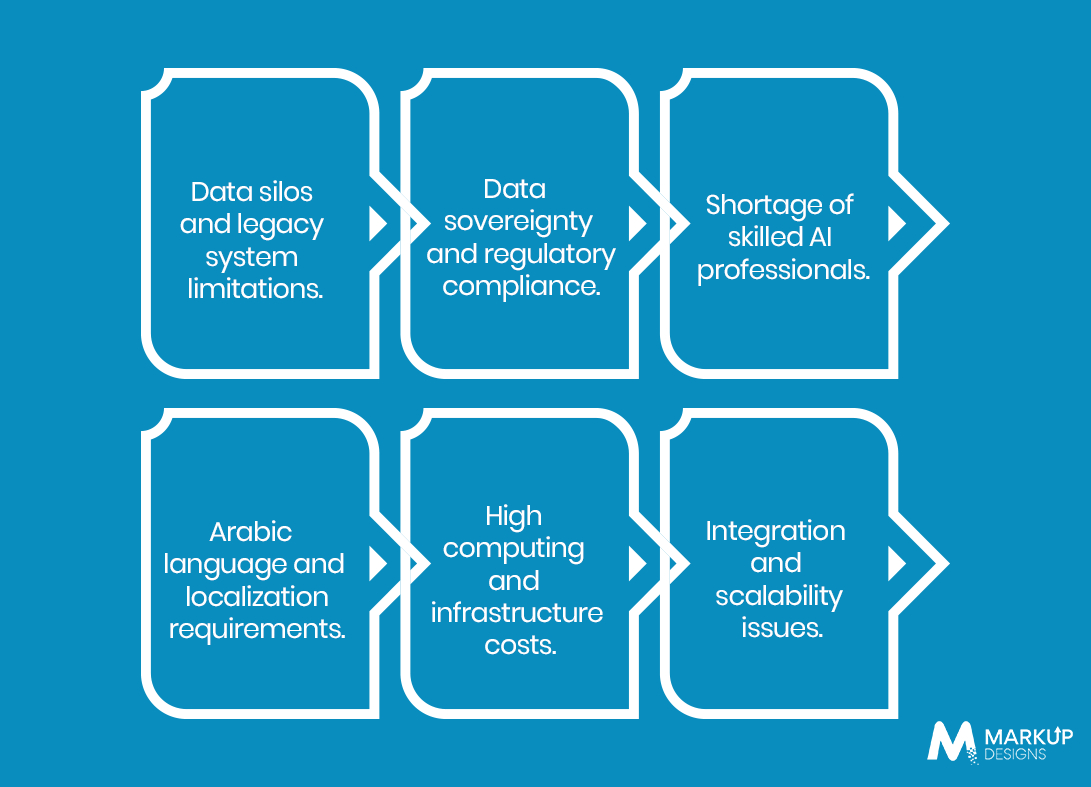
Although there are a number of opportunities presented by AI in the context of enterprises, there are also a number of difficulties in the incorporation of AI in the current business environment. Companies in the Middle East need to overcome these difficulties in order to successfully implement AI within their organization.
Some common challenges include:
Data silos and legacy system limitations.
Enterprises often have separate databases and legacy software. The incorporation of AI within such databases and legacy software may pose a problem in terms of compatibility.
Data sovereignty and regulatory compliance.
Countries like the UAE and Saudi Arabia have special regulations when it comes to data protection and data residency. Enterprises will need to make sure that AI incorporates these regulations.
Shortage of skilled AI professionals.
Recruiting skilled staff members who can work with AI technologies is still difficult for companies working on their enterprise AI systems.
Arabic language and localization requirements.
AI technologies might fail to comprehend regional languages, context, and bilingual business data. Organizations require solutions that are capable of meeting their local language needs.
High computing and infrastructure costs.
Advanced training and usage of AI technologies demand high computational power and infrastructure costs.
Integration and scalability issues.
Integrating AI systems into various enterprise infrastructures while ensuring performance and reliability might become difficult for organizations.
AI Integration Readiness Checklist for Middle East Enterprises
Prior to implementing an enterprise-wide AI initiative, businesses must perform a readiness assessment to determine whether their current infrastructure, data, and personnel are prepared for adoption.
Some key considerations include:
- Clear Business Use Cases: Are there well-defined use cases for AI based on business needs?
- Data Readiness: Is data well-organized and ready for use for AI purposes?
- Data Residency Requirements: Are data residency requirements known and accounted for?
- Infrastructure Compatibility: Do the cloud platform and enterprise IT infrastructure support AI implementations?
- System Interoperability: Does the solution integrate seamlessly with ERP, CRM, and other enterprise systems?
- Security and Regulatory Requirements: Are data protection and regulatory requirements considered and handled?
- Regional Requirements: Does the solution meet regional requirements, including support for the Arabic language?
- Workforce Readiness: Is the workforce ready for working with AI systems?
- Scalability Strategy: Does the company have a plan for scaling up from a pilot AI project to wide business adoption?
Evaluating these areas helps enterprises build a strong foundation before moving from AI planning to implementation.
How to Choose the Right Enterprise AI Integration Partner
Selecting the right partner in terms of technology is one of the most crucial steps for ensuring success when adopting enterprise AI technology. Businesses need partners that will understand the technology environment of the organization, regional specifics, and future perspectives of the company.
The following factors should be taken into consideration when choosing an enterprise AI integration partner:
Enterprise AI Experience:
Select partners that have experience in building and integrating AI solutions for various enterprise systems.
Regional Market Knowledge:
Make sure your potential partners know about the regulatory specifics and business environment of the Middle East region.
System Integration Skills:
Check if your potential partner has skills for integrating AI solutions into ERP, CRM, cloud infrastructure, legacy systems, and other enterprise systems.
Data Engineering and Cloud Technologies:
Evaluate their proficiency in data engineering, cloud computing technologies, AI architecture, and AI model deployment.
Data Protection and Industry Compliance:
A partner who has strong data security measures and knows all industry-specific compliance rules is what you need.
Post-Implementation Support:
Partners should provide you with technical support and monitoring services after implementation.
A reliable AI integration partner should offer more than technical implementation. They should understand business requirements and help organizations build secure AI systems that can adapt to changing needs and scale over time.
How Markup Designs Helps Enterprises Build Scalable AI Solutions
For successful implementation of AI in an enterprise environment, one has to have proper technology, infrastructure, and expertise in place. Markup Designs can help companies bring their AI vision to life through the implementation of intelligent technologies in their software and processes. Our skills cover enterprise AI integration, AI development, creation of AI agents, and chatbots for customer communication and internal processes.
We create AI-driven automation solutions for such purposes as reduction of repetitive processes, management of leads, customer support services, etc. Also, our experience in cloud technologies and data engineering allows us to create strong infrastructure and data pipelines for AI-based solutions.
We provide constant monitoring and maintenance of the performance of AI-based solutions to ensure alignment of these systems with your needs. Through a combination of enterprise software development, cloud technologies, and AI, Markup Designs can help your company implement safe and efficient AI solutions.
Move Your Enterprise Towards Scalable AI Adoption
Looking to integrate AI into your business operations? Connect with Markup Designs to discuss your requirements and build a secure, scalable AI strategy.

Conclusion
Integrating AI in enterprise environments has become a key component of digital transformation for businesses operating in the Middle Eastern region. As companies from the UAE, Saudi Arabia, Qatar, and other GCC markets continue to adopt AI solutions, there is an increased emphasis on embedding these technologies into the regular business process.
But in order to do so successfully, one needs not only to adopt AI but also to ensure that their organization has proper data architecture, infrastructure, AI governance, and integration capabilities. In addition, companies should think about regulatory compliance issues, language preferences, and scalability options.
With the help of an integration strategy and working with the right technology partners, enterprises will be able to go beyond stand-alone AI solutions and create intelligent business environments. The aim here is to practically integrate AI into businesses to support efficiency, innovation, and sustainable growth.
FAQs
1. What is enterprise AI integration?
Enterprise AI integration involves connecting AI technologies with existing business applications, databases, and workflows. It helps organizations automate processes, analyze data, and improve decision-making across different departments.
2. Why is enterprise AI integration important for businesses in the Middle East?
It helps businesses improve operational efficiency, modernize existing systems, automate repetitive tasks, and make better use of business data. It also supports regional digital transformation initiatives.
3. How much does enterprise AI integration cost in the Middle East?
The cost depends on the complexity of the solution, AI models, infrastructure, data requirements, and the number of systems being integrated. A basic integration may require a smaller investment, while enterprise-wide implementation can involve higher development and infrastructure costs.
4. How long does enterprise AI integration take?
The timeline depends on the project scope, existing infrastructure, data readiness, and integration requirements. A limited pilot may take a few weeks or months, while large enterprise-wide implementations can take considerably longer.
5. What are the major challenges of enterprise AI integration in the GCC?
Common challenges include data sovereignty, regulatory compliance, legacy system integration, Arabic language processing, infrastructure costs, and a shortage of skilled AI professionals.
Author's Perspective
Enterprise AI integration is not simply about adopting the latest technology. It is about building a connected business environment where data, applications, and intelligent systems work together to support better outcomes.
For Middle East enterprises, the opportunity lies in combining AI innovation with secure infrastructure, regional compliance, and practical business objectives. Organizations that focus on these foundations can move beyond experimentation and make AI a valuable part of their long-term growth strategy.
Gaurav Goyal
Global Sales- VP
Related Posts
How to Implement Responsible AI in Australia: A...

AI Strategy Services in Dubai: Helping Enterprises Scale...

How Businesses in Dubai Can Scale AI Integration...
Insights Are Valuable & Execution is Priceless
You’ve read about the digital future. Now, let’s build the infrastructure to take you there. Move your strategy from the page to the product.
Design Your Solution Now
Contact Us
Schedule The Appointment At Your Convenience Date And Time.
30 Min
Web Conference
Time Zone
Indian standard time (08:30pm)

Thanks For Getting In Touch!
You’ve Taken The First Step Toward Transforming Your Digital Presence. Our Experts Will Reach Out Shortly To Take It Forward.
Launch Your Dream Project
Provide a brief overview of your project, and our specialists will evaluate your requirements. We will connect with you to explore how the right digital solutions can help you launch faster.