
In Brief
- React Native supports both Android and iOS development using a single codebase and is thus a viable option for quick development, cross-platform applications, and cost-effectiveness.
- Native development provides platform-specific performance, integration, and control; therefore, it is appropriate for complex applications that require high performance.
- React Native can save time and effort in maintenance, while native development may require separate teams and maintenance for each of the individual platforms.
- The right choice depends on key business factors such as budget, launch timeline, target platforms, performance requirements, scalability, security, and maintenance needs.
- React Native is appropriate for start-ups, eCommerce, social media, bookings, and business applications, while native development is more appropriate for games, graphical applications, hardware-intensive applications, and specialized applications.
Choosing the appropriate technology stack for developing mobile applications could directly influence their performance, development costs, user experience, and scalability. When it comes to businesses launching their first mobile applications, one of the major questions that arises concerns whether to opt for React Native or develop native mobile applications for Android and iOS.
Each technology stack has certain advantages that should be considered when making a decision. It might be useful to use React Native when a business needs to launch a multi-platform app using the same codebase. On the other hand, native development provides deeper integration with the platform and higher performance.
This blog aims to compare React Native vs Native Mobile App Development in terms of performance, cost, development requirements, and important business aspects.
What is React Native App Development?
React Native is an open-source software tool used for developing mobile applications for Android and iOS operating systems with the help of a single source of code. It was created by Meta and uses technologies such as JavaScript and React, which makes this technology quite popular among companies looking for a way to create cross-platform mobile applications.
The major benefit of React Native is the ability to reuse a part of code while creating applications for Android and iOS. This approach helps to save time and effort and make further updates easier. Moreover, React Native supports native modules, APIs, and functionalities of mobile devices.
React Native may prove to be an appropriate choice for businesses in cases where speed, cross-platform capability, and cost of development matter most. But the ultimate decision will depend on the performance needs and the complexity of the application.
What is Native App Development?
Native mobile app development refers to creating an application exclusively for a certain operating system, which could either be Android or iOS. Typically, Java or Kotlin is used for the former while Swift or Objective-C is applied for the latter. As the application will only be used on the specified OS, the developers can use all the features available in it to their full advantage.
Such a solution tends to be the preferred choice in cases when performance, graphics, security, or device integration are key factors in the process. A native mobile app provides a better user experience since it is based on the specific platform.
However, in case the business aims at developing an application for both Android and iOS, then two teams will have to be established separately to develop both solutions. Thus, native mobile app development could be seen as an ideal solution for those who value performance above everything else.
React Native vs Native App Development: Key Differences
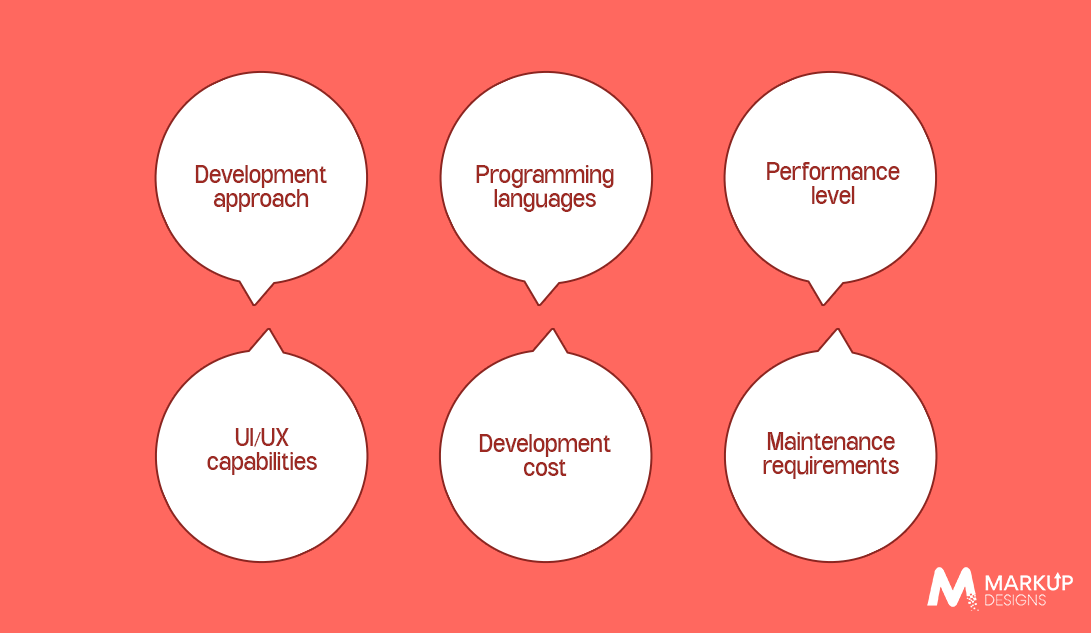
Both React Native and native development can provide high-quality apps, yet their methods are completely different from each other. This knowledge can be valuable to any business when choosing between the two based on their needs and resources.
| Factor | React Native | Native Development |
| Development Approach | Shared codebase for Android and iOS | Separate codebases for each platform |
| Programming Languages | JavaScript/TypeScript with React | Kotlin/Java for Android, Swift/Objective-C for iOS |
| Performance Level | Strong performance for most applications | Excellent platform-specific performance |
| Ui/Ux Capabilities | Cross-platform components with native capabilities | Highly optimized platform-specific interfaces |
| Development Cost | Often more cost-effective because one codebase can serve multiple platforms | Usually higher when separate Android and iOS development is required |
| Maintenance Requirements | One shared codebase can simplify updates | Separate platform maintenance is often required |
The right option ultimately depends on what matters most for your business—speed and cross-platform efficiency or maximum native performance and platform-specific control.
React Native vs Native App Development: Performance Comparison
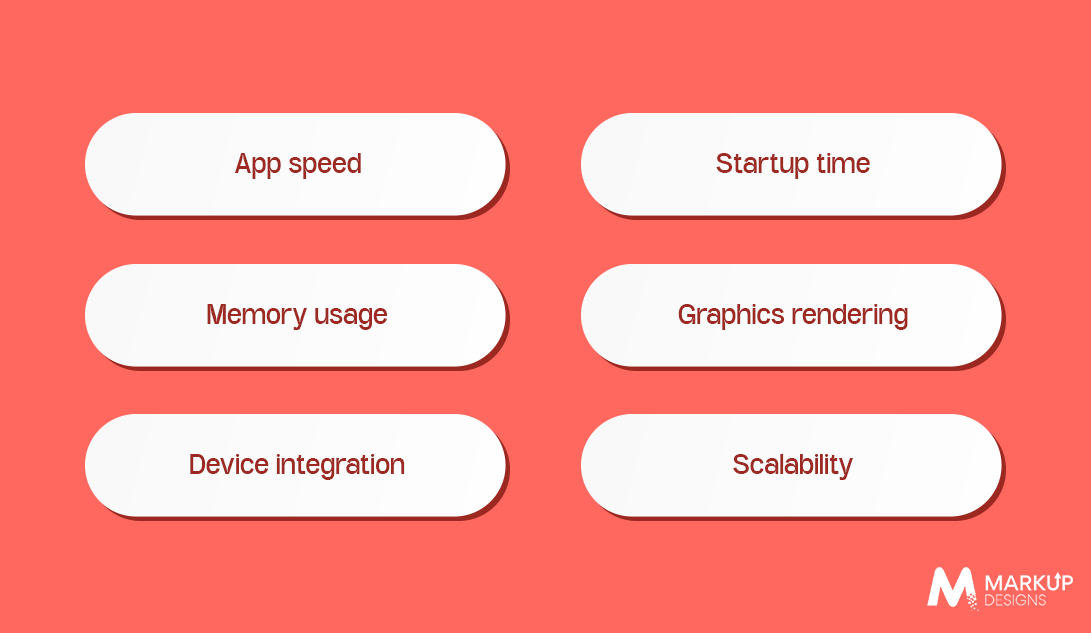
Performance is one of the key criteria in choosing between React Native and native application development. Although React Native has developed very much over time, native applications still enjoy an edge in the case of apps that require heavy computations, complicated animations, or deeper integration with the device capabilities.
Here are the key performance areas to consider:
1. App speed
Native apps will be faster and more efficient in most cases, while React Native will provide good performance for most business applications.
2. Startup time
Native apps usually start faster than React Native apps, especially if there is complex functionality within the app.
3. Memory usage
There is more control when it comes to memory utilization with native development.
4. Graphics rendering
Native apps are preferred in situations when there is a need for advanced graphics rendering.
5. Device integration
Native apps allow you to interact directly with the features of the operating system, such as the camera, GPS, Bluetooth, etc.
6. Scalability
It depends on the situation, but native development can be preferred in highly complex applications.
React Native will provide more than sufficient performance for standard business, eCommerce, social, and service-oriented apps. Native app development is essential where the performance of the platform is a primary need.
Turn Your App Idea into a Reality
Whether you need a cross-platform React Native app or a high-performance native application, our experts can help you plan, build, and launch your solution.

React Native vs Native App Development Cost Breakdown
The cost consideration often comes first on a business’s mind while choosing a path for mobile app development. But there are many aspects that contribute to the overall cost of developing a mobile application.
| Cost Factor | React Native | Native Development |
| Initial Development | Generally lower due to code reuse | Usually higher for Android and iOS |
| Development Team | One cross-platform team can often handle both platforms | Separate platform expertise may be required |
| Development Time | Typically shorter | Usually longer for multi-platform apps |
| Testing | Shared functionality can reduce some testing effort | Separate platform testing is required |
| Maintenance | One shared codebase can simplify updates | Multiple codebases may increase maintenance |
| Platform Expansion | Easier to support additional platforms | Requires separate development efforts |
What Influences the Overall Cost?
However, the development strategy constitutes just one component of the budget. Apart from the development strategy, enterprises need to take into account the number and complexity of the features, UI/UX design requirements, integration with other third parties, backend, security, testing, and post-release maintenance as well.
React Native turns out to be an affordable choice for companies that aim at launching their products on Android and iOS within a limited budget. The native development is more expensive; however, it may be justified for those applications that require high performance.
Hence, instead of relying solely on the budget aspect, enterprises need to calculate the total expenses.
Business Considerations Before Choosing React Native or Native
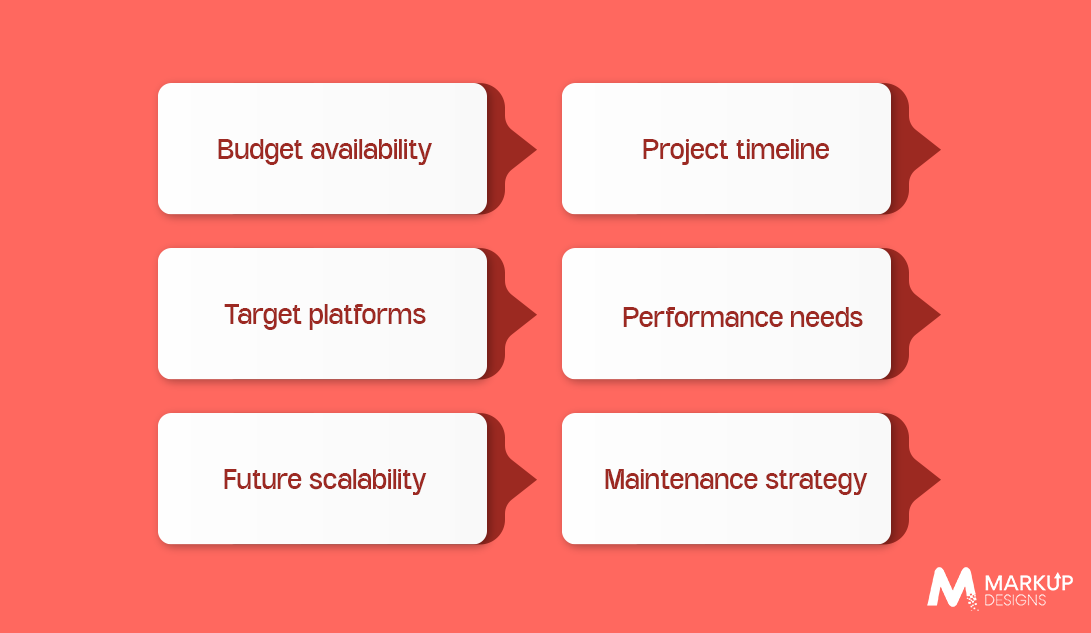
Choosing between React Native and native application development is not just a technical decision. Your budget, timelines, team needs, maintenance, and future scalability will depend on this choice. When selecting an option, you should take into account the following issues:
1. Budget Availability
For launching your product for Android and iOS on budget, React Native is a good solution due to shared coding. In the case of using native app development, you will need more funding due to different codebases or teams.
2. Project Timeline
A company that plans to reach its target market quickly might gain from React Native because developers write once for several platforms at once. When developing for both Android and iOS separately, native development takes more time.
3. Target Platform
React Native allows you to simplify cross-platform development when your audience consists of users from both Android and iOS. When you have a heavy focus on a specific platform, you should choose native development.
4. Performance Needs
The requirements of your future project should also be considered. The standard business and customer-oriented apps are successfully created on React Native, while games and applications with high performance requirements might require native development.
5. Future Scalability
Always think long-term when developing an app. The technology that you choose should be scalable for future growth in terms of features, integration, users, and business needs.
6. Maintenance Strategy
Having one common React Native codebase is much easier in terms of maintenance. With native app development, Android and iOS apps have to be maintained separately.
When Should You Choose React Native App Development?
React Native is an effective solution for those companies that would like to target their application not only at Android users but also at iOS ones without creating two separate apps.
You should consider React Native when:
- You require a fast go-to-market solution: A shared codebase may assist development teams in developing and releasing applications for multiple platforms.
- You have a budgeted plan: It saves developers and helps maintain apps and may be useful for startups or developing businesses.
- You require cross-platform functionality: It is helpful in cases where you target an audience that uses both Android and iOS equally.
- Your application needs to have basic features: eCommerce, social network, booking, delivery, educational, and business applications work well with React Native.
- You plan regular updates to the app: The management of a common codebase makes regular updates easy.
- You want to validate an idea: Startups can use React Native to launch an MVP, gather user feedback, and improve the product before making larger investments.
Overall, React Native is a strong option when development efficiency, cross-platform reach, and cost control are key business priorities.
When Should You Choose Native App Development?
When your application relies heavily on the capabilities of the specific platform, performance, and optimization, native app development might become the way to go. Though it will take more effort from developers to create it, sometimes the additional investment can be valuable for complex applications.
You should choose native development if:
- Performance is top priority: Native development is well-suited to applications requiring heavy processing and sophisticated animation capabilities.
- Device-level features are essential: Applications using cameras, sensors, Bluetooth, GPS, or any other hardware-specific features will be best served by native development.
- You are building a gaming app: High-end games and graphics-based applications may require native development for proper functioning.
- Platform-specific user experience is required: Native development enables the design of interfaces and interactions specific to Android or iOS devices.
- Security requirements are high: Financial applications and other enterprise apps require native development.
- You have long-term platform-specific goals: Native development can be considered in case Android or iOS platforms are at the core of your strategy.
Overall, native development becomes relevant when performance, advanced features, security, and platform-based optimization become more important than development effort or cost reduction.
Why Partner with Markup Designs for React Native and Native App Development?
The selection of the appropriate development partner will help significantly in the success of your mobile application. We at Markup Designs know that each business has its own objectives, audience, budget, and technical needs. We can assist you in choosing whether React Native or native development is better for you, considering your particular project needs.
We provide end-to-end services from the stage of project conception through UI/UX design and development. No matter whether you require an agile cross-platform React Native mobile application or a high-performance native app, our goal is always to develop a product that is reliable and easy-to-use.
When we develop an application, scalability, security, performance, and further maintenance are some other key things we take into account. Proper technology and development approaches will enable companies to make their mobile experience successful not only now but in the future.
Ready to Build the Right Mobile App for Your Business?
Whether you are considering React Native for faster cross-platform development or native technology for maximum performance, the right approach depends on your business goals. Talk to Markup Designs to discuss your app idea and find the development strategy that fits your requirements.

Conclusion
Choosing between React Native and native app development is not about finding one universally better technology. You just need to pick the development strategy that corresponds to the needs of your application, its budget, schedule, performance requirements, etc.
React Native could become an effective choice for companies that need fast cross-platform development, cost-effectiveness, and maintenance ease. Native development could become a preferable choice when it comes to advanced performance, advanced functionality, deeper device integration, platform-specific experience, etc.
Taking into account development costs, scalability, security, future updates, user expectations, and maintenance issues, you will easily choose the technology and create the app that will grow in the long run.
FAQs
1. Is React Native better than native app development?
Not necessarily. React Native is useful for cross-platform development, faster launches, and cost efficiency, while native development is generally better for highly demanding performance and platform-specific functionality.
2. Is React Native cheaper than native development?
React Native can be more cost-effective when building for both Android and iOS because developers can reuse a significant portion of the codebase. However, the final cost depends on the app’s features and complexity.
3. Which has better performance, React Native or native apps?
Native apps generally provide better performance because they are developed specifically for a particular platform. However, React Native can deliver strong performance for most standard business and consumer applications.
4. Can React Native apps work on both Android and iOS?
Yes. React Native allows developers to create applications for both Android and iOS using a shared codebase, while still supporting platform-specific functionality when required.
5. Which is better for startups: React Native or native?
React Native can be a good option for startups that want to launch on multiple platforms quickly and manage development costs. Native may be preferable when the product requires highly specialized performance or device capabilities.
Author's Perspective
By now, you should have a clear understanding of how React Native and native app development differ in terms of performance, cost, development requirements, and business value. There is no universal choice that works for every application. React Native can make sense when cross-platform development, faster delivery, and cost control are priorities, while native development can be the stronger option for applications demanding maximum performance and platform-specific capabilities. The key is to evaluate your business requirements first and then select the technology that can support your product both today and as it grows.
Discuss Your Project NowGaurav Goyal
Global Sales- VP
Related Posts

Cost to Build a Mobile App in Qatar...

How Much Does It Cost to Build an...
How to Build a Car Wash App: Development...
Insights Are Valuable & Execution is Priceless
You’ve read about the digital future. Now, let’s build the infrastructure to take you there. Move your strategy from the page to the product.
Design Your Solution Now
Contact Us
Schedule The Appointment At Your Convenience Date And Time.
30 Min
Web Conference
Time Zone
Indian standard time (08:30pm)

Thanks For Getting In Touch!
You’ve Taken The First Step Toward Transforming Your Digital Presence. Our Experts Will Reach Out Shortly To Take It Forward.
Launch Your Dream Project
Provide a brief overview of your project, and our specialists will evaluate your requirements. We will connect with you to explore how the right digital solutions can help you launch faster.