

In Brief
- State the app’s specifications: Specify the target users, the payment methods, the types of transfers to be made, and the geographical markets to operate in.
- Incorporate security in design: Introduce necessary protective measures such as encrypting any data stored or transmitted, implementing multi-factor authentication, secure APIs, and access restrictions to protect the financial information.
- Employ feasible payment methods: Use banking APIs and payment gateways to carry out the transactions properly.
- Ensure compliance with the regulations: Take care of KYC, AML, PCI DSS, and any other relevant regulations linked to the operations of the app.
- Carry out constant testing and monitoring of the app: Commission audits of security, detect fraudulent transactions, and run maintenance on the application on a regular basis.
Transfer applications have radically changed how people and companies receive and carry out payments. From cash transfers to international remittances, clients now expect digital platforms to be fast, convenient, and involve effective processing of transactions. However, this means that some clients’ private data may be vulnerable to attackers and lead to information theft and unauthorized transactions.
When developing a safe money transfer application, it is not enough to just implement payment gateways and create a comfortable interface for use. It is necessary to create the application architecture, apply strong encryption and authentication methods, connect reliable financial agencies, and take care of regulatory compliance from the very start. Continuous testing and monitoring of the transactions are important for security maintenance after launching the product, too. The current article describes how to create a secure money transfer application in detail, focusing on the development process, necessary security features, regulatory measures, costs, and possible issues.
What Are the Different Types of Money Transfer Apps?
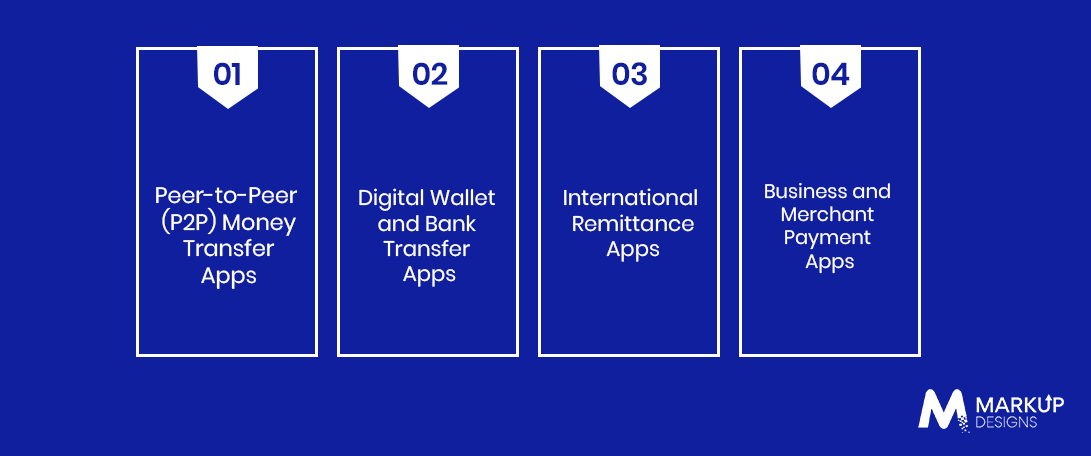
There are different types of money transfer applications suitable for different payment needs: personal transfers, digital payments, international money transfers, and business transactions. Choosing the correct type of application will help the company understand what features, integration options, and security measures need to be applied.
Peer-to-Peer Money Transfer Applications
The essence of peer-to-peer applications is that users can send and receive money from one another directly. It has such features as contact-based payments, QR code use, transaction history, instant notifications, and others that make transferring money easier for the users.
Multi-factor authentication, recipient verification, and transaction limits help protect users against unauthorized payments.
Digital Wallet and Bank Transfer Applications
Digital wallet applications keep payment information or available funds for quick payment processing, while bank transfer applications link users to their deposit accounts to transfer funds. These types of applications could include the opportunity to store favorite beneficiaries, recurring payments, and balance monitoring. It is very important to use secure authentication, encrypted messages, and the best bank integrations to protect financial information.
International Remittance Applications
International remittance applications make money transfers across a number of countries possible and, at the same time, provide the opportunity to use different currencies, convert them, and deposit the sums into banks abroad. The applications have to control many things, such as transfer fees, transfer settlement time, and regional legislation. Identity verification, transaction monitoring, and anti-money laundering technologies allow going through this.
Business and Merchant Payment Applications
Business and merchant payment applications allow making payments to customers, suppliers, and for payoffs. Besides, the applications could include invoicing, reconciliation of accounts, bulk payments, and financial reporting.
How to Build a Secure Money Transfer App: Step-by-Step
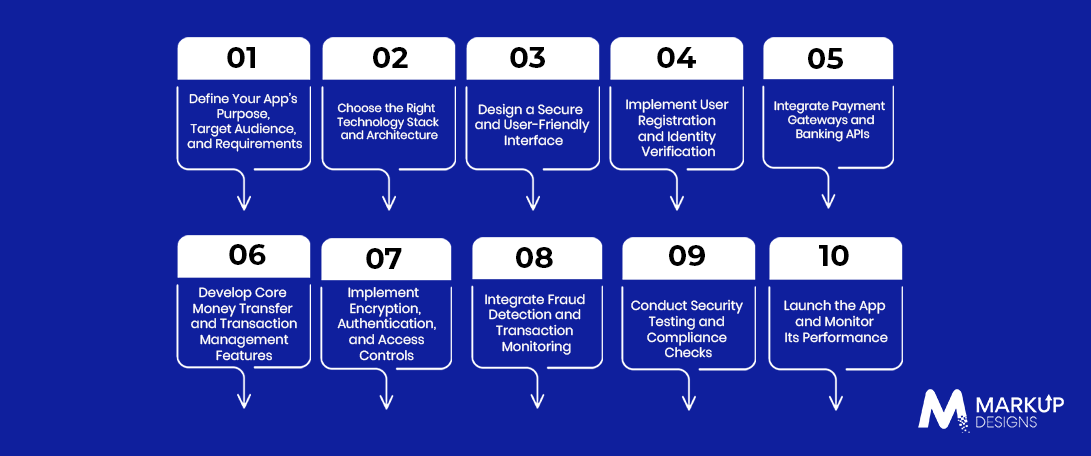
The development of a trustworthy app for money transfers requires proper strategy drafting, using safe financial integrations, and imposing security measures during the development process. A well-structured procedure will assist businesses in decreasing the chances of weaknesses, improving transaction reliability, and providing a proper and reliable service.
Define Your App’s Purpose, Target Audience, and Requirements
Make sure you identify the target users, payment applications of your service, and territories where the app will operate before the development starts. Decide whether your application will cover domestic transfers, international money remittances, e-wallets, and business payments. Make certain you are aware of all the app’s requirements, limits on transactions, currencies used, and security measures to be fulfilled within your project.
Choose the Right Technology Stack and Architecture
Select mobile frameworks, backend solutions, databases, and cloud platforms according to the app’s complexities, planned transaction volume, and scalability. The architecture must support secure data transfer and reliable processing of transactions, as well as provide access restrictions to sensitive information. It is advisable to choose technologies that have already been tested and have security practices.
Design a Secure and User-Friendly Interface
Design an easy-to-use interface that allows users to sign up, choose recipients, type in the amount they want to send, and finalize the payment. Make sure all transaction details are displayed and notify users about the completion of the process in order to prevent mistakes during the operation. Ensure that session handling is secure, provide user authentication, and issue alerts when suspicious activity is detected.
Implement User Registration and Identity Verification
Create a registration system designed to gather just enough data needed to identify the person. The app may require some form of documents to verify users and also use fingerprinting as the verification method, among others. Introduce various safeguards against identity theft and unauthorized usage of the service.
Integrate Payment Gateways and Banking APIs
Synchronize the app with payment gateways, payment networks, and any banking API that allows making transfers from bank to bank. Conduct thorough testing of the whole system and take security issues seriously.
Develop Core Money Transfer and Transaction Management Features
Construct the main components like recipient management, fund transfer, account tracking, transaction history, etc.
The backend must validate transactions, maintain accurate records, and handle failed or pending payments correctly. Implement idempotency controls and reconciliation processes to reduce duplicate processing and discrepancies between payment systems.
Implement Encryption, Authentication, and Access Controls
Use encryption to protect sensitive data both in transit and at rest, secure storage of access credentials, and strong authentication practices. Implement role-based access and the principle of least privilege to restrict access to financial data and other important functions. Use appropriate contrivances to protect cryptographic keys and only maintain sensitive payment information if absolutely necessary and appropriate.
Integrate Fraud Detection and Transaction Monitoring
Put a system in place to monitor unusual transaction amounts, repeated failures, suspicious transfer patterns, or compromised accounts. Rules-based or risk-scoring monitoring can lead to alerts, transaction hold-ups, or further investigation of transactions. Set up alerts and an escalation process to enable prompt investigation of suspicious transactions while ensuring legitimate payments are not interrupted.
Conduct Security Testing and Compliance Checks
Before launching the application, carry out an analysis of its security weaknesses, authentication vulnerabilities, insecure API access, data disclosure, and transaction processing issues. The analysis may involve reviewing code and software dependencies as well as penetration testing aimed at vulnerability discovery.
Launch the App and Monitor Its Performance
Deploy the application with secure configuration, monitoring, backups, and incident response procedures in place. Track transaction failures, processing delays, suspicious activity, and system performance to identify problems early. Regular security patches, access reviews, fraud-rule updates, and periodic testing help maintain protection as the platform grows.
What Security Features Should a Money Transfer App Include?
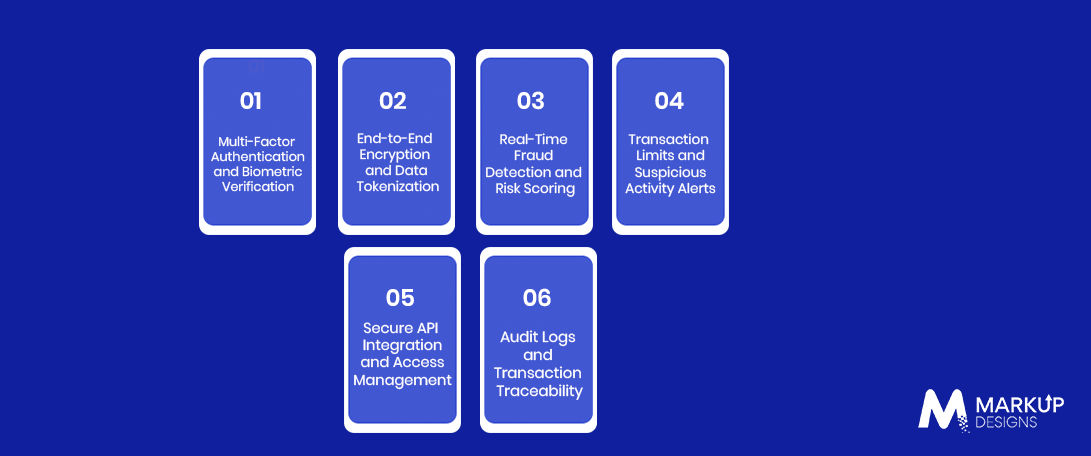
These are used to protect customers’ accounts, financial information, and payment processes from any form of intrusion and fraud. They depend on the transaction methods, risk level, and regulation of the app.
Multi-Factor Authentication and Biometric Verification
Multi-factor authentication involves additional layers of identification other than passwords, which may include the use of security keys, authenticator applications, one-time codes, among others. Biometric verification, like fingerprint scanning and facial recognition, makes access easier, especially on compatible gadgets. Strong verification should be applied where there are risks like changes to account information or adding payment beneficiaries.
End-to-End Encryption and Data Tokenization
End-to-end encryption prevents sensitive data from being exposed during transactions and storage. On the other hand, tokenization substitutes eligible sensitive information with tokens whose usability is limited to the authorized system. These controls help in minimizing the exposure of payment information. End-to-end encryption does not apply in all payment procedures, especially those that involve intermediaries analyzing payment information.
Real-Time Fraud Detection and Risk Scoring
A fraud detection system analyzes transaction information, user behavior, device data, and patterns to find possible fraud. Risk scoring allows additional authentication, holding the transaction, or starting an investigation if the transaction passes certain limits. Periodic review of fraud detection rules is necessary to adapt to new threats and avoid false alerts.
Transaction Limits and Suspicious Activity Notifications
Transaction limits control the volume or frequency of transactions that can be performed depending on account verification and risk assessment. Possible notifications about the transaction, new device login and changes in important account settings can help to decrease potential losses and report any fraudulent activity.
Secure API Integration and Access Management
API allows for integration with banks and other payment services and provide controlled access to operations. Use proper authentication and authorization, validate the inputs, use rate limits, and manage secrets securely. Periodic reviews will help you to prevent vulnerabilities that can be used by fraudsters.
Regularly review API access and dependencies to identify vulnerabilities before they can compromise transactions or customer information.
Audit Logs and Transaction Traceability
Audit logs record important system events, including authentication attempts, account changes, transaction status updates, and administrative actions. Tamper-resistant records help security teams investigate incidents, identify suspicious patterns, and support regulatory reviews. Logs should be access-controlled and designed to avoid exposing passwords, authentication secrets, or unnecessary sensitive financial data.
What Regulatory and Compliance Requirements Apply to Money Transfer Apps?
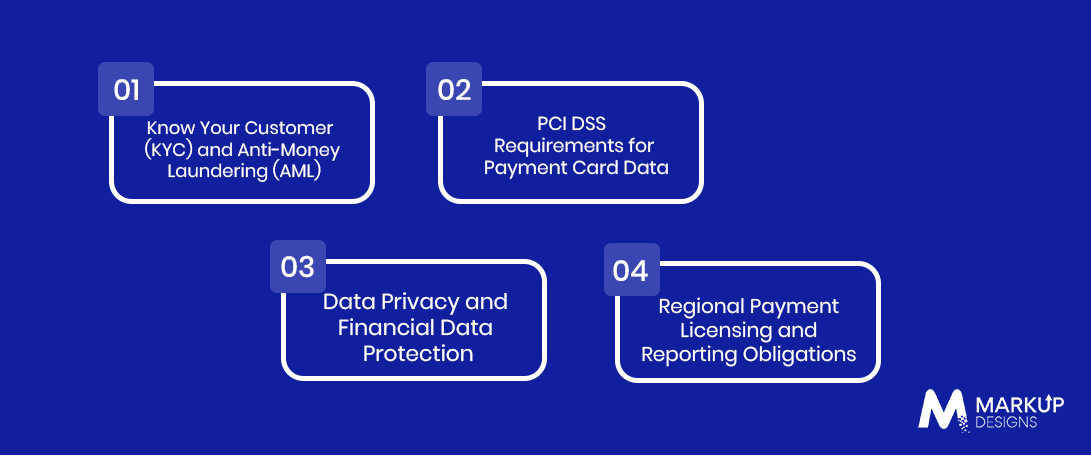
Compliance requirements will vary based on the geographic location where the app is operated, how the money moves, and what payment services the business offers. A business needs to define its compliance requirements prior to the start of the operation, as such compliance requirements could have an impact on licensing, onboarding, payments, and data handling.
Know Your Customer (KYC) and Anti-Money Laundering (AML)
The KYC requirement involves identity verification of customers, and the AML compliance requirement involves identifying and preventing money laundering and financial crime. Depending on the applicable law, the app could be required to perform customer due diligence, perform sanctions screening, monitor transactions, report suspicious activities, and keep records. The specific compliance requirement will depend on the jurisdiction and the role of the business in transferring the money.
PCI DSS Compliance Requirements for Payment Card Data
The Payment Card Industry Data Security Standard (PCI DSS) compliance is needed by organizations that store, process, and transmit payment card data, as well as those systems that affect the security of the payment card data. Business organizations need to evaluate the PCI DSS scope and apply relevant compliance requirements when storing, protecting, and handling the cardholder data.
Data Privacy and Financial Data Protection
The money transfer applications should ensure the processing of personal and financial information in compliance with privacy and data protection laws that might require obtaining valid consents where appropriate, restricting data collection, implementing retention policies, and other mechanisms for the protection of users’ rights. Encryption, restriction of access, and incident response contribute to information security.
Regional Payment Licensing and Reporting Obligations
Depending on the business model and country of operation, there may be the need for licensing, registering, or partnering with licensed financial institutions to carry out money transfers. Some businesses may have additional obligations regarding reporting, safeguarding, consumer protection, and maintaining transaction records. Get specific legal advice in the jurisdiction prior to launch, as using a payment gateway will not exclude licensing requirements.
What Is the Cost of Developing a Secure Money Transfer App?
The price of creating a secure money transfer application will depend on the functions of the app, the payment infrastructure that needs to be built, the security requirements, and the target countries of operation. The domestic money transfer application will usually be less expensive compared to an international application.
App Complexity and Feature Requirements
The number of features and their complexity will affect the cost of development. Simple functionality like registration, domestic transfers, and transaction history requires fewer resources than multi-currency payments, payout to businesses, analytics, or automatic reconciliation. The use of custom design, several mobile platforms, and complicated user roles will take more time and money to develop an application.
Security Infrastructure and Compliance Costs
Security will require authentication, encryption, security infrastructure, fraud protection, security assessments, and vulnerability management. Compliance costs may include services of identity verification, legal consultation, licensing, and systems for regulatory reporting. They will differ from company to company, according to its business model and the risk level and jurisdictions of the app operations.
Payment Gateway and Third-Party Integration Costs
Integration with banks, payment providers, identity verification companies, and fraud detection services may imply setup fees, usage fees, and subscription fees. Payment providers can charge fees for transactions or currency conversion. Businesses need to compare fees, supported jurisdictions, settlement terms, and requirements of providers.
Testing, Deployment, and Ongoing Maintenance
Pre-deployment costs include functional testing, security testing, performance testing, infrastructure setup, and deployment.
After launch, businesses must budget for cloud hosting, technical support, software updates, security patches, monitoring, and compliance reviews. Maintenance is a recurring operating expense, not a one-time development cost.
What Challenges Do Businesses Face When Building a Money Transfer App?
The development of a money transfer app means more than making digital payments possible. Companies should also address security issues, transaction reliability, dependency on third parties, and compliance with legal norms, while providing a quality user experience.
Preventing Fraud and Unauthorized Transactions
Clients may use stolen credentials, hacked devices, social engineering techniques, or flaws in the payment process to perform unauthorized payments. To minimize such risks, businesses can employ multi-factor authentication, transaction limitations, device monitoring, and risk-based verification. It is essential that fraud detection systems are able to identify suspicious activity without blocking legitimate transactions.
Protecting Sensitive Financial Information
Money transfer applications contain personal information, identification papers, and financial statements that are vulnerable to cybercriminals. Poor access control, insecure APIs, and improper data storage pose additional risks. Such methods as encryption, key management, minimization of information, and risk evaluation allow mitigating these dangers.
Managing Payment Failures and Transaction Reconciliation
Network failure, errors in payment gateways, and delayed responses from banks may cause discrepancies in order status. In this regard, companies require an efficient order status management system, idempotence mechanisms, methods for retrying operations in the case of failure, and a reconciliation procedure.
Integrating Banking Systems and Third-Party Services
Connecting to banks, payment systems, identification providers, and fraud detection providers may bring some technical complexity. Inconsistent APIs, different authentication, response formats, and availability may complicate the integration process. Standardization, secure API management, testing of integration, and failure handling may ensure the reliability of the payment system.
Maintaining Compliance Across Different Markets
Money transfer applications working in different countries may face different licensing requirements, identity verification, data protection, and transaction reporting requirements. These may influence onboarding, payment systems, data storage, and user funds management processes. Businesses need to assess compliance requirements for every country where they want to operate before developing the app.
How Can Businesses Ensure the Long-Term Security of a Money Transfer App?
Security is a never-ending process since the app will become outdated, fraud patterns will evolve, and legal regulations may change. It is crucial for businesses to create an approach for long-term monitoring and protection of transactions and customers’ data.
Conduct Regular Security Audits and Penetration Testing
Performing regular security audits and penetration testing is needed to identify weak spots in the application, backend, APIs, and payment flows.
Review access permissions, authentication controls, dependencies, and data handling practices, then prioritize remediation based on risk. Repeat assessments after major releases or significant infrastructure changes.
Monitor Transactions and Update Fraud Detection Rules
Continuously review transaction patterns, failed authentication attempts, unusual account activity, and payment anomalies. Update fraud detection rules as new threats emerge, and evaluate whether existing controls are generating excessive false alerts. Combining automated monitoring with a defined investigation process helps businesses respond to suspicious activity more effectively.
Keep APIs, Libraries, and Infrastructure Updated
Outdated software and unpatched dependencies can expose money transfer apps to known security vulnerabilities. Maintain an inventory of application components, monitor security advisories, apply patches promptly, and remove unsupported libraries. Regularly review API permissions, rotate credentials when appropriate, and secure cloud configurations to reduce avoidable risks.
Establish Incident Response and Recovery Procedures
Prepare documented procedures for handling compromised accounts, data breaches, payment disruptions, and suspected fraud. Assign response responsibilities, define escalation paths, and maintain tested backups and recovery plans. Regular exercises help teams restore services, investigate incidents, communicate with affected users, and meet applicable reporting obligations.
How Can Markup Designs Help You Build a Secure Money Transfer App?
At Markup Designs, we assist businesses in creating customized software solutions in line with the specific needs of the business, user preferences, and expansion strategies. We can assist you in designing a money transfer application based on the principles of reliability, scalability, and adequate security measures across application architecture, API integration, development, testing, and maintenance.
Depending on whether you need a payment application for local payments or international money transfers, we will be able to assist you in establishing the technical scope and development strategy for your project.
Build a Secure Money Transfer App for Your Business
Develop a payment solution designed around your business requirements, transaction workflows, and security needs. Partner with Markup Designs to plan your app development journey.

Conclusion
The creation of a secure money transfer app involves providing reliable payment infrastructure, implementing adequate security controls, managing transactions effectively, and being compliant with the relevant regulations. Businesses should be concerned with these aspects while developing the application and after its release in order to decrease the risks of fraud, keep the user data safe, and ensure proper performance of the payment process.
The correct development strategy is defined by the specifics of your target audience, payment method, integrations, and strategic goals.
FAQ
1. How much time will it take to create a money transfer application that is safe and reliable?
The amount of time will be influenced by the complexity of an app, its functionality, security measures, and licensing. An average application can take about several months to develop, but if the app includes some features and has banking integrations, fraud detection, cross-country payments and other functionality then it will take more than six months to create.
2. What kind of technologies are applied for creation of a money transfer app?
There are different kinds of technologies that can be applied to create a mobile money transfer application. Some of them are the following: Swift, Kotlin for mobile development; Flutter and React Native for cross-platform development; Node.js, Java, .NET for back-end technologies. There are also other kinds of technologies that will be applied depending on the project.
3. How can a money transfer app protect against fraud?
There are several ways to protect a money transfer application from fraud. Multi-factor authentication, secure API, transaction limits, identity verification, and transaction monitoring are among such ways. Also, risk-based verification can be helpful to recognize suspicious transactions.
4. Is it necessary to have a license to start a money transfer application?
This is needed when an enterprise itself provides regulated money transfer or payment services. The answer will depend on the country, business model, and whether there are licensed agents who hold, transfer, and process money transfers. Enterprises must contact lawyers specialized in this jurisdiction to get advice before launching their business.
5. Can a money transfer application process international transactions?
Of course, an application can process international transfers, but to do so, one needs to integrate suitable payment or banking systems, as well as implement currency exchange, calculate fees, monitor the transactions, and perform checks of cross-border transactions according to specific legislation. The availability depends on the coverage of the provider, supported settlement options, etc.
Author's Perspective
Creating a safe money transfer application implies that the business makes its primary focus on security, regulatory compliance, and transaction reliability as product characteristics rather than just features of an application. From our point of view, the right strategy is to select a correct payment model, integrate financial systems, and implement fraud prevention and monitoring tools in advance.
At Markup Designs, we recommend aligning the development strategy with your target market, operational needs, and long-term scalability goals before moving into development.
Discuss Your Project NowJupinder Singh Arora
Founder and CEO
Related Posts

How to Develop a Messaging App Like Telegram...
How Much Does It Cost to Hire Remote...

How Much Does It Cost to Create a...
Insights Are Valuable & Execution is Priceless
You’ve read about the digital future. Now, let’s build the infrastructure to take you there. Move your strategy from the page to the product.
Design Your Solution Now
Contact Us
Schedule The Appointment At Your Convenience Date And Time.
30 Min
Web Conference
Time Zone
Indian standard time (08:30pm)

Thanks For Getting In Touch!
You’ve Taken The First Step Toward Transforming Your Digital Presence. Our Experts Will Reach Out Shortly To Take It Forward.
Launch Your Dream Project
Provide a brief overview of your project, and our specialists will evaluate your requirements. We will connect with you to explore how the right digital solutions can help you launch faster.