
In Brief
- Study the peculiarities of custom biometric software development and its place in today’s business world.
- Get familiar with various kinds of biometric systems – fingerprint, facial, iris recognition, and speech recognition.
- Find out what elements are crucial for an effective biometric solution.
- Learn about cost, security concerns, and compliance issues related to biometric software development in 2026.
- Learn how to choose a suitable development approach.
As businesses continue to look for ways to increase the efficiency of security measures and the process of identifying users, biometric software plays an important role in the digital transformation. Be it a system for the automatic attendance check by fingerprints or facial recognition for access control, biometric solutions can help businesses to authenticate users based on physical or behavioral traits.
In 2026, more and more businesses will consider implementing custom biometric software in order to solve various business-related problems and enhance security. Yet, in order to develop effective biometric software, businesses should take into account much more than installing a fingerprint scanner or adding facial recognition tools to their systems.
It is crucial for organizations to choose the proper biometric technology, processing data requirements, system integration, privacy protection measures, and compliance regulations. Effective development strategies will help companies to create secure and scalable software that meets the business needs and ensures reliable identification of users.
What Is Custom Biometric Software Development?
Custom biometric software development implies the development of software products that perform personal verification or identification by unique biological characteristics of a person. Such custom-made software allows organizations to address particular security needs.
Understanding Biometric Authentication and Identification
Biometric authentication technology is responsible for verifying that a person is who he claims to be. Biometric identification technology helps to define the identity of a person through biometric data comparison with existing records.
Types of Biometric Technologies Used in Business Applications
Such biometric technologies as face recognition, fingerprints, iris recognition, voice recognition, as well as behavioral biometric technologies can be used in business applications. It is important to choose appropriate technology for a particular application.
Custom Biometric Software vs. Off-the-Shelf Solutions
Off-the-shelf products have predefined features and faster implementation, but offer fewer customization opportunities. Custom biometric software provides more flexible integration and security.
Why Should Businesses Invest in Custom Biometric Software in 2026?
Organizations are implementing biometric software in order to enhance identity management, simplify authentication, and eliminate security vulnerabilities. Custom software development enables integration of these features with specific business requirements.
Strengthening Identity Verification and Access Control
Biometric authentication will enable organizations to verify user identities before providing access to their applications, premises, or sensitive information. Biometrics may also be used for role-based authorization within business applications.
Reducing Identity Fraud and Unauthorized Access
Use of biometric authentication decreases the chances that an unauthorized individual could use a compromised password or credential. In addition, liveness detection and anti-spoofing capabilities will help prevent any attempts to deceive the recognition system.
Improving User Experience and Authentication Speed
Biometric authentication decreases dependence on passwords, PINs, and repeated authentication procedures. If implemented properly, biometric authentication provides fast and secure access.
Supporting Digital Transformation and Automation
Use of biometric software allows for automation of attendance tracking, customer onboarding, employee verification, and access management. In addition, integration with business applications helps to minimize unnecessary checks.
Meeting Industry-Specific Security Requirements
Certain industries, including financial services, healthcare, and government, have specific security requirements related to identity verification and access control. Custom solutions may be developed based on industry-specific regulations and policies.
Which Biometric Technologies Power Modern Authentication Systems?
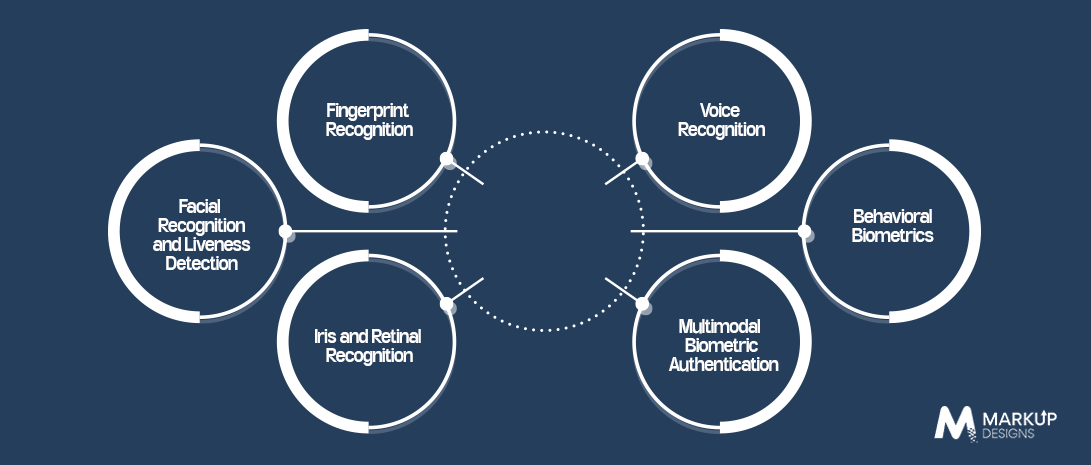
Biometric systems employ a number of methods for identifying individuals based on their characteristics, depending on various factors such as accuracy, environment, and level of security required. Some methods use one characteristic for identification, while others incorporate two or more biometric techniques.
Facial Recognition and Liveness Detection
Facial recognition technology identifies an individual based on their facial characteristics. Liveness detection helps establish whether an interaction with the system takes place with a live person or an image.
Fingerprint Recognition
The fingerprint recognition technique is based on analyzing certain characteristics of an individual’s fingerprint pattern and is used to authenticate an identity of a person. It is popular in attendance systems in companies and mobile device authentication.
Iris and Retinal Recognition
In the case of iris recognition, certain characteristics of the colored part of a person’s eye are analyzed, while retinal recognition uses characteristics of the blood vessels on the retina of a person’s eye. These two biometric techniques have some specific applications, and they require different hardware.
Voice Recognition
Voice recognition is used to authenticate individuals through their voice. This method is convenient when authentication is required through the telephone.
Behavioral Biometrics
This type of biometrics analyzes patterns related to typing, mouse actions, interaction with the device, or touches on the screen to help detect suspicious behavior and ensure continuous authentication.
Multimodal Biometric Authentication
It includes combining two or more biometric modalities such as face and fingerprint identification. In this way, it is possible not only to enhance verification accuracy but also to offer an alternative if one of the biometric methods fails.
What Features Should Custom Biometric Software Include?
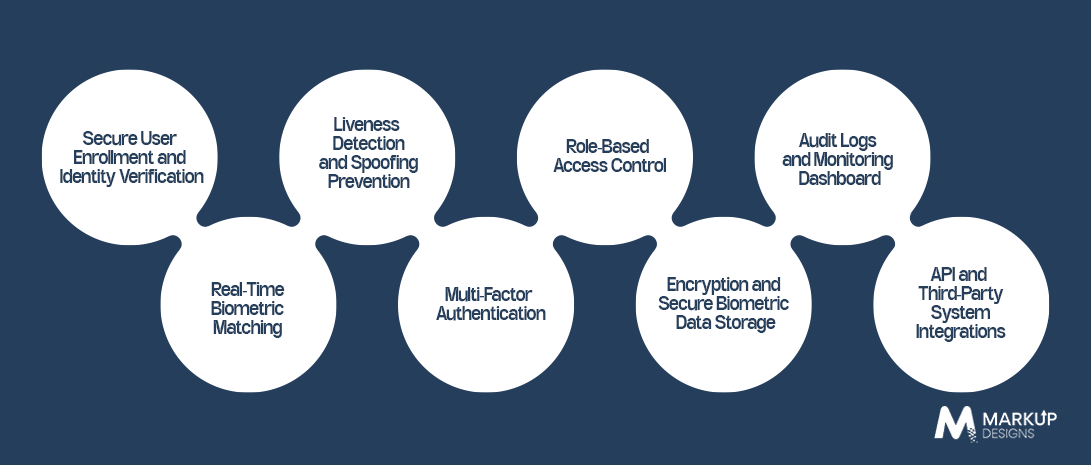
Apart from a reliable recognition engine, a proper biometric application should include features like accurate matching, data protection, access control, monitoring, and integration possibilities.
Secure User Enrollment and Identity Verification
At the enrollment stage, there should be a secure collection of data, identity verification if it is needed, and binding to the right account. Also, there should be consent and data retention policies established.
Real-Time Biometric Matching
The system should match the collected biometric samples with the ones that were previously stored as soon as possible. There should be matching thresholds that take into account false acceptance and false rejection rates based on the application’s security requirements.
Liveness Detection and Spoofing Prevention
Liveness detection can help differentiate real biometric samples from fake ones like photographs, masks, or audio recordings. Extra anti-spoofing measures need to relate to specific risks associated with the technology being used.
Multi-Factor Authentication
It is possible to combine biometric authentication with passwords, a security key, and a registered device. It will provide additional protection for sensitive accounts and risky transactions.
Role-Based Access Control
Role-based access control involves setting up different permissions depending on the role a person has. It makes sure that users get access to only those systems and information they are allowed to access.
Encryption and Secure Biometric Data Storage
Businesses need to protect biometric templates and any associated records by encrypting data, limiting access, and securely managing keys. In addition, businesses need to collect only necessary data and not store raw samples unless it is necessary.
Audit Logs and Monitoring Dashboard
Audit logs document authentication requests, access requests, as well as other changes made to the system. The monitoring dashboard allows for reviewing these actions and investigating suspicious ones.
API and Third-Party System Integrations
APIs allow biometric software to connect with HR platforms, banking systems, identity providers, attendance tools, and other business applications. Secure integrations reduce duplicate data entry and support consistent identity management.
How to Develop Custom Biometric Software for Your Business?
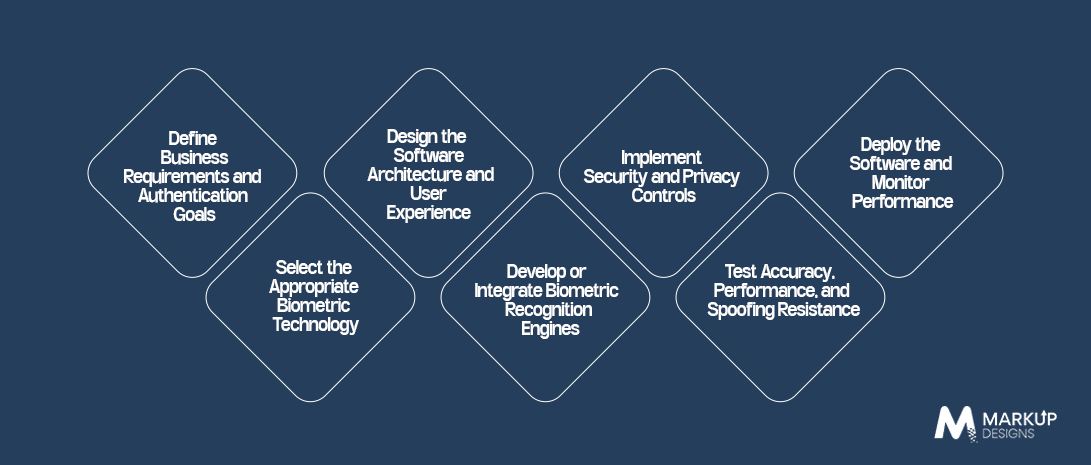
The creation of biometric software necessitates an organized process of connecting business needs to technology, security measures, and the needs of the user. Testing and monitoring play equally important roles in ensuring performance.
Define Business Requirements and Authentication Goals
Determine the problem that must be solved by the software, including workforce presence, customer registration, or building access. Define the user group, security threats, performance standards, and integration needs before choosing the technology.
Select the Appropriate Biometric Technology
Evaluate the different biometric technologies based on their accuracy, costs, availability of hardware, ease of use, and risk exposure. The chosen technology should fit the operational environment and provide a viable alternative in case of unsuccessful biometric authentication.
Design the Software Architecture and User Experience
Determine the elements of the software, data flow, authentication process, and system integrations. The user interface should facilitate the process of enrollment and authentication while providing alternatives for users unable to undergo biometric authentication.
Develop or Integrate Biometric Recognition Engines
Create the necessary recognition functionality or use a third-party recognition engine through SDK or API. Analyze licensing and deployment issues, performance, and control over biometric data.
Implement Security and Privacy Controls
Apply encryption, access restrictions, secure storage, consent management, and data-retention policies. Review applicable privacy laws and establish procedures for handling biometric data, user requests, and security incidents.
Test Accuracy, Performance, and Spoofing Resistance
Test recognition accuracy across relevant user groups, devices, lighting conditions, and operating environments. Assess false acceptance and rejection rates, response times, accessibility, and resistance to spoofing before deployment.
Deploy the Software and Monitor Performance
Roll out the application in phases, train users, and monitor system performance after launch. Regular security reviews, software updates, and accuracy assessments help maintain reliability as business needs evolve.
How Much Does Custom Biometric Software Development Cost in 2026?
The cost of bespoke biometric software development relies on recognition technology, features, integration, and security. Basic solutions are less expensive than advanced enterprise solutions that incorporate AI-powered recognition, sophisticated security measures, and large-scale deployment.
Complexity and Feature Requirements
Basic biometric login or attendance software requires less effort from developers than software capable of handling different biometric data, real-time monitoring, and advanced access control features.
Biometric Hardware and Software Integrations
Depending on whether your product will use existing sensors on the device or will rely on dedicated biometric scanners or remote recognition services, development efforts might differ. Integration with HR, payment gateways, and other identity management services will require extra funding.
AI Models and Recognition Algorithms
The development process becomes more complicated if a custom enterprise AI model is used as opposed to an API from a third-party recognition service. The complexity of the model is also a factor that influences the price.
Security, Compliance, and Testing
Encryption, liveness detection, penetration testing, and compliance with regulatory requirements increase the development cost but are absolutely necessary to protect the biometric data.
Infrastructure, Deployment, and Monitoring
Cloud hosting, on-premises infrastructure, storage, software maintenance, and monitoring will all impact the total cost. Businesses should account for these recurring expenses when planning their budget.
Which Industries Benefit From Custom Biometric Software Development?
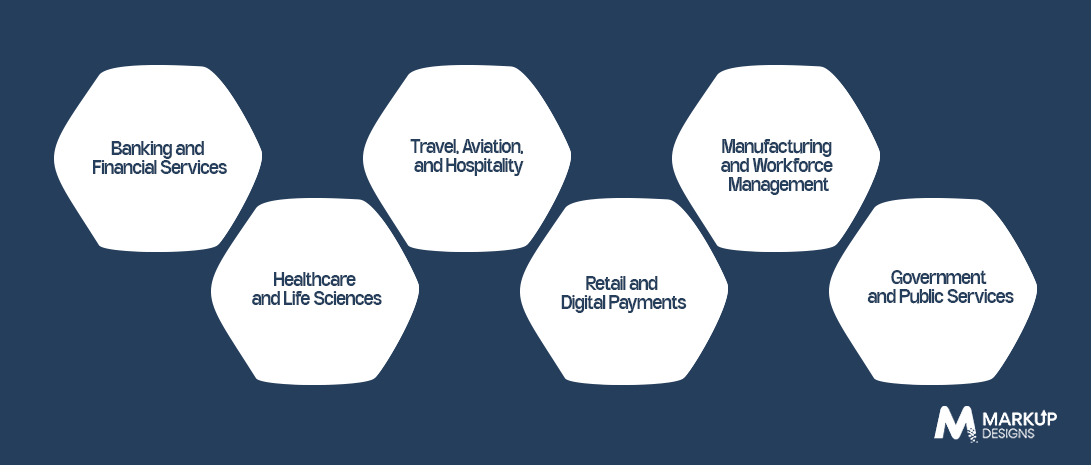
The custom-made biometric software caters to sectors that have stringent identity verification needs, secure entry, and efficient operations. The use of the technology varies across industries due to different workflows and security needs.
Banking and Financial Services
Biometrics can be used for customer onboarding, transaction validation, and account access within banks and fintech institutions. Biometric software combined with proper authentication controls can enhance fraud prevention.
Healthcare and Life Sciences
Healthcare providers can leverage biometrics to verify patient identity, control employee access, and protect electronic health records. Identification helps avoid errors resulting from duplicates or mismatches in patient records.
Travel, Aviation, and Hospitality
Biometric verification is useful at airports, airlines, and hotels to simplify check-in procedures, boardings, and identification of guests. Such implementations need to take into consideration consent and other issues.
Retail and Digital Payments
Companies in retail can deploy biometric authentication to enable secure payments, loyalty account access, and other customer-related features. Efficient verification control will help minimize fraudulent transactions.
Manufacturing and Workforce Management
Manufacturers use biometric solutions for attendance management, access control in restricted areas, and workforce management. Such software can integrate with workforce management solutions.
Government and Public Services
Governments may employ biometric solutions for identification purposes, citizen services, and restricted access to government buildings. This application area requires special attention to data governance, security, and regulation.
What Security and Compliance Requirements Should Businesses Consider?
Biometric data is sensitive as it is directly tied to personal identity and cannot be modified like passwords. It is crucial to ensure privacy, security, and accountability when designing the solution.
Protecting Biometric Data and User Consent
Gather only biometric data that is necessary for a specific task and inform your customers about its usage. Gather valid consent from customers where necessary and offer alternatives when people cannot or do not want to use biometrics.
Encryption and Secure Data Processing
Secure biometric data on transit and in storage through the use of strong encryption and limited access. Proper key management and data minimization reduce risks of data leaks even in case of a security breach.
Preventing Spoofing and Presentation Attacks
Introduce a mechanism of liveness detection and biometric spoofing prevention compatible with the chosen biometric solution. Test it regularly against modern threats, such as synthetic media and manipulated biometric data.
Meeting Applicable Data Protection Regulations
Determine the data privacy and biometric data legislation that would apply to the enterprise, its customers, and location of operations. Compliance requirements can include India’s DPDP Act, the EU GDPR, or others.
Establishing Data Retention and Deletion Policies
Specify for how long you will retain biometric data and when it will be erased. Ensure that erasure policies include active systems, backups, and third parties (data processors).
Conducting Security Audits and Continuous Monitoring
Conduct periodic security audits, penetration testing, and access control checks. Perform monitoring of authentication processes and establish incident response policies.
What Challenges Do Businesses Face in Biometric Software Development?
The challenge of biometric software is to provide reliable identification while securing users’ privacy and being able to operate on various types of hardware and under various circumstances. Solving the challenges at the early stage of development will help avoid expensive redesign.
Maintaining Accuracy Across Different User Groups
Accuracy of the process can depend on lighting conditions, sensors used, environment, and individual characteristics of different users. Testing across representative populations and real-world scenarios helps identify and reduce accuracy gaps.
Preventing Deepfakes and Biometric Spoofing
Attackers could employ photos, video clips, masks, or artificial media generated through AI techniques to trick authentication mechanisms. Businesses should implement layered approaches and tests instead of trusting any single security attribute.
Integrating With Legacy Systems
Old applications used by businesses could rely on incompatible data formats, authentication processes, or hardware components. APIs, middleware components, and a phased integration approach could be used to integrate biometric software.
Balancing Security With User Convenience
Extra layers of authentication could increase the security of the process, but at the same time, slow down the overall authentication process. Businesses should select their verification methods according to risks involved.
Managing Infrastructure and Maintenance Costs
Biometric authentication requires specific infrastructure, dedicated hardware, frequent updates of models, and secure storage of data. A plan for scalable growth and proper maintenance of infrastructure reduces costs for businesses.
Addressing Privacy Concerns and User Trust
A user could refuse to share biometric data because of privacy concerns. Clear policies and data limitation would help users to trust the system.
What Biometric Software Development Trends Will Shape 2026?
The development of biometrics in 2026 will pay increasing attention to improving fraud protection measures, privacy-oriented processing, and multi-device authentication. Business entities need to evaluate these trends according to their security needs instead of implementing a new feature without any goal.
AI-Powered Liveness Detection and Deepfake Prevention
AI-based detection allows recognizing fake images, voices, and various spoofing attempts. It depends on the accuracy of detection models and their testing against newly emerging attacks.
Passwordless Authentication and Passkeys
Using passkeys makes it possible to implement authentication using cryptographic keys stored in the device and authenticated by means of biometrics. It enables a business not to rely on passwords while avoiding the storage of biometric information.
Privacy-Preserving Biometric Processing
Protected biometric templates and on-device matching are two methods that can minimize data exposure. They can be selected depending on the particularities of the application, threat model, and legal regulations.
Behavioral Biometrics and Continuous Authentication
Behavioral biometrics involves analysis of interaction patterns with the system such as typing behavior and device use. Continuous monitoring adds security to the process without disturbing users constantly.
Multimodal Authentication Systems
Using more than one approach, for instance, facial and fingerprint recognition, will help increase reliability, especially when one alone cannot be used. Companies should balance the increased level of security with costs incurred and extra hardware required.
Edge-Based Biometric Processing
Edge computing carries out the biometric processing of data samples on a client’s local device or close system instead of sending all data samples to a central server.
How Can Businesses Choose the Right Biometric Software Development Partner?
A good biometric software development company should have knowledge of biometric technology as well as data security and software system integration and maintenance. The business should consider the technical capabilities and experience of the software developer.
Evaluate Technical Expertise and Industry Experience
Look into the experience of the software developer in relation to biometric recognition, artificial intelligence integration, and their applications in your field. Inquire how the team evaluates accuracy, failure cases, and validation of their processes.
Assess Security Engineering and Compliance Knowledge
Ensure that the software developer understands how to implement security measures, including encryption, secure data handling, proper access control, as well as privacy protection requirements. They should also understand the compliance obligations relevant to your target markets.
Review Integration and Scalability Capabilities
Assess the partner’s ability to integrate with existing systems, support future users, and adapt to changing business requirements. A modular architecture can make upgrades and additional integrations easier.
Compare Development Costs and Long-Term Support
Compare proposals based on scope, security testing, deployment, maintenance, and licensing—not just the initial development price. Clear support commitments help businesses estimate long-term costs and manage risks.
How Can Markup Designs Help You Build Custom Biometric Software?
Markup Designs assists businesses in planning and developing software based on operational needs, integration, and security requirements. The main aspects include solution architecture, integration of artificial intelligence, and custom application development.
Build a Secure Biometric Solution for Your Business
Develop biometric software tailored to your authentication, security, and operational requirements. Partner with Markup Designs to plan the right technology stack, integrate essential capabilities, and build for long-term scalability.

Conclusion
Custom biometric software can be a tool that would assist businesses in enhancing the identity verification process, minimizing fraud, and managing access. The implementation of such systems will depend on the appropriate selection of technologies, protection of biometric information, and planning the integration and other aspects of the work. A well-developed development strategy will help to combine security, user-friendly solutions, and cost.
FAQ
1. How expensive is biometric software development in 2026?
The price will depend on feature complexity, type of biometric technology, integrations, security standards, and scale of deployment. The simpler verification app will cost you less than a complex enterprise platform with custom-made AI models and sophisticated mechanisms for fraud prevention.
2. How much time do developers need to create a biometric system?
The development time depends on the complexity of the system and may be several months for a basic solution and six months or even more for an enterprise platform.
3. Which type of biometric technology should be used for business authentication?
There are different technologies like facial recognition and fingerprint reading that are suitable for most authentication requirements. But iris recognition, voice, and behavioral biometrics fit into specific cases.
4. Is biometric authentication more secure than passwords?
While biometric technology can reduce the risk of password leakage or reuse, it is not more secure per se. It is still crucial to include liveness detection, encryption, access control, and fallback authentication methods.
5. What measures should be taken to prevent spoofing attacks and deepfake attacks with biometric software?
Biometric systems can combine liveness detection, presentation-attack detection, anti-spoofing models, and risk-based verification. Regular testing and updates are necessary because attack techniques continue to evolve.
Author's Perspective
Biometric software has to be viewed not as an upgrade but as an investment in long-term identity security. Businesses will have to find the optimal balance between recognition accuracy, privacy, user-friendliness, and fraud prevention. Choosing technologies that meet all these criteria from the very beginning could contribute to more stable solutions by 2026.
Discuss Your Project NowGaurav Goyal
Global Sales- VP
Related Posts

Custom Warehouse Management System Development: Features, Process, and...

How to Develop Healthcare Software in Australia: Process,...

Enterprise Application Integration: A Complete Guide for Modern...
Insights Are Valuable & Execution is Priceless
You’ve read about the digital future. Now, let’s build the infrastructure to take you there. Move your strategy from the page to the product.
Design Your Solution Now
Contact Us
Schedule The Appointment At Your Convenience Date And Time.
30 Min
Web Conference
Time Zone
Indian standard time (08:30pm)

Thanks For Getting In Touch!
You’ve Taken The First Step Toward Transforming Your Digital Presence. Our Experts Will Reach Out Shortly To Take It Forward.
Launch Your Dream Project
Provide a brief overview of your project, and our specialists will evaluate your requirements. We will connect with you to explore how the right digital solutions can help you launch faster.