
In Brief
- Enterprise Application Integration (EAI) enables various software applications to be connected for information sharing and collaboration. It ensures that there is less manual data input, fewer information silos, greater information accuracy, and faster availability of current information.
- Some of its benefits are increased efficiency of operations, faster decision-making, enhanced customer experience, reduced operating expenses, and scalability. EAI approaches include point-to-point, hub-and-spoke, Enterprise Service Bus (ESB), middleware approach, API-led, and microservices integration.
- Use cases where EAI can be applied include CRM and ERP system integration, HR and payroll application integration, e-commerce and inventory system integration, finance and payment application integration, and customer support with marketing and logistics application integration.
- Integration depends on proper definition of business objectives, evaluation of the existing systems, correct architecture, security, phase-based deployment, and continuous performance analysis. Integration cost estimates are from $5,000 to $15,000 for simple integration, from $15,000 to $50,000 for medium complexity integration, and from $50,000 to $150,000+ for complex enterprise integration.
- Companies will be able to minimize integration costs if they focus on critical processes, reuse existing APIs, choose appropriate tools, and plan for future maintenance needs. Markup Designs has 14+ years of experience, 200+ professionals, and expertise in working with more than 500 companies.
Today’s business enterprises employ various applications in order to perform such activities as sales, finance, stock, customer support, HR, and others. But if all these programs are used independently of each other, employees face some problems connected with a lack of integration, duplication of efforts, and difficulties with access to essential information. This may affect the efficiency of the company’s operations negatively.
Enterprise Application Integration (EAI) is an effective way to overcome these challenges. Using EAI, an enterprise is able to connect different software systems and make them interact, thus eliminating information gaps, coordinating activities of different departments, and managing processes more effectively.
When an organization grows, its integration becomes vital for preserving efficient workflows and expanding in the future. The right integration approach can save money and enhance customer experience as well.
In this blog post, we will find out what enterprise application integration is, how it works, why you need it, what types of it there are, and what use cases there are for it. We will also talk about its implementation, its cost, and Markup Designs’ help in connecting enterprise applications.
What is Enterprise Application Integration (EAI)?
EAI stands for Enterprise Application Integration and refers to the connection between various applications within an enterprise through which data sharing can be accomplished between them. Instead of handling every application in a disconnected fashion, the enterprise can establish a connected environment wherein information flows seamlessly from one department to another.
For example, a business could have an application dealing with customers, another dealing with accounts, and yet another dealing with inventory. In the absence of integration, the users of these applications may have to input the same data again and again in different applications.
EAI can leverage the use of technologies like API, middleware, messaging, and integration platforms for facilitating communications among different applications. EAI is capable of providing real-time or scheduled data exchanges according to the specific needs of the business.
The fundamental objective of EAI is to help different systems integrate without necessarily having to upgrade their entire system software. The process enables companies to become more efficient, streamline processes, access information, and create a more flexible technological environment.
How Does Enterprise Application Integration Work?
Enterprise Application Integration involves linking up various software solutions and enabling a seamless flow of data among them through the use of integration technologies that enable the applications to communicate, exchange data, and coordinate with each other without having to physically move data around for employees.
Here is how the process generally works:
- Data Integration: Data is shared and synchronized across various applications in order to maintain consistency within records.
- APIs and Middleware: API enables communication among various applications, while middleware facilitates data transfer between different technological solutions.
- Event-Driven Architecture: Various applications are triggered through certain events, such as an order being placed or the receipt of a payment.
- Workflow Orchestration: Multiple activities are orchestrated across various applications to streamline business processes.
For example, when a consumer purchases on an e-commerce website, integration will automatically update the inventory, send information to the finance application, and notify the delivery staff.
This is dependent on the applications being used, the amount of data that needs to be moved, security considerations, and whether information should be sent immediately or at scheduled times.
Why Do Modern Businesses Need Enterprise Application Integration?
Current business entities rely on various applications in order to handle their daily business activities. Nevertheless, if these systems are running independently from one another, employees might have difficulties due to possible information gaps, repetition of tasks, and delays in the completion of significant procedures. This is where Enterprise Application Integration comes in handy and solves these problems.
The following list represents some major reasons for companies to apply EAI:
- Independent Systems: Integration unites independent applications, allowing departments to have access to unified information.
- Manual Data Entry: Automated exchange of data eliminates redundant actions and the possibility of mistakes made manually.
- Delayed Information: Employees receive updated information in a faster way, being able to react to changes taking place in the company.
- Limited Visibility: Integration provides better visibility of operations, customers’ activity, and performance of the business.
- Growing Operations: Integration assists in linking applications while the company is expanding its processes.
- Enhanced Customer Service: Employees receive all necessary information regarding customers’ requests from integrated systems.
For growing organizations, EAI is not just about connecting software. It is a good opportunity for growing businesses to organize their operations and collaborate with each other better.
Key Benefits of Enterprise Application Integration
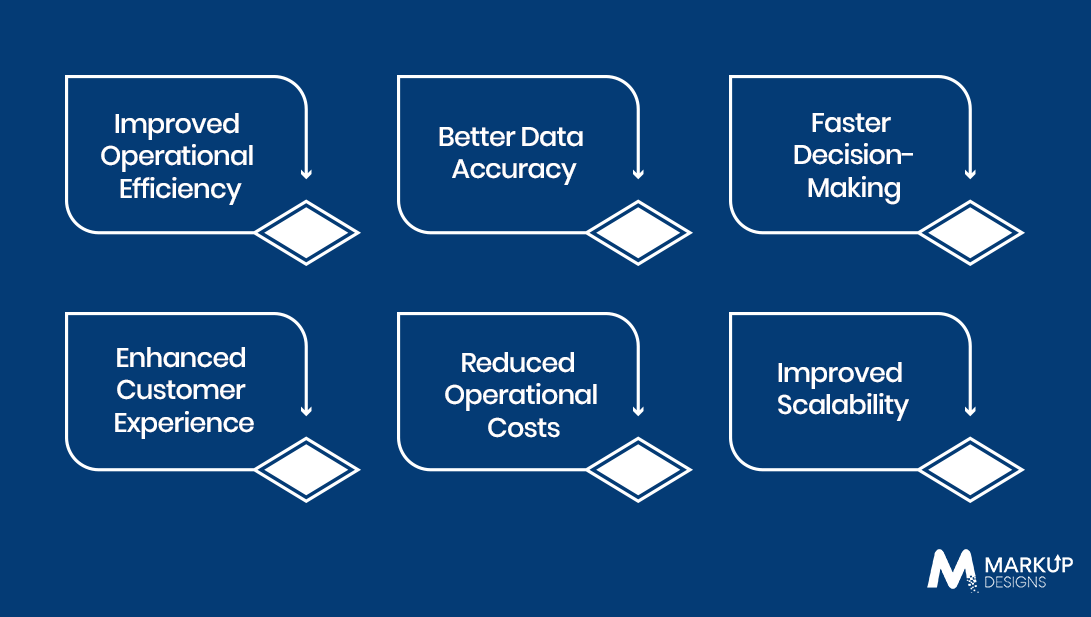
Enterprise Application Integration assists organizations in extracting additional benefits from their software through integration and improved data flow across different applications. If properly carried out, integration will assist in streamlining daily processes and making better business decisions.
Improved Operational Efficiency
Through integration, routine activities such as order entry, record updates, and customer data transfer become automated. This results in decreased manual labor and increased productivity for employees.
Better Data Accuracy
Since data is automatically transferred between applications, there will be fewer duplicates and errors. Consistent records will help teams work with accurate data.
Faster Decision-Making
As a result of integration, managers have the ability to quickly access relevant data. They can analyze the latest sales, financial, and operational data without having to wait for reports from different departments.
Enhanced Customer Experience
It is easier for the customer service department to have access to information regarding order history, support queries, and account information.
Reduced Operational Costs
The automation of data transfer and reduction in repetitive actions lead to lower expenses. It is possible for businesses to save on the correction of errors as well as separate processes.
Improved Scalability
As the organization grows, it might require more applications, departments, or even branches. Therefore, an effective system for integration allows for simpler expansion and development.
Types of Enterprise Application Integration
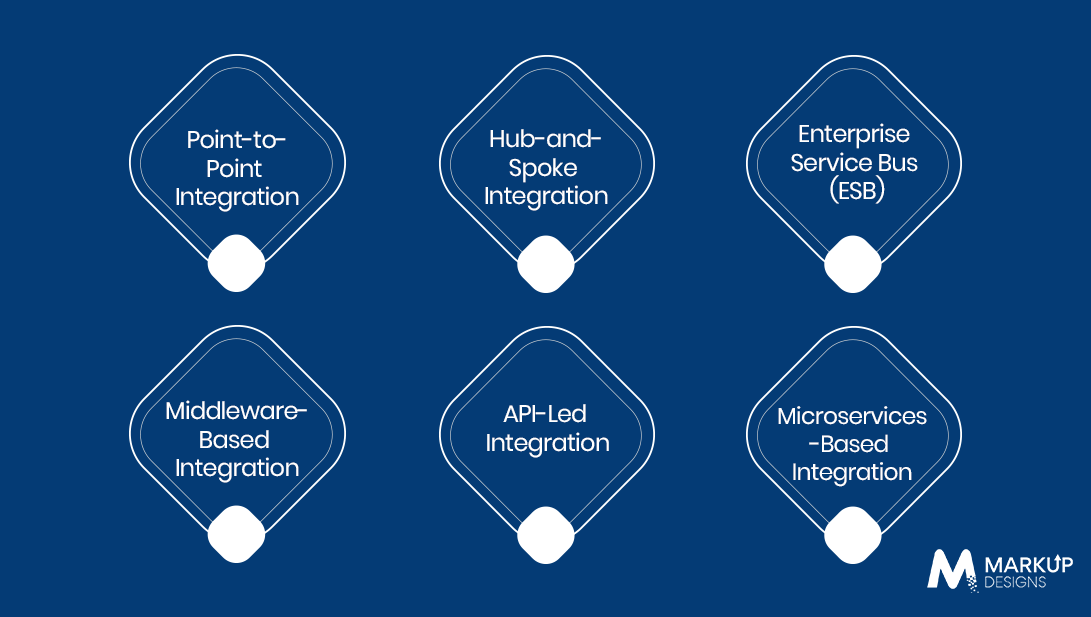
Companies can use different methods to connect their applications depending on their current infrastructure, requirements, and plans. Selecting the appropriate method will help facilitate communication between the applications while simplifying the integration process with business growth.
Point-to-Point Integration
Point-to-point integration means that two applications are directly connected. In the case of point-to-point integration, an e-commerce platform is directly connected to an inventory management system to update the inventory after each purchase made.
Hub-and-Spoke Integration
In this type of integration, the hub controls the process of communication between applications. This means that instead of establishing communication between every application individually, applications communicate via the hub.
Enterprise Service Bus (ESB)
An Enterprise Service Bus is a common communication layer that lets applications communicate by sending and receiving messages and data.
Middleware-Based Integration
Middleware serves as an interface among applications that cannot interact directly. It facilitates data transfer, processes requests, and manages interactions between different applications.
API-Led Integration
API integration enables applications to exchange data using application programming interfaces (APIs). It enables managed communication between applications and external components.
Microservices-Based Integration
Microservices integration integrates small-scale services that are responsible for particular business processes. They interact using APIs, messaging, and events.
Common Enterprise Application Integration Use Cases
Enterprise Application Integration is a solution that helps support different business processes through integrating applications that have to exchange information with each other. The following examples will give some insights into how businesses use Enterprise Application Integration in practice.
CRM and ERP Integration
By integrating Customer Relationship Management (CRM) and Enterprise Resource Planning (ERP) applications, sales, finance, and operations departments will have access to one source of information about customers and orders.
HR and Payroll System Integration
By integrating human resource management and payroll systems, companies can eliminate multiple data inputs and reduce errors by automatically sending updates on changes to employee information, time, and leave management.
E-commerce and Inventory Integration
The online shop will not be able to provide correct information about the availability of certain products unless e-commerce and inventory systems are integrated.
Finance and Payment System Integration
Linking up financial applications to payment gateways and accounting systems will make sure that businesses have all transaction details, reconciliation of payments, and unpaid balances in one place, thus streamlining the process for better reporting.
Customer Support and Marketing Integration
By integrating the customer support applications with the marketing automation applications, organizations can easily view all customer communications and their preferences, making it easier for the organization to plan their campaigns and follow-up communications.
Supply Chain and Logistics Integration
Integration can link up procurement, warehousing, inventory, and shipping applications, making it easy for organizations to track order progress and stock flow.
How to Build an Effective Enterprise Application Integration Strategy
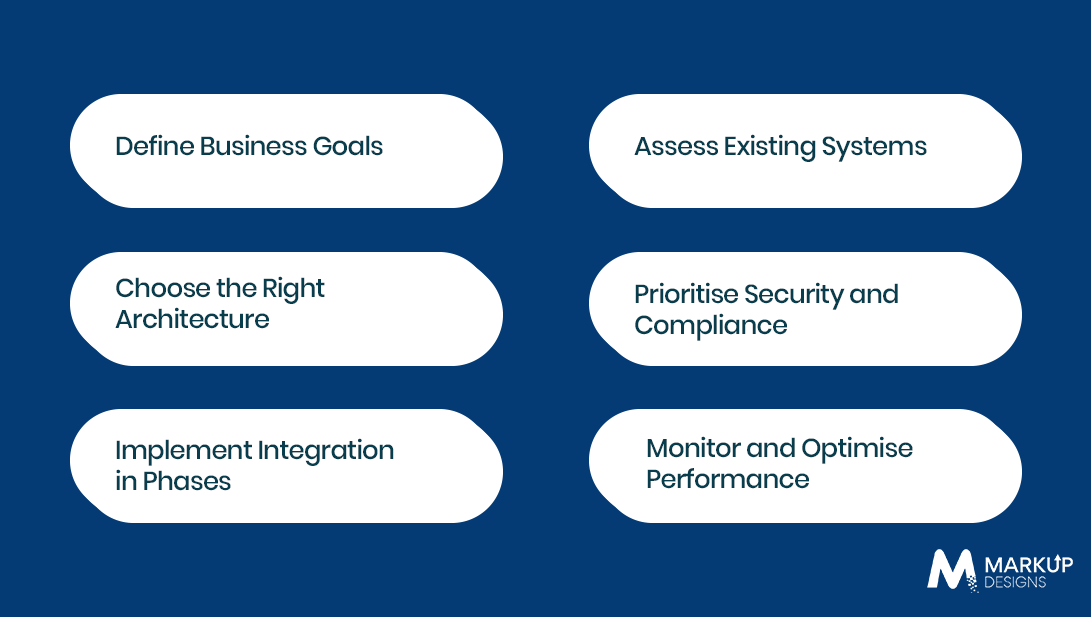
In addition to linking applications, businesses should consider their objectives, evaluate current systems, select appropriate technology solutions, and develop plans for future maintenance of the architecture. Proper planning will help to lower costs and minimize disruptions.
Define Business Goals
Businesses should clarify why integration is needed in terms of resolving some problems such as automation of manual data input, improvement of reporting capabilities, order processing, or sharing information about customers among different departments.
Assess Existing Systems
Businesses should analyze the applications in use, the data they operate with, and how they exchange data. Businesses should pay attention to obsolete applications, duplicate data, limitations of technologies used, and any processes requiring manual labor.
Choose the Right Architecture
Businesses need to select an integration architecture depending on the complexity of their business, characteristics of applications, the amount of data operated with, and the growth of their operations.
Prioritise Security and Compliance
Integration of systems may involve handling confidential information related to customers, employees, and finances. Use the appropriate security and compliance measures.
Implement Integration in Phases
Do not integrate all applications unless the need is there according to project requirements. Identify an important workflow, test data accuracy and system performance, and then work on improvement.
Monitor and Optimise Performance
Once integrated, measure the data flows, errors, synchronization, and response time. Arrange for timely alerts and recovery plans so that any problem is handled quickly.
How Much Does Enterprise Application Integration Cost?
The cost of Enterprise Application Integration is determined by the number of applications, complexity of systems, type of integration being done, and quantity of data exchange. The cost of connecting two contemporary applications is likely to be low compared to the cost of integrating many legacy systems.
Businesses should assess their requirements before setting a budget, as the final cost can vary significantly from one project to another.
Estimated Enterprise Application Integration Cost
| Project complexity | Estimated cost (USD) | Typical scope |
| Basic integration | $5,000–$15,000 | Connecting two standard applications |
| Medium-complexity integration | $15,000–$50,000 | Multiple applications with custom workflows |
| Complex enterprise integration | $50,000–$150,000+ | Legacy systems, complex data flows, and enterprise-wide requirements |
How Markup Designs Helps Businesses Integrate Enterprise Applications
Markup Designs helps companies integrate their software platforms for better data exchange, workflow efficiency, and elimination of redundant manual work. Our company has more than 14 years of experience, more than 200 experts, and we have helped more than 500 businesses, which allows us to know the significance of developing a solution that will be beneficial for the current needs and future growth.
Our team analyzes your current software solutions to determine what type of integration is needed, taking into account the specifics of your technologies and business objectives. We can assist you in developing APIs, integrating your software platform with third-party applications and legacy systems, automating your workflows, and creating an integrated IT infrastructure.
Whether you need to integrate your CRM and ERP systems, synchronize your business data, or upgrade your current software system, Markup Designs can assist you in planning and implementing a viable integration strategy for greater efficiency and scalability in the future.
Looking to Simplify Your Enterprise Application Integration?
Connect your existing systems, reduce manual work, and improve data flow with the right integration strategy. Markup Designs can help you build reliable solutions that support your business goals.

Conclusion
Enterprise Application Integration assists companies in today’s world in connecting various software systems, enhancing data sharing, and simplifying operations. This will help organizations decrease the number of manual processes, ensure the accuracy of data, and increase the access of employees to needed information.
It is important that integration be done in a proper way, as it demands good planning by the business organization. Organizations have to decide on the proper architecture, analyze their systems, and take care of security operation services measures and maintenance.
Starting with high-priority workflows and building up gradually can be a solution for businesses that want to take care of the risks and still deliver the results. Continuous monitoring and optimization will make sure that integration keeps pace with changing needs.
In case your apps work in different systems and cause delays, it is high time to reconsider your integration strategy. In collaboration with the right technical partner, you will be able to establish a connected software environment.
Markup Designs will assist you in developing enterprise application integration solutions in accordance with your existing systems and business objectives.
FAQs
1. What is enterprise application integration used for?
Enterprise application integration connects different software applications so they can share data and coordinate workflows. Businesses use it to reduce manual work, improve data accuracy, and streamline processes across departments such as sales, finance, HR, and inventory management.
2. What are the main types of enterprise application integration?
The main types include point-to-point integration, hub-and-spoke integration, Enterprise Service Bus (ESB), middleware-based integration, API-led integration, and microservices-based integration. Each approach serves different needs depending on system complexity, scalability requirements, and the number of applications involved.
3. How long does enterprise application integration take?
The timeline depends on the number of applications, system complexity, data migration requirements, and testing needs. A basic integration may take a few weeks, while a complex enterprise-wide project can take several months or longer. A technical assessment helps establish a realistic timeline.
4. Is enterprise application integration secure?
Yes, enterprise application integration can be secure when designed with appropriate safeguards. These include encryption, secure authentication, role-based access controls, monitoring, and regular security testing. Businesses should also ensure that their integrations meet applicable data protection and industry compliance requirements.
5. What is the difference between EAI and API integration?
Enterprise Application Integration (EAI) is a broader approach to connecting applications and coordinating data flows across an organization. API integration is one method used within EAI to enable communication between software systems. EAI may also use middleware, message queues, event-driven architecture, and other integration technologies.
Author's Perspective
Enterprise Application Integration is an important step for businesses looking to improve how their software systems work together. Disconnected applications can create unnecessary complexity, but the right integration strategy helps teams share information, automate workflows, and make better decisions. Businesses should focus on their actual operational needs rather than adopting technology simply because it is popular. A well-planned approach, supported by strong security and regular monitoring, can deliver lasting value. With the right expertise, organizations can build a connected technology environment that supports efficiency, flexibility, and long-term growth.
Discuss Your Project NowJupinder Singh Arora
Founder and CEO
Related Posts
How Much Does Custom Accounting Software Development Cost...

How Much Does It Cost to Develop Property...

How to Build an Insurance Portal with CRM,...
Insights Are Valuable & Execution is Priceless
You’ve read about the digital future. Now, let’s build the infrastructure to take you there. Move your strategy from the page to the product.
Design Your Solution Now
Contact Us
Schedule The Appointment At Your Convenience Date And Time.
30 Min
Web Conference
Time Zone
Indian standard time (08:30pm)

Thanks For Getting In Touch!
You’ve Taken The First Step Toward Transforming Your Digital Presence. Our Experts Will Reach Out Shortly To Take It Forward.
Launch Your Dream Project
Provide a brief overview of your project, and our specialists will evaluate your requirements. We will connect with you to explore how the right digital solutions can help you launch faster.