
In Brief
- AI Is Becoming Core: Generative AI, AI agents, and on-device intelligence are making apps more responsive and personalised.
- Connected Experiences: 5G, IoT, wearables, and edge computing are enabling faster, real-time interactions across devices.
- Immersive Interfaces: AR and spatial computing are expanding how users interact with mobile applications.
- Smarter App Development: Cross-platform frameworks and cloud native architectures are helping businesses build scalable applications faster.
- Security by Design: Privacy, biometric authentication, encryption, and intelligent fraud detection are becoming essential to future-ready apps.
Mobile apps are moving beyond simple tools for browsing, booking, shopping, or communication. In 2026, they are becoming intelligent platforms that can understand user behaviour, automate tasks, deliver personalised experiences, and connect seamlessly with other devices. Technologies such as generative AI, edge computing, 5G, IoT, and spatial computing are changing what users expect from mobile applications.
For businesses, this shift creates both opportunities and challenges. Adopting emerging technology can improve engagement, efficiency, and customer experiences, but adding technology without a clear purpose can increase complexity and cost. The future of mobile app development will therefore depend on choosing the right technologies, building scalable architecture, and creating experiences that solve real user needs.
How Mobile Apps Are Evolving in 2026
Mobile apps are shifting from basic tools into intelligent, connected experiences. AI, faster connectivity, and connected devices are changing how apps respond to users and interact with the wider digital ecosystem.
From Feature-Based Apps to Intelligent Experiences
Apps are becoming more adaptive, using AI to understand behaviour, personalise content, and automate routine actions instead of simply offering fixed features.
From Cloud-Dependent Apps to On-Device Processing
More processing is moving directly onto devices. This can improve response times, support offline functionality, and reduce the need to send sensitive data to remote servers.
From Single Purpose Apps to Connected Ecosystems
Apps are increasingly integrating with payments, wearables, smart devices, vehicles, and third-party platforms, creating connected experiences beyond a single application.
From Mobile Screens to Multidevice Experiences
The mobile experience now extends across smartphones, tablets, smartwatches, vehicles, and other connected devices, allowing users to continue tasks across multiple touchpoints.
Emerging Technologies Shaping the Future of Mobile Apps
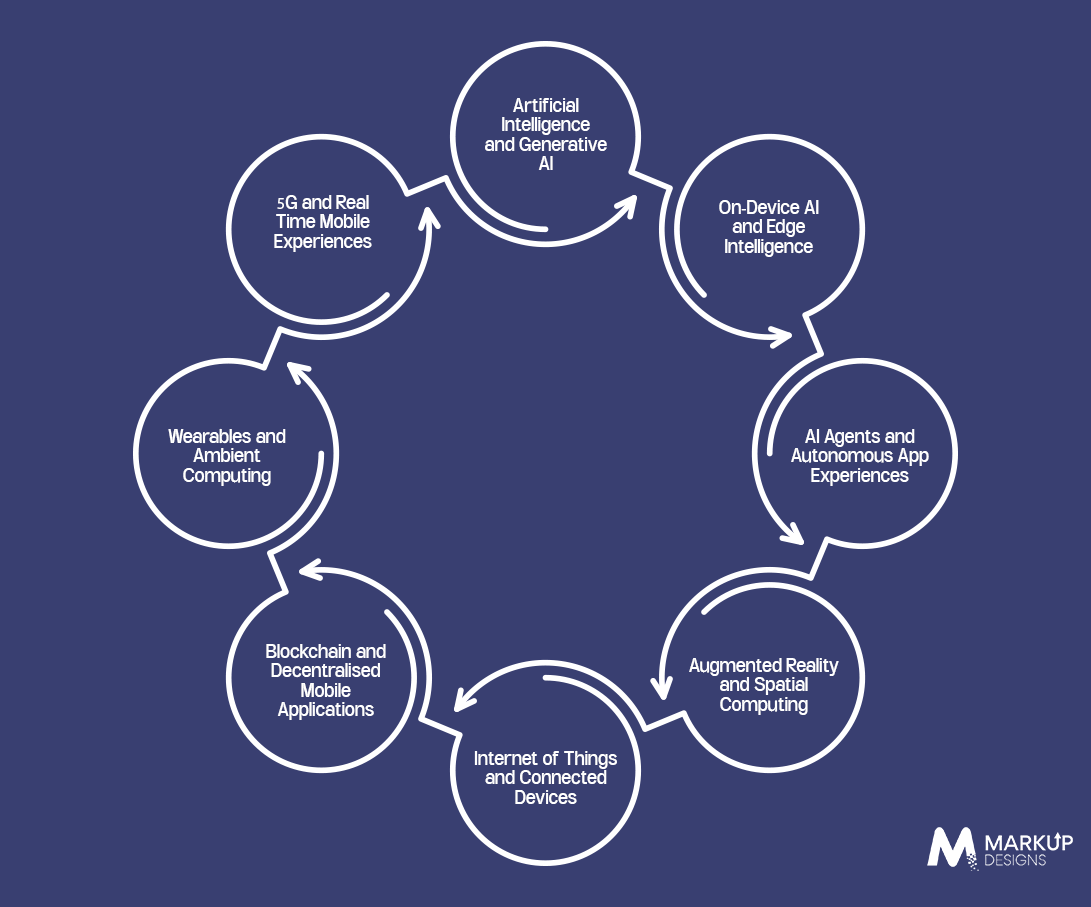
The next generation of mobile apps will be shaped by technologies that improve intelligence, connectivity, automation, and user interaction.
Artificial Intelligence and Generative AI
AI and generative AI are enabling personalised recommendations, natural language interactions, content generation, and smarter application functionality.
On-Device AI and Edge Intelligence
On-device AI processes information closer to the user, helping applications deliver faster responses while improving privacy and reducing cloud dependency.
AI Agents and Autonomous App Experiences
AI agents can understand user goals and complete multi-step tasks, reducing the need for users to manually navigate through different app functions.
5G and Real-Time Mobile Experiences
5G enables faster, low-latency experiences for applications involving live collaboration, streaming, cloud gaming, connected vehicles, and real-time services.
Augmented Reality and Spatial Computing
AR and spatial computing are creating more interactive experiences for retail, education, healthcare, navigation, training, and other industries.
Internet of Things and Connected Devices
IoT allows mobile apps to communicate with connected devices, making smartphones useful as control centres for smart homes, vehicles, and industrial systems.
Blockchain and Decentralised Mobile Applications
Blockchain can support applications requiring decentralised transactions, digital ownership, secure records, and transparent data management.
Wearables and Ambient Computing
Wearables allow apps to deliver information and actions through smartwatches, fitness devices, and other connected hardware without relying entirely on smartphones.
AI Is Becoming the Core of Next-Generation Mobile Apps
AI is moving beyond standalone features and becoming part of the overall mobile experience. It can help applications understand users, predict needs, and automate interactions.
Hyper-Personalised User Experiences
AI can analyse user behaviour and preferences to deliver more relevant content, recommendations, and notifications.
Conversational Interfaces
Users can interact with apps through natural language instead of navigating through multiple menus and screens.
Predictive Recommendations
AI can identify behavioural patterns to recommend products, content, services, or actions that are relevant to individual users.
Automated Task Execution
AI can handle repetitive actions such as scheduling, form completion, reminders, and other routine workflows.
Intelligent Search and Content Discovery
AI-powered search can understand user intent and deliver more relevant results, summaries, and recommendations.
AI-Powered Customer Support
AI assistants can answer common questions, guide users through processes, and escalate complex issues to human support when required.
On-Device AI and Edge Computing Are Changing App Architecture
On-device AI and edge computing are changing where mobile applications process and analyse data. By moving selected workloads closer to the user, apps can become faster, more responsive, and less dependent on constant cloud communication.
Faster Response Times
Local processing reduces the time required to send data to a remote server and receive a response, making AI-powered features feel faster and more responsive.
Offline AI Capabilities
Certain AI functions can continue working without a stable internet connection, making apps more reliable in low connectivity environments.
Improved Data Privacy
Keeping sensitive information on the device can reduce unnecessary data transfers and give businesses greater control over how user information is processed.
Reduced Cloud Processing Costs
Processing suitable workloads locally can reduce the volume of data sent to cloud infrastructure, potentially lowering cloud usage and processing costs.
Real-Time Intelligence at the Edge
Edge computing allows applications to analyse data closer to where it is generated, supporting faster decisions for connected devices, vehicles, industrial systems, and other real-time applications.
The Rise of Super Apps and Mini App Ecosystems
Mobile platforms are increasingly combining multiple services within a single ecosystem. Super apps and mini apps allow businesses to offer broader functionality without requiring users to switch between multiple standalone applications.
What Is a Super App?
A super app brings multiple services such as payments, shopping, communication, travel, or financial services into one platform.
Why Businesses Are Moving Toward Multi-Service Platforms
Multi-service platforms can increase user engagement by giving customers more reasons to remain within the same digital ecosystem.
Mini Apps and Embedded Experiences
Mini apps provide smaller, focused services inside a larger application without requiring users to download separate apps.
Payments, Commerce and Services Under One Platform
Super apps can combine payments, shopping, bookings, communication, and other services into a unified experience.
Challenges of Building a Super App
Super apps require complex architecture, strong security, scalable infrastructure, and careful management of multiple services and integrations.
Cross-Platform Development Is Reaching Maturity
Cross-platform development has become a practical option for businesses looking to build applications for multiple platforms while sharing a significant portion of the codebase.
Flutter
Flutter enables businesses to build applications for multiple platforms from a shared codebase while maintaining a consistent user interface.
React Native
React Native allows developers to create mobile applications using React and JavaScript while supporting native platform capabilities.
Kotlin Multiplatform
Kotlin Multiplatform allows developers to share business logic across platforms while retaining native capabilities where required.
When Cross-Platform Development Makes Sense
It is suitable when businesses need faster development, consistent experiences, and reduced duplication across iOS and Android.
When Native Development Is Still the Better Choice
Native development remains useful for applications requiring advanced hardware access, intensive graphics, or highly platform-specific functionality.
5G and Edge Computing Will Enable Real-Time Mobile Experiences
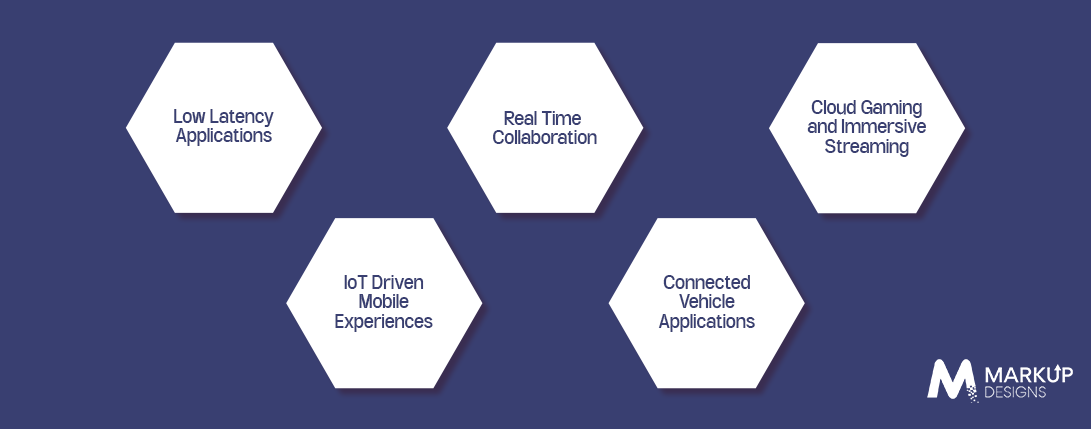
The combination of 5G and edge computing can support mobile experiences that depend on fast data transfer and minimal latency.
Low Latency Applications
Faster network responses can improve applications that depend on real-time communication and data exchange.
Cloud Gaming and Immersive Streaming
High bandwidth connectivity can support richer gaming and streaming experiences on mobile devices.
Real-Time Collaboration
Teams can collaborate through video, shared workspaces, and other interactive applications with reduced communication delays.
Connected Vehicle Applications
5G can support faster communication between mobile apps, vehicles, and connected infrastructure.
IoT-Driven Mobile Experiences
Mobile applications can process and respond to data from connected devices more efficiently.
AR, VR and Spatial Computing Will Expand Mobile Interaction
Immersive technologies are creating new ways for users to interact with digital content and physical environments.
AR Commerce and Virtual Try Ons
Customers can visualise products in their surroundings or try them virtually before making a purchase.
Navigation and Location-Based Experiences
AR can overlay directions, information, and points of interest onto real-world environments.
Industrial and Enterprise Applications
Businesses can use immersive technology for equipment visualisation, remote assistance, maintenance, and operational workflows.
Virtual Training and Education
AR and VR can create interactive learning and training environments that are difficult to replicate through traditional mobile interfaces.
Spatial Interfaces Beyond Smartphones
Spatial computing is extending digital interactions beyond conventional screens through environments that respond to movement, location, and physical surroundings.
IoT and Wearables Will Extend the Mobile App Ecosystem
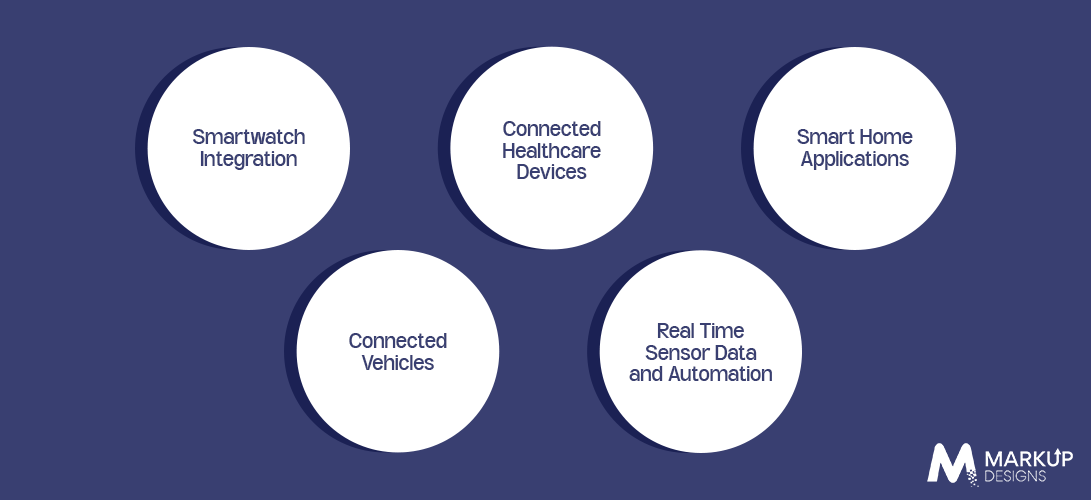
Mobile apps are increasingly becoming control and interaction layers for connected devices. This creates opportunities for applications to deliver continuous experiences across smartphones, wearables, vehicles, and smart environments.
Smartwatch Integration
Apps can provide notifications, health data, quick actions, and other services directly through smartwatches.
Connected Healthcare Devices
Mobile apps can collect and display data from connected health and monitoring devices in real time.
Smart Home Applications
Users can control lighting, security systems, appliances, and other connected home devices through mobile applications.
Connected Vehicles
Apps can connect with vehicles to support functions such as navigation, remote controls, vehicle status, and alerts.
Real-Time Sensor Data and Automation
Sensor data can trigger automated actions, helping applications respond to changing conditions without constant user input.
Privacy and Security Will Become Core App Requirements
As apps collect more personal information and process increasingly sensitive data, privacy and security need to be built into the architecture rather than added after development.
Privacy First App Architecture
Applications should collect only necessary data and define clear controls for how information is stored, processed, and shared.
Biometric Authentication
Fingerprint and facial authentication can provide convenient and secure access to mobile applications.
Passkeys and Passwordless Login
Passkeys can reduce reliance on traditional passwords while providing a more streamlined authentication experience.
Data Encryption
Encryption helps protect sensitive information both during transmission and while stored.
Zero Trust Security
Zero trust principles require every user, device, and access request to be verified rather than automatically trusted.
AI-Driven Fraud Detection
AI can analyse transaction and behavioural patterns to identify unusual activity and help detect potential fraud earlier.
How Emerging Technologies Will Transform Different Industries
Emerging mobile technologies are not just changing app features; they are reshaping how entire industries operate. AI, IoT, AR, 5G, and automation can help businesses deliver faster services, improve decision-making, and create more personalised customer experiences.
Healthcare
AI-powered apps can support remote monitoring, personalised care, appointment management, and communication between patients and healthcare providers.
Banking and Fintech
Mobile banking can use AI for fraud detection, personalised financial insights, automated support, and faster digital transactions.
Retail and Ecommerce
AR, AI recommendations, and intelligent search can create more personalised shopping journeys while helping customers make faster purchase decisions.
Education
Mobile learning apps can use AI-driven personalisation, interactive content, AR, and real-time collaboration to create more engaging learning experiences.
Transportation and Logistics
Connected devices, GPS, 5G, and predictive analytics can improve route planning, fleet management, delivery tracking, and real-time transportation services.
Entertainment and Media
AI recommendations, immersive experiences, cloud streaming, and interactive content are creating more personalised ways for users to consume entertainment.
Manufacturing
Mobile apps connected to IoT devices can provide real-time equipment data, support predictive maintenance, and improve communication across industrial operations.
What Will Mobile Apps Look Like Beyond 2026?
The future of mobile apps will be defined by applications that understand context, anticipate user needs, and operate across multiple devices. Instead of waiting for users to initiate every action, apps will increasingly become proactive digital assistants.
More Context-Aware Applications
Apps will use factors such as location, behaviour, time, and device activity to deliver more relevant experiences.
AI-Driven Personalisation as the Default
Personalised content, recommendations, interfaces, and interactions will become standard rather than premium features.
Less Screen-Based Interaction
Voice, wearables, AR, and other interfaces will reduce the need to interact with apps entirely through traditional screens.
Autonomous App Workflows
AI agents will increasingly handle multi step tasks based on user objectives, reducing manual navigation and repetitive actions.
Multidevice and Ambient Experiences
Applications will work across smartphones, wearables, vehicles, smart homes, and other connected environments.
Continuous Real-Time Experiences
Apps will increasingly respond to live data, connected devices, and changing user conditions rather than relying only on static information.
Challenges Businesses Must Consider Before Adopting Emerging Technologies
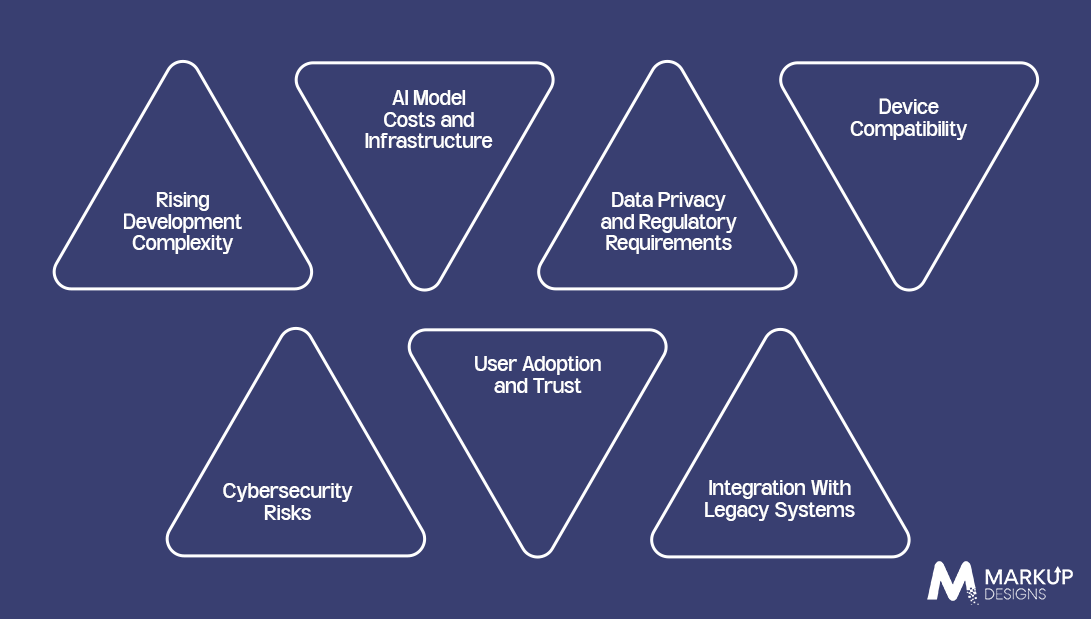
Adopting emerging technology can create significant advantages, but it also introduces technical, financial, and operational challenges. Businesses need to evaluate whether a technology solves a genuine problem before adding it to their mobile strategy.
Rising Development Complexity
AI, IoT, AR, and multidevice functionality require specialised skills and more complex development environments.
Data Privacy and Regulatory Requirements
Businesses must ensure that data collection, processing, storage, and sharing comply with applicable privacy regulations.
AI Model Costs and Infrastructure
AI-powered applications may require additional computing resources, model infrastructure, APIs, and ongoing optimisation.
Device Compatibility
Applications must account for different devices, operating systems, hardware capabilities, and screen sizes.
Cybersecurity Risks
More connected features and data sources can create additional attack surfaces that require strong security controls.
User Adoption and Trust
Users may hesitate to adopt features that feel intrusive, complicated, or unclear about how their data is being used.
Integration With Legacy Systems
Connecting modern mobile applications with older enterprise systems can require extensive API development and backend changes.
How Businesses Can Prepare Their Mobile App Strategy for the Future
Future-ready development is less about predicting every technology and more about building an application that can adapt as technology and user expectations change.
Identify Technology Based on Business Objectives
Choose technologies that address specific customer needs or operational challenges instead of adopting trends without a clear purpose.
Build an MVP Before Scaling Advanced Features
Start with essential functionality, validate the concept with users, and introduce advanced capabilities based on actual demand.
Adopt Scalable and Modular Architecture
A modular architecture makes it easier to introduce new technologies, integrations, and features without rebuilding the entire application.
Prioritise Security From the Start
Security should be considered during architecture and development rather than treated as a final testing requirement.
Design for Multiple Devices and Platforms
Consider how the application may eventually interact with different platforms, wearables, connected devices, and interfaces.
Continuously Monitor User Behaviour and App Performance
Analytics and performance monitoring help businesses identify what users need, where applications struggle, and which improvements should be prioritised.
Why Future Ready Mobile App Development Matters
Future-ready mobile app development is not about adding every emerging technology to an application. It is about creating a scalable foundation that can adopt useful technologies as business needs evolve. Intelligent features, flexible architecture, strong security, and continuous optimisation allow businesses to improve their apps without repeatedly starting development from scratch.
How Markup Designs Can Help Build Future-Ready Mobile Apps
Markup Designs helps businesses build scalable mobile applications by combining modern development practices with technologies such as AI, cloud, IoT, and cross-platform frameworks. From initial product strategy and UI/UX design to development, integration, testing, and ongoing optimisation, the focus remains on building applications that can adapt to changing user expectations and technology requirements.
Build Your Future Ready Mobile App
Turn your mobile app idea into a scalable, intelligent digital experience.

Conclusion
The future of mobile apps will not be defined by a single technology. AI, edge computing, 5G, IoT, spatial computing, wearables, and advanced development frameworks are collectively changing how applications are built and experienced. The biggest shift is from apps that simply respond to users towards applications that can understand context, predict needs, and automate actions.
For businesses, adopting these technologies should be a strategic decision rather than a race to follow trends. A scalable architecture, strong security, thoughtful user experience, and continuous optimisation provide the foundation for building mobile applications that can evolve beyond 2026.
FAQs
What is the future of mobile app development in 2026?
Mobile app development is moving towards intelligent, connected, personalised, and multi-device experiences. AI, on-device processing, 5G, IoT, AR, and automation are expected to play a major role in how future apps are built and used.
What technologies are shaping the future of mobile apps?
Key technologies include generative AI, AI agents, edge computing, 5G, AR and spatial computing, IoT, wearables, blockchain, and cross-platform development frameworks.
How will AI change mobile app development?
AI will make apps more personalised and proactive while automating tasks, improving search, predicting user needs, powering conversational interfaces, and supporting intelligent decision-making.
What is on-device AI in mobile apps?
On-device AI allows certain AI models and processing tasks to run directly on a smartphone or other device. This can improve response times, support offline functionality, and reduce the need to send sensitive information to cloud servers.
Will cross-platform development dominate the future?
Cross-platform development will continue to grow because it allows businesses to share code across platforms and reduce development effort. However, native development will remain important for applications requiring advanced hardware capabilities or highly platform-specific performance.
Author's Perspective
The future of mobile apps is less about adding more features and more about making every interaction useful. Businesses that focus on intelligent experiences, adaptable architecture, privacy, and real user needs will be better positioned to evolve as mobile technology advances.
Discuss Your Project NowJupinder Singh Arora
Founder and CEO
Related Posts
Cost to Build a Mobile App in Qatar...
How Much Does It Cost to Build an...
How to Build a Car Wash App: Development...
Insights Are Valuable & Execution is Priceless
You’ve read about the digital future. Now, let’s build the infrastructure to take you there. Move your strategy from the page to the product.
Design Your Solution Now
Contact Us
Schedule The Appointment At Your Convenience Date And Time.
30 Min
Web Conference
Time Zone
Indian standard time (08:30pm)

Thanks For Getting In Touch!
You’ve Taken The First Step Toward Transforming Your Digital Presence. Our Experts Will Reach Out Shortly To Take It Forward.
Launch Your Dream Project
Provide a brief overview of your project, and our specialists will evaluate your requirements. We will connect with you to explore how the right digital solutions can help you launch faster.