
In Brief
- Enterprise Retrieval-Augmented Generation (RAG) makes use of large language models and reliable enterprise knowledge sources in order to provide precision-oriented and contextful AI responses while limiting hallucination instances.
- The usage of RAG-powered enterprise solutions allows companies to convert internal documents, knowledge bases, and business data into intelligent AI systems that help improve efficiency.
- The incorporation of technologies including vector databases, semantic search, embeddings, and large language models makes Enterprise RAG deliver instant results without needing to retrain base models.
- Industries such as healthcare, banking, law, retail, and customer service exploit the effects of Enterprise RAG in order to master their knowledge management, implement automation of processes, implement compliance systems, and realize improvement of customer satisfaction.
- Cooperation with a proven Enterprise RAG construction company allows organizations to create efficient, safe, and highly scalable business applications that fit into the existing business environment and help it move towards the future.
Generative AI has changed the method of data processing in businesses, workflow automation, and the way organisations provide services. Nevertheless, in terms of legacy large language models, their accuracy, security, and compliance in corporate environments leave much to be n desired, as it has to deal with out-of-date data, irrelevant corporate contexts, and language hallucinations. Retrieval Augmented Generation (RAG) resolves the issue and provides a platform for boosting enterprise AI by dynamically combining language technology with real-time access to credible corporate knowledge.
By developing enterprise RAG solutions, companies receive an opportunity to create artificial intelligence apps that identify the required information from internal documentation, knowledge bases, databases, and enterprise programs before generating responses. Such solutions guarantee the provision of reliable, context-aware, and explainable results without permanently retraining AI technologies.
This guide explores how Enterprise RAG works, its core architecture, business benefits, implementation challenges, real-world use cases, and why it is becoming the preferred approach for building next-generation enterprise AI solutions.
What Is Enterprise Retrieval Augmented Generation (Enterprise RAG)?
The Enterprise Retrieval Augmented Generation (Enterprise RAG) is a sophisticated AI framework that integrates the abilities of large language models (LLMs) with the internal knowledge resources of an organization. Unlike traditional systems that solely rely on previous training datasets, Enterprise RAG obtains information from valuable sources like documents, databases, knowledge repositories, and enterprise systems before generating an output. Therefore, this technology makes it possible for AI applications to produce precise, context-aware, reliable answers while decreasing the number of erroneous outputs.
Understanding Retrieval Augmented Generation (RAG)
RAG plays a critical role in enhancing generative AI by retrieving relevant information in real time, providing the AI systems with context for producing outputs.
Differences between Enterprise RAG and Traditional Generative AI
In contrast to traditional systems that generate outputs based solely on previous training, Enterprise RAG connects AI with real business data and internal resources, allowing the generation of accurate and meaningful business-specific responses without the need for model retraining.
Reasons for the Increasing Popularity of Enterprise RAG
Organizations prefer Enterprise RAG to allow accurate outputs, minimize false information, ensure confidentiality, explore knowledge more rapidly, and provide the staff and clients with trustworthy information in real time.
How Enterprise RAG Works
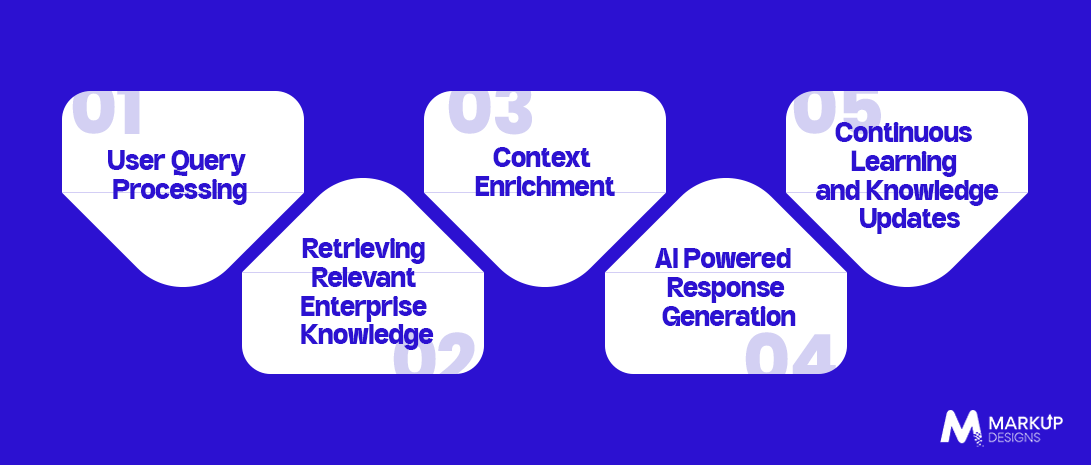
Enterprise Retrieval Augmented Generation (RAG) combines intelligent information retrieval with Large Language Models (LLMs) to generate accurate, context-aware responses. Instead of relying only on pre-trained knowledge, it retrieves relevant enterprise data before producing an answer, ensuring responses are reliable, current, and aligned with business information.
Step 1: User Query Processing
The process begins when a user submits a question. The system analyses the query, understands the user’s intent, and determines what information is needed to answer it accurately.
Step 2: Retrieving Relevant Enterprise Knowledge
The retrieval engine searches connected enterprise data sources, such as documents, knowledge bases, and business applications, to find the most relevant information related to the query.
Step 3: Context Enrichment
The retrieved content is filtered, ranked, and refined using semantic search so only the most relevant context is provided to the language model.
Step 4: AI-Powered Response Generation
The LLM combines the retrieved knowledge with its language capabilities to generate a natural, accurate, and context-aware response with minimal hallucinations.
Step 5: Continuous Learning and Knowledge Updates
As enterprise data changes, new documents and information are indexed automatically, allowing the AI to deliver updated responses without retraining the model.
Read Also: Enterprise Digital Transformation Strategy: The Ultimate Guide for Business Growth
Core Components of an Enterprise RAG Architecture
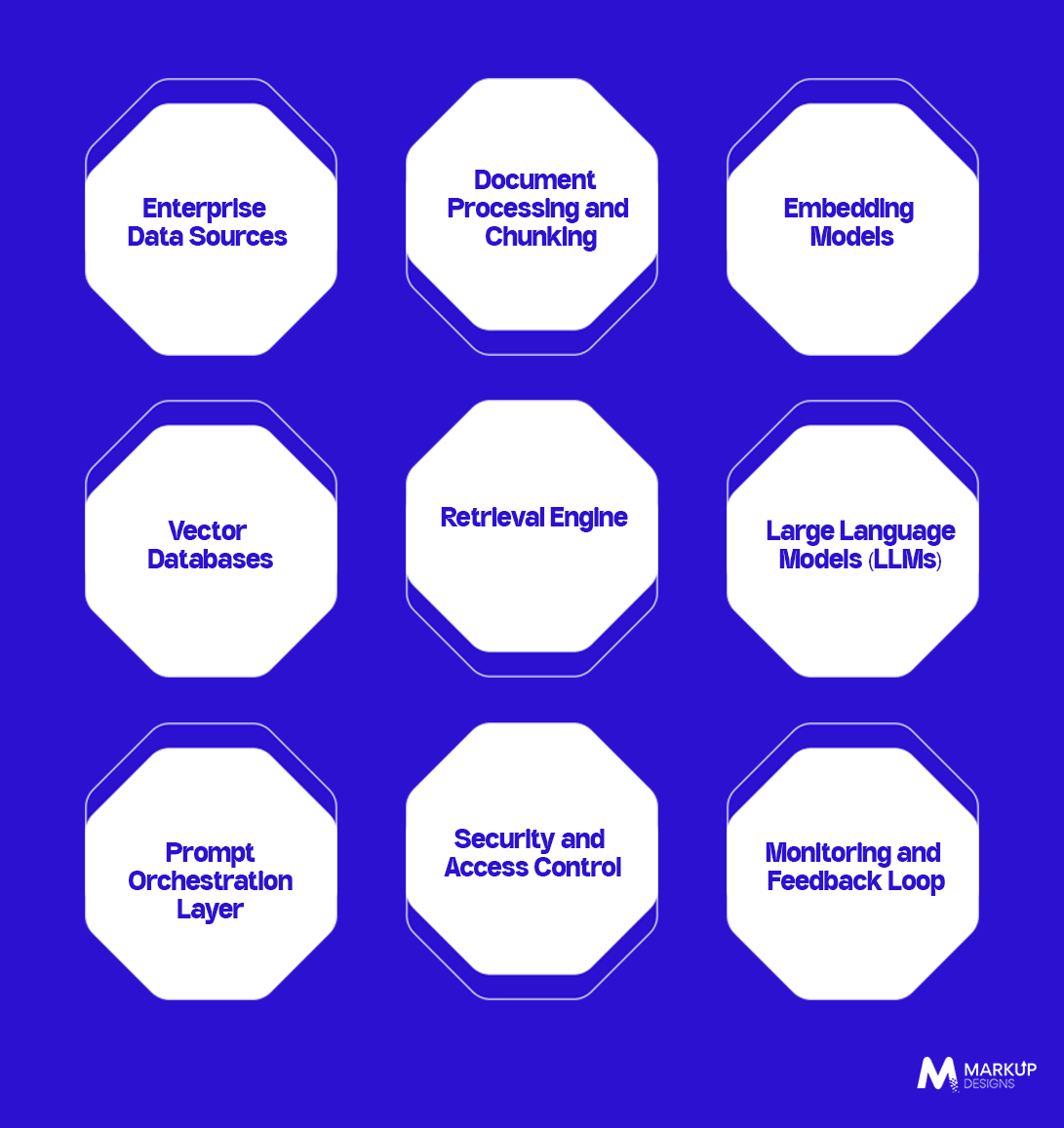
Enterprise RAG consists of several components that work together to retrieve, process, and generate reliable business insights.
Enterprise Data Sources
Enterprise RAG connects with structured and unstructured data, including ERP and CRM systems, databases, PDFs, emails, policies, manuals, and internal knowledge bases.
Document Processing and Chunking
Large documents are divided into smaller sections, making it easier for the system to retrieve the most relevant information quickly and accurately.
Embedding Models
Embedding models convert enterprise content into vector representations that capture the meaning of the information, enabling semantic search.
Vector Databases
Vector databases store embeddings and rapidly identify content that is most relevant to a user’s query based on context rather than keywords.
Retrieval Engine
The retrieval engine searches, ranks, and selects the best matching information from enterprise knowledge sources before passing it to the language model.
Large Language Models (LLMs)
LLMs use the retrieved business context to generate clear, accurate, and human-like responses tailored to the user’s request.
Prompt Orchestration Layer
This layer combines user queries with retrieved knowledge and applies business rules to improve response quality and consistency.
Security and Access Control
Role-based permissions, authentication, and encryption ensure users can only access authorised enterprise information while maintaining compliance.
Monitoring and Feedback Loop
Continuous monitoring and user feedback help improve retrieval accuracy, optimise AI performance, and keep enterprise knowledge up to date.
Enterprise Use Cases of Retrieval Augmented Generation
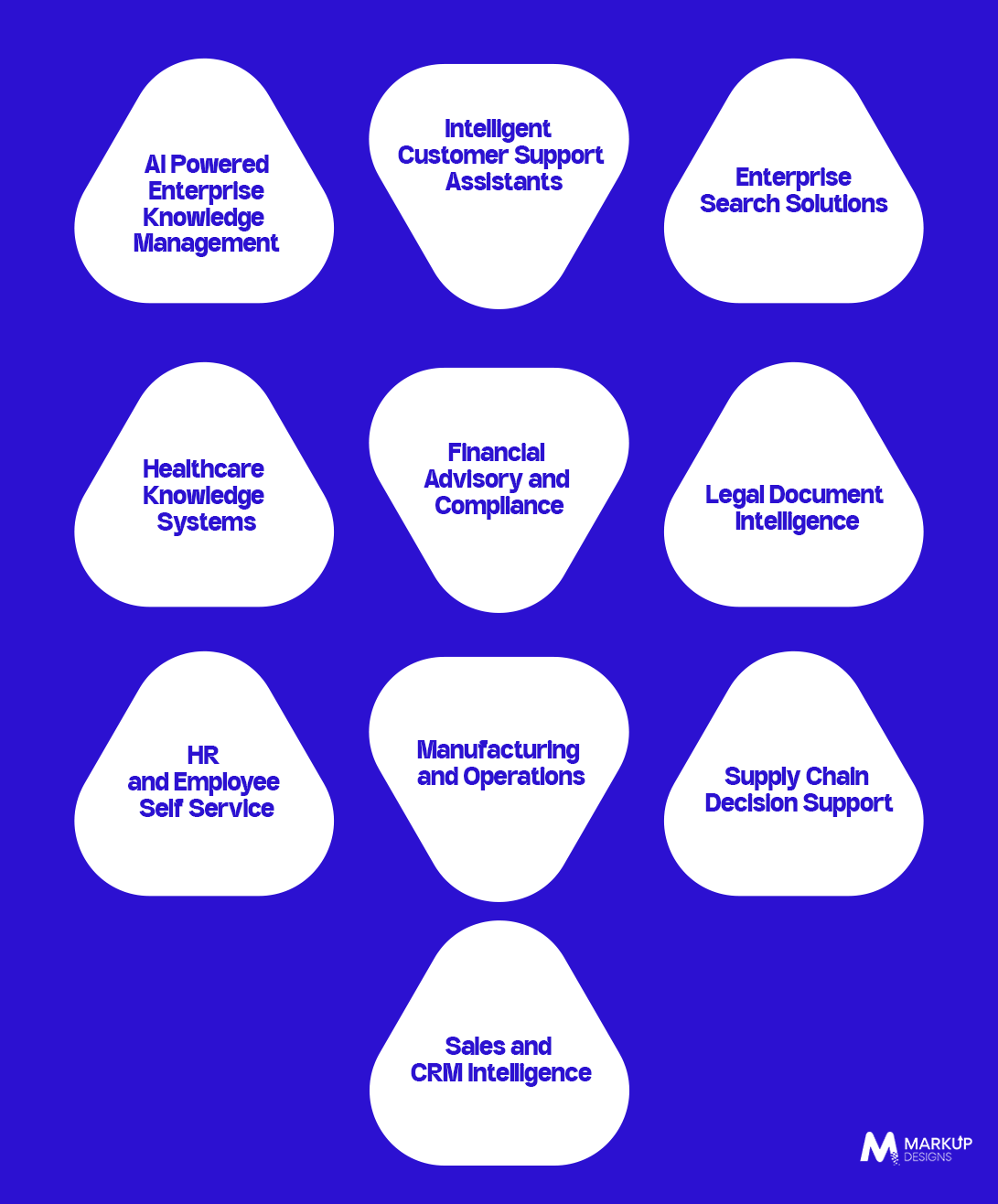
Retrieval Augmented Generation (RAG) is helping enterprises move beyond generic AI responses by connecting large language models with trusted business knowledge. From internal knowledge management to industry-specific decision support, Enterprise RAG enables organisations to deliver accurate, context-aware, and secure information across departments while improving productivity and operational efficiency.
AI-Powered Enterprise Knowledge Management
Enterprise RAG creates a centralised knowledge ecosystem by connecting AI with internal documentation, policies, SOPs, technical manuals, project files, and knowledge bases. Employees can ask natural language questions and receive accurate answers sourced directly from trusted company documents. This significantly reduces time spent searching for information while ensuring consistent knowledge sharing across teams.
Intelligent Customer Support Assistants
RAG enhances customer support by enabling AI assistants to retrieve answers from product documentation, FAQs, warranty information, troubleshooting guides, and customer records. Instead of providing generic responses, support agents and chatbots deliver personalised, accurate, and context-relevant solutions that improve customer satisfaction and reduce response times.
Enterprise Search Solutions
Traditional enterprise search often returns long lists of documents, forcing employees to manually locate relevant information. RAG transforms enterprise search by understanding user intent, retrieving the most relevant content from multiple enterprise systems, and generating concise, source-backed answers. This improves productivity while making organisational knowledge more accessible.
Healthcare Knowledge Systems
Healthcare organisations use Enterprise RAG to provide clinicians with instant access to medical guidelines, research publications, patient protocols, and treatment documentation. By retrieving evidence-based information from approved medical sources, healthcare professionals can make faster, better-informed clinical decisions while maintaining regulatory compliance.
Financial Advisory and Compliance
Financial institutions leverage RAG to retrieve regulatory guidelines, compliance policies, investment reports, audit documentation, and risk management frameworks. Advisors and compliance teams can quickly access verified financial information, helping reduce compliance risks while improving the accuracy of financial recommendations.
Legal Document Intelligence
Legal teams use Enterprise RAG to analyse contracts, case files, legal precedents, regulations, and internal legal knowledge repositories. AI retrieves relevant clauses and supporting references, allowing lawyers and compliance professionals to accelerate legal research, contract review, and document analysis without compromising accuracy.
HR and Employee Self-Service
Human Resources departments implement RAG-powered assistants to answer employee queries related to leave policies, payroll, onboarding, benefits, performance management, company guidelines, and training resources. Employees receive immediate, policy-based responses, reducing HR workloads while improving the employee experience.
Manufacturing and Operations
Manufacturing companies use RAG to provide engineers, technicians, and operations teams with instant access to equipment manuals, maintenance procedures, quality standards, production documentation, and operational guidelines. Faster access to technical knowledge minimises downtime and improves operational efficiency across production facilities.
Supply Chain Decision Support
Enterprise RAG supports supply chain teams by retrieving logistics data, supplier documentation, inventory records, procurement policies, transportation updates, and demand forecasts. Decision makers gain real-time contextual insights that improve inventory planning, supplier management, risk mitigation, and overall supply chain performance.
Sales and CRM Intelligence
Sales teams use RAG to retrieve customer histories, CRM records, product information, proposals, pricing documentation, market insights, and previous client interactions. AI delivers context-aware recommendations that help sales representatives personalise conversations, prepare proposals more efficiently, and improve customer engagement throughout the sales cycle.
Enterprise RAG vs Fine Tuning: Which Approach Is Right for Your Business?
Enterprise RAG and fine-tuning are two powerful approaches for improving AI performance, but they address different business needs. While RAG enhances AI by retrieving real-time information from enterprise knowledge sources, fine-tuning permanently adapts a model to specific tasks or domains. Choosing the right approach depends on your data, objectives, and long-term AI strategy.
Enterprise RAG vs Fine Tuning
| Factor | Enterprise RAG | Fine Tuning |
| Data Freshness | Retrieves the latest enterprise information in real time | Limited to the data used during model training |
| Accuracy | Provides responses grounded in trusted business knowledge | Excels at specialised tasks but may lack updated information |
| Cost | Lower long term cost as retraining is not required | Higher due to model training and ongoing updates |
| Maintenance | Easy to update by refreshing the knowledge base | Requires retraining whenever knowledge changes |
| Scalability | Easily scales across multiple enterprise data sources | Scaling often involves additional training efforts |
| Security | Supports role-based access and secure enterprise data retrieval | Depends on deployment architecture and training data controls |
When Should You Choose Each Approach?
Choose Enterprise RAG when your AI application depends on frequently changing information, enterprise documents, or internal knowledge bases. Fine-tuning is better suited for highly specialised tasks that require consistent behaviour, such as industry-specific language generation or domain-specific classifications. For many organisations, a hybrid approach that combines RAG with fine-tuned models delivers the best balance of accuracy, contextual awareness, and performance.
Challenges of Enterprise RAG Development and How to Overcome Them
Building a successful Enterprise RAG solution requires more than integrating an AI model with enterprise data. Organisations must ensure high-quality information, secure access, and reliable system performance to maximise business value.
Data Quality and Retrieval Accuracy
A well-organised knowledge base is essential for reliable AI responses. Regularly updating enterprise content, removing duplicate information, and optimising retrieval mechanisms help improve response accuracy and minimise irrelevant results.
Performance, Scalability, and System Integration
As enterprise data grows, RAG systems must maintain fast response times while integrating with existing business applications. Cloud infrastructure, vector databases, and API driven architectures help organisations build scalable and high-performing AI solutions.
Security, Compliance, and AI Governance
Enterprise AI must protect sensitive business information through encryption, role-based access controls, regulatory compliance, and continuous monitoring. Strong AI governance ensures responses remain secure, accurate, and aligned with organisational policies.
Technologies Powering Enterprise RAG Development
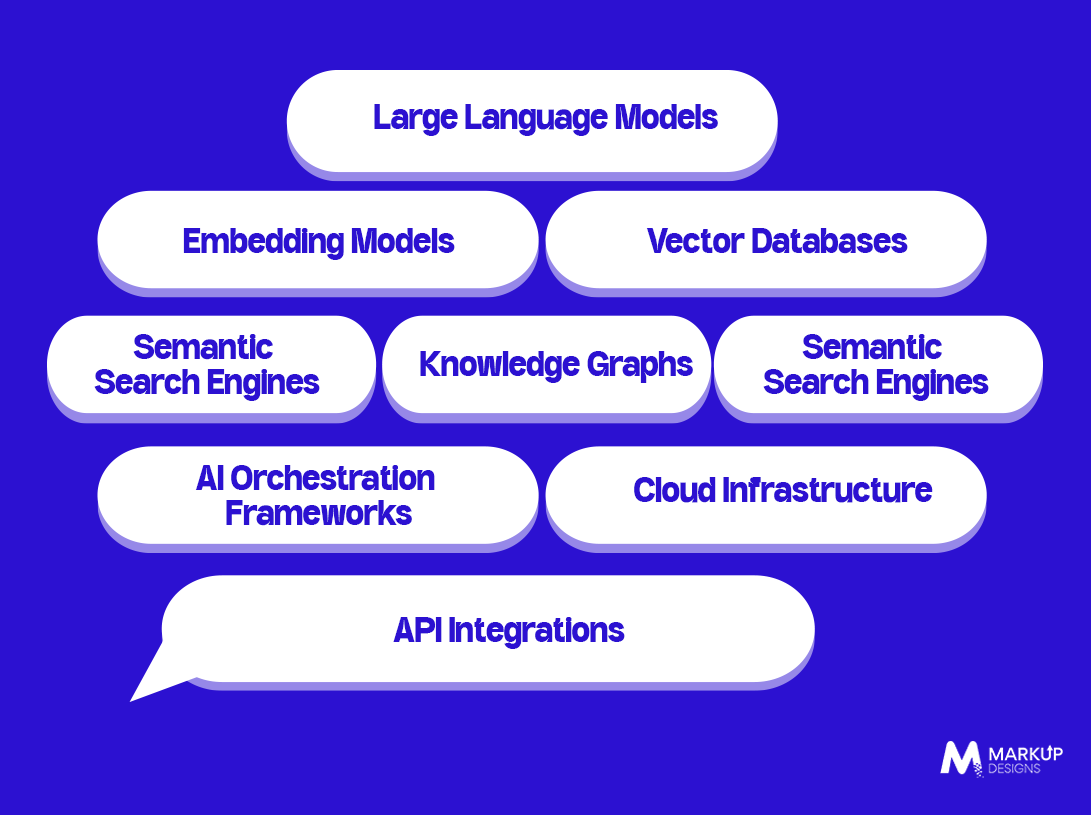
Enterprise RAG combines several AI technologies to retrieve, process, and generate accurate responses from trusted business knowledge.
Large Language Models
LLMs understand user intent and generate natural, context-aware responses using retrieved enterprise information.
Embedding Models
Embedding models convert enterprise content into vector representations, enabling semantic search beyond simple keyword matching.
Vector Databases
Vector databases efficiently store and retrieve embeddings, helping AI quickly locate the most relevant information.
Semantic Search Engines
Semantic search identifies information based on context and meaning, delivering more accurate search results than traditional keyword searches.
Knowledge Graphs
Knowledge graphs connect related business entities and relationships, improving reasoning and contextual understanding.
AI Orchestration Frameworks
These frameworks manage data retrieval, prompt construction, model interactions, and workflow execution across the RAG pipeline.
Cloud Infrastructure
Cloud platforms provide scalable computing resources, secure storage, and reliable deployment for enterprise AI applications.
API Integrations
APIs connect RAG applications with enterprise systems such as CRM, ERP, HRMS, and document management platforms.
AI Monitoring Platforms
Monitoring tools track AI performance, retrieval quality, response accuracy, and system health to support continuous optimisation.
Best Practices for Building Enterprise RAG Applications
Successful Enterprise RAG implementations depend on strong data management, optimised retrieval, and responsible AI governance.
Build High-Quality Knowledge Bases
Maintain accurate, structured, and regularly updated enterprise content to improve retrieval quality.
Choose the Right Chunking Strategy
Divide documents into meaningful sections so the retrieval engine can identify the most relevant context.
Optimise Retrieval Performance
Fine-tune search parameters, embeddings, and ranking mechanisms to deliver faster and more accurate responses.
Implement Strong Security Controls
Protect enterprise information through encryption, identity management, and role based access permissions.
Continuously Refresh Enterprise Knowledge
Regularly update business documents and repositories to ensure AI responses remain current.
Monitor AI Performance
Track response quality, latency, and user feedback to identify opportunities for improvement.
Test with Real Business Scenarios
Validate AI performance using real enterprise workflows before large-scale deployment.
Ensure Human Oversight
Keep human experts involved in reviewing critical AI outputs to maintain accuracy, compliance, and accountability.
Future Trends in Enterprise Retrieval Augmented Generation
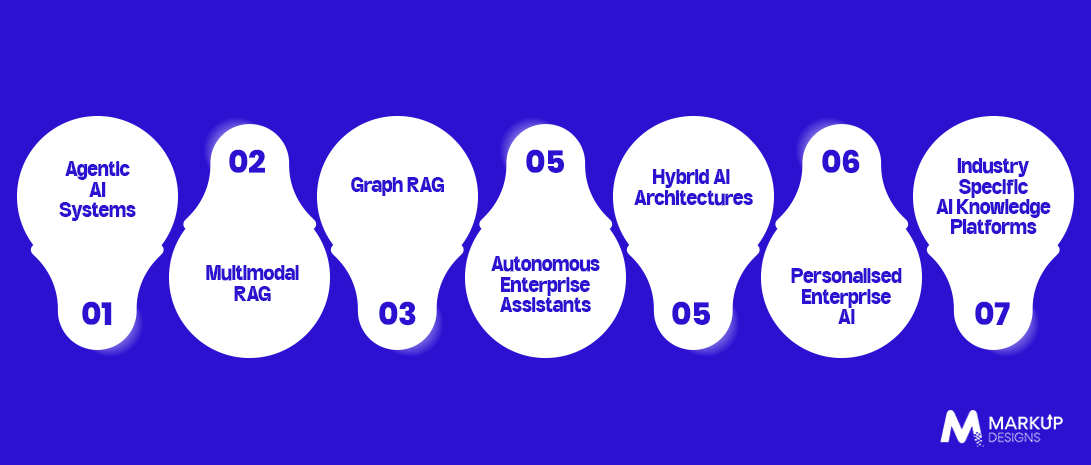
Enterprise RAG continues to evolve as AI technologies become more intelligent, autonomous, and industry-focused.
Agentic AI Systems
AI agents will independently retrieve information, execute tasks, and support complex business workflows with minimal human intervention.
Multimodal RAG
Future RAG systems will retrieve and process text, images, audio, video, and structured data within a single AI workflow.
Graph RAG
Combining knowledge graphs with RAG will improve contextual reasoning and relationship-based information retrieval.
Autonomous Enterprise Assistants
AI assistants will evolve into intelligent enterprise collaborators capable of handling multi-step business processes.
Hybrid AI Architectures
Businesses will increasingly combine RAG, fine-tuned models, and AI agents to build more capable enterprise applications.
Personalised Enterprise AI
AI systems will deliver responses tailored to user roles, permissions, and business context for greater relevance.
Industry-Specific AI Knowledge Platforms
Sector-focused RAG solutions will provide specialised intelligence for industries such as healthcare, finance, legal, manufacturing, and retail.
How Markup Designs Helps Businesses Build Enterprise RAG Solutions
At Markup Designs, we help organisations develop intelligent Enterprise RAG solutions that transform business knowledge into secure, reliable, and scalable AI applications.
Enterprise AI Strategy Consulting
We assess your business goals, data landscape, and AI readiness to create a tailored Enterprise RAG roadmap.
Custom RAG Application Development
Our team builds bespoke RAG-powered applications designed for your workflows, users, and industry requirements.
Enterprise Knowledge Base Development
We organise, structure, and optimise enterprise content to improve retrieval accuracy and AI performance.
AI Model Integration
We integrate leading large language models with your enterprise systems for seamless AI experiences.
Secure Enterprise AI Architecture
Security is embedded throughout our solutions with encryption, access controls, and compliance-driven development.
Vector Database Implementation
We implement high-performance vector databases that enable fast and accurate semantic retrieval.
End-to-End AI Deployment and Support
From strategy and AI development to deployment, optimisation, and ongoing support, we help businesses maximise the value of Enterprise RAG.
Build Reliable Enterprise AI with Retrieval Augmented Generation
Turn your enterprise knowledge into secure, intelligent, and scalable AI applications with Markup Designs. Build AI solutions that deliver accurate insights, improve productivity, and accelerate digital transformation.
Conclusion
Enterprise Retrieval Augmented Generation services are redefining how organisations build reliable AI applications by combining the power of large language models with trusted enterprise knowledge. Unlike traditional AI systems, Enterprise RAG delivers accurate, context-aware, and up-to-date responses while reducing hallucinations and protecting sensitive business information. This makes it an ideal solution for organisations seeking scalable AI that supports informed decision-making and operational efficiency.
As enterprise data continues to grow, businesses that invest in Enterprise RAG will be better positioned to improve knowledge management, automate workflows, enhance customer experiences, and drive innovation. With the right technology strategy and an experienced development partner like Markup Designs, organisations can build future-ready AI applications that create measurable business value.
FAQs
1. What is Enterprise RAG?
Enterprise Retrieval Augmented Generation (Enterprise RAG) is an AI framework that combines large language models with enterprise knowledge sources to generate accurate, context-aware, and real-time responses based on trusted business information.
2. How does Enterprise RAG improve AI accuracy?
Enterprise RAG retrieves relevant information from enterprise documents, databases, and knowledge bases before generating responses, reducing hallucinations and improving factual accuracy.
3. What is the difference between Enterprise RAG and fine-tuning?
Enterprise RAG enhances AI with real-time enterprise knowledge, while fine-tuning modifies the enterprise AI model development itself using specialised training data. RAG is generally more suitable for dynamic business information, whereas fine-tuning is ideal for highly specialised tasks.
4. Which industries benefit most from Enterprise RAG?
Industries including healthcare, banking, finance, legal, retail, manufacturing, logistics, education, and customer service benefit from Enterprise RAG by improving knowledge management, compliance, and decision-making.
5. What technologies are required for Enterprise RAG development?
Enterprise RAG solutions typically use large language models, embedding models, vector databases, semantic search engines, cloud infrastructure, APIs, AI orchestration frameworks, and enterprise security technologies to deliver reliable AI experiences.
Author's Perspective
Dubai Vision 2040 is reshaping the future of business through innovation, smart infrastructure, and digital transformation. Custom enterprise applications are enabling organisations to streamline operations, improve service delivery, and build connected digital ecosystems that support long-term growth.
At Markup Designs, we believe enterprise software should be built around business objectives, not just technology. By combining AI, cloud computing, IoT, and scalable architectures, businesses can create future-ready solutions that drive efficiency, strengthen competitiveness, and support Dubai’s vision of becoming a global digital leader.
Discuss Your Project NowGaurav Goyal
Global Sales- VP
Related Posts
Enterprise AI Agents: Practical Use Cases Driving Business...
LLM-as-a-Judge Explained: Improving Enterprise AI Governance and Evaluation
Enterprise AI Outsourcing: How to Choose the Right...
Insights Are Valuable & Execution is Priceless
You’ve read about the digital future. Now, let’s build the infrastructure to take you there. Move your strategy from the page to the product.
Design Your Solution Now
Contact Us
Schedule The Appointment At Your Convenience Date And Time.
30 Min
Web Conference
Time Zone
Indian standard time (08:30pm)

Thanks For Getting In Touch!
You’ve Taken The First Step Toward Transforming Your Digital Presence. Our Experts Will Reach Out Shortly To Take It Forward.
Launch Your Dream Project
Provide a brief overview of your project, and our specialists will evaluate your requirements. We will connect with you to explore how the right digital solutions can help you launch faster.