
In Brief
- The role of AI in social media has involved personalized recommendations, better search capabilities, moderation, bots, sentiment analysis, and smart content generation.
- AI social media platforms can leverage their ability to increase user engagement, improve customer service, manage content, ensure security, and make data-driven decisions.
- Some of the major AI technologies that can be used in social media platforms include machine learning, NLP, computer vision, generative AI, predictive analytics, and recommendation systems.
- The development of AI social media platforms involves setting goals, picking relevant AI applications, designing the experience, building the platform, deploying AI models, and improving performance.
- There are some other challenges that organizations face in the context of using AI in social media platforms.
AI is transforming the way in which users communicate and interact with the various social media sites. Content recommendation, search, automated moderation, and customer service with AI are just some of the applications of AI technology in daily social media use.
The business gets the chance to interact with consumers, get to understand their needs, and make quick decisions, while the consumer will benefit from getting relevant feed recommendations.
In this blog, we will analyze how AI is revolutionizing social media and the technologies that support such innovations. In addition to that, we will talk about the advantages of using AI, key features of this technology, the development process, the technology stack, and potential obstacles faced by enterprises while implementing AI into their social media solutions.
Understanding Artificial Intelligence in Social Media Platforms
AI in Social Media involves applying AI and machine learning to study user behaviors, process large volumes of data, automate functions, and enhance digital interactions. As opposed to conventional platforms that work with a set of pre-defined rules, AI platforms have the capacity to learn from user behaviors and keep improving their processes of content/service delivery.
AI can evaluate activities including search, like, comment, share, video watch time, browsing, among others. The evaluation helps to determine user interests and enhance user experience. AI can also help organizations automate customer interactions, discover trends, and conduct sentiment analysis of the audience.
Some of the key AI technologies used in social media include:
- Machine Learning: Helps platforms learn from user behavior and improve recommendations.
- Natural Language Processing: Understands text, comments, messages, and user queries.
- Computer Vision: Identifies objects, faces, images, and video content.
- Generative AI: Helps create posts, captions, images, videos, and other content.
- Predictive Analytics: Helps businesses identify patterns and anticipate user behavior.
As these technologies continue to improve, AI is becoming an important part of how modern social media platforms operate.
How AI is Redefining Social Media Platforms
AI is transforming the social media experience from a basic platform for sharing content into a smart and dynamic digital space. Today, platforms can learn about interests of users, automate processes, and react dynamically to behavioral changes on the fly. It provides an opportunity for users and companies to benefit from social media more.
1. Personalized Content Feeds
AI analyzes users behavior, interests, and engagement patterns and recommends posts, videos, accounts, and topics that will be interesting for users.
2. Smart Content Recommendations
Recommendation algorithms analyze viewing and interaction history to suggest content users are more likely to watch, like, or share.
3. Automated Content Moderation
With AI, spam, any form of harmful material, and fake account detection, moderation of policies can be enforced easily and quickly, ensuring safety for the platforms’ online communities.
4. AI Customer Service
Virtual assistants can take up common inquiries and requests without being required to constantly interact with humans.
5. Better Audience Understanding
Through analysis of social media data, AI helps companies understand their customers’ likes, interests, and trending topics to make better decisions.
6. Smart Content Creation
With generative AI, people can get help with captions, posts, images, videos, and other types of content creation.
Key Benefits of AI in Social Media
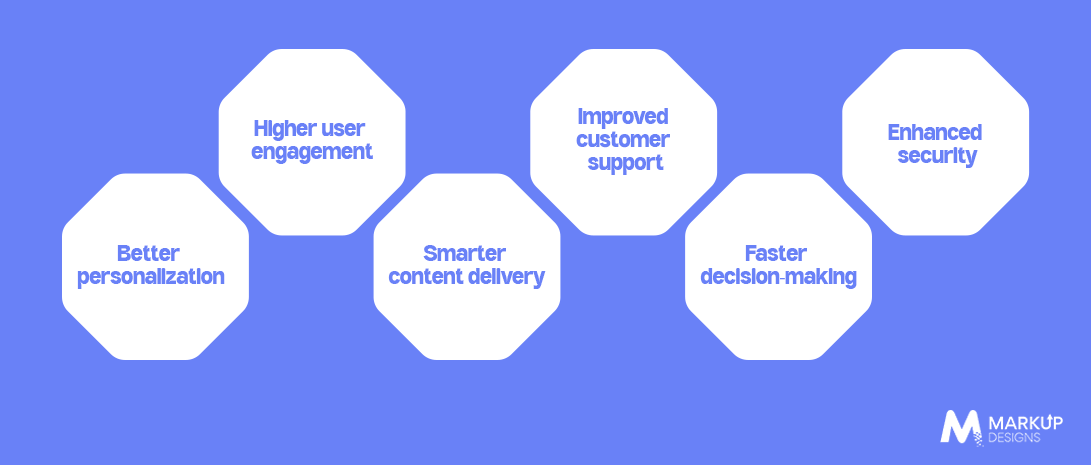
AI has many advantages for social media in a practical sense, as it helps social media platforms know about their users, automate activities, and enhance their platform performance. Social media is becoming increasingly competitive, and through AI, businesses can provide better user experiences to users.
Better Personalization
AI learns about users through behavioral analysis, interests, and interaction patterns and offers them personalized content, recommendations, ads, and feeds. This way, the platform becomes more relevant to individual users.
Higher User Engagement
Whenever users find themselves interacting with content they enjoy, they become engaged and active on the platform.
Smarter Content Delivery
AI-driven chatbots help answer routine queries. The business is able to offer round-the-clock support to its customers while decreasing the customer support team’s workload.
Improved Customer Support
AI will allow moderation teams to spot spam, inappropriate content, duplicates, and many other unwanted things. It will become easier for them to handle high content volumes.
Faster Decision-Making
AI will be able to process high volumes of social media data and see patterns in customer behavior. Businesses will then use this information to improve their marketing and engagement.
Enhanced Security
AI will detect unusual account behavior, fraudulent actions, and many other suspicious things. The sooner these issues are spotted, the easier it is to secure the platform.
Essential AI Features in Modern Social Media Platforms
Social media platforms that have emerged today are adopting AI technology to make the interactions more personal, automated, and secure. There are various ways in which the technologies can benefit users, creators, marketers, and even social media platform administrators.
Smart Recommendations
The recommendation engines powered by artificial intelligence technology will be able to recommend various posts, videos, profiles, and other types of content based on the user interaction pattern.
AI Chatbots
AI-powered chatbots can respond to common questions, guide users through platform features, and support businesses with automated customer conversations.
Content Moderation
AI can detect spam and inappropriate content in texts, images, audio, and video files. This can lead to faster and better moderation of the content.
Image Recognition
Computer vision can help platforms recognize different types of objects and scenes. It is also useful for organizing the content, searching for it, tagging, and moderating the content.
Sentiment Analysis
AI can analyze user comments, reviews, and other conversations to determine the sentiment behind them, whether it is positive, negative, or neutral in relation to a certain topic/brand.
Fraud Detection
With the help of artificial intelligence, one can detect any strange behavior and even scams that are used by people in order to avoid being abused.
Build a Smarter Social Media Platform with AI
Transform your social media idea into an intelligent digital platform with AI-powered recommendations, automation, personalization, and security. Partner with an experienced development team to turn your concept into a scalable solution.

How to Develop an AI-Powered Social Media Platform
Creating an AI-enabled social media platform demands more than simply integrating AI into an already existing platform. The company will need to get to know its target audience, define objectives, find appropriate AI solutions, and create an infrastructure capable of processing an increased amount of data and users.
1. Define the Platform Goals
Firstly, the company will need to define what the platform is about, who will use it, which key features it should have, and how it will be able to help the business.
2. Selecting AI Use Cases
The choice of AI features should be defined by real user needs and business goals. These might be smart feeds, intelligent search, sentiment analysis, AI chatbots, and even AI-generated content.
3. Design the User Experience
Design a basic platform where AI-based elements integrate seamlessly into the design. The objective here is to enhance ease of interaction without adding unnecessary complexity to the platform.
4. Build the Core Platform
Develop core elements like user registration, profiles, messaging, content sharing, notifications, search, and social features before integrating advanced AI capabilities.
5. Integrate AI Models
Integrate relevant machine learning, natural language processing, computer vision, or generative AI models based on the chosen use case. APIs as well as other AI development services can also be integrated as needed.
6. Test, Launch, and Improve
Test the platform in terms of performance, security, usability, and accuracy of AI capabilities before launching. Post-launch, analyze feedback from users and the performance of models to improve the platform.
Technology Stack for AI Social Media Development
The technology stack is significant when it comes to creating an efficient and scalable AI-powered social media platform. The appropriate selection of frontend, backend, databases, cloud computing solutions, and AI technologies contributes to efficient operation as the platform becomes larger.
Frontend Technologies
Technologies such as React, Angular, Flutter, and React Native can be applied to developing a responsive user interface for social media apps.
Backend Technologies
Node.js, Python, Java, and .NET can perform all backend tasks in the social media platform, including API creation, authentication, messaging, etc.
AI and Machine Learning
Frameworks that use the Python language, such as TensorFlow, PyTorch, and Scikit-learn, could be used for recommendation, sentiment analysis, content classification, and predictive analytics.
Natural Language Processing
NLP methods and AI algorithms enable analyzing feedback, messages, reviews, and other communications with the help of text.
Databases
Database management systems like MongoDB, PostgreSQL, MySQL, etc., may be used for storing the information concerning the user profiles, social communication, and other features of the platform.
Cloud and Infrastructure
Cloud services like Amazon Web Services (AWS), Microsoft Azure, Google Cloud, etc., enable to provide computing capabilities, storage, security, analytics, and scalability for social media platforms using AI technology.
Challenges of Implementing AI in Social Media
Despite the advantages that the usage of artificial intelligence technologies will provide in various areas of social media platforms, some problems need to be taken into account. They can help businesses develop an appropriate solution.
Data Privacy
The introduction of AI technologies requires the collection, analysis, and storage of enormous amounts of data.
AI Bias
The information received as a result of AI technologies may be biased because of the imbalance in training data sets.
High Costs
The creation, training, implementation, and maintenance of AI models require significant financial resources.
Scalability Issues
Social media networks deal with large volumes of data and events happening inside of them. The infrastructure of AI should be scalable enough to deal with growing volume and frequency of events.
Content Moderation
AI has difficulty detecting context, sarcasm, cultural subtleties, and emerging trends online. Human intervention can play an essential part in certain content moderation situations.
Compliance Challenges
For any business entity, there is a variety of considerations when it comes to privacy issues, data protection, AI control, and social media usage.
Read Also: Cost to Develop an App Like Instagram in 2026
Why Businesses Choose Markup Designs for AI-Driven Social Media Platforms
When you create a social media website by using AI technology, the choice of the right technology partner might turn out to be quite essential for you. Markup Designs has the necessary expertise regarding AI technology and software development to materialize your ideas for a social media website into reality.
1. Utilizing AI Technologies
Our professionals use AI technologies such as machine learning, generative AI, NLP, computer vision, and other technologies in order to provide various social media functionalities.
2. Business-Oriented Approach
At first, we review the purpose of the platform, target audience, and other aspects related to business needs in order to choose appropriate AI features.
3. Scalable Infrastructure
Developers design scalable infrastructure that can support the increase in users, content, integrations, and other aspects when the platform grows.
4. Convenient User Experience
AI-based features are designed in parallel with user experience, ensuring that personalization, recommendations, AI chatbots, and other automation services are convenient.
5. Security and Data Protection
All concerns relating to development are considered from the points of view of safety and protection of sensitive data.
6. Technical Support
Technical support can also encompass other aspects such as monitoring performance, maintenance, new features, and security.
Take Your Social Media Platform to the Next Level with AI
Have an idea for an AI-powered social media platform? Turn it into a scalable digital solution with the right technology, AI capabilities, and development strategy.

Conclusion
AI technology is changing the way social media works. Intelligent recommendations, intelligent searches, automation of moderation processes, chatbots, and artificial content – all these are just examples of the application of this type of technology.
When it comes to business organizations, the application of AI technology allows enhancing interaction with their audience and making the best out of data available on their social media channels. It is necessary to develop an appropriate strategy considering such aspects as privacy, security, scalability, AI accuracy, and compliance.
With the development of AI technologies, social media becomes smarter and better at personalized responses to their customers. Businesses have to know how to apply AI technology to social media.
FAQs
1. How is AI transforming social media platforms?
The use of AI is enhancing social media platforms in terms of recommendations, moderation, search, bots, content creation, analytics, and fraud detection.
2. What are the primary advantages of AI on social media?
The major advantages include improved personalization, increased engagement, efficient content management, enhanced customer support, better security, and decision-making based on data.
3. What kind of AI technology is being used on social media platforms?
Machine learning, natural language processing, computer vision, generative AI, predictive analytics, and recommendation systems.
4. What is the cost of developing an AI-enabled social networking platform?
The cost will vary depending on a number of factors, including the complexity of the platform, its features, AI models used, development costs, technology stack used, etc. The basic platform will cost less compared to the platform that has more features.
5. What are the challenges of using AI for social networking?
The main challenges are related to data privacy, bias, high costs of development, scalability, content management, accuracy of algorithms, etc.
Author's Perspective
Artificial Intelligence is moving social media beyond basic content sharing toward more intelligent and personalized digital experiences. Its ability to analyze data, understand user behavior, automate tasks, and support real-time decisions creates opportunities for both businesses and users. However, successful AI adoption requires a clear purpose, responsible data practices, strong technology, and continuous improvement. As the technology evolves, businesses that focus on meaningful use cases and user value can build social media platforms that remain relevant, engaging, and competitive.
Discuss Your Project NowJupinder Singh Arora
Founder and CEO
Related Posts

Enterprise AI Agents: Practical Use Cases Driving Business...

LLM-as-a-Judge Explained: Improving Enterprise AI Governance and Evaluation

Enterprise AI Outsourcing: How to Choose the Right...
Insights Are Valuable & Execution is Priceless
You’ve read about the digital future. Now, let’s build the infrastructure to take you there. Move your strategy from the page to the product.
Design Your Solution Now
Contact Us
Schedule The Appointment At Your Convenience Date And Time.
30 Min
Web Conference
Time Zone
Indian standard time (08:30pm)

Thanks For Getting In Touch!
You’ve Taken The First Step Toward Transforming Your Digital Presence. Our Experts Will Reach Out Shortly To Take It Forward.
Launch Your Dream Project
Provide a brief overview of your project, and our specialists will evaluate your requirements. We will connect with you to explore how the right digital solutions can help you launch faster.