
In Brief
- The concept of Retrieval-Augmented Generation (RAG) connects artificial intelligence models with enterprise data sources like documents, databases, and knowledge bases to create more relevant, context-aware responses.
- There are three ways an enterprise can implement RAG technology: develop its own customized solution for full control and flexibility, buy a ready-to-use platform for a shorter development period, and combine both approaches.
- Developing your own solution gives you more flexibility when choosing architecture, data processing capabilities, integration tools, and models to use; however, it needs special expertise and skills from the team, more development efforts, and a longer implementation period.
- The right approach is determined by the goals of the business, data complexity, security and compliance requirements, budget, time frame, and future adaptability. Organizations need to evaluate the total cost of ownership, considering development, licensing, infrastructure, integration, AI application, and maintenance.
- Markup Designs can assist organizations in determining their RAG needs, creating customized solutions, integrating existing systems, planning security and governance, and testing performance. Continuous evaluation and monitoring ensure that the results remain relevant and sensitive data is protected.
Companies are implementing AI for the purpose of increased productivity, handling vast amounts of data, and quicker reactions. Nonetheless, AI technologies can be efficient only based on the information that they have access to. This is where the value of the RAG framework can be seen. It enables the retrieval of data from enterprise data by AI technologies and the subsequent generation of answers using that data.
The question that arises in connection with implementing RAG is whether to develop your own solution from scratch or purchase a ready-made platform for RAG. Both these approaches have their advantages, risks, and expenses.
The wrong approach may increase expenses, prolong implementation, and cause maintenance problems.
In this blog, we will explore the build vs. buy RAG approach, compare costs and key factors, and explain when enterprises should build, buy, or choose a hybrid solution to meet their AI goals.
What are RAG Solutions and Why Do Enterprises Need Them?
RAG, or Retrieval-Augmented Generation, refers to the approach that links LLMs or Large Language Models with external information. It means that rather than solely depending on the information gathered during the training process, the retrieval mechanism will search for related information from company documents, databases, and other knowledge sources.
As an illustration, an employee can ask an internal AI assistant about the company policy, and it can use retrieval to get related documents.
Why Do Enterprises Need RAG Solutions?
- Company data access: Through RAG, AI technologies can leverage internal documents and knowledge bases in order to provide answers to questions.
- More accurate responses: The extracted information can be leveraged by the model in order to create responses in the given business context.
- Higher employee productivity: It is possible to retrieve information more quickly without having to look for it manually across different systems.
- Customer support improvement: AI assistants are able to utilize approved product information, FAQs, and other support documentation to give answers to customer questions.
- Increased control over the information: Access controls and data permissions may enable users to retrieve only the information that they have permission to view.
- Flexibility of AI solutions: Enterprises can apply RAG to knowledge management, document search, customer service, and other data-related tasks.
Still, RAG does not ensure that the solution will always deliver the correct information and control data access.
Build vs. Buy RAG Solutions: What Are Your Options?
When creating a RAG implementation strategy, organizations usually have three possibilities: to create it manually, purchase a platform, or combine these solutions. The decision is determined by organizational needs, available technical capabilities, data requirements, and budget.
1. Build a Custom RAG System
Development of a customized solution involves building the system according to the needs and requirements of the organization. One can use certain models, data sources, retrieval mechanisms, security controls, and other capabilities.
The strategy is effective when the organization requires a specific product feature that no platform offers yet, or RAG functionality is an essential component of the product itself. Nonetheless, one should be ready to spend money and effort.
2. Buy a RAG Solution
Acquiring a platform or an accelerator enables the use of the existing capabilities, including document processing, data connectors, retrieval mechanisms, monitoring capabilities, etc. An organization will configure those and integrate them into its processes.
The decision will save money and time required for development. However, licensing costs, limitations regarding customization, etc., must be considered.
3. Choose a Hybrid RAG Approach
A hybrid strategy means using both an existing platform and creating some features through customized development. Companies can take help from tools already available to them for doing RAG, while creating something specific according to their own requirements.
Building a Custom RAG Solution: Benefits and Challenges
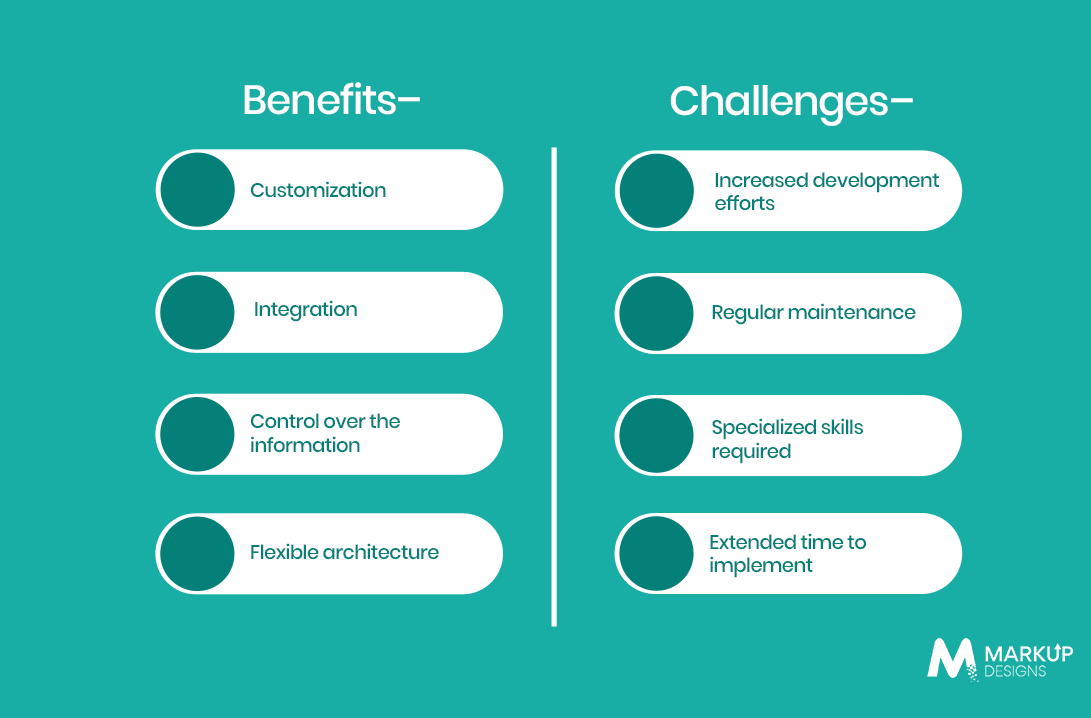
When developing an RAG solution, a company obtains increased control over the process of using AI for internal information. At the same time, custom development requires careful preparation and effort.
Benefits of Developing a Custom RAG Solution
- Customization: You get the freedom to tailor your approach to retrieval and processing of information according to your needs.
- Integration: With custom software development, you have the freedom to integrate RAG with other databases, CRM systems, ERP systems, etc.
- Control over the information: You will be able to define how your information will be stored, retrieved, processed, etc.
- Flexible architecture: You will have the possibility to choose AI models, databases, and other technical solutions.
Challenges of Building a Custom RAG Solution
- Increased development efforts: You will have to develop and validate crucial components such as data pipelines, retrieval systems, and evaluation procedures.
- Regular maintenance: Connectors, models, security, and data sources will require periodic updating.
- Specialized skills required: You need to possess AI product engineering, data management, cloud computing, and security skills.
- Extended time to implement: It may take more time to develop and validate the entire system than to rely on an existing one.
Building is justified in case the requirements warrant it. Evaluate whether your team can cope with development and maintenance before you begin.
Build vs Buy RAG: Key Factors to Consider
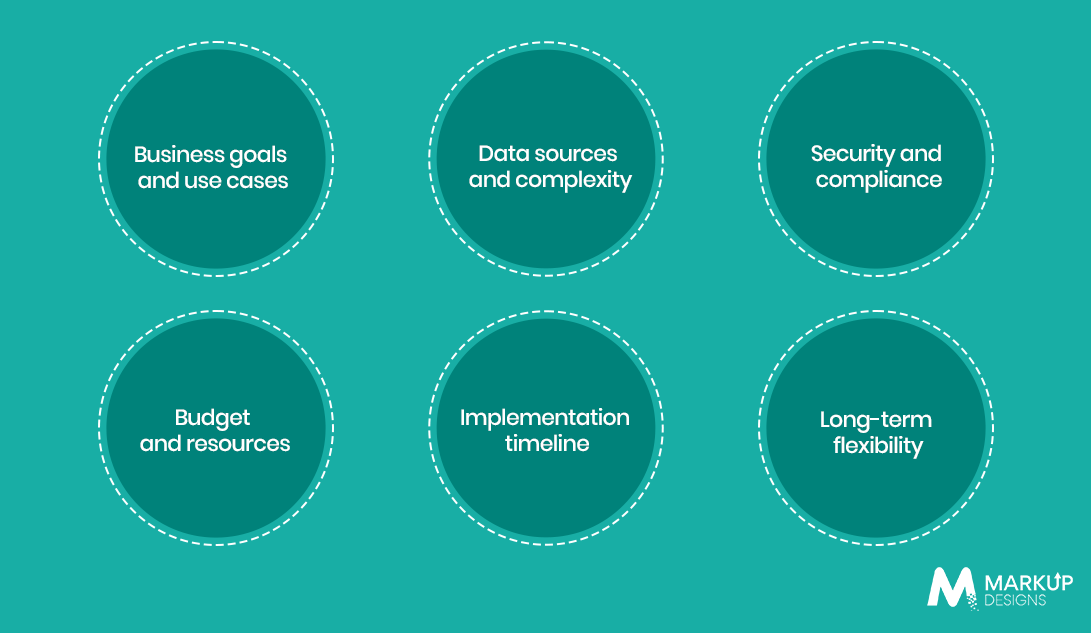
Deciding on the building or buying of a RAG solution is not limited to the comparison of development costs versus licensing fees. Businesses should consider their current needs and future plans prior to making a decision.
Business goals and use cases
Define the issues that the solution has to resolve and what value it should provide.
Data sources and complexity
Assess the number of systems, types of documents, and data formats that the solution has to work with.
Security and compliance
Examine the options for access control, encryption, auditing, data residency, and applicable regulations.
Budget and resources
Compare development costs, licensing fees, infrastructure, staffing, and maintenance.
Implementation timeline
Set the deadline by which the solution should be available to your employees and customers.
Long-term flexibility
Think about model portability, ability to customize, scalability, dependency on the vendor, and the cost of migration to another platform.
Assessing these factors will help you make an informed decision and avoid any potential difficulties.
How Much Does It Cost to Build or Buy a RAG Solution?
The costs associated with the implementation of RAG technology will depend on the data sources that you use, system complexity, security needs, and projected volume of usage. Building your own RAG system will demand higher initial costs than purchasing an existing one, which, however, will demand ongoing licensing costs.
Before making any decision, it is wise to estimate the total cost of ownership (TCO).
1. Cost of Building a Custom RAG Solution
Developing the RAG system involves costs for development, infrastructure, integration, testing, and maintenance.
Costs will involve:
- Development team: AI engineers, software developers, data engineers, and security professionals.
- Data pre-processing: Cleaning documents, preparing information, generating embeddings, and establishing data pipelines.
- Infrastructure: Cloud infrastructure, vector databases, using models, and storing data.
- Integration and testing: Integrating enterprise applications, evaluating retrieval performance, and conducting permission tests.
- Security and compliance: Providing access controls, auditing, monitoring, and security measures is required.
- Maintenance: Updating connectors, updating models, improving retrieval, and solving technical problems.
The key benefit will be control over architecture and functionality. The drawback is that the company must maintain the system according to changing requirements.
2. Cost of Buying a RAG Platform
The purchase of the RAG platform/accelerator could lower the amount of infrastructure and functionality you have to develop on your own. Nevertheless, the total price will depend on the pricing model of the vendor and the additional work needed to make the platform production-ready.
Some common costs are:
- License fees: Fees depend on users, usage, features, or deployment options.
- Implementation: Customizing the platform and integrating it with your system.
- Customization: Developing features that are not available out of the box.
- Infrastructure and AI usage: Model calls, storage, data processing, and other pay-per-use charges, except for the license.
- Security and compliance: Extra security measures, assessments, and customizations are needed for enterprise-level usage.
- Renewal and support: Subscription fees, support, and other ongoing costs.
Even though the ready-to-use solution may save some development time, enterprises should still be clear about what the license covers.
Build vs Buy RAG: A Side-by-Side Comparison
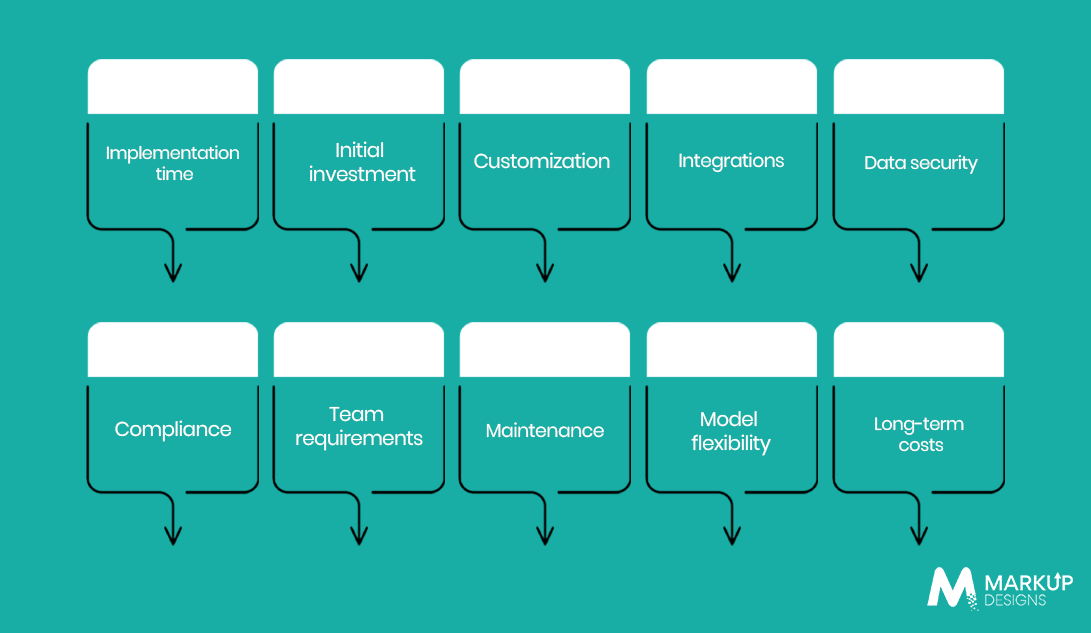
Building and buying a RAG system can both serve the needs of AI for enterprises, yet they vary in terms of control, implementation, and ongoing responsibilities. The comparison of these two methods can help you better grasp their differences.
| Decision factor | Build a RAG solution | Buy a RAG solution |
| Implementation time | Requires development and testing | Can be faster with suitable existing capabilities |
| Initial investment | Higher development effort | Lower initial development effort in many cases |
| Customization | Greater architectural control | Depends on the vendor’s flexibility |
| Integrations | Connectors can be developed as needed | Depends on supported connectors and APIs |
| Data security | Controls must be designed and maintained | Vendor capabilities must be assessed and configured |
| Compliance | Enterprise owns implementation responsibilities | Shared responsibilities depend on the service and contract |
| Team requirements | Needs strong internal technical expertise | Still needs integration, security, and platform expertise |
| Maintenance | Enterprise manages core components | Vendor manages supported platform components; customer responsibilities remain |
| Model flexibility | Can be designed for portability | Depends on supported models and export options |
| Long-term costs | Engineering, infrastructure, and maintenance | Licensing, usage, integration, and renewal fees |
When Should Enterprises Build, Buy, or Choose a Hybrid RAG Solution?
There is no universal approach to applying RAG that will work in all cases. It is dependent on the significance of AI in the products being offered by the organization, the type of data, and the level of control required by the organization.
When Should You Build a RAG Solution?
Building is reasonable if your needs exceed the capabilities of any available platform.
Custom development is recommended if:
- RAG is integral to your product or unique competitive offering.
- You deal with special document formats and/or sophisticated retrieval processes.
- Control over installation, data processing, or system design is crucial.
- You have the capability to sustain the solution in-house.
The available platforms do not meet important security and/or integration needs. Examples include a financial services firm creating an AI research assistant on proprietary financial documents.
When Should You Buy a RAG Solution?
When time, out-of-the-box functionality, and less development effort are essential, buying is usually a more practical approach.
Use a pre-built platform in case:
- You have the need to introduce an AI assistant within a limited period.
- Your data source includes typical corporate applications and standard documents.
- Your organization lacks experience with AI infrastructure.
- A provider already satisfies your integration and security needs.
- The cost of licensing and operating the platform does not exceed the budget.
For example, a firm that needs an AI assistant to serve internal HR policies, product documentation, and user manuals does not necessarily require developing an RAG infrastructure.
When Should You Choose a Hybrid Approach?
The hybrid model would be appropriate in cases where the functionalities available on the platform are sufficient for performing ordinary tasks, while some other tasks demand custom development.
Consider this option when:
- You wish to speed up deployment but retain full control over certain functionalities.
- Your processes need specific retrieval or business logic.
- You intend to integrate your enterprise systems with custom applications.
- You have the desire for future modification of the model or its expansion.
For example, a healthcare organization can use an RAG platform to ingest documents while customizing other processes that involve clinical knowledge retrieval.
Read Also: Building Enterprise AI Applications with Retrieval-Augmented Generation (RAG)
How Markup Designs Can Help You Implement the Right RAG Strategy
Proper selection of an appropriate RAG depends on understanding the objectives of your business, data resources, technical aspects, and security concerns. At Markup Designs, we assist businesses in analyzing their requirements and selecting the most appropriate RAG option: a custom RAG tool, a ready-made solution, or a hybrid. We can assist in developing a custom RAG system, implementing artificial intelligence models, configuring data pipelines, and integrating RAGs with enterprise systems.
We pay attention to such aspects as data access restrictions, data retrieval efficiency, and testing and monitoring of performance. This helps to develop solutions that are able to retrieve relevant data, taking into account enterprise requirements. Throughout the process, we will help you to match the capabilities of RAG with your practical business needs.
If you need to improve your knowledge management system, automate information retrieval or build a customer-facing artificial intelligence application, Markup Designs can help you in planning an approach to RAG implementation, balancing efficiency and flexibility.
Ready to Plan Your Enterprise RAG Solution?
Whether you need a custom RAG application or support integrating AI into existing systems, Markup Designs can help you evaluate your requirements and plan the next steps.
Conclusion
The decision about whether to build or purchase a RAG solution is one of those that enterprises face when thinking about the implementation of AI technologies using their corporate data. There are certain pros and cons in both cases that should be taken into account when deciding which path to take.
While building provides more opportunities for control and customization, it requires development competencies and maintenance. Purchase allows faster deployment of standard functionalities, but one should take into account potential licensing costs, vendor dependence, and customization difficulties. One can combine the two approaches and integrate available infrastructure and customization.
When choosing a particular way, one should take into account such factors as TCO, integration possibilities, permission management, and business benefits.
The main point is that building and purchasing are not the goals. The goal is to select the right RAG strategy that would help solve real business problems and enable responsible AI usage.
FAQs
1. Is it cheaper to build or buy a RAG solution?
Buying a RAG platform can reduce initial development effort, while building requires investment in developers, infrastructure, integration, and maintenance. The more cost-effective option depends on licensing terms, customization needs, usage, and long-term ownership costs.
2. How long does it take to implement a RAG solution?
Implementation time depends on data complexity, integrations, security requirements, and testing. A ready-made platform may speed up deployment, while a custom solution may take longer because its components must be developed and validated.
3. Can a purchased RAG platform be customized?
Yes, many platforms support customization through APIs, connectors, configuration options, and custom retrieval logic. However, the level of flexibility depends on the vendor’s architecture, licensing terms, and available features.
4. Are ready-made RAG solutions secure enough for enterprises?
They can meet enterprise security requirements, but businesses must evaluate each platform carefully. Check access controls, encryption, data residency, audit logs, retention policies, and whether customer data is used for model training. Security also depends on how the solution is configured and managed.
5. When should an enterprise choose a hybrid RAG approach?
A hybrid approach is useful when an enterprise wants to use existing platform capabilities while developing custom features for its specific needs. It can balance implementation speed, flexibility, and control without requiring every component to be built from scratch.
Author's Perspective
The decision to build or buy a RAG solution should start with business needs rather than technology preferences. Enterprises need to understand their data, security requirements, internal capabilities, and long-term goals before selecting an approach. While ready-made platforms can speed up implementation, custom development offers greater control when specialized requirements demand it. A hybrid strategy can also provide a practical balance. The best RAG investment is one that solves real problems, protects enterprise information, and remains flexible as AI needs evolve.
Discuss Your Project NowAjit Kumar Jha
VP - Business Operations
Related Posts
How AI is Revolutionising Industrial Automation in Australia
How UK Enterprises Can Build an Effective AI...

AI Voice Agent for Real Estate: Features, Benefits,...
Insights Are Valuable & Execution is Priceless
You’ve read about the digital future. Now, let’s build the infrastructure to take you there. Move your strategy from the page to the product.
Design Your Solution Now
Contact Us
Schedule The Appointment At Your Convenience Date And Time.
30 Min
Web Conference
Time Zone
Indian standard time (08:30pm)

Thanks For Getting In Touch!
You’ve Taken The First Step Toward Transforming Your Digital Presence. Our Experts Will Reach Out Shortly To Take It Forward.
Launch Your Dream Project
Provide a brief overview of your project, and our specialists will evaluate your requirements. We will connect with you to explore how the right digital solutions can help you launch faster.