
Digital Transformation Framework: A Practical Blueprint for Enterprise Growth
Digital transformation isn’t about adopting the latest tools or upgrading your IT systems; it’s about fundamentally rethinking how your business operates. At its core, it reshapes how people, processes, and technology come together to drive meaningful performance and long-term growth.
This is not a surface-level change. It’s a strategic shift that transforms your organization into an agile, data-driven, and customer-centric enterprise, one that can adapt quickly and stay ahead in an increasingly competitive landscape.
The key to surviving and expanding in today’s market is digital transformation. Your company’s operations, value creation, and audience engagement must completely transform in response to market constraints, disruptive rivals, and ever-rising customer expectations.
As per the recent survey, the size of the global digital transformation market was estimated at USD 1,302.95 billion in 2025 and is expected to increase at a compound annual growth rate (CAGR) of 19.4% from 2026 to 2033, reaching USD 5,493.15 billion. In order to increase productivity and flexibility, the market entails the extensive integration of cutting-edge technologies into corporate processes.
Let’s Understand What Exactly the Digitalization, Digitization, and Digital Transformation Terms Mean
| Term | Definition | Key Focus |
| Digitization | The process of converting analog or physical information into a digital format | Data conversion |
| Digitalization | The use of digital technologies to improve existing business processes and workflows. | Process improvement |
| Digital Transformation | A holistic transformation of business models, culture, and operations using digital technologies to drive innovation and growth. | Business transformation |
Why Digital Transformation Fails: Key Challenges and How to Fix Them
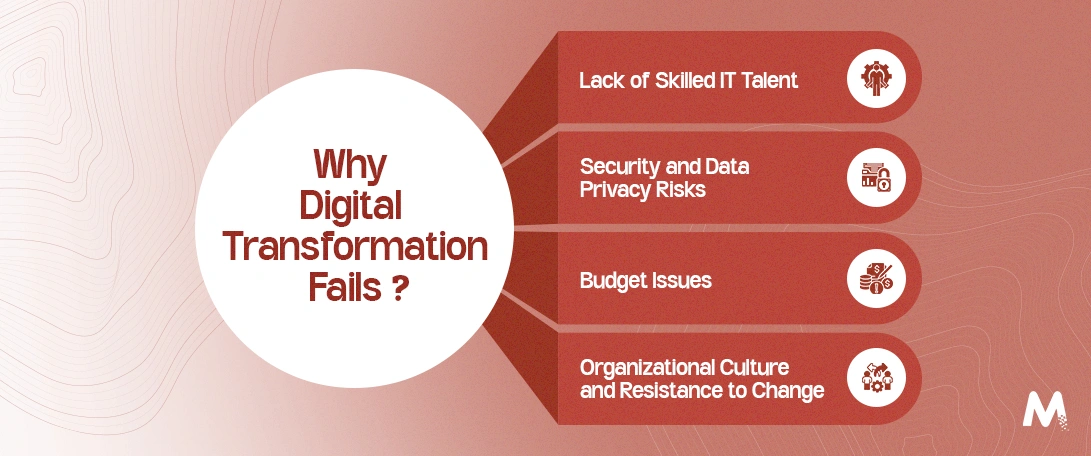
Lack of Skilled IT Talent
Challenge: Successful digital transformation depends heavily on having a capable and experienced IT team. However, building such a team is increasingly difficult due to the ongoing shortage of skilled tech professionals. Many organizations struggle to meet their transformation goals because they lack the necessary technical expertise.
Solution: Invest in continuous upskilling programs, hire specialized talent where needed, and consider partnering with technology experts or outsourcing providers to bridge capability gaps.
Security and Data Privacy Risks
Challenge: As businesses move from legacy systems to cloud-based environments and centralize their data, the risk of cyber threats increases. This includes data breaches, unauthorized access, and potential loss of sensitive information.
Solution: Strengthen your cybersecurity framework by implementing measures such as data encryption, strict access controls, and real-time threat monitoring to proactively protect your digital ecosystem.
Budget Issues
Challenge: Digital transformation requires significant investment, and without a clearly defined roadmap, projects can easily expand beyond scope. Unexpected technical issues and changing customer demands can further increase costs and delay timelines.
Solution: Create a well-structured roadmap with defined milestones, realistic budgets, and flexible timelines. Focus on high-impact initiatives, prioritize based on ROI, and leverage scalable cloud solutions to manage long-term costs efficiently.
Organizational Culture and Resistance to Change
Challenge: One of the biggest barriers to transformation is cultural resistance within the organization. Many businesses assume that adopting new technologies alone is enough, but real transformation requires people to adapt as well. Poor communication and a lack of clarity around transformation goals often lead to employee pushback and slow adoption.
Solution: Build a culture that embraces change by aligning leadership, promoting collaboration across teams, and investing in employee training. Transparent communication and involving employees in the transformation journey can significantly reduce resistance and improve adoption.
Unlocking the Key Benefits of Digital Transformation for Enterprise Growth
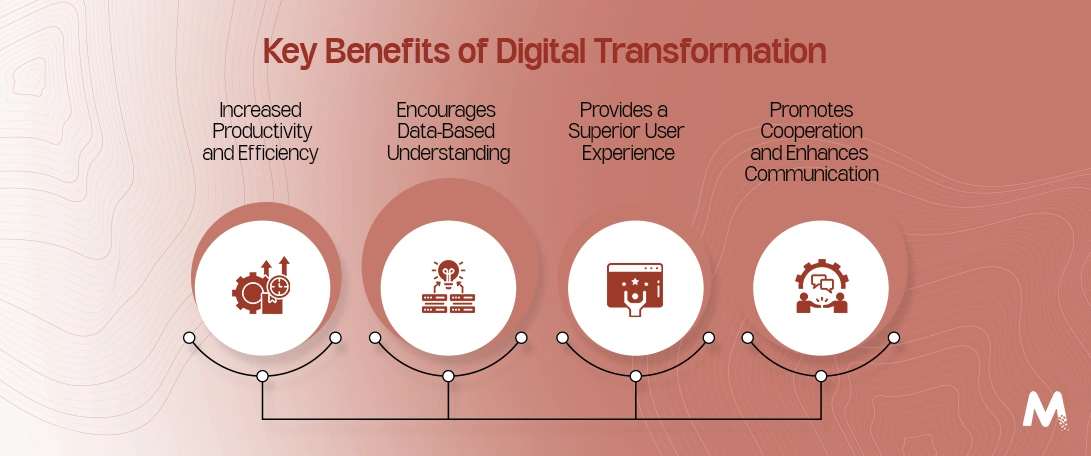
1. Increased Productivity and Efficiency
Conventional approaches often rely heavily on manual effort, consuming valuable employee time and limiting efficiency. By leveraging advanced technologies such as machine learning, artificial intelligence, the Internet of Things, and ERP systems, businesses can significantly enhance scalability, improve accuracy, and streamline operations.
2. Turning Data into Revenue Opportunities
With digital transformation, enterprises can move beyond basic data collection to intelligent analysis. Centralized data systems and analytical tools help identify customer behavior, optimize operations, and unlock new income-generating opportunities.
3. Provides a Superior User Experience
High-value businesses are aware that they are providing experiences rather than just products. Beautiful, seamless experiences that rely on automation, artificial intelligence, and self-service tools are made possible by digital transformation.
4. Promotes Cooperation and Enhances Communication
You must have a digital platform that encourages communication among all internal departments to encourage innovation and output. Roundabout communication, redundancy, slow reaction times, missing information, and inefficient idea sharing are eliminated by the digital transition. Digitalizing your company’s internal communications will boost innovation, productivity, and accountability while giving you a competitive advantage.
Read Also: Selecting the Right Digital Transformation Framework for Your Organization
Key Pillars of a Digital Transformation Framework
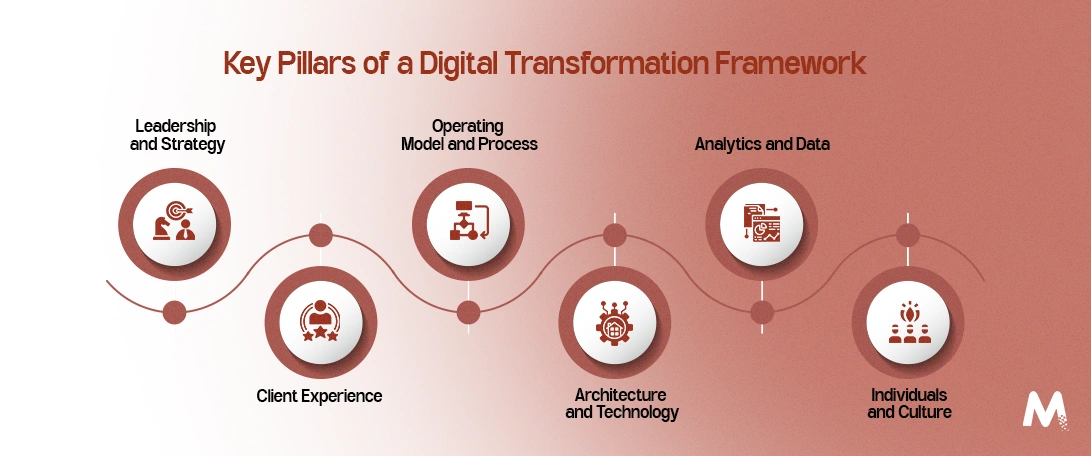
1.Leadership and Strategy
It creates a distinct digital vision that is in line with corporate objectives and results. While governance frameworks aid in setting priorities and directing transformation programs, strong leadership is needed to guarantee the use of appropriate resources and cross-functional alignment.
2.Client Experience
It focuses on providing smooth, customised experiences at every touchpoint. Businesses may enhance customer understanding, boost engagement, and foster enduring loyalty by utilising data, artificial intelligence, and omnichannel tactics.
3.Operating Model and Process
It entails rethinking processes to increase scalability, agility, and efficiency. Automation and agile approaches facilitate quicker decision-making and creativity, while streamlining processes and lowering manual labour.
4.Architecture and Technology
It uses cloud, AI, IoT, and contemporary architectures to create a scalable and secure technology foundation. It guarantees flexibility, system integration, and the capacity to swiftly adjust to changing business requirements.
5Analytics and Data
Strong governance, real-time insights, and sophisticated analytics enable data-driven decision-making. Data is used by organisations to spot trends, improve client experiences, and maximise performance.
6.Individuals and Culture
It promotes a culture of creativity and flexibility, which pushes change. Upskilling staff, promoting teamwork, and making sure teams are prepared to adopt new technology and methods of operation are its main objectives
Step-by-Step Digital Transformation Framework
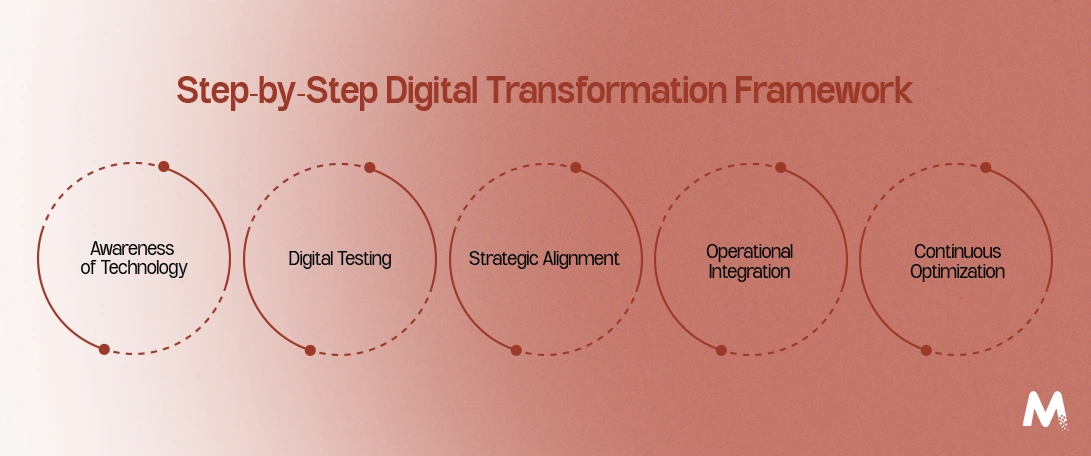
It rarely happens that the digital transformation proceeds in a straight line; instead, most businesses go through several different phases. Knowing these stages makes it easier to prioritise tasks and track advancement.
Step 1: Awareness of Technology
Organisations recognise the need for digital transformation but lack a cohesive strategy. Efforts remain fragmented, with isolated initiatives and experimentation occurring across departments without clear coordination or long-term focus.
Step 2: Digital Testing
Businesses begin testing ideas through pilot projects and proofs-of-concept in areas such as marketing automation, data analytics, and customer experience. These initiatives are limited in scope and typically deliver value within specific functions rather than across the organisation.
Step 3: Strategic Alignment
Digital initiatives start aligning with overall business objectives. Leadership defines clear priorities, governance structures, and roadmaps, ensuring that investments are purposeful and tied to measurable business outcomes.
Step 4: Operational Integration
Digital capabilities are embedded into core business processes. Systems become more connected, allowing smoother data flow across departments, while automation is scaled to improve efficiency, consistency, and operational performance.
Step 5: Continuous Optimization
Digital transformation becomes an ongoing process focused on continuous improvement. Organizations use performance insights and feedback to refine strategies, enhance operations, and maintain competitiveness in a changing environment.
A well-defined digital transformation framework connects initiatives to each of these stages, ensuring organizations avoid scaling too early or getting stuck in prolonged pilot phases.
Digital Transformation Misconceptions That Are Costing Businesses
Several widespread misconceptions about digital transformation can mislead businesses and reduce the effectiveness of their efforts. Unrealistic expectations regarding technology, scale, and results are frequently the source of these errors. Developing an effective transformation plan requires an understanding of the truth underlying these myths.
- Myth: Digital transformation is only about technology
Reality: True transformation goes beyond tools and platforms. It requires a balanced integration of people, processes, and technology to create a meaningful business impact. - Myth: It requires building entirely new products from scratch
Reality: Most digital initiatives focus on enhancing and optimizing existing products, services, and operations rather than reinventing everything from the ground up. - Myth: Digital transformation is a one-time project with a clear endpoint
Reality: It is an ongoing journey that continuously evolves alongside changing customer expectations, market trends, and technological advancements. - Myth: It is only relevant for large enterprises or tech companies
Reality: Organizations of all sizes, including small and medium businesses, are adopting digital transformation to improve agility, efficiency, and competitiveness. - Myth: Digital transformation guarantees instant ROI
Reality: Achieving measurable results takes time and depends on a well-defined strategy, effective execution, and continuous optimization.
Tracking the ROI of Digital Transformation in a Business
Successful digital transformation is strongly indicated by faster reaction times, more individualized services, and smooth interactions. Over time, digital infrastructure and cloud computing can lower operating and maintenance expenses. Some of the core factors that help to track digital transformation ROI are:
- The Adoption Rate Is Crucial: The degree to which customers and workers embrace new technologies is a critical factor in the success of digital transformation projects.
- Utilize Data Analytics To Gain An Understanding: Organizations can continuously evaluate performance and modify tactics to increase return on investment by using real-time data.
- Operational KPIs — How Fast and How Well: Process efficiency and productivity are often the earliest signs that transformation is actually working. If your teams are delivering faster and doing more with less, that’s measurable value, and even before it shows up in the financials.
- Customer KPIs — Are Customers Happier?: Digital tools only create value if customers feel it. Key metrics to watch include CSAT score, Net Promoter Score (NPS), customer retention rate, and customer lifetime value.
- Innovation KPIs — Staying Competitive: Speed of change is a competitive advantage. Time-to-market and responsiveness to shifting market conditions show whether your transformation is building the agility needed to stay ahead, and not just operate efficiently today.
Trends That You Need to Look for in 2026 and Beyond
From 2026 onward, businesses will move away from trial-and-error approaches and focus on digital transformation that delivers clear results. They will rely more on automated, intelligent systems to manage processes, while building strong data-driven cultures supported by unified platforms. At the same time, organisations will place greater importance on cybersecurity and environmentally sustainable technologies.
Automation and Agentic AI:
Moving beyond generative AI, businesses are adopting ‘agentic’ systems where specialized AI agents autonomously manage complex departmental tasks such as supply chain operations and contract negotiations, improving efficiency and decision-making.
Hyper-automation & Low-Code Platforms:
Organizations are automating end-to-end processes by combining AI, low-code platforms, and robotic process automation (RPA). This empowers non-technical teams to rapidly build, deploy, and scale applications with minimal effort.
Data-First Culture and Unified Platforms:
To eliminate data silos and enable real-time insights, businesses are embracing unified data platforms and lakehouses. Data is increasingly treated as a strategic asset, driving smarter and faster decision-making.
Green IT and sustainability:
Sustainability is becoming integral to digital transformation. Companies are leveraging AI to reduce carbon footprints, optimize energy usage, and adopt environmentally responsible practices in IT and manufacturing.
Zero-Trust and Confidential Computing:
With growing cloud adoption, Zero Trust security models are essential. Confidential computing further enhances data protection by securing information not just at rest or in transit, but also during processing.
Immersion Experiences (XR/VR):
Virtual and augmented reality technologies are transforming training, customer engagement, and manufacturing. Studies show these immersive experiences can improve training performance by up to 70%.
Simulation-Driven AI (Digital Twins):
Businesses are using simulation tools and digital twins to test AI models in realistic environments before deployment, increasing reliability, reducing risks, and maximizing ROI.
Cloud Cost Management (FinOps):
As cloud usage matures, organizations are focusing on FinOps to control costs, reduce overprovisioning, and ensure better financial accountability across IT operations.
Read Also: Guide to Choosing a Reliable AI Development Partner
Start Your Digital Transformation Journey with Markup Designs
By partnering with Markup Designs, companies can accelerate their digital transformation journey through well-crafted strategies that deliver measurable results. We will guide you through the entire journey of digital transformation by understanding requirements, difficulties, and present systems.
Our experts will utilize the technologies along with modern methods of implementation and analysis. By adopting cloud computing, developing customized software applications, automation, and analytics, we will make sure that every process implemented will create maximum value.
Our services are not about implementing technologies; rather, they are all about partnering with you throughout the entire process. Our team of IT experts will assist you at every stage of implementation, allowing you to experience all the advantages of digital transformation.
FAQs
1.What is a digital transformation framework?
A digital transformation framework refers to a set of practices and techniques that businesses can use when adopting digital technologies. It harmonizes the people, processes, and strategies involved.
2. Why is digital transformation necessary for businesses?
Digital transformation makes businesses more competitive, as it ensures that the operations are efficient and meet the customers’ expectations. It also involves data-driven decision-making.
3. How long does digital transformation take?
Digital transformation does not happen overnight; it is a lengthy process whose duration is dependent on factors such as the size of the business, objectives, and level of complexity. Most companies realize their benefits after a few months, but continue to grow for several years.
4. What are some of the challenges involved in digital transformation?
Some of the challenges that businesses might face during digital transformation include a lack of talent, change management problems, financial limitations, and cybersecurity threats.
5. How should businesses assess the success of digital transformation?
The success of digital transformation is often determined using various financial and non-financial metrics such as growth in revenue, operational efficiency, customer satisfaction (CSAT/NPS), and employee.
Author's Perspective
Digital transformation is often misunderstood as a technology upgrade, but in reality, it is a continuous business evolution driven by clear strategy, strong leadership, and disciplined execution. From my perspective, organizations succeed when they focus on aligning people, processes, and data rather than chasing trends. Small, measurable improvements, supported by a solid data foundation and tied directly to business outcomes. Ultimately, transformation works best when it is treated as an ongoing journey, not a one-time project.
Discuss Your Project NowGaurav Goyal
Global Sales- VP
Related Posts

Digital Transformation in Financial Services: Trends, Benefits &...

IoT in Banking: Transforming Financial Services Through Connected...

Digital Transformation for Australian Enterprises: Strategy, Technology &...
Insights Are Valuable & Execution is Priceless
You’ve read about the digital future. Now, let’s build the infrastructure to take you there. Move your strategy from the page to the product.
Design Your Solution Now
Contact Us
Schedule The Appointment At Your Convenience Date And Time.
30 Min
Web Conference
Time Zone
Indian standard time (08:30pm)

Thanks For Getting In Touch!
You’ve Taken The First Step Toward Transforming Your Digital Presence. Our Experts Will Reach Out Shortly To Take It Forward.
Launch Your Dream Project
Provide a brief overview of your project, and our specialists will evaluate your requirements. We will connect with you to explore how the right digital solutions can help you launch faster.