

ROI of Cloud Computing: Is It Really Worth the Investment?
In Brief
- Cloud computing offers a strong ROI when backed by clear planning and continuous optimization.
- Reduces upfront infrastructure costs by shifting from CapEx to pay-as-you-go pricing.
- Speeds up development and deployment, improving time to market.
- Hidden costs like migration, DevOps, and data transfer can impact overall savings.
- Cost optimization (right-sizing, monitoring) can reduce cloud spend by 20–40%.
- Most businesses start seeing ROI within 12–24 months.
- Best results come from choosing the right cloud strategy and partner.
Investing in cloud computing has become a major topic for modern businesses. Companies of all sizes are trying to decide whether moving to the cloud is worth it. While many see it as expensive, most also recognize it as an important step for staying competitive in today’s digital world.
The problem is that the conversation rarely starts with clarity. IT Partners promise reduced costs, seamless scalability, and operational efficiency. However, industry experience demonstrates that after the transition begins, several unanticipated costs tend to arise.
The major issues that arise are connected with unpredictable costs of infrastructure, resource provision problems, security and compliance costs, and the need to spend more time and effort on learning the basics of cloud technologies. Additionally, many organizations find it difficult to determine whether their investments pay off in general.
This article can help you understand the true costs of using cloud computing, the opportunities for saving money in this regard, and the ways to assess its return on investment.
The Main Concept of Cloud Computing
ROI in cloud computing is not just about cutting server bills. It is about what you save on infrastructure management, how fast the team can move, and what becomes possible when you stop babysitting hardware.
When businesses calculate cloud ROI, they look at three key factors.
- First, cost savings, less hardware, fewer IT staff hours, and no emergency replacements.
- Second, speed to market so that your development team ships faster when environment setup is not a blocker.
- Third, uptime and reliability, which is downtime, is expensive, and cloud vendors carry that weight, so you do not have to.
To fully understand how cloud impacts cost, scalability, and infrastructure, it is first necessary to understand how it works in the real world, as explained in this Cloud Computing for Business Guide.
- Where Businesses Actually Save Money: The savings from cloud computing tend to show up in three main areas, and most founders underestimate at least one of them.
- Reducing upfront hardware costs: Traditional on-premise infrastructure demands significant initial investment, often requiring businesses to purchase capacity for future needs, leading to underutilized resources and tied-up capital. Cloud computing changes this model by allowing you to scale resources on demand, so you only pay for what you actually use, when you need it.
- Reducing IT overhead: When AWS or Azure manages patching, security updates, and hardware failures, your internal team is building instead of maintaining. That is the real labor cost recovered.
- Avoiding downtime losses: Downtime costs vary by industry. Retail loses roughly $5,600 per minute. Healthcare can lose far more. Cloud platforms with 99.99% uptime SLAs reduce the chance of that hitting your books.
4 Key Factors That Determine Your Cloud ROI
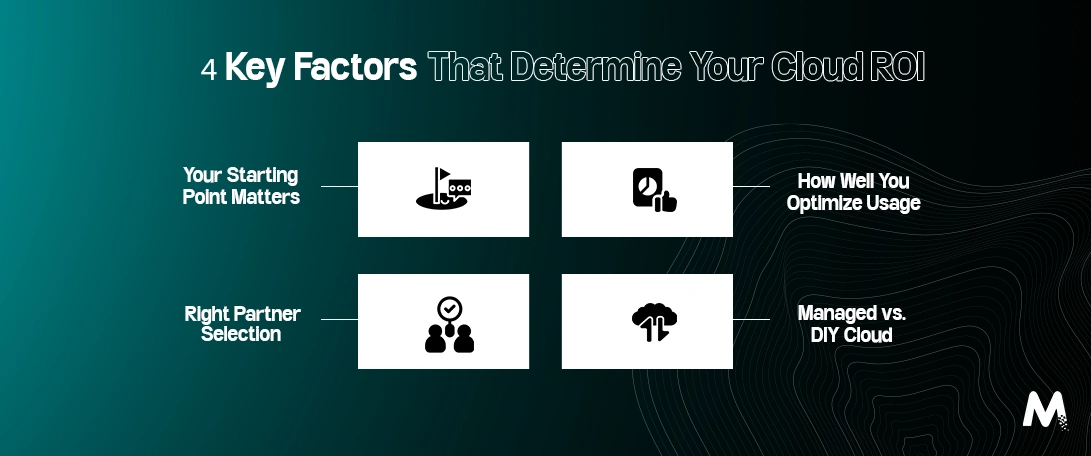
1. Your Starting Point Matters
If you are running legacy systems, migration gets complex and expensive. Greenfield companies, such as those building from scratch, almost always see faster ROI because they do not carry migration baggage.
2. How Well You Optimize Usage
Gartner has consistently flagged cloud waste as a top issue. Many organizations overprovision and end up paying for idle resources. Optimization through right-sizing and reserved instances typically cuts bills by 20 to 40%.
3. Right Partner Selection
Every company sets its own pricing model differently. Getting competitive quotes and understanding their pricing models before committing saves money long-term. Do not default to the biggest name without running the numbers first.
4. Managed vs. DIY Cloud
Managing cloud internally requires skilled DevOps engineers, who are expensive to hire. Working with a managed cloud partner often delivers better outcomes at lower total cost, especially for teams under 50 people.
Cloud Importance for Every Business Stage
Early-Stage Startups (0–10 employees). Cloud almost always wins here. The flexibility, low upfront cost, and managed services let a small team punch above its weight. You do not need a dedicated infrastructure team to run on AWS.
Growth-Stage Companies (11–100 employees). This is where decisions get more nuanced. You are spending more on the cloud, and you need someone watching it. This is typically where a cloud partner or managed service makes the most financial sense.
Enterprise (100+ employees). At scale, hybrid cloud or multi-cloud strategies often make sense. Some workloads stay on-premise, others move to the cloud. ROI calculations are complex and require detailed audits.
Cloud ROI by Business Stage
| Business Stage | Cloud ROI Potential | Key Benefits | Cost Considerations |
| Early-Stage Startups (0–10 employees) | Very High | Low upfront cost, rapid scalability, no need for an infrastructure team | Minimal costs; typically $200–$500/month |
| Growth-Stage Companies (11–100 employees) | High (with optimization) | Flexibility, faster deployment, improved team productivity | Costs increase; requires monitoring and possible managed services |
| Mid-Sized Businesses (100–500 employees) | Moderate to High | Better performance, scalability, and hybrid flexibility | Needs cost governance and architecture optimization |
| Enterprise (500+ employees) | Variable | Advanced scalability, hybrid/multi-cloud strategies | Complex ROI; requires audits, governance, and workload |
Common Mistakes That Can Impact Cloud ROI
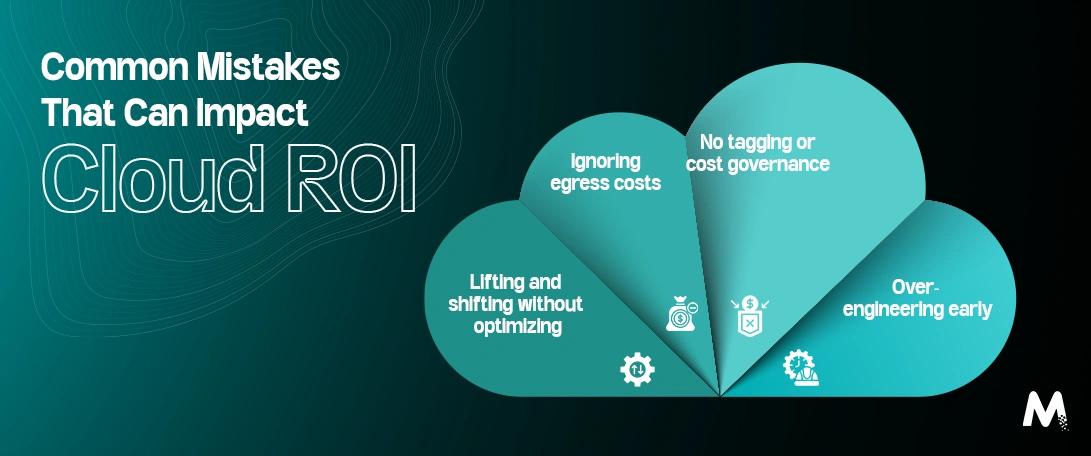
Most cloud disappointments come from execution problems, not the cloud itself.
Lifting and shifting without optimizing: Moving your old architecture to the cloud without rethinking it means you pay cloud prices for on-premise thinking. The bill goes up, the benefits do not follow.
Ignoring egress costs: Data transfer out of the cloud costs money. Many teams discover this late and are surprised by their bills.
No tagging or cost governance: Without proper cost allocation, you cannot tell which teams or projects are driving spend. Waste builds fast and quietly.
Over-engineering early: Startups sometimes build for a massive scale they do not yet have, which drives up costs unnecessarily. Start lean, scale when the need is real.
Where Businesses Actually Save Money in the Cloud
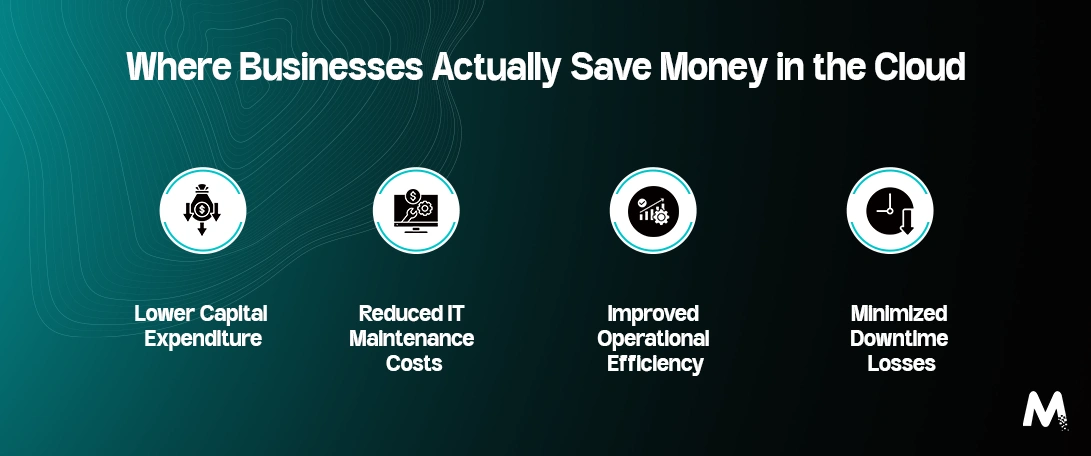
Most cloud savings don’t come from just ‘cheaper servers’, they come from smarter operations and reduced overhead across the business.
Lower Capital Expenditure
Cloud eliminates the need for heavy upfront investments in servers and hardware. Instead of overbuying for future demand, businesses can scale resources in real time and only pay for what they use.
Reduced IT Maintenance Costs
Cloud providers handle infrastructure management, including updates, patching, and hardware failures. This frees internal teams to focus on innovation rather than maintenance, significantly reducing labor costs.
Improved Operational Efficiency
Faster deployment cycles and automated workflows reduce time spent on setup and troubleshooting. This leads to faster product releases and lower operational delays.
Minimized Downtime Losses
With high uptime guarantees (often 99.9% or higher), cloud platforms reduce the financial impact of outages, which can be extremely costly for sectors like e-commerce and healthcare
Markup Designs Approach Towards Cloud Computing
Moving to the cloud is not a decision you want to make blindly, and it is definitely not one you want to execute without the right partner. Markup Designs has worked with founders and enterprises to help them plan, build, and manage cloud infrastructure without the usual headaches.
- Strategic planning before execution. Before any migration starts, the team audits your current setup, maps out what moves, what stays, and what gets rebuilt. No assumptions, no guesswork.
- Cost-first architecture. Every infrastructure decision is evaluated against cost impact. The team builds for performance without bloating your monthly cloud spend.
- Ongoing optimization, not just setup. The real savings in the cloud happen over time. Markup Designs does not hand off a setup and walk away. They monitor, right-size, and continuously reduce waste across your environments.
- Business-aware, not just technically competent. The team understands that cloud decisions affect product roadmaps, hiring plans, and growth timelines. They speak the language of a founder, not just an engineer.
- Transparent pricing. No hidden fees, no scope creep surprises. You know exactly what you are getting into before work starts.
If you are a founder trying to decide whether the cloud makes sense for your stage, or you are already on the cloud but not seeing the ROI you expected, Markup Designs is worth a conversation.
FAQs
Q: How long does it take to see ROI from cloud computing?
Most businesses start seeing measurable savings between 12 and 24 months after migration. Companies that optimize consistently see returns sooner.
Q: Is cloud computing cheaper than on-premise?
For most companies under 500 employees, yes. For very large enterprises with stable, predictable workloads, on-premise or hybrid can sometimes be cheaper. It depends on your specific usage patterns.
Q: What is the highest hidden cost of cloud computing?
Egress costs (data transfer out), idle resources that keep running, and the DevOps talent needed to manage them properly are the three most common cost surprises.
Q: Which cloud provider gives the best ROI?
AWS has the largest ecosystem. Azure is often preferred by companies already using Microsoft products. Google Cloud tends to be competitive on pricing, especially for data-heavy workloads. The right answer depends on your tech stack and how your team already works.
Q: Should I manage the cloud internally or hire a managed service?
For teams under 50 people, a managed cloud partner almost always delivers better ROI than building an internal team. The annual cost of one good cloud architect often exceeds what a managed service costs for the year.
Q: What is a reasonable cloud budget for a startup?
Early-stage startups can get started for $200–$500 per month. Growth-stage companies should budget $2,000–$10,000 per month, depending on traffic, data volume, and the number of environments running.
Conclusion
Cloud computing delivers real, measurable returns. But only when the move is planned properly and managed consistently. The ROI is not automatic. It comes from smart architecture, ongoing cost governance, and making sure your team has the support they need to run the cloud efficiently.
For founders, the question is rarely “should we go to the cloud?” The real question is “how do we go to the cloud in a way that actually pays off?” This is really well answered by Markup Designs. If you are ready to stop guessing and start building with clarity, reach out to our team today.
Author's Perspective
From my experience working with B2B organizations, one pattern is clear—businesses that invest early in scalable IT infrastructure grow faster and face fewer operational challenges. Remote managed IT services are not just a cost-saving measure; they are a strategic move. They allow businesses to focus on what truly matters—growth, innovation, and customer experience.
Companies that try to manage everything internally often struggle with delays, inefficiencies, and security gaps. On the other hand, those who partner with the right IT provider gain speed, flexibility, and confidence to scale without hesitation.
Discuss Your Project NowJupinder Singh Arora
Founder and CEO
Related Posts

Why Businesses Fail to Optimize Cloud Costs: Common...

Cloud Infrastructure Basics Every Founder Must Understand
Insights Are Valuable & Execution is Priceless
You’ve read about the digital future. Now, let’s build the infrastructure to take you there. Move your strategy from the page to the product.
Design Your Solution Now
Contact Us
Schedule The Appointment At Your Convenience Date And Time.
30 Min
Web Conference
Time Zone
Indian standard time (08:30pm)

Thanks For Getting In Touch!
You’ve Taken The First Step Toward Transforming Your Digital Presence. Our Experts Will Reach Out Shortly To Take It Forward.
Launch Your Dream Project
Provide a brief overview of your project, and our specialists will evaluate your requirements. We will connect with you to explore how the right digital solutions can help you launch faster.