
Digital Transformation in Healthcare: Building Smarter, Connected Care Systems
In Brief
- Digital transformation in healthcare is no longer optional; it is the foundational shift that separates care systems built for today from those still running on yesterday’s infrastructure.
- The global digital transformation in the healthcare market was valued at USD 86.8 billion in 2025 and is projected to reach USD 385 billion by 2036, growing at a CAGR of 14.5%. AI-enabled telehealth is delivering measurable outcomes: Mayo Clinic reduced hospital readmissions by 40%, and Cleveland Clinic achieved 94% accuracy in virtual triage
- Healthcare digitization spans Electronic Health Records (EHRs), AI diagnostics, remote patient monitoring, telehealth, and connected IoT medical devices—each working together to form a smarter care continuum.
- The software segment dominates the health tech landscape, accounting for 74.6% of the total digital transformation market share in 2025 (Source: Future Market Insights, 2026).
- The biggest risks to successful hospital transformation are not technological — they are organizational: fragmented data systems, resistance to change, and cybersecurity vulnerabilities.
Healthcare has never lacked data. It has always lacked the infrastructure to make that data useful, accessible, and actionable when it matters the most.
Clinicians today operate inside systems that were never designed to talk to each other. Patient histories are fragmented across disconnected platforms. Critical information arrives late, lands in the wrong hands, or never reaches the point of care at all. Administrative processes consume nearly half of a clinician’s working day.
Digital transformation in healthcare is the direct response to these challenges. Not as a technology initiative, but as a fundamental restructuring of how care is coordinated, delivered, and sustained across the entire patient journey.
In this article, we break down how digital transformation is revolutionizing the healthcareand what these changes mean for patients, providers, and the industry as a whole.
According to recent research, the global digital transformation in the healthcare market was valued at USD 86.8 billion in 2025 and is estimated to reach USD 99.4 billion in 2026, growing to USD 385 billion by 2036 at a CAGR of 14.5%.
What Digital Transformation Looks Like in Healthcare?
Digital transformation in healthcare refers to the comprehensive integration of technologies, including artificial intelligence, cloud computing, the Internet of Things (IoT), electronic health records, and telehealth.
Unlike a simple technology upgrade, true healthcare digitization fundamentally transforms how care is defined, delivered, and experienced, shifting healthcare systems from reactive treatment to proactive, preventive care.
The healthcare providers gaining a competitive advantage aren’t just adopting new tools; they’re replacing outdated, siloed operations with connected, data-driven ecosystems. These systems support smarter clinical decisions using real-time data and ensure every part of the organization works in sync.
How Digital Transformation Is Making Healthcare More Connected and Accessible
Before exploring the solutions, it’s worth pausing on the problem. The healthcare industry is operating under a quiet but compounding crisis, one that affects both the organizations delivering care and the people receiving it.
The Administrative Burden Is Stealing Time from Care
Nearly 50% of physicians and nurses report substantial burnout symptoms, driven largely by bureaucratic and administrative tasks and excessive working hours. Fragmented data across multiple systems—EHRs, spreadsheets, and legacy platforms, makes reporting slow, error-prone, and inefficient, turning what should be a care-focused profession into a documentation marathon.
Siloed Systems Are Breaking the Procurement Chain
Healthcare procurement is rarely simple. A single purchasing decision can involve doctors, IT advisors, and entire committees, taking months before anything is finalized. Add to that a widespread lack of digital know-how within organizations, and you have a supply chain that moves far too slowly for an industry where timing can be critical
Patients Are Evolving — But the System Hasn’t
There’s a rising interest in self-help and home remedies, with patients increasingly taking charge of their own health journeys. Today’s patients are informed and digitally enabled — and a system still built on manual workflows and disconnected records simply cannot meet that expectation.
Key Steps to Digital Healthcare Innovation
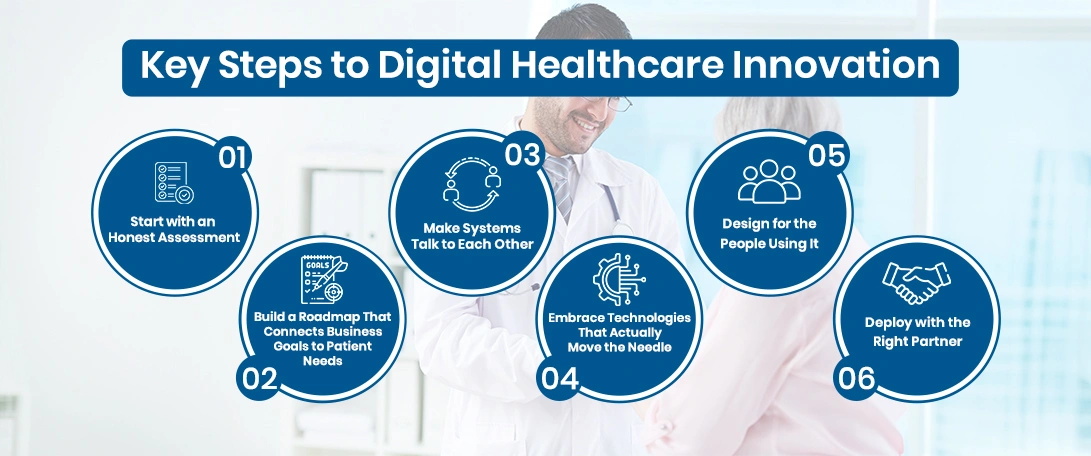
Digital transformation in healthcare doesn’t happen overnight; it follows a deliberate path. Here’s how healthcare organizations can move from legacy systems to smarter, connected care:
- Start with an Honest Assessment. Before adopting anything new, organizations need to understand where they stand. This means taking a close look at existing technology, workflows, and system integrations to spot what’s working, what’s outdated, and where the biggest gaps lie.
- Build a Roadmap That Connects Business Goals to Patient Needs. Digital transformation without direction leads nowhere. Organizations should define measurable milestones and align technology investments with real outcomes, whether that’s expanding remote care, cutting down on paperwork, or improving how teams communicate across departments.
- Make Systems Talk to Each Other. One of the biggest challenges in healthcare is data living in silos. New digital solutions must be designed to integrate with existing EHR systems from day one. Equally important is building strong data security practices, including privacy compliance and safeguards that protect sensitive patient information at every touchpoint.
- Embrace Technologies That Actually Move the Needle AI-powered diagnostics, predictive analytics, and cloud infrastructure aren’t just buzzwords; they’re practical tools that help clinicians make better decisions.
- Design for the People Using It. The best technology fails if people don’t use it. Patient portals, mobile apps, and clinical tools should be intuitive enough that adoption happens naturally for both patients managing their health and staff navigating daily workflows.
- Deploy with the Right Partners. Implementation is where many digital initiatives fall short. Working with an experienced technology partner reduces risk, but equally important is investing in thorough staff training. People need to feel confident using new tools.
Key Drivers of Digital Transformation in Healthcare
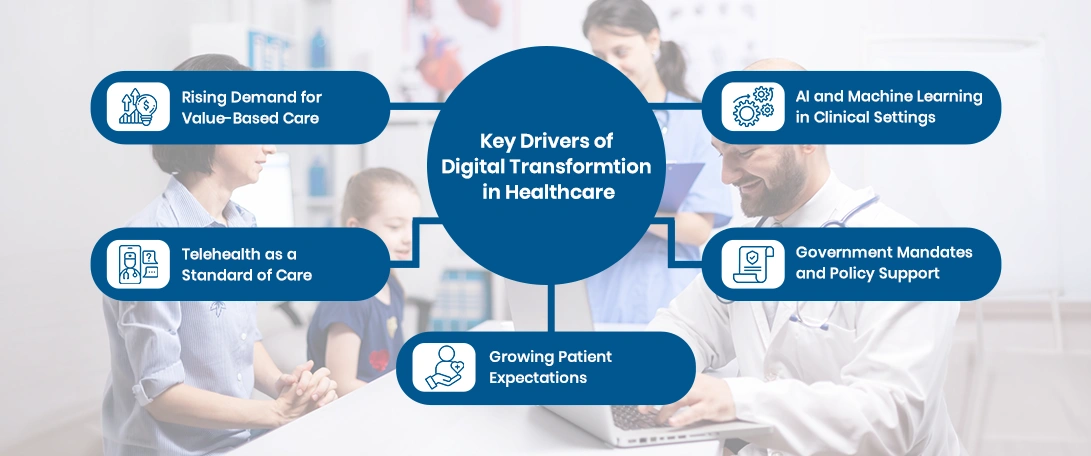
Several converging forces are accelerating health tech adoption globally.
1.Rising Demand for Value-Based Care
Healthcare payers and regulators are shifting from fee-for-service models to outcomes-based frameworks. This creates direct financial pressure on hospitals to invest in digital tools that demonstrate measurable improvements in patient outcomes, readmission rates, and care efficiency.
2.AI and Machine Learning in Clinical Settings
AI systems are now processing medical images 30 times faster than conventional methods without sacrificing diagnostic accuracy. From detecting early-stage cancer in radiology scans to predicting sepsis from EHR patterns, AI has moved from pilot programs into mainstream hospital operations. As of 2025, 70% of healthcare organizations use automated surveillance or AI-assisted analytics to identify patient safety risks in real time.
3.Telehealth as a Standard of Care
The pandemic normalized virtual care, and reimbursement policy shifts have sustained it. Telehealth represented nearly 47% of 2025 digital health spending, as patients now expect video consultations, remote follow-ups, and app-based chronic disease management as standard services.
4.Government Mandates and Policy Support
Governments across the globe are investing directly in healthcare digitization. India’s next-generation Health Management Information System was launched in April 2025. The UK’s NHS is rolling out a national EHR platform through Oracle Health. The US is enforcing interoperability mandates under value-based care frameworks. These regulatory tailwinds are accelerating hospital transformation timelines across sectors.
5.Growing Patient Expectations
Modern patients are digital consumers. They expect appointment booking via apps, access to their own health records, teleconsultation options, and personalized health insights from wearables. Health systems that fail to meet these expectations risk losing patient trust and market share to more digitally agile competitors.
The Future of Digital Transformation in Healthcare
Healthcare is no longer just going digital; it’s being fundamentally reimagined. Generative AI is stepping into clinical spaces, supporting diagnostics and patient triage, while smart wearables enable real-time health monitoring that shifts care from hospitals into everyday life.
Telehealth has evolved into a permanent hybrid model, giving patients seamless access to scheduling, consultations, and health information through a single “digital front door. ” Blockchain is securing sensitive health data across providers, and 5G connectivity is making remote surgeries and rural specialist consultations a growing reality.
Top Digital Transformation Trends in the Healthcare Industry
Looking ahead, digital twins will allow clinicians to simulate treatment responses before applying them to real patients. Together, these advancements are steering healthcare toward a future where technology and human care work hand in hand.
- AI diagnostics, telehealth, and remote monitoring (IoMT) are driving the digital transformation of healthcare toward patient-centric, personalized care. With wearable technology delivering real-time health data and generative AI streamlining healthcare operations, key themes center on increasing accessibility and efficiency.
- Artificial Intelligence (AI) and Machine Learning: AI is utilised for clinical documentation and administrative activities, whereas generative AI is employed for diagnostic imaging and predictive analytics to identify health hazards.
- Wearables and the Internet of Medical Things (IoMT): In order to provide proactive and individualised care, gadgets like smartwatches continuously monitor patient vital signs and transmit real-time data into EHRs (Electronic Health Records).
- Workflow Automation: Automation solutions are speeding billing procedures, optimizing scheduling, and reducing the administrative load on employees.
- Cloud computing and Interoperability: Better patient data integration across many platforms is made possible by secure cloud storage, which enhances provider-to-provider communication.
Build Your Digital Healthcare Strategy with Markup Designs
Every health system has a unique transformation journey that is influenced by its size, the complexity of its current infrastructure, the populations it serves, and the treatment outcomes it is responsible for.
At Markup Designs, we think that using the newest technology is not the key to successful healthcare digitisation. It involves implementing the appropriate technology in the RIGHT order and surrounding it with the human support systems.
We collaborate with healthcare organizations to map their existing digital journey, pinpointing the most impactful intervention points, and create transformation roadmaps that are operationally feasible, clinically sound, and long-term scalable.
Markup Designs works with healthcare organizations at every level of their digital transformation, from telehealth platform design to EHR integration strategy, from AI readiness evaluations to connected care infrastructure planning. We do more than merely assist you with technology development. We help you in creating more intelligent, interconnected care systems that have a quantifiable impact on the patients who rely on them.
Conclusion
Digital transformation in healthcare is not a technology trend; it is a structural shift in how care is designed, delivered, and experienced. The organizations that lead this shift are already demonstrating what is possible: fewer readmissions, faster diagnoses, more engaged patients, and care teams unburdened from administrative overload.
The data is clear, the clinical evidence is mounting, and the patient’s expectation is already set. The question for every health system is no longer whether to pursue healthcare digitization; it is how quickly, how strategically, and how comprehensively to build the connected care infrastructure that modern medicine demands.
A smarter, more connected health system does not happen overnight. But with the right strategy, the right partners, and a clear commitment to clinical outcomes over technology novelty, it is entirely within reach.
FAQs
1.What is digital transformation in healthcare?
Digital transformation in healthcare refers to the integration of digital technologies, including AI, EHRs, telehealth, cloud systems, and IoT medical devices, into the processes of care delivery, hospital operations, and patient engagement, enabling smarter, more connected, and more proactive care.
2.Why is healthcare digitization important in 2026?
Healthcare digitization improves patient outcomes, reduces operational costs, enables preventive care through real-time data, and meets the expectations of modern patients who demand seamless digital access to their health information and care providers.
3.How does AI support hospital transformation?
AI supports hospital transformation by enabling faster diagnostics, predicting patient deterioration, automating administrative tasks, improving triage accuracy, and providing clinical decision support — all of which improve care quality and reduce clinician workload.
4.What is the market size of digital transformation in healthcare?
The global digital transformation in the healthcare market was valued at USD 86.8 billion in 2025 and is projected to reach USD 385 billion by 2036, growing at a CAGR of 14.5%.
5.What are the key technologies in health tech transformation?
Key technologies include Electronic Health Records (EHRs), Artificial Intelligence, remote patient monitoring, telehealth platforms, cloud infrastructure, IoT-connected medical devices, and health data interoperability frameworks.
6.What are the biggest challenges in healthcare digital transformation?
The most significant challenges include legacy system integration, data privacy and cybersecurity compliance, workforce change management, digital equity across patient populations, and demonstrating clear return on investment for technology deployments.
7.How does telehealth fit into healthcare digital transformation?
Telehealth is a central pillar of digital transformation, extending care beyond hospital walls, reducing readmissions, supporting chronic disease management, and enabling specialist access in underserved regions with outcomes now shown to be clinically comparable to in-person care for many conditions.
8.How do we measure the success of hospital digital transformation?
Success is measured through clinical outcomes, readmission rates, diagnostic turnaround times, and patient satisfaction scores, as well as operational metrics such as staff productivity, administrative cost reduction, and real-time risk detection rates.
Author's Perspective
From my perspective, custom blockchain development is not just about adopting a modern technology trend; it’s about making strategic decisions that create real business impact. Many organizations rush into blockchain adoption without clearly defining their objectives, which often leads to underutilized solutions.
The key lies in understanding where blockchain truly adds value. Not every system needs decentralization, but for processes involving multiple stakeholders, trust gaps, or data integrity concerns, blockchain can be transformative.
Discuss Your Project NowGaurav Goyal
Global Sales- VP
Related Posts
IoT in Banking: Transforming Financial Services Through Connected...
Digital Transformation for Australian Enterprises: Strategy, Technology &...

How to Hire AI Consultants for Enterprise Digital...
Insights Are Valuable & Execution is Priceless
You’ve read about the digital future. Now, let’s build the infrastructure to take you there. Move your strategy from the page to the product.
Design Your Solution Now
Contact Us
Schedule The Appointment At Your Convenience Date And Time.
30 Min
Web Conference
Time Zone
Indian standard time (08:30pm)

Thanks For Getting In Touch!
You’ve Taken The First Step Toward Transforming Your Digital Presence. Our Experts Will Reach Out Shortly To Take It Forward.
Launch Your Dream Project
Provide a brief overview of your project, and our specialists will evaluate your requirements. We will connect with you to explore how the right digital solutions can help you launch faster.