
Selecting the Right Digital Transformation Framework for Your Organization
You’ve probably heard the term “digital transformation” many times now, that it doesn’t even feel important anymore. It just starts to feel like another buzzword you hear everywhere, and you stop paying attention to what it actually means for your business.
Imagine running a business where everything still depends on manual work-spreadsheets, calls, and endless follow-ups. At first, it feels manageable. But slowly, things start slipping. A competitor delivers faster, customers expect smoother experiences, and your team struggles to keep up.
You sit on valuable data, but can’t really use it to make decisions. Small delays turn into bigger problems, and costs quietly increase. Growth starts feeling harder than it should be. That’s what happens when digital transformation is missing from your ecosystem, but a slow gap that keeps widening while the world around you moves ahead.
You didn’t do it wrong because you lacked commitment. You did it wrong because you started with tools instead of a digital transformation framework. It is the most expensive mistake in the digital transformation journey.
Why Good Intentions Aren’t Enough
Most organizations that struggle with digital change aren’t struggling because they don’t care enough. They struggle because caring isn’t a strategy.
The numbers are hard to ignore:
- 70% of digital transformations fail to meet their stated goals. That’s not a fringe statistic – it’s the consistent finding across McKinsey, BCG, and Harvard Business review research. Seven out of ten organizations spend real money and real energy and come out the other side with less than they hoped for.
- The average company wastes $900,000 per year on unused or underused software. Think about what that number means in practice: subscriptions running quietly in the background, tools nobody trained on, platforms that solved a problem the team had already worked around.
- Around 62% of employees say they resist digital change when they don’t understand why it’s happening. This isn’t an obstacle. People don’t resist change – they resist unexplained change. When nobody connects the new tool to a real goal, the default response is to keep doing things the old way.
These numbers share a common thread. The problem was never the tools. It was always the absence of a plan that connected those tools to actual business goals.
What a Digital Transformation Framework Actually Is (And Why It’s Not as Complicated as It Sounds)
Here’s the simple version: a framework is a structured way of deciding what to change, in what order, and why.
It’s not a 200-page document. It’s not something that requires an IT department or a six-figure consultant. It’s a map – and maps are useful precisely because they show you where you are before you start moving.
There’s a persistent myth that frameworks are only for large enterprises with massive budgets and dedicated transformation teams. That myth keeps small and mid-size organizations stuck. The truth is that a good digital transformation strategy framework is actually more important when your resources are limited, because you can’t afford to waste time going in the wrong direction.
Think of it like a renovation. Before you knock down a wall, you need to know which ones are load-bearing. A blueprint doesn’t slow down your renovation – it’s the thing that makes sure the ceiling doesn’t fall on your head. A framework does the same thing for your organization.
Adopting a tool without a framework is like buying lumber before you have a floor plan. You’ll have plenty of material and nowhere useful to put it.
A digital transformation strategy framework gives your team a shared language, a clear sequence, and a way to measure whether what you’re doing is actually working. Without it, every tool becomes an island.
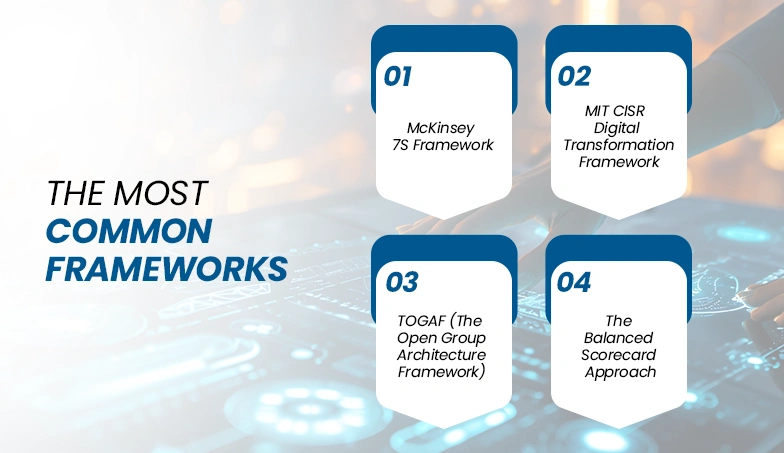
The Most Common Frameworks
You don’t need to memorize these. You just need to recognize which one sounds like your situation.
McKinsey 7S Framework
What it is: A model that looks at seven interconnected elements of your organization – strategy, structure, systems, shared values, style, staff, and skills.
Best for: Teams where the problem isn’t technology – it’s alignment. If your departments are pulling in different directions, or if culture seems to undercut every new initiative, this is the framework that names what’s actually wrong.
What problem it solves: It stops you from fixing the wrong thing. Most orgs try to fix systems when the real issue is structure or staff readiness.
MIT CISR Digital Transformation Framework
What it is: Developed at MIT’s Center for Information Systems Research, this framework focuses on two axes – operational backbone (doing existing things better) and digital platform (building new things).
Best for: Organizations trying to figure out whether they’re transforming what they do or how they do it. That’s a more important question than it sounds.
What problem it solves: It prevents the “transformation theater” problem – where teams look busy changing things without actually moving the business forward.
As AI becomes central to modern digital platforms, these shifts are already shaping how frameworks evolve. Explore the future of AI in digital transformation to understand what’s coming next.
TOGAF (The Open Group Architecture Framework)
What it is: A detailed, structured approach to enterprise architecture – essentially a methodology for designing and managing information systems across a large organization.
Best for: Mid-to-large organizations with complex IT environments and multiple systems that need to work together. This is one of the more technical frameworks.
What problem it solves: When your system’s sprawl has gotten out of control and nobody knows what connects to what, TOGAF gives you a way to map the whole picture before touching anything.
The Balanced Scorecard Approach
What it is: Originally a performance management tool, it’s been adapted widely for digital transformation management – connecting digital initiatives to four perspectives: financial results, customer impact, internal processes, and learning and growth.
Best for: Organizations that need to show results quickly and communicate progress clearly to stakeholders, boards, or investors.
What problem it solves: It keeps transformation tied to outcomes that matter to the business – not just technical milestones that mean nothing to a general manager or business owner.
How to Choose the Right Framework for YOUR Organization
You don’t need to read every framework in detail before picking one. You need to answer four honest questions first.
Q1: How big is your organization?
If you have less than 50 people, a heavyweight enterprise framework like TOGAF will create more overhead than value. Leaner models – McKinsey 7S or Balanced Scorecard – will give you structure without bureaucracy. Larger organizations with layered systems may genuinely need the rigor of a more comprehensive approach.
Q2: What’s your biggest pain point right now – customer experience, internal operations, data, or culture?
Your answer tells you where the leverage is. Culture problems point toward McKinsey 7S. Operations problems point toward MIT CISR or Balanced Scorecard. Data architecture problems point toward TOGAF. If you’re not sure, that’s a signal you haven’t diagnosed clearly enough yet – and that’s exactly what a good digital transformation strategy framework helps you do.
Q3: How much change can your team realistically absorb right now?
Be honest here. Not aspirationally honest – actually honest. A team that’s already stretched thin doesn’t need a transformation that adds ten new processes at once. The right framework for your organization is one your team can actually implement without burning out or quietly reverting to the old way.
Q4: Are you transforming to survive or to grow?
These aren’t the same situation, and they don’t call for the same approach. Survival-mode transformation needs quick wins and clear cost savings – Balanced Scorecard is well-suited here. Growth-mode transformation can afford a longer horizon and deeper structural change. Knowing which one you’re in shapes every decision that follows.
The Three Mistakes Organizations Make When Choosing a Framework
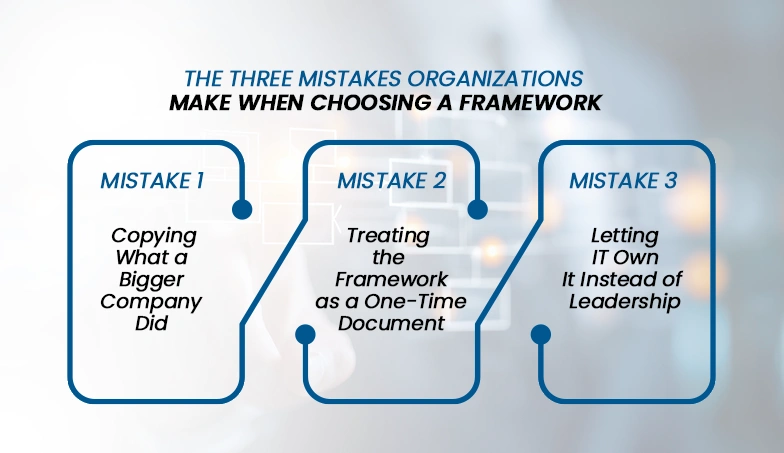
Mistake 1: Copying What a Bigger Company Did
We’ve seen teams walk into a planning session with a printout of what some large enterprise announced at a conference- “They used this framework, let’s do what they did”. As a result, it never worked out the way they hoped.
A framework that fits a 10,000-person company with a dedicated transformation office will break a 40-person business with one operations manager and a part-time IT contractor. Context isn’t a small variable – it’s everything.
The right question isn’t “What did they use?” It’s “What do we actually need to change, and what’s the lightest structure that gets us there?”
Mistake 2: Treating the Framework as a One-Time Document
We’ve seen organizations spend real time building a thoughtful framework, file it away after the kickoff meeting, and then six months later operate as if it never existed. The framework becomes an artifact instead of a guide.
A framework isn’t a destination. It’s a tool you’re supposed to keep using. It should be referenced in planning meetings. It should be the lens through which you evaluate new tool purchases. It should evolve as your organization does.
Mistake 3: Letting IT Own It Instead of Leadership
The biggest reason digital transformations stall isn’t technical failure. It’s a leadership absence.
We’ve seen well-intentioned IT teams get handed the keys to a transformation initiative and genuinely try to do the right thing – only to hit resistance at every turn because the people with budget authority and organizational influence weren’t engaged.
Transformation touches every part of the organization. That means it requires leadership from the people who have visibility and authority across the whole organization. IT is a critical partner. They are not the right owner.
In the absence of leadership, the transformation quietly shrinks down to an IT project. And IT projects, however well executed, do not change organizations.
What Good Digital Transformation Management Looks Like in Practice
Remember where we started the blog-the idea that “digital transformation” often feels like just another buzzword until you see what happens when it’s actually missing in real operations.
The real problem wasn’t just the lack of tools-it was the lack of clarity in how work connected across the system. Valuable data existed, but it wasn’t being used effectively for decision-making. Small delays kept compounding into bigger operational issues, and costs began to rise without clear visibility.
Good digital transformation management doesn’t look like a dramatic reinvention. It looks like quiet, measurable improvement over time. Problems start getting identified earlier, decisions become faster, and teams stop repeatedly facing the same issues in different forms.
Transformation isn’t a one-time shift. It’s an ongoing practice-and without a structured approach, the gap between potential and performance only continues to grow.
The Cost of Picking the Wrong Framework (Or None at All)
Let’s close the loop.
What this really comes down to is how digital transformation is often misunderstood. It’s not just about wasted software spend-it’s about the time lost before realizing something isn’t working. It’s about energy spent managing inefficiencies instead of driving real progress. And the most overlooked cost isn’t financial at all-it’s the gradual erosion of confidence that meaningful change is actually possible.
Starting over always costs more than starting right. Not just in financial terms-although the cost of correcting a failed transformation is significantly higher, often multiplying the original investment-but in momentum.
When transformation efforts fail, organizations don’t just lose direction; they lose trust in the process itself. Teams become skeptical, leadership becomes more cautious, and future change initiatives face resistance before they even begin.
A strong digital transformation framework doesn’t eliminate risk, no system ever will but it gives you the clarity and control to navigate it with confidence. What it does is make decisions more deliberate, progress more visible, and corrections earlier and less disruptive.
The organizations that succeed are not necessarily the ones with the biggest budgets or the most advanced technology. They are the ones that take the time to build clarity before execution and structure before speed.
Where Do You Go From Here?
Right now, you’re in one of two places.
Place A: You have a framework. Your team understands it. Every tool you’re using connects back to a business goal. When someone proposes something new, there’s a clear way to evaluate whether it fits or not. Progress is visible, if not always fast. You’re not certain – but you’re oriented.
Place B: You have tools. You have intentions. You have a growing, quiet sense that something isn’t adding up. The subscriptions are running. The team is trying. But the business isn’t moving the way you hoped it would, and you’re not entirely sure why.
If you’re in Place B, you don’t need more tools. You need to take one day and decide what your framework is. It doesn’t have to be perfect. It has to be shared, written down, and honest about where you actually are.
That’s your next step. Not a software demo. Not another conference. One day with your key people, asking 4 honest questions about what your organization actually needs to change and why. Start there.
Conclusion
Digital transformation doesn’t have to be overwhelming. It just has to be deliberate. The organizations that get it right aren’t the smartest- they’re the ones that stopped reacting and started building with intention.
You already know something needs to change. That awareness is the hardest part, and you’re past it. What comes next is simpler than it’s been made to sound: pick a framework that fits your size, your pain points, and your team’s capacity. Then use it – consistently, honestly, and together.
The tools were never the problem. The plan was always the answer.
Author's Perspective
From my perspective, custom blockchain development is not just about adopting a modern technology trend; it’s about making strategic decisions that create real business impact. Many organizations rush into blockchain adoption without clearly defining their objectives, which often leads to underutilized solutions.
The key lies in understanding where blockchain truly adds value. Not every system needs decentralization, but for processes involving multiple stakeholders, trust gaps, or data integrity concerns, blockchain can be transformative.
Ultimately, the success of any blockchain initiative depends on balancing innovation with practicality. With the right strategy, technology, and development partner, businesses can unlock the full potential of blockchain and drive long-term growth.
Discuss Your Project NowGaurav Goyal
Global Sales- VP
Related Posts

IoT in Banking: Transforming Financial Services Through Connected...
Digital Transformation for Australian Enterprises: Strategy, Technology &...
How to Hire AI Consultants for Enterprise Digital...
Insights Are Valuable & Execution is Priceless
You’ve read about the digital future. Now, let’s build the infrastructure to take you there. Move your strategy from the page to the product.
Design Your Solution Now
Contact Us
Schedule The Appointment At Your Convenience Date And Time.
30 Min
Web Conference
Time Zone
Indian standard time (08:30pm)

Thanks For Getting In Touch!
You’ve Taken The First Step Toward Transforming Your Digital Presence. Our Experts Will Reach Out Shortly To Take It Forward.
Launch Your Dream Project
Provide a brief overview of your project, and our specialists will evaluate your requirements. We will connect with you to explore how the right digital solutions can help you launch faster.