
In Brief
- Agentic AI is revolutionizing enterprise data engineering in that it enables AI agents to understand intentions, make decisions, perform actions, and assess outcomes with minimal human involvement.
- Unlike conventional rule-based data engineering, Agentic AI is geared towards supporting adaptive automation via smart data ingestion, self-healing pipelines, data quality monitoring, smarter transformations, real-time processing, and governance.
- Finance companies, health care institutions, retail companies, manufacturers, logistics providers, and companies from other industries can leverage Agentic AI for reducing manual labor, improving data quality, pipeline reliability, cost reduction, and speeding up business insights.
- A successful adoption calls for the analysis of current infrastructure, identification of use cases, launch of narrow pilot projects, creation of secure agentic architectures, development of governance and human control, and gradual adoption.
- The technology can be used by businesses to create scalable, resilient, and smart data environments, but it needs reliable data, robust security, system integration, qualified staff, and a proper strategy.
Data within enterprises has been growing at an unprecedented rate. There is a lot of data that is gathered by organizations using applications, clouds, connected devices, customer engagements, transactions, and several other types of sources. The management of such data has become increasingly difficult for enterprises, which continue to rely on manual approaches and existing data pipelines.
This is the area where the power of Agentic AI comes into play. Agentic AI is different from normal automation as it has the capability to make decisions, initiate actions, monitor the outcomes, and manage workflows with little or no human intervention at all.
With organizations seeking smarter, quicker and scalable solutions to handle their data, Agentic AI plays a crucial role in the modern-day data engineering approach.
This blog will discuss the impact of Agentic AI on enterprise data engineering, its benefits and applications, implementation factors, adoption issues, and preparation for the future of data management.
What is Agentic AI in Data Engineering?
The definition of agentic AI in data engineering includes AI technologies which are capable of understanding goals, making decisions, executing tasks, and adapting to changes in the data environment with minimal human involvement. Rather than just carrying out a set of pre-programmed instructions, agentic AI can analyze the environment and take the most suitable actions accordingly.
The tasks performed by AI agents in the enterprise data environment include ingestion, monitoring, validation, transformation, detection of anomalies, and optimization of workflows. For instance, an agent may be able to detect a failure in a pipeline, diagnose the reasons, and initiate the proper response without any intervention on the part of the engineer.
However, the true power lies in enhancing the autonomy and adaptability of these operations. Depending on changes in the data source, business requirements, and workload, Agentic AI can adapt to the workflow.
In other words, it is not just an automation solution. Instead, it is a smart layer that allows data engineers to handle complex settings, avoid redundancy, and make enterprise data operations effective.
Why Businesses Need an Agentic AI Strategy
In order to manage these increasingly complicated enterprise data environments, companies need more than simply automation techniques to ensure that their data operations remain effective. The data is generated by a number of sources, changes constantly, and requires processing in real time. Performing management of such environments manually can result in increased workload, a slower decision-making process, and a lack of agility on the part of the teams involved.
An agentic AI approach can be used to help companies prepare for the implementation of AI agents into their current data engineering environment. Rather than implementing AI randomly, the company would learn where it could be utilized effectively.
Strategic planning could assist companies to achieve:
- Automation of data engineering activities that are repetitive
- Enhancement of data quality and pipeline reliability
- Faster handling of any data problems
- Scaling of operations as the volume of data increases
- Reducing operational costs and manual intervention
- Developing an adaptive data architecture
It is not enough for organizations to incorporate AI agents. They have to plan based on their architecture, quality of data, security, governance, and human supervision to make sure that the Agentic AI will meet the business and data objectives.
Agentic AI vs Traditional Data Engineering
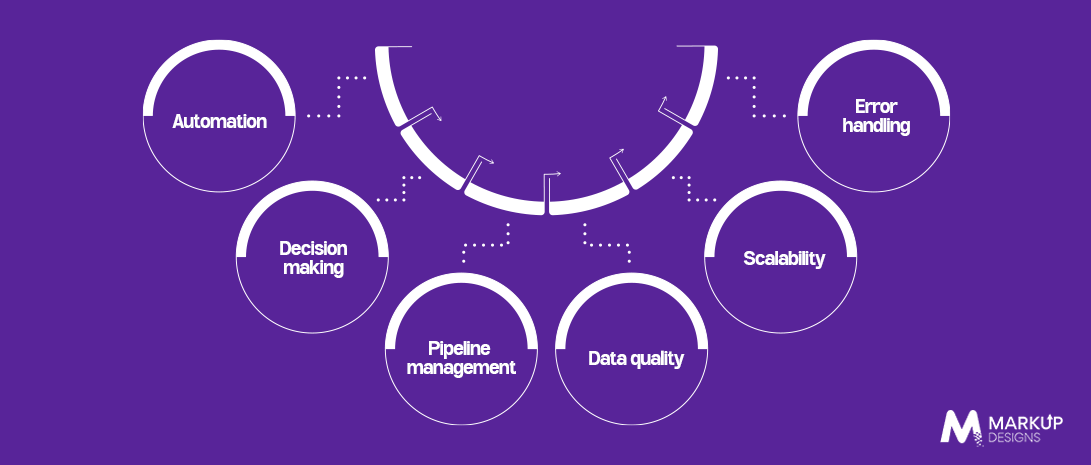
The traditional method of data engineering is largely dependent on pre-set rules and scheduled processes, as well as human participation. These methods are effective in performing tasks that are predictable in nature, but they can get complicated in situations where there is frequent change in the data environment within an enterprise organization.
| Factor | Traditional Data Engineering | Agentic AI Data Engineering |
| Automation | Rule-based tasks | Goal-driven automation |
| Decision-making | Human-defined logic | AI-assisted decisions |
| Pipeline management | Scheduled and monitored | Adaptive and autonomous |
| Data quality | Periodic checks | Continuous monitoring |
| Error handling | Manual intervention | Automated response |
| Scalability | Planned in advance | Dynamically adaptive |
The key difference is that of adaptability. Conventional technologies normally behave based on what has been directed at them, whereas an Agentic AI system can assess changing scenarios and decide what should be done next.
It is important to note that Agentic AI does not necessarily replace data engineers but helps in handling repetitive operations while the engineers concentrate on other important aspects.
How Agentic AI is Transforming Enterprise Data Engineering
Agentic artificial intelligence is revolutionizing enterprise data engineering by shifting many tasks from manual, rules-based processes to intelligent, autonomous ones. Agentic AIs can monitor the data environment, identify problems, take action, and optimize processes as changes occur.
These are some of the main ways that Agentic AI is impacting modern data engineering:
- Automation of Data Ingestion and Integration
AI-powered agents can discover data sources, control the ingestion processes, recognize schema updates, and assist in integrating data from databases, APIs, cloud services, and enterprise applications.
- Building Self-Healing Data Pipelines
Instead of just notifying engineers about a pipeline failure, Agentic AI can analyze it, find out what might have caused it, and take necessary steps to fix it.
- Enhancing Data Quality
The agents can perform real-time checks on enterprise data to detect any missing data, duplicates, inconsistencies, and outliers, thus enabling teams to solve quality issues early.
- Enhancing Data Transformation Intelligence
The agentic tools can help in performing transformation tasks and can be aware of changing data schemas and workflows based on evolving business needs.
- Enabling Real-Time Data Processing
The AI-based agents can observe real-time data and initiate workflows based on events, allowing businesses to gain access to real-time data.
- Enhancing Data Governance
The agents can help in data classification, policy enforcement, monitoring access, and compliance workflows.
Agentic AI enables the creation of data environments that are highly flexible, automated, and adaptable, and hence enables data engineering teams to spend their efforts on solving business problems rather than dealing with repetitive tasks.
Ready to move beyond traditional data workflows?
Markup Designs can help you explore Agentic AI solutions that automate data operations, improve pipeline performance, and support smarter enterprise decision-making. From strategy and architecture to implementation and optimization, we help businesses build scalable AI-powered data ecosystems.

Key Enterprise Use Cases of Agentic AI in Data Engineering
Agentic AI is helpful in data engineering in industries that involve businesses operating with massive amounts of data, multiple systems, and dynamic information. This is due to its capability to track workflows, make decisions, and act.
Financial Services
Agentic AI can be helpful in banks and other financial institutions for the monitoring of transaction data, detection of anomalies, automation of workflows, and analysis of risks and fraud.
Healthcare
In the healthcare industry, Agentic AI can assist in the integration of patient data, tracking of data quality, management of clinical data workflows, and privacy and compliance processes.
Retail and E-commerce
AI agents could help in connecting retail customers’ data with sales, inventory, and product-related information, thus enhancing data pipelines for personalization, forecasting, and customer analytics.
Manufacturing
Manufacturing companies could utilize data from Internet of Things sensors, manufacturing systems, and machines. AI agents would be able to detect and analyze data flows and help with predictive maintenance.
Logistics and Transportation
Logistics companies could leverage agentic AI solutions for managing shipment data, fleet data, warehouse data, and route data in real time.
Enterprise Operations
Enterprise companies could benefit from integrating AI agents into their systems in order to facilitate data integration processes and monitor data pipelines.
Benefits of Agentic AI for Enterprise Data Engineering
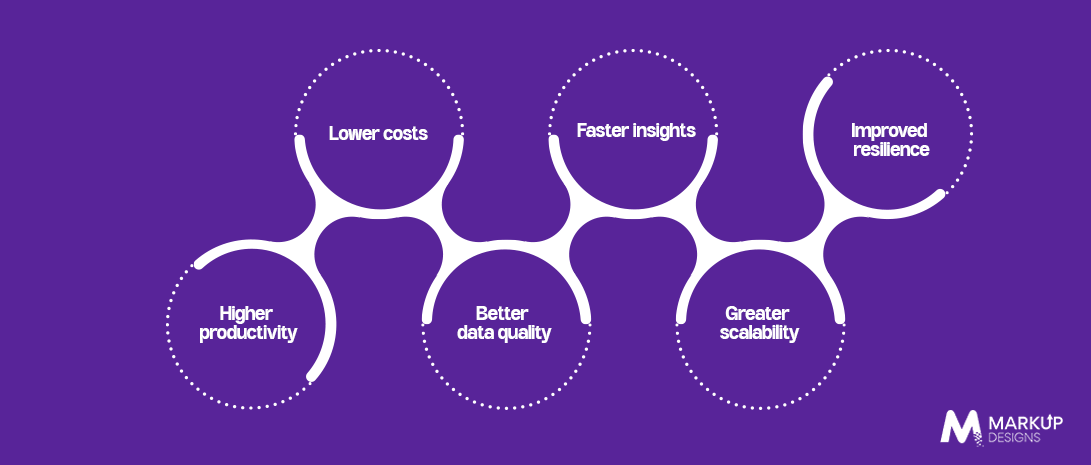
Agentic AI could provide many benefits to corporate data activities by automating and speeding up those processes. Instead of sticking only to fixed processes, corporations could apply the intelligence of agents that would track, analyze, and respond to dynamic data situations.
Higher productivity
AI agents could take care of all boring tasks like pipeline surveillance, data quality checks, and workflow management so that engineers could focus on something else.
Lower costs
Automation of routine data operations could save money on manual labor, eliminate downtime, and increase the efficiency of infrastructure and engineering resources.
Better data quality
Continuous monitoring assists in the identification of missing, duplicated, inconsistent, or anomalous data to ensure that better-quality information is used throughout the enterprise.
Faster insights
The automation of data preparation and processing through Agentic AI will assist in making the data available to the analytics and business team more quickly.
Greater scalability
The workflows powered by artificial intelligence can adapt to varying data volumes and loads, thus helping enterprises scale their data operations without having to increase manual workloads at the same time.
Improved resilience
Agentic AI will be able to identify errors, investigate their root causes, and take the necessary actions for recovery.
How to Implement Agentic AI in Enterprise Data Engineering
Rolling out Agentic AI throughout your enterprise data infrastructure is an exercise that needs a solid strategy. Companies shouldn’t try to automate all their operations right away. Instead, they should proceed step-by-step in order to be able to assess which tasks are worth automating and how efficient the technology will prove to be.
Evaluate Your Existing Data Architecture
Take a look at your current data sources, pipelines, platforms, work processes, and other aspects of your business operation that you would like to automate.
Identify High-Value Use Cases
It makes sense to pay attention to repetitive processes that take much time and can cause errors, such as pipeline monitoring, data quality, ingestion, transformations, and incident management.
Begin with a Targeted Pilot
Select one workflow, apply Agentic AI in a controlled setting, and evaluate its performance, reliability, accuracy, and effect on engineering work.
Create an Appropriate Agentic Architecture
Link AI agents with necessary data platforms, APIs, tools, orchestration frameworks, and monitoring layers. Decide what the agent will have access to and what actions it will be able to perform.
Ensure Security and Governance
Create policies around data access, privacy, permissions, human approvals, monitoring, and auditability of operations before allowing the agent to execute significant enterprise tasks.
Scale and Optimize
When a pilot is completed and yields meaningful outcomes, slowly scale Agentic AI to additional workflows. Keep monitoring the performance of the agent and the effects on the business continuously.
Challenges of Adopting Agentic AI in Data Engineering
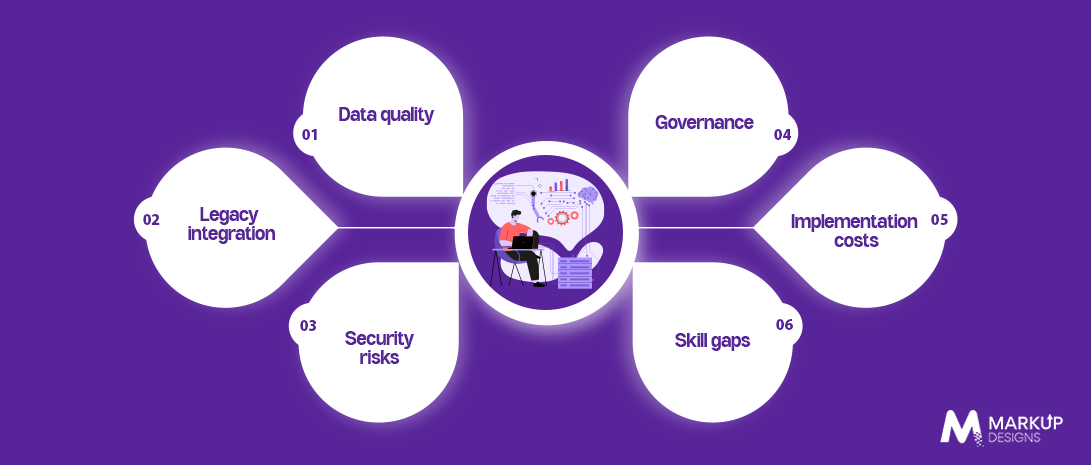
While Agentic AI provides numerous benefits for enterprise data processes, there is a list of practical problems that need to be solved for AI agents to work effectively. Below, you can find three main problem areas businesses need to solve to make AI agents work efficiently and reliably.
Data quality
AI agents work based on good data. The quality of decisions and automation processes will be influenced by the completeness and up-to-date nature of the data.
Legacy integration
Many enterprises have old databases and applications. This means that for AI agents to work, integration with these systems is required.
Security risks
When enterprises connect their data and systems with AI agents, the problem of security arises.
Governance
There must be clear guidelines regarding the access, decision-making, and execution capabilities of AI agents. Human control is crucial in operations that are sensitive or highly impactful.
Implementation costs
Implementation costs of Agentic AI technologies may entail investing in technology, infrastructure, and experts.
Skill gaps
Agentic AI involves AI, data engineering, cloud, automation, and security, making it difficult to find people with the right combination of skills.
Why Choose Markup Designs for Agentic AI Data Engineering
Selection of the appropriate technology partner plays a crucial role in the implementation of Agentic AI across enterprise data environments. Markup Designs provides the expertise of both AI and data engineering to assist enterprises in shifting from experiments to scalable solutions.
We approach the problem by studying the current data environment, business objectives, and business challenges faced and offering Agentic AI solutions according to those needs. We can help enterprises find appropriate use cases for AI, design AI-based data processes, integrate Agentic AI into the system, and ensure the necessary security and governance measures.
In addition to the aforementioned, Markup Designs works on creating solutions that will scale along with the growing needs of businesses. Intelligent data pipelines, automated quality control, workflow optimization, and AI-based decision-making assistance are just some of the solutions we can develop depending on the enterprise.
Focusing on scalability, security, integration, and business benefits of adopting the solution, Markup Designs helps enterprises discover Agentic AI opportunities without harming existing operations.
Ready to Transform Your Enterprise Data Engineering?
Agentic AI can help your business build more intelligent, adaptive, and efficient data operations. Markup Designs can help you plan, develop, integrate, and scale Agentic AI solutions aligned with your enterprise goals.

Conclusion
AI agency is affecting the way enterprises are handling modern-day data engineering. With the help of intelligent agents, firms can perform the monitoring of processes, detect problems, make decisions, and take actions at various stages of data engineering.
Starting from automated ingestion of data and its quality management, through self-healing pipelines, governance, and real-time processing, Agentic AI can improve enterprise data environments by increasing adaptability and efficiency. It may also assist the team in eliminating repetitive tasks and focusing on more strategic operations.
However, effective adoption of the concept necessitates adequate preparation. Enterprises must have accurate data, secure architecture, proper governance, human oversight, and implementation strategies.
With the constant increase in the amount of enterprise data, Agentic AI may become an essential element of scalable and intelligent data engineering systems.
FAQs
1. What is Agentic AI in data engineering?
Agentic AI refers to AI systems that can understand goals, make decisions, perform tasks, monitor results, and respond to changing conditions with limited human intervention.
2. How does Agentic AI improve data engineering?
It can automate repetitive tasks, monitor pipelines, improve data quality, detect issues, support data transformation, and optimize workflows.
3. What are the main use cases of Agentic AI in data engineering?
Common use cases include data ingestion, pipeline monitoring, data quality management, transformation, governance, anomaly detection, and workflow optimization.
4. Can Agentic AI manage data pipelines?
Yes. Agentic AI can monitor pipelines, identify failures, analyze potential causes, and trigger predefined or approved recovery actions.
5. How does Agentic AI improve data quality?
AI agents can continuously check data for missing values, duplicates, inconsistencies, anomalies, and other quality issues.
Author's Perspective
Agentic AI is reshaping enterprise data engineering by helping businesses build systems that can understand, respond, and adapt to changing conditions. However, adoption should focus on real business challenges rather than technology trends. The future will involve closer collaboration between AI agents and data professionals, combining automation with human judgment. With the right foundation, Agentic AI can help enterprises build more intelligent, scalable, and resilient data operations.
Discuss Your Project NowAjit Kumar Jha
VP - Business Operations
Related Posts

How Artificial Intelligence Is Changing Mobile Game Development
How to Build Production-Ready Applications with AI Coding...
Cost, Benefits & Business Impact: Generative AI vs....
Insights Are Valuable & Execution is Priceless
You’ve read about the digital future. Now, let’s build the infrastructure to take you there. Move your strategy from the page to the product.
Design Your Solution Now
Contact Us
Schedule The Appointment At Your Convenience Date And Time.
30 Min
Web Conference
Time Zone
Indian standard time (08:30pm)

Thanks For Getting In Touch!
You’ve Taken The First Step Toward Transforming Your Digital Presence. Our Experts Will Reach Out Shortly To Take It Forward.
Launch Your Dream Project
Provide a brief overview of your project, and our specialists will evaluate your requirements. We will connect with you to explore how the right digital solutions can help you launch faster.