
In Brief
- AI adoption starts with preparation. Businesses should evaluate their strategy, data quality, technology infrastructure, workforce readiness, and governance to ensure successful AI implementation and long-term value.
- Assessing AI readiness helps identify gaps before implementation, reducing risks, improving ROI, accelerating deployment, and ensuring AI initiatives align with overall business objectives.
- Key indicators of AI readiness include clear business goals, reliable and accessible data, modern IT infrastructure, leadership support, skilled employees, strong security practices, and clearly defined AI use cases.
- A structured AI readiness assessment enables organizations to prioritize high-impact opportunities, strengthen compliance, build scalable AI roadmaps, and overcome common challenges such as poor data quality, legacy systems, and skills gaps.
- With the right AI strategy, expert guidance, and a strong implementation foundation, businesses can confidently adopt AI to improve operational efficiency, enhance customer experiences, drive innovation, and achieve sustainable business growth.
Before investing in artificial intelligence, every business should ask one important question: Is it truly ready for AI adoption? While AI has become a major driver of innovation, simply implementing AI tools doesn’t guarantee success. Organizations need the right strategy, quality data, scalable infrastructure, skilled teams, and clear business objectives to maximize the value of AI investments.
Businesses that skip these foundational steps often face challenges such as poor adoption, inaccurate insights, higher implementation costs, and limited return on investment. On the other hand, companies that assess their readiness beforehand are better equipped to integrate AI into their operations and achieve sustainable growth.
In this blog, we’ll explore what AI readiness means, why it matters, the key indicators that your business is ready for AI adoption, and the practical steps you can take to build a strong foundation for a successful AI transformation.
What Does AI Readiness Mean?
AI readiness refers to how well your business is prepared to adopt, implement, and scale AI solutions successfully. It’s not just about having access to the latest AI technologies, it’s about ensuring your organization has the right foundation to support them.
A business that is AI-ready has clear objectives for using AI, reliable and organized data, modern technology infrastructure, skilled teams, and processes that can adapt to change. It also has governance policies in place to ensure AI is used securely, ethically, and in compliance with industry regulations.
Think of AI readiness as preparing the ground before planting a seed. Even the most advanced AI solution cannot deliver meaningful results if the underlying systems and processes are not ready.
In simple terms, AI readiness brings together five key elements:
- Business strategy and leadership
- Data quality and accessibility
- Technology and infrastructure
- People and organizational culture
- Security, governance, and compliance
When these elements work together, businesses can confidently move from AI experimentation to enterprise-wide adoption, unlocking greater efficiency, smarter decision-making, and long-term business value.
Why AI Readiness Matters Before AI Adoption
Many businesses are eager to adopt AI, but rushing into implementation without proper strategy can lead to disappointing results. AI is not a plug-and-play solution, it relies on quality data, well-defined business goals, and systems that can support intelligent automation. Without these essentials, even the most advanced AI models may fail to deliver the expected outcomes.
Assessing your AI readiness helps you understand where your business stands today and what improvements are needed before investing in AI. It allows you to identify gaps in your technology, data management, workforce skills, and governance practices, reducing risks during implementation.
Being AI-ready also ensures that your AI initiatives align with your business objectives rather than becoming isolated technology projects. This leads to faster deployment, better user adoption, improved operational efficiency, and a higher return on investment.
In short, AI readiness isn’t an extra step, it’s the foundation that determines whether your AI initiatives will succeed or struggle. The more prepared your business is, the more effectively you can leverage AI to drive innovation, improve customer experiences, and achieve long-term growth.
Key Signs Your Business is Ready for AI
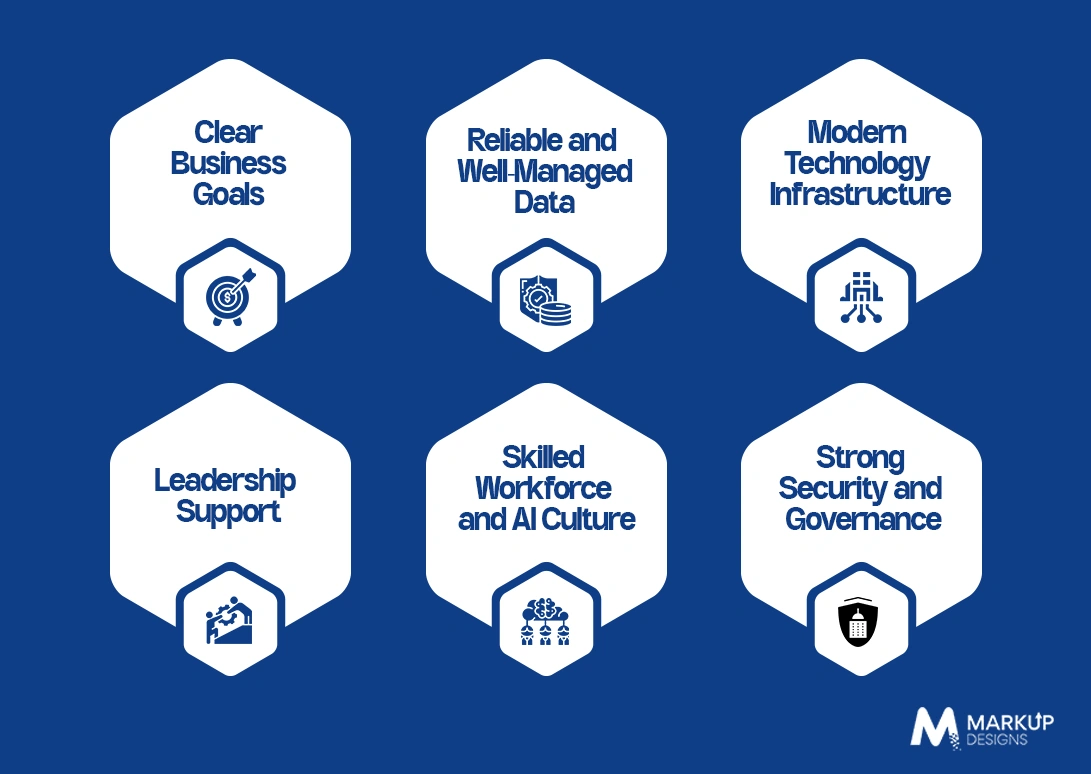
Not every business reaches AI readiness at the same pace. Some organizations already have the right systems and processes in place, while others may need to strengthen certain areas before adopting AI. Identifying these signs can help you understand whether your business is prepared to move forward with confidence.
Clear Business Goals
Your organization has identified specific challenges or opportunities where AI can create measurable value, such as improving customer support, automating repetitive tasks, or enhancing decision-making.
Reliable and Well-Managed Data
Your business collects accurate, organized, and accessible data. Since AI depends on data to learn and generate insights, maintaining high-quality data is essential.
Modern Technology Infrastructure
Your existing IT systems, cloud platforms, and software applications can integrate with AI solutions without requiring major upgrades.
Leadership Support
Business leaders understand the value of AI and are committed to investing in its successful implementation and long-term growth.
Skilled Workforce and AI Culture
Employees are open to adopting new technologies, and your organization is willing to invest in AI training and change management.
Strong Security and Governance
You have policies in place to protect sensitive data, manage AI risks, and ensure compliance with relevant regulations. These safeguards help build trust while enabling responsible AI adoption.
The Core Pillars of AI Readiness
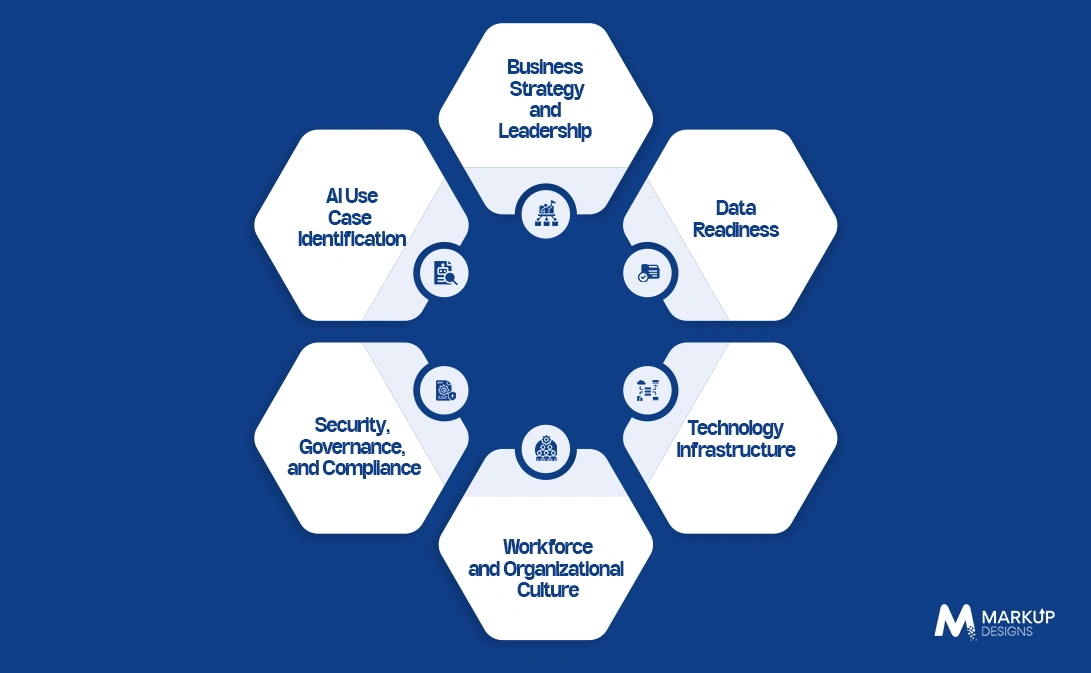
Building a successful AI strategy starts with strengthening the key areas that support AI adoption. These six pillars help businesses evaluate their readiness and create a solid foundation for implementing AI effectively.
- Business Strategy and Leadership
AI initiatives should align with your overall business goals. Leadership must define clear objectives, allocate resources, and establish a roadmap that ensures AI delivers measurable business value rather than becoming a standalone technology project.
- Data Readiness
High-quality data is the backbone of every AI solution. Businesses need accurate, consistent, and well-organized data that can be easily accessed and used for training AI models and generating reliable insights.
- Technology Infrastructure
Your IT environment should be capable of supporting AI workloads. This includes scalable cloud platforms, modern software systems, secure APIs, and integration capabilities that allow AI to work seamlessly with existing business applications.
- Workforce and Organizational Culture
AI adoption requires more than technology, it requires people who are ready to embrace change. Businesses should invest in employee training, encourage collaboration, and foster a culture that supports innovation and continuous learning.
- Security, Governance, and Compliance
Organizations must establish clear policies for data privacy, cybersecurity, ethical AI usage, and regulatory compliance. Strong governance helps reduce risks while ensuring AI is deployed responsibly and transparently.
- AI Use Case Identification
Instead of trying to implement AI everywhere, businesses should prioritize use cases that offer the greatest impact. Identifying high-value opportunities based on business needs helps maximize ROI and ensures a smoother AI implementation journey.
Ready to Assess Your AI Readiness?
At Markup Designs, we help businesses evaluate their AI readiness, identify high-impact opportunities, and develop tailored AI strategies that align with their goals.

AI Readiness Assessment Checklist
Before investing in AI, it’s important to evaluate whether your business has the right foundation in place. A simple readiness assessment can help you identify strengths, uncover gaps, and determine the areas that need improvement before implementation. Use the checklist below to assess your organization’s AI readiness.
| Readiness Area | Questions to Ask |
| Business Strategy | Have you defined clear business goals and AI objectives? |
| Leadership Support | Is your leadership team committed to AI adoption and digital transformation? |
| Data Readiness | Is your business data accurate, secure, and easily accessible? |
| Technology Infrastructure | Can your existing systems integrate with AI solutions efficiently? |
| Workforce Skills | Do your employees have the knowledge or training needed to work with AI? |
| Governance & Compliance | Are policies in place for data privacy, security, and responsible AI usage? |
| AI Use Cases | Have you identified high-impact business areas where AI can deliver value? |
| Scalability | Is your organization prepared to scale AI initiatives as business needs grow? |
If you answered “Yes” to most of these questions, your business is likely on the right path toward AI adoption. If not, addressing these gaps before implementation can significantly improve the success of your AI initiatives and help you achieve better long-term results.
Common Challenges to AI Adoption and How to Overcome
While AI offers significant opportunities for growth and innovation, many businesses face obstacles during adoption. Recognizing these challenges early and taking the right steps to address them can make the implementation process smoother and more successful.
1. Challenge: Poor Data Quality
How to Overcome It: Clean, organize, and standardize your data before implementing AI to ensure accurate results.
2. Challenge: Lack of Clear Business Goals
How to Overcome It: Define measurable objectives and focus on AI use cases that solve real business problems.
3. Challenge: Legacy Systems
How to Overcome It: Modernize your IT infrastructure and integrate AI with scalable, cloud-based platforms.
4. Challenge: Skills Gap
How to Overcome It: Invest in employee training or partner with experienced AI consultants to bridge technical expertise.
5. Challenge: Resistance to Change
How to Overcome It: Promote AI awareness, involve employees early, and implement effective change management strategies.
6. Challenge: Security and Compliance Concerns
How to Overcome It: Establish strong governance policies, protect sensitive data, and ensure compliance with industry regulations.
Every business encounters challenges during digital transformation, but they don’t have to become roadblocks. By proactively addressing these issues, organizations can reduce implementation risks, improve user adoption, and create a stronger foundation for long-term AI success.
How Enterprises Need to Prepare for AI Co-Workers
Explore how enterprises can prepare for AI co-workers with a strategic AI readiness roadmap. Explore AI governance, workforce transformation, human-AI collaboration, and AI-native workplace strategies that will be capable of executing multiple complex workflows.
Step-by-Step AI Readiness Assessment Process
Assessing your AI readiness doesn’t have to be complicated. By following a structured approach, businesses can identify opportunities, address gaps, and create a clear roadmap for successful AI adoption.
Step 1: Define Your Business Objectives
Start by identifying the problems you want AI to solve. Whether your goal is to improve customer service, automate repetitive tasks, or gain better business insights, having clear objectives will guide your AI strategy.
Step 2: Evaluate Your Current Infrastructure
Review your existing technology, software, cloud environment, and integration capabilities to determine whether they can support AI applications.
Step 3: Assess Data Readiness
Analyze the quality, availability, and security of your business data. Reliable and well-managed data is essential for accurate AI performance.
Step 4: Identify High-Impact AI Use Cases
Prioritize AI initiatives that align with your business goals and offer measurable value. Starting with practical, high-impact use cases can deliver quicker results.
Step 5: Strengthen Governance and Security
Establish policies for data privacy, cybersecurity, compliance, and responsible AI usage to minimize risks and build trust.
Step 6: Create an AI Implementation Roadmap
Develop a phased plan that includes pilot projects, performance evaluation, employee training, and gradual scaling. A well-defined roadmap helps ensure a smoother transition from planning to enterprise-wide AI adoption.
Benefits of Assessing AI Readiness Before Implementation
Taking the time to assess your AI readiness before implementation can significantly improve the success of your AI initiatives. It helps businesses make informed decisions, reduce risks, and maximize the value of their AI investments. Here are some of the key benefits:
1. Faster Deployment
A well-prepared organization can implement AI solutions more efficiently because the necessary infrastructure, data, and processes are already in place, reducing delays during deployment.
2. Better Return on Investment (ROI)
When AI projects align with business goals and are supported by quality data, they are more likely to deliver measurable results, helping businesses achieve a higher return on their investment.
3. Lower Implementation Risk
Identifying potential challenges before adopting AI allows businesses to address technical, operational, and security issues early, minimizing costly mistakes and project failures.
4. Higher Employee Adoption
Employees are more likely to embrace AI when they receive proper training, understand its benefits, and are involved throughout the implementation process.
5. Improved Decision-Making
AI-powered insights enable organizations to analyze data more effectively, identify trends, and make faster, data-driven business decisions with greater confidence.
6. Scalable AI Initiatives
A strong AI foundation allows businesses to expand AI capabilities across different departments and use cases as their needs evolve, ensuring long-term scalability.
7. Regulatory Compliance
Assessing readiness helps organizations establish governance frameworks that protect sensitive data, ensure responsible AI usage, and meet industry regulations and compliance standards.
8. Competitive Advantage
Businesses that prepare for AI adoption are better positioned to innovate, improve operational efficiency, enhance customer experiences, and stay ahead of competitors in an increasingly AI-driven market.
Industry Use Cases: AI Readiness Across Different Sectors
AI readiness looks different for every industry because each sector has unique goals, data requirements, and operational challenges. Understanding these differences helps businesses prepare for AI adoption in a way that delivers the greatest impact.
Healthcare
Healthcare providers use AI to improve diagnostics, streamline administrative tasks, support patient care, and enhance medical decision-making. Success depends on secure data management and compliance with healthcare regulations.
Finance
Banks and financial institutions leverage AI for fraud detection, risk assessment, customer service automation, and personalized financial recommendations. Strong governance and data security are essential for implementation.
Retail & E-commerce
Retail businesses adopt AI to deliver personalized shopping experiences, optimize inventory, forecast demand, and improve customer support through AI-powered chatbots.
Manufacturing
Manufacturers use AI for predictive maintenance, quality control, production planning, and supply chain optimization. Reliable operational data and connected systems are key to success.
Logistics
AI helps logistics companies optimize delivery routes, manage warehouses, predict demand, and improve fleet management, leading to faster operations and reduced costs.
Real Estate
Real estate businesses use AI to analyze market trends, recommend properties, automate customer interactions, and streamline property management processes.
Education
Educational institutions implement AI to personalize learning experiences, automate administrative tasks, and provide intelligent learning support, improving outcomes for both students and educators.
Why Choose Markup Designs as Your AI Technology Partner?
Adopting AI is more than just implementing new technology, it requires the right strategy, expertise, and ongoing support to achieve lasting business value. At Markup Designs, we help businesses navigate every stage of their AI journey, from assessing readiness to deploying scalable AI solutions that align with their goals.
Our team works closely with you to understand your business challenges, identify high-impact AI opportunities, and build customized solutions that integrate seamlessly with your existing systems. Whether you’re looking to automate workflows, enhance customer experiences, or make smarter business decisions, we provide end-to-end AI/ML services tailored to your needs.
Here’s how Markup Designs can help your business become AI-ready:
- AI Readiness Assessment to evaluate your organization’s preparedness for AI adoption.
- AI Strategy & Consulting to create a roadmap aligned with your business objectives.
- Custom AI Solution Development for intelligent, scalable, and business-specific applications.
- Data Preparation & Integration to ensure your AI models are powered by high-quality, reliable data.
- AI Automation & Workflow Optimization to improve efficiency and reduce manual effort.
- Secure AI Implementation with governance, compliance, and data security best practices.
- Continuous Support & Optimization to monitor, enhance, and scale your AI solutions as your business grows.
With a customer-centric approach and expertise across industries, Markup Designs empowers organizations to confidently adopt AI, minimize implementation risks, and unlock long-term business growth.
Turn AI Potential into Business Growth
A successful AI strategy requires the right combination of data, technology, governance, and expertise. Markup Designs delivers end-to-end AI consulting and implementation services, helping organizations build a strong foundation for scalable, secure, and ROI-driven AI solutions.

Conclusion
AI has the potential to transform the way businesses operate, improve customer experiences, and drive long-term growth. However, successful AI adoption begins with preparation. Assessing your organization’s readiness helps you identify gaps in strategy, data, technology, workforce, and governance before investing in AI solutions.
By taking a structured approach to AI readiness, businesses can reduce implementation risks, improve ROI, accelerate deployment, and build scalable AI initiatives that deliver measurable results. Whether you’re planning your first AI project or expanding existing capabilities, having a strong foundation is the key to long-term success.
If your business is ready to explore AI, start by evaluating where you stand today. The better prepared you are, the more value you’ll gain from your AI investments and the more confidently you can embrace the future of intelligent business.
FAQs
1. What is AI readiness?
AI readiness refers to how prepared a business is to successfully adopt and scale artificial intelligence. It involves evaluating business strategy, data quality, technology infrastructure, workforce capabilities, and governance to ensure AI initiatives deliver meaningful results.
2. Why should businesses assess AI readiness before implementation?
An AI readiness assessment helps identify gaps that could impact implementation. It reduces risks, improves planning, ensures better alignment with business goals, and increases the chances of achieving a higher return on investment.
3. What are the key components of AI readiness?
The core components include business strategy, leadership support, data readiness, technology infrastructure, workforce skills, governance and compliance, and identifying high-impact AI use cases.
4. How long does an AI readiness assessment take?
The duration depends on the size and complexity of the organization. Small businesses may complete an assessment within a few weeks, while large enterprises may require more comprehensive evaluations over several weeks or months.
5. Which industries benefit the most from AI adoption?
Almost every industry can benefit from AI, including healthcare, finance, retail, manufacturing, logistics, real estate, and education. The specific use cases and readiness requirements vary based on business objectives and operational needs.
Author's Perspective
AI adoption is no longer just about staying ahead of the competition-it’s about building a business that can adapt, innovate, and grow in a rapidly evolving digital landscape. Before investing in AI, organizations should focus on creating a strong foundation through strategic planning, quality data, and the right technology. A well-prepared approach not only minimizes risks but also helps businesses unlock the full potential of AI for sustainable, long-term success.
Discuss Your Project NowAjit Kumar Jha
VP - Business Operations
Related Posts
How to Build Production-Ready Applications with AI Coding...
Cost, Benefits & Business Impact: Generative AI vs....
Enterprise AI Agents: Practical Use Cases Driving Business...
Insights Are Valuable & Execution is Priceless
You’ve read about the digital future. Now, let’s build the infrastructure to take you there. Move your strategy from the page to the product.
Design Your Solution Now
Contact Us
Schedule The Appointment At Your Convenience Date And Time.
30 Min
Web Conference
Time Zone
Indian standard time (08:30pm)

Thanks For Getting In Touch!
You’ve Taken The First Step Toward Transforming Your Digital Presence. Our Experts Will Reach Out Shortly To Take It Forward.
Launch Your Dream Project
Provide a brief overview of your project, and our specialists will evaluate your requirements. We will connect with you to explore how the right digital solutions can help you launch faster.