
In Brief
- Education chatbots help UAE institutions deliver faster and more accessible student support.
- AI-powered automation reduces administrative workload and improves operational efficiency.
- Multilingual capabilities support both Arabic and English-speaking student communities.
- LMS and institutional integrations enable personalized learning experiences.
- Security, compliance, and scalability are essential for successful chatbot implementation.
- Education institutions investing in AI today can build stronger digital experiences for the future.
Admissions season transforms the pace of operations at a university office as phones ring non-stop, emails pile up in the inbox, and similar questions come repeatedly about deadlines, documentation, and courses. While dealing with all this, university officials try to manage their usual workload. In order to minimize the daily chaos, many universities have turned to an educational AI chatbot that will answer some of their inquiries.
Of course, the purpose is not to eliminate human support completely but to help with faster and clearer communication. An educational AI chatbot could assist students in understanding the admission process, provide reminders, and answer any questions related to courses in Arabic or English.
However, implementing such systems in UAE requires careful consideration. This is due to the institutions’ need to meet the PDPL privacy considerations, bilingual capabilities, and a diverse body of international students. Furthermore, the KHDA, ADEK, and UAE’s Ministry of Education guidelines are taken into account by the institutions when implementing digital student services in order to meet national standards.
Understanding UAE Education Market and Its Requirements
Entering any university assistance center in UAE on weekdays, one observes a trend of students checking what documents should be uploaded. The second trend involves students attempting to find links to their lectures. Meanwhile, a phone call from a parent checks on the payment deadlines.
Campuses that educate not only the local population but also students from Asian, European, and African countries have made it essential to communicate clearly. For this reason, educational organizations are considering conversational artificial intelligence solutions to deal with queries and provide easy-to-access information.
There is nothing optional about digital learning anymore. Students use their phones to check their timetable, turn in their assignments digitally, and attend virtual classes when required. This transformation is not just seen in the growing market. The UAE edtech market size reached USD 1,350.5 million in 2025. Looking forward, IMARC Group expects the market to reach USD 3,535.5 Million by 2034, exhibiting a growth rate (CAGR) of 10.95% during 2026-2034
Some of the key trends shaping the Edtech Market of UAE are:
The queries do not cease after office hours: An educational institution should consider the option of a chatbot for online platforms, as students require assistance even late into the night or in different time zones.
The campus accommodates international students: Differences in languages and academic background determine how the services will be provided.
Learners require guidance that will keep them on course. Tools, including an intelligent AI chatbot that provides navigational help to the learners.
Online experience determines the choice of institutions: Parents and students evaluate institutions based on their digital experience.
How Do AI Chatbots Work in Education?
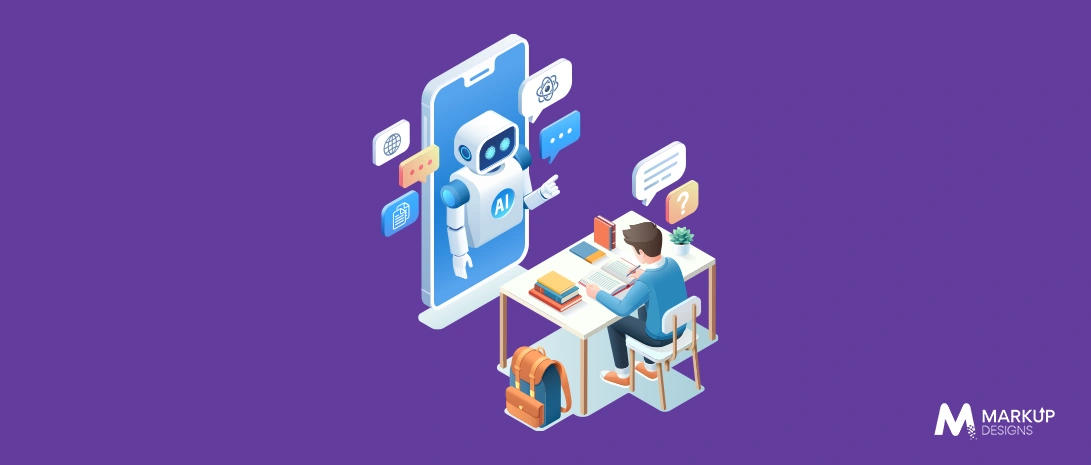
Chatbots used for modern education purposes are not restricted to programmed replies. In most cases, they use language models along with Retrieval-Augmented Generation (RAG), databases from institutions, and system integration. With this combination, the chatbot can respond to conversation questions while grounding them in verified data from universities.
Process when a student poses a question:
- Student writes a query in either Arabic or English
- The AI chatbot understands the requirements of the student
- It retrieves the response from the systems or the database of the university
- If the query is vague, then it poses another question
- For complicated questions, the chatbot assigns the task to an employee
How is this achieved?
- Natural Language Processing enables the chatbot to comprehend common queries.
- Retrieval-Augmented Generation (RAG) obtains information from institutional databases through the use of validated data
- Integration ensures that replies take into account updated information about schedules and policies
- Large language models formulate human-like responses
The multilingual nature of chatbots makes it easier to provide services to different student populations. The AI chatbot infrastructure, when well-devised, enables educational institutions to address frequently asked questions rapidly, while the staff concentrates on issues that require personal attention.
Architecture of an Education Chatbot System
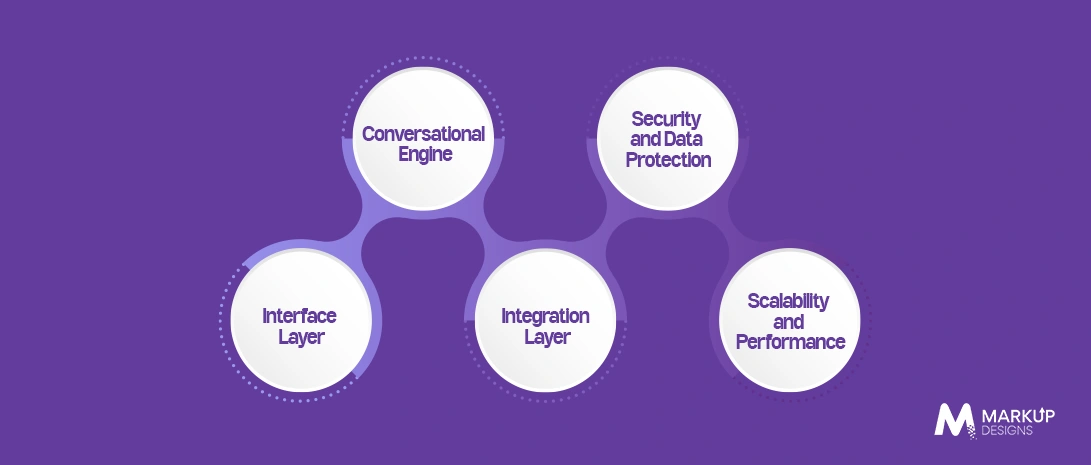
At its face value, the chatbot appears to be nothing but a small chat interface. But behind this chat interface lies a technology that integrates language processing, institutional database access, and security control mechanisms to ensure that the students get their answers within seconds. The design and functioning of an effective educational chatbot are based on the premise that all the elements need to work seamlessly.
The current approach usually relies on large language models along with Retrieval Augmented Generation Models (RAG).
1. Interface Layer
This is what the users will see and experience. The user interface must be designed to be easy-to-use, user-friendly, and intuitive in order to avoid discouraging users from asking questions.
- Access will be provided from within websites, the student portal, and mobile applications
- User-friendly design tailored for mobile browsing and low-speed internet access
- Ease of navigation through frequently visited pages like admission, schedule, and tuition fee pages.
- Switching between the Arabic and English languages without disruption
- An intuitive user interface will lead to high adoption rates among the users.
2. Conversational Engine
Students rarely ask questions in complete or perfectly structured sentences. To deliver meaningful support, the chatbot must understand conversational language, interpret user intent, and generate relevant responses in real time.
- Understanding the questions in both Arabic and English
- Understand the purpose of the question: deadline, price, or assignment?
- Using Retrieval Augmented Generation to respond with information from credible sources
- Contextualizing follow-up questions relative to previous ones
- Performance evaluation and careful model update
- Most universities integrate workflow and AI understanding.
3. Integration Layer
The chatbot is useful once it gets integrated with systems students depend on.
- Access to the LMS system for assignments, content, and course schedules
- Integration with Student Information Systems for registration and record keeping
- Systems for communication for alerts and messages
- Policy management systems for academic policies
- Integration results in generic answers, whereas non-integration provides actionable answers.
4. Security and Data Protection
Educational institutions store confidential personal and academic information. Proper security cannot be a secondary thing.
- Encryption secures information both while transferring and storing it
- Role-based access control restricts access to sensitive data to only relevant people
- Data masking hides personal data from any third-party access in logs, dashboards, and technical support views
- Secure API management secures interactions between different systems
- Audit logging logs access and activities to track down anything wrong with system access
5. Scalability and Performance
Inquiry traffic rises during admission times, examination periods, and enrollment times. Systems should be responsive at all times.
- A cloud-based system handles traffic spikes.
- Load balancing avoids any lags during peak hours
- The modular system enables feature growth in the future
- Monitoring identifies any performance problems early
The scalability of the chatbot guarantees its efficiency even when there is high demand. The architectural design of an AI-based chatbot in education not only answers questions but also ensures that the students get access to the right kind of information through the chatbot in a timely, reliable, secure, and scalable manner.
Key Features of Education Chatbots
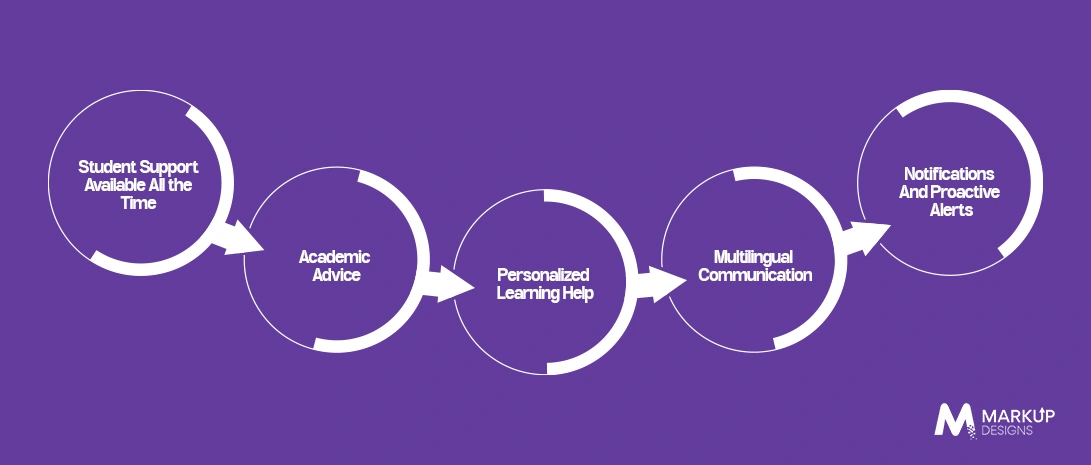
Campus support is not experienced in sequential steps by learners. At times, students need quick access to assignment deadlines; at other times, they are looking for lecture materials or guidance on where and how to submit their coursework. An educational chatbot gains relevance when it addresses those day-to-day challenges rather than forcing the student to navigate between portals.
From a business perspective, this translates into fewer repetitive inquiries. From a user’s perspective, it translates into efficient responses. It takes certain features to make a chatbot more conversational than just a messaging app.
1. Student Support Available All the Time
Developing Chatbots in education apps offers immediate replies to queries related to admissions, tuition fees, timetables, and exams. It helps in reducing waiting periods and also helps students after working hours. This makes it easier for students to access services and cuts down on lengthy administrative processes.
2. Academic Advice And Help With Courses
Chatbots assist students in managing deadlines and examination schedules while providing access to learning material swiftly. They help in navigating the LMS and providing updates on academics. It makes sure that learners remain organized and up-to-date. Consequently, they are able to handle academics more effectively.
3. Personalized Learning Help
AI-based virtual assistants send notifications and suggestions about learning resources depending on the performance of the students. Engagement levels are monitored, and timely alerts are provided. The integration of Learning Management System (LMS) platforms facilitates personalized assistance to learners.
4. Multilingual Communication
The education chatbots enable communication in a variety of languages, such as Arabic and English. This allows for clear and fluent multilingual communication. This enables students to engage better with their studies.
5. Notifications And Proactive Alerts
Educational chatbots notify their users of all the necessary aspects, such as deadlines, upcoming tests, and other relevant information regarding their education. They immediately inform about changes that occurred to schedules and other important pieces of information.
Build a Smarter Learning Experience for Your Institution
Partner with our team to develop secure, multilingual, and scalable education chatbot solutions tailored for UAE educational institutions.

Steps to Develop an Education Chatbot in UAE
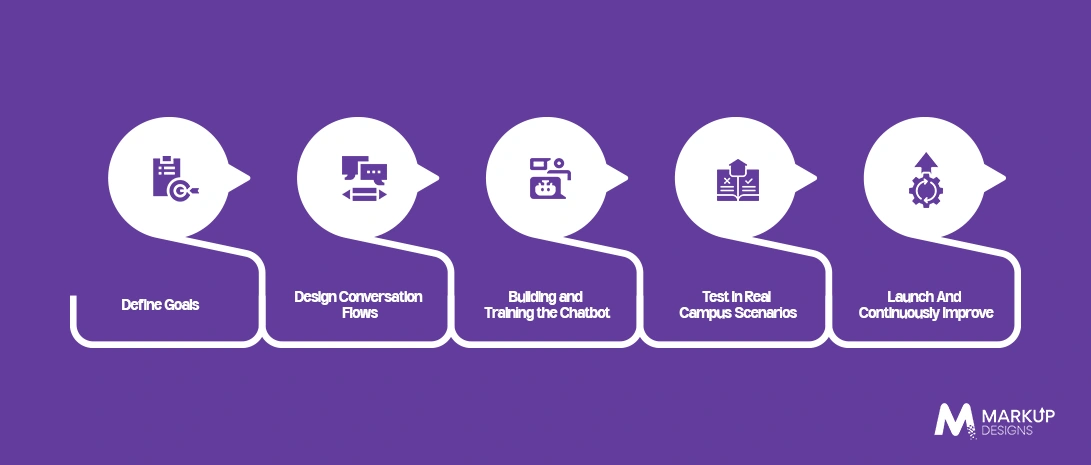
The decision to implement an AI bot in education is simple. What is not easy is ensuring that this new initiative benefits learners and faculty members. The problem here is that some organizations implement the chatbot without taking into account how to integrate it into existing operations.
An organized method allows chatbot to be integrated into day-to-day operations, to comply with the privacy regulations of the organization, and to be seamlessly integrated into other platforms. It is for this reason that many universities in the Middle East partner with an AI development company in Dubai.
1. Define Goals and Use Cases
- Start by looking at the difficulties that are faced by students and teachers every day.
- Note down their problems or deficiencies
- Be mindful of areas such as applications, course advising, and notifications
- Keep in mind language restrictions and other considerations
- Consider your accountability for privacy
2. Design Conversation Flows and User Experiences
Think about the conversation flows for students before beginning to develop the chatbot.
- Recognize and map student engagement and inquiries
- Ensure accessibility via portals and mobile devices
- Use clear and culturally appropriate language
- Prepare answers in both English and Arabic
3. Building and Training the Chatbot System
Here, the technical backbone will be defined, which sets out the limits in terms of accuracy, security, and scalability.
- Construct the architecture of the artificial intelligence model through the application of the large language model and RAG to ensure that the answers generated are anchored in validated knowledge.
- Organize the knowledge database to incorporate policies, FAQs, and processes from academia that would generate accurate responses.
- Train the chatbot model in query processing in both Arabic and English languages, as well as combinations thereof.
- Incorporate an intent detection model and context manager to support multistep dialogues.
- Connect the learning management system, student databases, and communication platforms through API access.
- Create role-based access control mechanisms and basic security measures.
4. Test In Real Campus Scenarios
What works for development can be different once students start posting their questions. Testing will make sure that the chatbot responds well in the real environment.
- Ensure correct operation and dialogue flow within various types of questions from students
- Check data privacy and security requirements
- Test for performance to withstand the admissions peak load
- Test using pilots with both staff and students
- Optimize answers and dialogue workflows based on real interaction
- Identify hand-off moments to human support
5. Launch And Continuously Improve
The launch is the point when the actual use begins, not the end.
- Monitor trends in usage and performance
- Adjust answers based on student queries
- Increase functionality and integration slowly
- Iteratively refine accuracy and usability
Cost of Designing an Education Chatbot
Developing AI chatbot for educational use in UAE will depend on various elements that include the chatbot’s functionality, the AI technology used, and how much the chatbot needs to be integrated. For instance, schools might require the inclusion of multilingual app development capacity, automation of students’ queries, integration with learning management systems, and personal learning assistance, among others.
| Education Chatbot Type | Estimated Cost (AED) |
| Basic Support Chatbot | AED 150,000 – 300,000 |
| Academic Support Chatbot | AED 300,000 – 900,000 |
| AI Learning Assistant | AED 900,000 – 1,470,000 |
Benefits of AI Chatbots for Educational Institutions

If you were to ask any student about their frustrations in the academic calendar, the answer is rarely about technology. Students are frustrated with delays, lack of information, and uncertainty about how to get assistance. An educational AI chatbot can help address these frustrations by providing more accessible information and assistance.
Institutions benefit from this innovation not only in terms of convenience but also in managing growing workloads while at the same time being responsive.
1. Increased Engagement of Students
The use of chatbots in learning makes learners more active through quick answers to queries without waiting for office hours. It also facilitates admission processes and course enrollments, thus making the process easier. This way, learners will always have information and support available at all times, hence being more engaged.
2. Reduced Administrative Effort
Chatbots assist in reducing the administrative burden by streamlining the response process to frequently asked questions by the students regarding fees, schedules, policies, admissions, and necessary documents. Chatbot systems streamline repetitive processes by minimizing human involvement, allowing administrators to focus on providing assistance to students and attending to other important tasks.
3. Enhanced Learning Assistance
Chatbots powered by artificial intelligence are beneficial for students because they enhance their ability to manage tasks effectively. They assist by ensuring that students have relevant and up-to-date information concerning deadlines while making academic materials available instantly. The end result is an enhanced learning experience that contributes to better academic performance among students.
4. Improved Access for Diverse Student Groups
The implementation of chatbots with multiple languages increases the availability of education services to students of different linguistic and cultural backgrounds. International students get better communication through chatbots, as well as easier navigation through the academic process and institutions. Chatbots provide consistent and accurate information that eliminates any confusion among students.
5. Quick Responses & 24/7 Availability
Chatbot systems provide constant educational assistance irrespective of constraints such as office timings or geographical locations. This gives students easy access to help at any time, providing increased convenience. Through prompt replies to queries and worries, chatbots allow for the speedy resolution of issues.
Challenges in Education Chatbot Development & How to Solve
In theory, getting a chatbot up and running seems like an easy process. However, while implementing the same in a college campus, one must consider many factors. Students often switch between Arabic and English within the same conversation, making contextual understanding essential for effective chatbot interactions. barriers, aging technology, and high demands for privacy. If these aspects are overlooked, a technology designed to ease the process may end up adding to the confusion.
1. Language and Cultural Contexts
Inappropriate responses or tone in the chatbot will reduce credibility rapidly.
Problem: Chatbot responses seem unnatural, excessively literal, or out-of-context in relation to the culture.
Solution:
- Fine-tuning of Arabic NLP to better comprehend regional idioms and academic jargon
- Handling dialects to parse variations in Gulf Arabic expressions
- Identification of code-switching so that the chatbot comprehends Arabic-English combinations
- RTL UI support for ensuring correct rendering in Arabic conversations
2. Integration Into Existing Systems
There are many organizations that have older platforms, and student information could be present on more than one system.
Problem: The information might seem old, inconsistent, or irrelevant due to not being integrated into existing processes on the campus.
Solution:
- Make systems talk with each other via APIs (middleware) to allow the chatbot to provide live updates rather than generic responses
- Provide relevant course details from LMS APIs (course schedule, assignments, and learning materials)
- If relevant, integrate SIS APIs that will give access to enrollment status and student profiles
- Utilize identity and access APIs (SSO) to make sure that the chatbot displays only relevant information depending on permissions
- Perform incremental integration starting from low-risk processes (FAQ, admissions)
3. Student Records and Privacy
Student records contain both private and academic information and have to be protected.
Problem: Providing fast reactions while protecting sensitive information
Solution: Encrypting data, limiting access, and matching PDPL guidelines regarding storage
4. Promoting Usage
It’s also possible that people will neglect useful tools just because they don’t know when to use them.
Problem: Lack of user involvement by students and faculty
Solution: Use the chatbot during admission or orientation processes, as well as making human support available.
5. Defining Parameters
A chatbot may help students find their answers; however, it should not substitute for the role of advisors.
Problem: Chatbot users consider it competent enough to resolve difficult cases
Solution: Define its capabilities, as well as transferring the call to a member of the faculty.
How Markup Designs Helps in Education Chatbot Development?
We assist educational institutions in developing intelligent and scalable chatbots that will help increase student engagement and make academic processes more efficient. We design custom-made educational chatbots that have several features like automatic student support, multi-language interaction capability, LMS integration, personalized learning support, and real-time notifications. Our chatbot solutions emphasize security, ease of use, and artificial intelligence.
Ready to Transform Student Support With AI?
Build an intelligent education chatbot that improves student engagement, streamlines operations, and delivers personalized support across every academic touchpoint.
Conclusion
The educational establishments within United Arab Emirates face the need for a faster exchange of communications and availability of information. The implementation of education chatbots helps to optimize operations such as admissions procedures, assistance in the learning process, routine activities, and improve general student performance. In case when these solutions possess multiple language options, safety integration, and comply with the regulations, there is a chance to achieve considerable results.
FAQs
1. What is an education chatbot?
An education chatbot is an AI-powered virtual assistant designed to support students by answering questions, guiding admissions, sharing academic information, and improving communication across educational platforms.
2. How much does education chatbot development cost in the UAE?
The cost generally ranges from AED 150,000 to AED 1,470,000 depending on chatbot features, AI complexity, integrations, multilingual support, and scalability requirements.
3. Can education chatbots support Arabic and English languages?
Yes, modern education chatbots can support both Arabic and English communication and provide seamless multilingual interactions for diverse student communities.
4. Can chatbots integrate with LMS and student management systems?
Yes, chatbots can integrate with LMS platforms, student information systems, communication tools, and institutional databases to provide personalized and real-time responses.
5. Are education chatbots secure for handling student data?
Education chatbots can be built with encryption, role-based access controls, secure APIs, and privacy frameworks to protect student information and maintain compliance requirements.
Author's Perspective
The field of education is shifting towards connectivity and smart student experiences. Universities and institutions cannot be defined solely on the basis of excellence anymore; they are being judged on the efficiency with which they help their students during the course of their educational life. Intelligent education chatbots have given rise to possibilities that include increased accessibility, efficiency, and personalization. With the current scenario in UAE, language capabilities will become an essential factor for success in the future of education.
Discuss Your Project NowJupinder Singh Arora
Founder and CEO
Related Posts
Hiring an AI Development Partner in the UK:...
10 AI Innovations Transforming the UK Healthcare Industry...
AI Chatbots in Banking: Enhancing Customer Experience Through...
Insights Are Valuable & Execution is Priceless
You’ve read about the digital future. Now, let’s build the infrastructure to take you there. Move your strategy from the page to the product.
Design Your Solution Now
Contact Us
Schedule The Appointment At Your Convenience Date And Time.
30 Min
Web Conference
Time Zone
Indian standard time (08:30pm)

Thanks For Getting In Touch!
You’ve Taken The First Step Toward Transforming Your Digital Presence. Our Experts Will Reach Out Shortly To Take It Forward.
Launch Your Dream Project
Provide a brief overview of your project, and our specialists will evaluate your requirements. We will connect with you to explore how the right digital solutions can help you launch faster.