

In Brief
- The price of developing custom accounting software depends on the complexity of the system and its features, AI level of customisation, number of integrations, and other factors.
- Basic bookkeeping and invoice processing solutions require smaller investments compared to platforms with predictive analytics and fraud detection.
- Development of AI models, data preparation, integration with third-party applications, and regulatory compliance can greatly affect the overall price of development.
- Companies can control the initial prices by implementing an MVP with the necessary features for accounting and adding new functionality later when needed.
- Costs for cloud hosting, AI model updates, security, and maintenance should be estimated to determine the overall cost.
AI is affecting accounting by automation of financial tasks, increasing precision of data and helping businesses make faster decisions. From invoice processing to fraud detection, all these features and others can be performed with AI accounting software. While implementing AI in their businesses, companies should know how much it will cost. The cost to develop custom AI accounting software depends on the software features, capabilities of AI, technology stack used, and other aspects.
A basic bookkeeping solution will have a different budget from an enterprise platform that handles complex financial workflows and predictive analytics. This guide explores the major cost components, influencing factors, development stages, and ongoing expenses to help businesses estimate their investment more accurately.
What Is the Average Cost to Develop Custom AI Accounting Software?
The cost of creating custom AI accounting software will be affected by how complicated the solution is, what features it includes, and how integrated the artificial intelligence is. Simple platforms are less costly to develop, whereas enterprise ones with high automation and analytics come with significant software development costs.
Estimated Cost Based on Software Complexity
The cost of development can amount to 30,000-50,000 for simple software, 50,000-120,000 for mid-level solutions, and 120,000-250,000+ for enterprise-grade software. They are approximate figures; the budget will depend on your needs and requirements of your projects.
Cost Differences Between Basic, Mid-Level, and Enterprise AI Accounting Solutions
Basic platforms deal with bookkeeping, invoicing, and expense management. Mid-level ones have predictive analytics, automated reconciliation of accounts, and third-party integrations, whereas enterprise software solutions work with complicated financial operations, fraud detection, and multi-entity accounting.
Custom AI Accounting Software vs Off-the-Shelf Solutions
Readymade accounting software is cheaper and priced on a subscription basis, whereas custom ones require an increased initial budget and are better suited to the specific needs of your company. Custom software requires a higher initial investment but offers tailored workflows, greater control over integrations, and flexibility to scale with business operations.
What Factors Affect the Cost of AI Accounting Software Development?
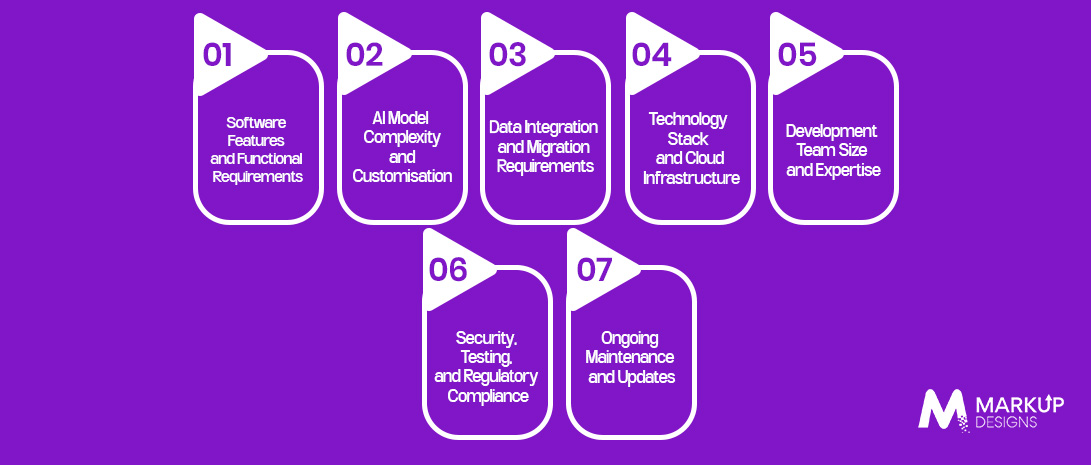
Various technical and commercial aspects play an important role in defining the budget of the whole process. Being aware of them can assist organizations in defining the right requirements and preventing any unanticipated costs.
Software Features and Functional Requirements
The number and complexity of features impact development time and cost significantly. The implementation of basic bookkeeping and invoice management will be less costly compared to advanced functionalities like automatic reconciliation, financial forecasting, and real-time reporting.
AI Model Complexity and Customisation
Pre-trained AI models and APIs are helpful for decreasing the cost of the initial development phase, whereas custom AI models will need some extra investments for their preparation, training, testing, and optimization. More specific AI functions usually mean more cost and time.
Data Integration and Migration Requirements
Integration with other accounting systems, ERP software, bank accounts, payment gateways, as well as migration of historical financial information, requires additional efforts in the form of data validation and cleansing.
Technology Stack and Cloud Infrastructure
The choice of programming languages, AI technologies, databases, and cloud computing services also has an impact on costs and expenses. Scalability of the technology stack can be achieved at the expense of more initial investments.
Development Team Size and Expertise
The budget for AI accounting software is determined by the size, level of experience, and localization of the development team. Each professional, be it an AI engineer, a developer, a designer, or a tester, has different sets of skills, and specialized AI skills can affect the overall development costs.
Security, Testing, and Regulatory Compliance
AI accounting software will handle confidential data; thus, security and compliance are of vital importance. Such things as encryption, security tests, audit trails, access control measures, etc., can influence the cost of development.
Ongoing Maintenance and Updates
To function effectively, the product should be periodically updated and maintained to address bugs, enhance performance, add new integrations, and ensure compatibility with new technologies. In some cases, AI models need to be retrained.
What Are the Key Features That Influence AI Accounting Software Development Costs?
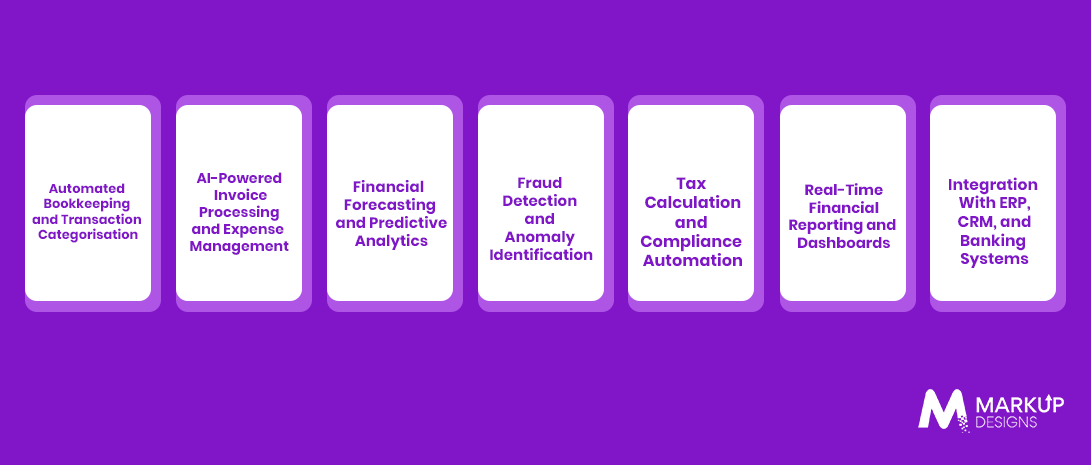
Features determine the functionality of the product and resources required to implement it. Typically, advanced automation and AI-powered predictive features involve greater effort than regular accounting software features.
Automated Bookkeeping and Transaction Categorisation
It involves automatic recording and classification of financial transactions based on certain criteria and machine learning algorithms. Its cost depends on categorisation accuracy, automation requirements, and the number of supported transaction types.
AI-Powered Invoice Processing and Expense Management
AI-driven invoice processing involves the extraction of data from invoices and other financial documents through OCR technology and machine learning algorithms. Additional development costs come from automating expense categorisation and approvals.
Financial Forecasting and Predictive Analytics
Predictive analytics involves analysis of historical financial data for predicting cash flow, income trends, and future expenses. Development efforts involve appropriate data sets, predictive analytics models, and their validation.
Fraud Detection and Anomaly Identification
AI-driven models detect anomalies such as duplicate payments, fraudulent transactions, and other unusual financial patterns based on detection needs, model accuracy, and whether real-time monitoring is required.
Tax Calculation and Compliance Automation
Features for automating tax processes include calculations, organization of financial data, and compliance workflows. The development expenses will be determined by the tax jurisdictions and regulations.
Real-Time Financial Reports and Dashboards
Dashboards show the company’s financial performance in the form of reports and charts. Real-time data pipelines will be needed, resulting in higher development costs.
Integration With ERP, CRM, and Banking Systems
Integrations allow accounting software to exchange data with ERP, CRM, banking, and payment platforms. Development costs depend on API availability, integration complexity, data synchronisation, and the number of external systems involved.
How Much Does It Cost to Develop AI Accounting Software at Each Stage?
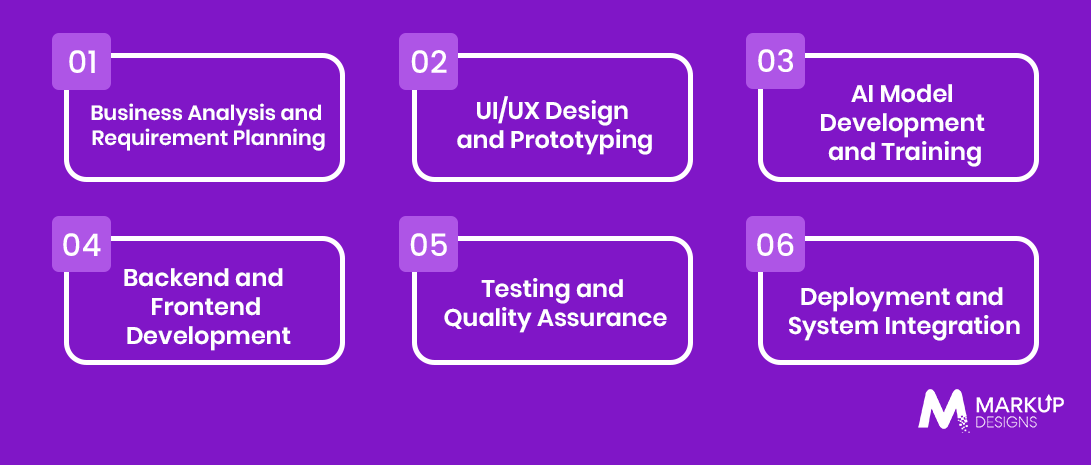
The development process for the AI-powered accounting software is comprised of several stages that contribute to the budget of the project.
Business Analysis and Requirement Planning
This stage includes business needs identification, definition of key features, assessment of technical feasibility, and project requirement documentation. Good planning helps avoid changes in scope and excessive development costs later.
UI/UX Design and Prototyping
Designers build wireframes, user journeys, and interactive prototypes to define user interaction with the platform. The cost is determined by the number of screens, complexity of the dashboard, and customisation needs.
AI Model Development and Training
This stage encompasses data preparation, AI model selection, training, and validation. Customised AI features need extra resources to increase precision and ensure that models work properly with financial data.
Backend and Frontend Development
At the frontend level, there is work on dashboards, reports, and user interface implementation. At the backend level, it concerns business logic, databases, APIs, and AI implementation. The number of modules and complexity of workflows determine the cost.
Testing and Quality Assurance
Testing specialists check functionality, data accuracy, system performance, security, and integration quality. AI features also have to be validated on various datasets to reveal incorrect predictions and inconsistencies.
Deployment and System Integration
The final stage involves configuring the production environment, connecting external systems, migrating data, and deploying the software. Costs vary based on infrastructure requirements, deployment complexity, and user onboarding needs.
What Technology Stack Is Required to Build AI Accounting Software?
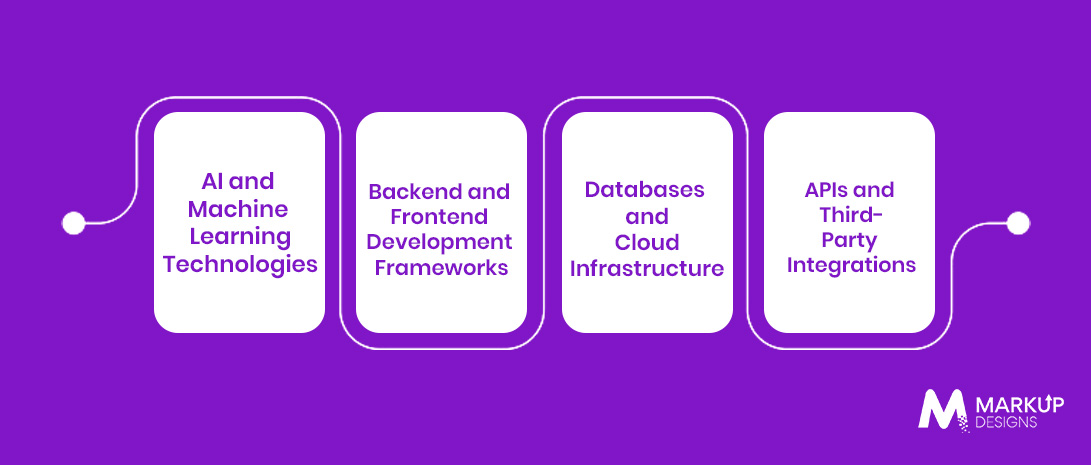
Technology stack impacts software performance, scalability, security, and development costs. The appropriate technology stack is based on the requirements for AI on the platform, volume of data, and integrations.
Artificial Intelligence and Machine Learning Technologies
Python, TensorFlow, PyTorch, and scikit-learn are useful for machine learning, predictive analytics, and processing of financial data. OCR and natural language processing technologies will allow automating the extraction of invoices and documents.
Backend and Frontend Development Frameworks
Backend technologies like Python, Java, and Node.js will help in implementing business logic and development of APIs. React, Angular, and Vue.js are useful frameworks to implement interactive dashboards and the front end.
Databases and Cloud Infrastructure
PostgreSQL and MongoDB databases will help to manage financial records and data of the application. Cloud infrastructure like AWS, Microsoft Azure, and Google Cloud will provide hosting, storage, and computing.
APIs and Third-Party Integrations
APIs enable integration of accounting software with banking, payment, and ERP platforms. Integration is chosen based on the availability of APIs and the cost of third-party services.
How Can Businesses Reduce AI Accounting Software Development Costs?
The development costs can be controlled without sacrificing any crucial aspects of performance through strategic decisions regarding the technology and planning. The staged development model will allow businesses to ensure the quality of the product before moving on to advanced solutions.
Start With an MVP and Prioritise Essential Features
The development process should start with basic functions like accounting, invoicing, and managing expenses. The other capabilities can be added gradually based on feedback and requirements.
Use Pre-Trained AI Models and Existing APIs
Pre-built algorithms and third-party APIs could decrease the time and effort required to develop the new capabilities. It is important to test them for accuracy and compatibility, and consider privacy risks and API limits.
Choose a Scalable Cloud Infrastructure
Cloud computing allows scaling computing and storage resources in accordance with the requirements. The choice of appropriate cloud services from the very beginning can help in avoiding excessive investments in infrastructure.
Automate Testing and Development Workflows
Automated tests and tools that support CI/CD will minimize repetitive work and eliminate bugs earlier. This helps improve development efficiency and limits the cost of fixing problems at later stages.
Plan for Maintenance From the Beginning
Including maintenance in the initial budget helps businesses prepare for updates, security improvements, and AI model monitoring. A well-planned architecture can also reduce long-term maintenance and upgrade expenses.
What Are the Ongoing Costs of Maintaining AI Accounting Software?
Development budget is not the only cost that needs to be considered. Companies have to take into account expenses that will ensure the safety, accuracy, and reliability of the software as financial needs change.
Cloud Hosting and Infrastructure Expenses
The costs for cloud hosting depend on the size of storage space, computer capacity, data processing, and user interaction. With the increase in the number of transactions, companies may need to create more infrastructure.
AI Model Monitoring and Retraining
Monitoring is required in order to detect any problems in the model’s performance and any changes in data patterns. Retraining and optimization can incur additional costs related to preparing the data, computing capacity, and validating the model.
Security Upgrades and Compliance Management
These measures help to secure sensitive financial data, and they are important in order to build trust between the parties and reduce risks.
Technical Support and Feature Enhancements
Support will help to fix possible technical problems and maintain integrations, while feature enhancements will ensure that the platform meets company needs. The cost will depend on the type of support and frequency of upgrades.
How Can Markup Designs Help Businesses Build Custom AI Accounting Software?
Creating custom AI accounting software is all about combining the necessary abilities of AI, security, and proper accounting workflow. Markup Designs makes businesses transform their requirements into custom solutions by analyzing their business goals, choosing appropriate technologies, and creating useful features.
Whether it is automated bookkeeping, invoices processing, predictive analysis or fraud detection, our development team works hard at creating scalable and functional software for better financial management. Data security, integration with other tools, and maintainability are the key priorities of our developers.
Create Custom Accounting Software With AI
Revolutionize your complex financial operations by creating custom accounting software with AI technology integrated. Rely on Markup Designs to create scalable and smart accounting solutions.

Conclusion
The cost of creating custom accounting software based on AI will depend on multiple factors such as the level of complexity of the software, the AI model required, features, integration, and security options needed. The basic accounting software can be created for quite low cost, while more complex solutions will cost more.
Businesses need to understand their needs, choose needed features, and think about software maintenance to make a proper budget for custom accounting software development. Choosing a good software development company can help reduce costs and build software that will ensure the company’s further growth.
FAQ
1. What is the cost of custom AI accounting software development?
The price for custom AI accounting software development can range between $30,000 and $50,000 for basic solutions, $50,000 to $120,000 for mid-level platforms, and $120,000 to $250,000 or even more for enterprise platforms. The final price will depend on features, AI complexity, integrations, and security requirements.
2. How long does it take to create custom AI accounting software?
The development time for basic software will be 3–6 months, whereas for a complex enterprise solution it will be 6-12 months or even longer.
3. Is it possible for AI accounting software to be integrated into the existing ERP system and accounting tools?
It is possible. Custom AI accounting software can be integrated into existing ERP systems, accounting applications, banking systems, and payment gateways via APIs. Requirements for integration will depend on the availability and compatibility of third-party systems.
4. Is custom AI accounting software more expensive than the ready-made one?
The development of custom AI accounting software requires a larger initial investment, as the software is created according to individual business processes. At the same time, custom AI software gives much greater flexibility, custom integrations, and control over features, while off-the-shelf software implies subscription fees.
5. What are the main factors influencing development costs of AI accounting software?
The main cost drivers are software complexity, AI model customization, feature requirements, data migration, third-party integrations, technology infrastructure, and regulatory compliance. Maintenance and AI model updates are also part of development costs.
Author's Perspective
Custom AI accounting software has to be considered not as a simple automation tool but as a business investment. The right solution depends on the complexity of financial operations, the level of automation required, and the ability to integrate with existing systems. Businesses should focus on essential capabilities first and build towards advanced AI functionality as their needs evolve.
Discuss Your Project NowJupinder Singh Arora
Founder and CEO
Related Posts

How to Build an App With Claude Code:...

AI Development Firm in the UK: How to...

Hiring an AI Development Partner in the UK:...
Insights Are Valuable & Execution is Priceless
You’ve read about the digital future. Now, let’s build the infrastructure to take you there. Move your strategy from the page to the product.
Design Your Solution Now
Contact Us
Schedule The Appointment At Your Convenience Date And Time.
30 Min
Web Conference
Time Zone
Indian standard time (08:30pm)

Thanks For Getting In Touch!
You’ve Taken The First Step Toward Transforming Your Digital Presence. Our Experts Will Reach Out Shortly To Take It Forward.
Launch Your Dream Project
Provide a brief overview of your project, and our specialists will evaluate your requirements. We will connect with you to explore how the right digital solutions can help you launch faster.