
In Brief
- English-Arabic app development is crucial in the Middle East due to the region’s bilingual user base and rapid mobile-first digital growth, making localization a key success factor for businesses.
- These apps require more than translation; they need full localization with RTL (right-to-left) UI support, cultural adaptation, and seamless switching between English and Arabic without affecting usability.
- Key challenges include RTL layout design, mixed-language handling, Arabic typography issues, dialects vs Modern Standard Arabic choices, and complex bilingual testing and QA processes.
- Best practices involve using i18n frameworks, RTL-first design, Unicode compliance, native Arabic validation, and early-stage localization planning to ensure smooth performance across both languages.
- The blog also highlights that AI, proper technical architecture, and localization strategy improve scalability and user experience, while enabling businesses to gain higher engagement, trust, and market growth in the MENA region.
The Middle East is one of the fastest-growing digital markets, where mobile apps play a central role in daily life. With a large Arabic-speaking population and increasing use of English in business and education, the demand for bilingual applications is rising quickly. This is where English-Arabic app development becomes essential for businesses aiming to scale in the region.
Developing apps that support both languages is not just about translation. It involves creating a seamless experience where users can switch between English and Arabic without losing usability, design quality, or performance. Arabic, being a right-to-left (RTL) language, requires special attention in UI/UX design, layout structure, and navigation flow.
Companies that invest in bilingual app development gain a strong advantage in user engagement, trust, and market reach. In a competitive Middle Eastern digital landscape, offering a smooth English-Arabic experience is now a key factor for long-term success.
Understanding the Middle East Mobile App Market
The Middle East mobile app market is one of the fastest-growing digital ecosystems globally, driven by high smartphone penetration, youth population, and strong government-led digital transformation initiatives. According to Statista, smartphone subscriptions in the MENA region are expected to grow from 540 million in 2024 to around 710 million by 2030. This rapid adoption highlights the increasing dependency on mobile-first services across industries.
Several reports indicate that smartphone penetration in countries like the UAE and Saudi Arabia exceeds 95–96%, making mobile devices the primary gateway to digital services. Additionally, the Gulf mobile app market is estimated to be worth over $8 billion in 2026, growing at nearly 18% annually, fueled by fintech, eCommerce, healthcare, and government digital platforms.
The broader MENA app ecosystem is also expected to expand significantly, with the smartphone applications market projected to reach $12–16 billion by 2035. This growth is supported by rising digital payments, increased internet access, and strong demand for localized Arabic experiences.
With over 308 million mobile internet users and rapidly increasing digital engagement, the Middle East presents a highly lucrative opportunity for English-Arabic app development that prioritizes localization, UX quality, and cultural relevance.
Why English-Arabic Apps Require a Different Development Approach
Do you know why English-Arabic apps require a completely different development approach? Let us answer this question in a simple way.
In the Middle East, users don’t just interact in one language. They constantly switch between English and Arabic depending upon the environment they’re working in. This creates a unique challenge where an app must feel equally natural in both languages.
Another important factor is that Arabic is a right-to-left (RTL) language, while English is left-to-right (LTR). So, everything from layout alignment to navigation flow needs to be mirrored properly. If this is not handled correctly, the app feels broken or difficult to use for Arabic users.
In this region, cultural expectations also play a big role. Users expect apps to reflect their language, tone, and reading behavior. A simple translation is not enough-it must feel native.
That’s why English-Arabic apps need a dual design mindset, where both languages are treated as primary, not secondary. This is what makes development in the Middle East truly different from global app development.
Key Challenges in English-Arabic App Development
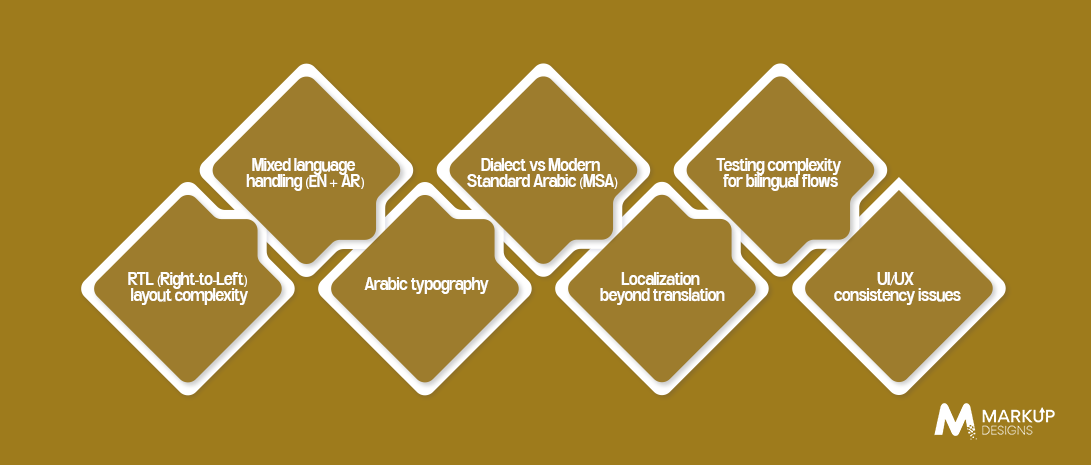
Building English-Arabic apps comes with several technical and UX challenges that need careful planning. Here are the major ones:
RTL (Right-to-Left) layout complexity
Arabic requires full UI mirroring, including navigation, icons, and alignment. Even small mistakes can break the user experience.
Mixed language handling (EN + AR)
Many apps in the Middle East use both languages together, which creates challenges in text alignment and consistency.
Arabic typography and font rendering issues
Arabic script behaves differently than English, and poor font support can lead to broken or unreadable UI.
Dialect vs Modern Standard Arabic (MSA)
Choosing between formal Arabic (MSA) and regional dialects can impact user understanding and engagement.
Localization beyond translation
Simple translation is not enough-content must be culturally adapted for each market.
Testing complexity for bilingual flows
QA becomes more time-consuming because every feature must be tested in both RTL and LTR modes.
UI/UX consistency issues
Maintaining design consistency across two languages with opposite reading directions is difficult.
These challenges make English-Arabic app development more complex than standard app development, requiring specialized expertise and planning.
Effective Solutions and Best Practices for Bilingual Apps
To successfully overcome English-Arabic development challenges, businesses need a clear set of practical solutions and best practices:
Adopt an RTL-first design approach
Instead of adapting later, design interfaces from the start to support right-to-left layouts.
Use proper internationalization (i18n) frameworks
Separate content from code using localization files to easily manage both English and Arabic text.
Ensure Unicode (UTF-8) compliance
This prevents issues with Arabic characters breaking or displaying incorrectly.
Implement seamless language switching
Users should be able to switch between English and Arabic instantly without UI glitches or reload issues.
Work with native Arabic language experts
Human validation ensures translations are accurate and culturally relevant, not just literal.
Create a unified design system for both languages
Maintain consistent spacing, typography rules, and UI components across RTL and LTR views.
Perform bilingual QA testing
Test every screen in both languages to ensure layout, alignment, and functionality remain intact.
Plan localization early in development
Avoid treating it as a post-launch task; it should be part of the core architecture.
Technical Architecture for English-Arabic Mobile Applications
A strong technical architecture is the backbone of any successful English-Arabic app, especially in the Middle East where bilingual functionality is a core requirement. The architecture must support scalability, localization, and seamless user experience across both languages.
At the base level, the system should follow a modular architecture, separating UI, business logic, and data layers. This makes it easier to manage language-specific changes without affecting core functionality.
Frontend Layer (iOS/Android/Web)
Uses internationalization (i18n) libraries like Flutter i18n, React i18next, or native localization APIs. The UI must dynamically adapt between RTL and LTR layouts based on user language preference.
Localization Layer
Stores all text, labels, and messages in separate language files (JSON, ARB, or XML). This ensures content is not hardcoded and can scale easily.
Backend Layer
Handles language preferences at the API level, ensuring responses are delivered in the correct language format. It also manages regional content personalization.
Database Layer
Designed to support multilingual fields, allowing content storage in both English and Arabic without duplication issues.
Middleware/AI Layer
Used for real-time translation, Arabic NLP, and personalized content delivery.
This layered architecture ensures flexibility, performance, and smooth bilingual experiences across all user touchpoints.
Must-Have Features in English-Arabic Apps
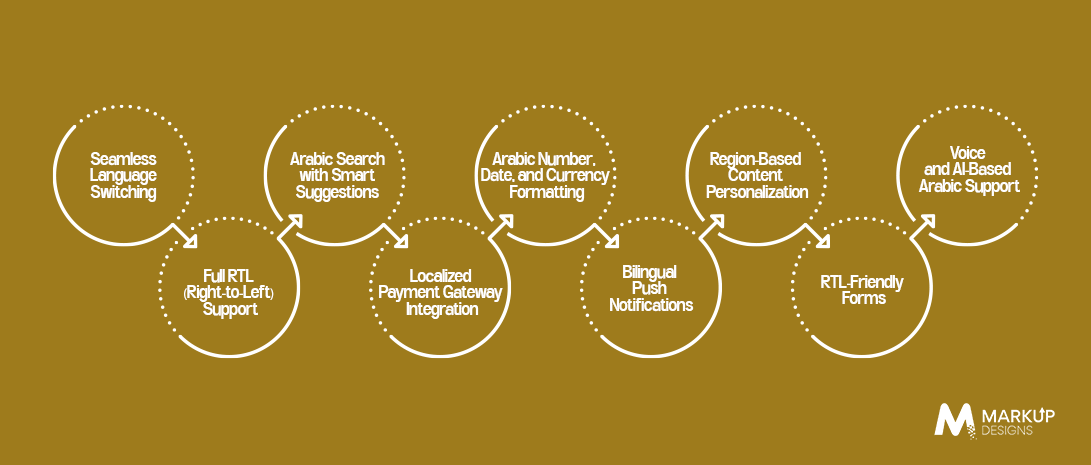
To build a successful English-Arabic app for the Middle East, features must go beyond basic functionality. The goal is to ensure users feel the app is designed specifically for them, not just translated.
Seamless Language Switching (EN ↔ AR)
Users should be able to switch languages instantly without restarting the app. The UI must update dynamically, including layout direction, fonts, and alignment.
Full RTL (Right-to-Left) Support
Arabic users expect a completely mirrored experience. This includes navigation menus, icons, buttons, and even animations flowing correctly in RTL format.
Arabic Search with Smart Suggestions
Search should understand Arabic keywords, synonyms, and even mixed-language queries. Predictive suggestions improve usability and engagement.
Localized Payment Gateway Integration
Apps must support regional payment methods like Mada, STC Pay, Apple Pay (region-specific setups), and cash-on-delivery options where relevant.
Arabic Number, Date, and Currency Formatting
Formatting must adapt based on locale settings, ensuring clarity and familiarity for users in both languages.
Bilingual Push Notifications
Notifications should be delivered in the user’s preferred language with proper tone and cultural relevance.
Region-Based Content Personalization
Content should adapt based on user location, cultural context, and language preference to improve engagement.
RTL-Friendly Forms and Input Fields
Forms must support Arabic text entry, correct cursor alignment, and proper validation rules for bilingual inputs.
Voice and AI-Based Arabic Support
Voice search, chatbots, and AI assistants should understand Arabic dialects for better accessibility.
These features ensure that the app doesn’t just function in two languages but truly delivers a native experience for both English and Arabic users, which is essential for success in the Middle Eastern market.
Role of AI and Automation in Arabic App Development
AI and automation are now playing a major role in making English-Arabic app development faster, smarter, and more accurate. In a region like the Middle East, where users expect highly personalized and culturally relevant experiences, AI helps bridge the gap between languages and user expectations.
One of the biggest use cases is AI-powered translation and localization, where machine learning models help convert English content into Arabic with better context awareness. This reduces manual effort while improving consistency across large applications.
Another key area is Arabic Natural Language Processing (NLP). Since Arabic has complex grammar and multiple dialects, AI helps apps understand user intent more accurately, especially in search, chatbots, and voice assistants.
- AI chatbots can handle customer queries in both English and Arabic seamlessly
- Voice recognition systems are improving support for Arabic dialects
- Smart recommendation engines personalize content based on language and behavior
- AI-driven testing tools can automatically detect RTL layout issues
Automation also helps in continuous localization, where updates in the app are automatically reflected in both languages without manual rework. This reduces time-to-market and improves scalability.
Overall, AI is transforming Arabic app development from a manual, time-consuming process into a more intelligent and scalable ecosystem, making it easier for businesses to succeed in the Middle East.
Read: Also: How AI Is Transforming UAE Businesses in 2026
Cost Factors in Developing English-Arabic Apps
The cost of developing English-Arabic apps in the Middle East is generally higher than standard single-language apps because of the added complexity of localization, RTL design, and bilingual testing. However, this investment directly impacts user adoption, retention, and long-term revenue in the region.
Several factors influence the overall development cost, and understanding them helps businesses plan budgets more effectively.
1. App complexity and feature set
More advanced features like AI chatbots, real-time translation, or multi-region support significantly increase development effort.
2. RTL (Right-to-Left) UI implementation
Designing mirrored interfaces requires additional design and development cycles.
3. Localization and translation effort
Arabic translation is not just linguistic-it involves cultural adaptation and contextual accuracy.
4. QA and bilingual testing
Every feature must be tested in both English and Arabic, increasing testing time and cost.
5. Backend scalability for multilingual content
Systems must support dynamic content delivery in multiple languages.
6. Maintenance and continuous localization
Ongoing updates require dual-language synchronization.
| App Type | Approx. Cost (USD) | Key Drivers |
| Basic MVP App | $20,000 – $40,000 | Simple UI, limited features, basic RTL support |
| Mid-Level App | $40,000 – $100,000 | API integration, bilingual support, moderate UX complexity |
| Enterprise App | $100,000 – $250,000+ | AI features, advanced RTL UX, large-scale localization |
While localization can increase overall costs by 40–60%, it also significantly expands market reach across the Middle East. Businesses that invest early in proper English-Arabic architecture often see higher ROI due to stronger engagement and regional adoption.
In short, the cost should be seen not as an expense, but as a strategic investment in long-term growth within the MENA digital ecosystem.
Business Benefits of Building English-Arabic Applications
Building English-Arabic apps is not just a technical decision-it is a strategic business move for companies targeting the Middle East. Here are the key benefits:
Wider market reach across MENA region
Supporting both English and Arabic allows businesses to connect with millions of users across GCC countries and beyond.
Higher user engagement and retention
Users are more likely to stay active on apps that communicate in their native language and feel culturally familiar.
Improved brand trust and credibility
Arabic-first experiences build stronger emotional trust with local users, especially in sensitive sectors like fintech and healthcare.
Competitive advantage in regional markets
Many global apps still lack strong Arabic support, giving bilingual apps a clear edge.
Increased conversion rates
Localized content, UI, and payment flows reduce friction and improve purchasing behavior.
Better customer satisfaction
Users feel understood when apps support their language, tone, and cultural context.
Stronger monetization opportunities
Regional ads, subscriptions, and localized pricing models perform better in bilingual apps.
These benefits show that English-Arabic apps are not just about language support-they are about unlocking full business potential in one of the fastest-growing digital regions in the world.
Step-by-Step Development Process for English-Arabic Apps
Developing a successful English-Arabic app requires a structured, step-by-step approach. Each stage must account for bilingual functionality, RTL design, and cultural alignment to ensure a smooth user experience across the Middle East.
Step 1: Market Research and Requirement Analysis
Start by understanding your target audience in the MENA region.
- Identify user behavior in both English and Arabic markets
- Study competitors offering bilingual apps
- Define core features based on regional needs
Step 2: Localization Strategy Planning
Before development begins, create a clear localization roadmap.
- Decide between Modern Standard Arabic (MSA) and dialect usage
- Define content tone and cultural adaptation rules
- Plan language-switching behavior
Step 3: UI/UX Design with RTL Support
Design plays a critical role in success.
- Create wireframes for both LTR and RTL layouts
- Mirror navigation, icons, and content flow
- Ensure Arabic typography is readable and visually balanced
Step 4: Development with Internationalization (i18n)
Build the app using scalable architecture.
- Separate UI text using localization files
- Implement dynamic language switching
- Ensure backend APIs support multilingual responses
Step 5: Arabic Content Integration
Integrate high-quality localized content.
- Use culturally relevant translations, not literal text
- Validate Arabic grammar and context with native experts
- Optimize for regional SEO and app store listings
Step 6: Testing and Quality Assurance
Testing ensures stability across languages.
- Run RTL and LTR UI testing on multiple devices
- Validate Arabic text rendering and alignment
- Perform bilingual usability testing with real users
Step 7: Deployment and Continuous Optimization
Launch is not the end-it’s the beginning.
- Monitor user behavior separately for English and Arabic users
- Continuously improve localization accuracy
- Release updates with synchronized bilingual content
Are You Ready to Capture the Middle Eastern Market with a Flawless Bilingual App?
Overcome the complexities of localization by leveraging our deep expertise in RTL (Right-to-Left) architecture and cultural nuances, ensuring your English-Arabic app resonates instantly with local users.

Conclusion
Building successful English-Arabic apps for the Middle East is no longer optional-it is a strategic requirement for businesses aiming to scale in the region. The MENA market is highly mobile-driven, culturally diverse, and linguistically unique, which makes bilingual app development a key success factor.
From RTL design challenges to localization strategies, every stage of development must be carefully planned. Companies that treat Arabic support as a core product feature-rather than an afterthought-are the ones that achieve stronger engagement and long-term growth.
With the right architecture, UX approach, and AI-driven enhancements, businesses can create seamless experiences that feel native in both English and Arabic. Ultimately, success depends on how well the app adapts to user behavior, not just language translation.
FAQs
1. Why is English-Arabic app development important in the Middle East?
Because the region has a large Arabic-speaking population, and users prefer apps that support their native language along with English for flexibility.
2. What is the biggest challenge in Arabic app development?
The biggest challenge is RTL (Right-to-Left) UI implementation and ensuring a seamless bilingual experience.
3. Is translation enough for Arabic apps?
No, localization is required. This includes cultural adaptation, UX changes, and contextual language usage.
4. Which industries benefit most from bilingual apps?
Fintech, eCommerce, healthcare, education, and government services benefit the most.
5. Does AI help in Arabic app development?
Yes, AI improves translation, search, chatbots, voice recognition, and personalization.
Author's Perspective
Developing English-Arabic apps is one of the most impactful digital opportunities in today’s global economy. The Middle East is rapidly evolving into a technology-first region, and businesses that invest in localization today will lead tomorrow’s digital ecosystem. From a development perspective, bilingual apps are more complex, but they also open doors to deeper user engagement and stronger brand loyalty. The key is not just building for two languages, but building for two user experiences that feel equally native.
Discuss Your Project NowGaurav Goyal
Global Sales- VP
Related Posts
Case Management Software Development: Enterprise Features & Implementation...
Farm Management Software Development in Australia: Features, AI...
Knowledge Management System Development in Australia: Building AI-Ready...
Insights Are Valuable & Execution is Priceless
You’ve read about the digital future. Now, let’s build the infrastructure to take you there. Move your strategy from the page to the product.
Design Your Solution Now
Contact Us
Schedule The Appointment At Your Convenience Date And Time.
30 Min
Web Conference
Time Zone
Indian standard time (08:30pm)

Thanks For Getting In Touch!
You’ve Taken The First Step Toward Transforming Your Digital Presence. Our Experts Will Reach Out Shortly To Take It Forward.
Launch Your Dream Project
Provide a brief overview of your project, and our specialists will evaluate your requirements. We will connect with you to explore how the right digital solutions can help you launch faster.