

In Brief
- Real-time transaction monitoring enables financial institutions to analyze transactions instantly and identify suspicious activities, fraud risks, and compliance violations before they escalate.
- The increasing adoption of digital banking, cross-border transactions, and evolving AML regulations in UAE is making real-time monitoring a business necessity.
- Modern monitoring platforms use AI, machine learning, streaming technologies, and automated detection models to improve speed, accuracy, and fraud prevention.
- Building an effective monitoring system involves risk modeling, real-time data ingestion, detection engines, dynamic risk scoring, alert management, and automated compliance reporting.
- Regulatory alignment is a key requirement, with systems needing audit trails, reporting automation, explainable decision-making, and integration with regulatory frameworks such as goAML.
- Development costs generally range from AED 147,000 to AED 1.47M+, depending on transaction volume, AI capabilities, integration complexity, and enterprise requirements.
Real-time transaction monitoring software development in UAE has transformed how financial institutions track and manage transactions. This technology captures data from payment rails, banking systems, and digital platforms in real time, enabling institutions to assess potential risks within seconds, unlike traditional batch-processing systems that analyze transactions only after delays.
The legacy monitoring systems are unable to operate effectively in rapidly changing financial ecosystems. Legacy monitoring systems even use T+1 or T+2 processes. Any suspicious transactions usually come to light only when funds have been transferred from one account to another or across jurisdictions. Yet another drawback of such systems is the immutability of their rule sets. They cannot evolve in response to any changes.
Since UAE handles a high volume of cross-border transactions through banks, FinTech platforms, and remittance networks, with non-oil trade recently reaching AED 1.24 trillion, the transaction ecosystem has become increasingly complex. This growing scale creates pressure on traditional systems, making real-time data processing and instant risk detection essential for maintaining speed, security, and operational efficiency.
The demand for faster detection and higher accuracy in AML transaction monitoring software is growing across UAE, which is driven by the country’s evolving anti-money laundering landscape. Regulatory requirements introduced by UAE Central Bank have become more stringent, while continued alignment with Financial Action Task Force (FATF) standards is encouraging institutions to strengthen their monitoring and compliance capabilities.
Transaction monitoring is not a back-office function anymore. Transaction monitoring functions as a risk intelligence system that safeguards transactions.
Understanding Real-Time Transaction Monitoring in UAE Financial Institutions
Real-Time transaction monitoring refers to the ongoing evaluation of transactions as soon as they occur in order to determine any anomalies, suspicious activities, compliance breaches, or operational risks. Real-time systems offer immediate visibility, as compared to batch-based transaction monitoring approaches, where transactions are evaluated after being processed.
As UAE is a controlled financial market, real-time transaction monitoring can help in enhancing fraud prevention, regulatory compliance, and customer trust for institutions without hampering their efficiency. Real-time transaction monitoring tools use various technologies, including AI, machine learning, rule-based systems, and data analysis. With these tools, financial institutions will be able to make decisions promptly, manage risks proactively, and avoid financial losses.
Why Is Real-Time Transaction Monitoring Becoming Essential in UAE?
Transaction Monitoring in real time is crucial in UAE due to the large transactions by financial institutions, an increase in digital payment usage, and regulatory expectations. Traditional monitoring methods usually too slow in terms of detecting risks. With real-time transaction monitoring, financial institutions can detect any suspicious activities.
1. Increasing Digital Banking Usage – The rising adoption of digital banking and financial technology requires real-time transaction visibility. As consumers require faster and streamlined digital transactions, it is imperative for banks to keep an eye on the transactions in real-time.
2. Meeting Compliance Needs– Real-time transaction monitoring ensures continuous compliance with the changing requirements of financial monitoring. Financial institutions can report accurately and prepare themselves for audits with the help of automated financial monitoring.
3. Detecting Frauds & Response: Real-time transaction monitoring enables organizations to detect and respond to risks instantly instead of waiting for traditional batch processing cycles. Through immediate alerts and automated actions, institutions can identify suspicious activities early, reduce potential losses, and protect both business operations and customer experiences.
Read Also: AI in Fintech: Use Cases, Adoption, and Growth Strategies
Step-by-Step Process to Build a Real-Time Transaction Monitoring System
The development of real-time transaction monitoring applications in UAE will have to take into account large amounts of transactions, international transactions, and reporting regulations. Transaction events are captured from banking systems, remittance platforms, and payment networks, then analyzed in real time to assess potential risks within seconds. Each layer should ensure low latency and full auditability.
Define Risk Models, Compliance Scope, and Detection Objectives
The development of a transaction monitoring system involves setting the detection objectives and monitoring important transactions, like domestic, international, card transactions, point of sale (POS), and digital wallet transactions. The risk patterns, including structuring, layering, spikes in transactions, and high-risk corridor transactions, must be consistent with reporting guidelines as per the Central Bank of UAE and FATF.
Build the Data Ingestion and Streaming Pipeline
The development of anti-money laundering software solutions in Dubai depends on consistent data feeds from the core banking systems, payment gateways, card networks, SWIFT payments, and foreign exchange houses. In real-time event streaming technology such as Kafka, it is easier to manage higher transaction volumes by segregating data based on categories and geography.
Develop the Detection Engine
The detection engine analyzes live transaction streams through rule checks that include transaction limits, fast transfer velocity, and transaction patterns. Frameworks for stream processing, such as Flink or Spark Streaming, use rule checks in real time, which combine stateless validation and tracking to determine relationships between transactions and send notifications within seconds.
Integrate AI and Machine Learning Models
A rules-based approach will not be sufficient for monitoring financial crimes in UAE. The system uses machine learning algorithms and automated KYC to detect any suspicious transactions based on the frequency, amount, counterparties, and behaviors of the peers.
Build Dynamic Risk Scoring and Decision Engine
Every transaction is assigned a real-time risk score based on a combination of predefined rules, intelligent models, and the customer’s risk profile. The scoring system applies weighted criteria according to regulatory requirements and risk levels, allowing low-risk transactions to proceed smoothly.
Develop Alert Management System
The alerting process for systems often produces a large number of alerts that must be prioritized using risk scores and confidence levels. An AML Case Management System must manage alerts, keep tabs on investigations, and maintain audit trails. Feedback from investigators about the quality of the alerts could be incorporated into detection systems.
Compliance Reporting
The transaction monitoring system reporting should be automated, accurate, and meet the requirements of UAE FIU. The flagged transactions should automatically generate the STRs and SARs and link up with the goAML system. The reports will need to capture all relevant information about the transactions, risk factors, investigation findings, and full audit trail.
Testing, Deployment, and Continuous Monitoring
The real-time AML system needs to be tested through scenarios related to regional issues such as fast remittance chains, cross-border money transfers, and transaction peaks before going into deployment. This is necessary for the validation of its efficiency during periods of maximum load.
Core Components of a Real-Time Transaction Monitoring System
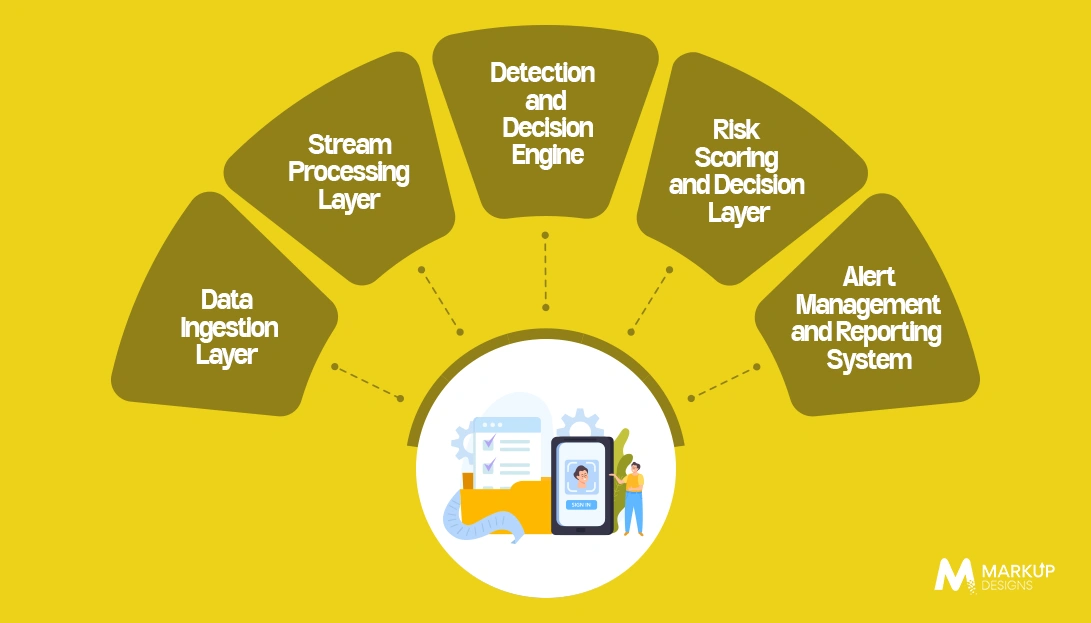
The development of real-time transaction monitoring software solutions in UAE follows a structured architectural workflow. Transaction events are collected from multiple sources and passed through a real-time streaming pipeline for processing. During this process, transactions are evaluated against detection rules, assigned risk scores, and used to generate alerts and reports when necessary.
In UAE, such architecture will have to work for international payments, remittances, and multi-currency transactions.
Data Ingestion Layer
Transaction details are gathered from core banking systems, payment gateways, fintechs’ application programming interfaces (APIs), and SWIFT networks and standardized to create a uniform database. Validations are performed to identify missing information, wrong formatting, and duplicates in the database, ensuring accurate data for further analysis.
Stream Processing Layer
This level analyzes transactional data real-time through event-driven systems and streaming engines such as Flink or Spark. Models. These are used in processing include trade-offs between speed and reliability, with the use of at least processing to enhance accuracy.
Detection and Decision Engine
This layer evaluates each transaction using a combination of rule-based checks and machine learning models to identify potentially suspicious activity. Stateful processing continuously monitors behavioral patterns over time, while the decision engine determines whether a transaction should be approved, flagged for review, or escalated for further investigation.
Risk Scoring and Decision Layer
Each transaction is assessed for real-time risk score through a combination of rule triggers, model results, and customer profiles. Through the decision engine, the transactions are analyzed in order to assess the true level of risk and make decisions based on incoming information.
Alert Management and Reporting System
Transaction alerts are prioritized based on risk scores and confidence levels, ensuring that high-risk activities are reviewed by investigators at an early stage. Integrated case management tools support alert assignment, investigation workflows, and evidence storage while maintaining complete audit logs for transparency, compliance, and traceability.
Key Features of Real-Time Transaction Monitoring Software
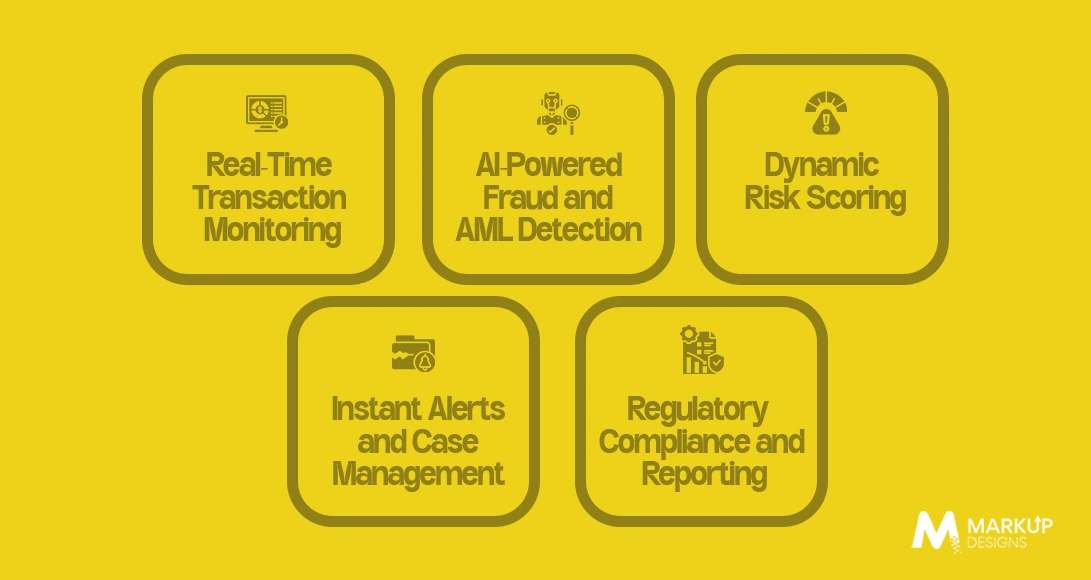
Real-Time Transaction Monitoring
This functionality constantly analyses the transactional processes, making it possible for banks to spot anything suspicious right away and not wait until the batch process is done to do this analysis.
AI-Powered Fraud and AML Detection
AI and machine learning models detect unusual transaction patterns, hidden frauds, and potential AML risks that might not be detected by traditional rules-based systems. This helps reduce false positives and improve detection accuracy.
Dynamic Risk Scoring
Dynamic risk scoring evaluates multiple factors in real time, including customer profiles, transaction history, behavioral patterns, and predefined risk indicators, to determine the risk level of each transaction as it occurs.
Instant Alerts and Case Management
Alerts are raised right away when any suspicious activity is detected, and cases are assigned to investigators. The system has built-in case management for assigning tasks, conducting investigations, and auditing.
Regulatory Compliance and Reporting
Features for automatic compliance include report generation, auditing, and compliance through monitoring, documentation, and reporting of suspicious activities.
Read Also: Fintech Platform Development: Complete Guide for 2026
Regulatory and Compliance Considerations in UAE
When creating software for the compliance of anti-money laundering regulations in UAE, it is important to take into consideration that there are not just one but more than 80 regulators, each one having its own regulations concerning surveillance, reporting, and data management.
Core Regulatory Bodies And Jurisdictions
Central Bank of UAE oversees banks, exchange houses, and payment firms on the mainland. It defines how transactions must be monitored and when suspicious activity must be reported.
The Dubai International Financial Centre runs as a separate financial zone. Firms here follow DFSA rules, which focus on risk-based monitoring and clear internal controls.
The Abu Dhabi Global Market has a similar setup with FSRA oversight. It places strong focus on transaction tracking, governance, and record-keeping.
All three follow global standards set by the Financial Action Task Force.
What Does This Mean for System Design?
- These regulations are tangible. They affect financial software compliance on all levels of the system.
- The monitoring process needs to occur in real time. Anything else is unacceptable in a situation where money moves internationally in just a few seconds.
- Every decision needs to have a paper trail. When some transaction raises red flags, it is important to understand the reason behind this and which data was used for this purpose.
- The model needs to be easily comprehensible. It means that when it is impossible for a system to provide a reason behind its alerting decision, it will create trouble during the audit process.
- The management of data needs to occur in accordance with certain restrictions. The financial information cannot be transferred freely between various systems.
- Suspicious activity reports need to be automatically generated. Their transfer needs to occur immediately after detection. This process includes goAML integration.
Build a Smarter Transaction Monitoring Framework
Strengthen fraud detection, improve compliance readiness, and gain real-time visibility across financial transactions with a scalable monitoring solution built for UAE institutions.

Challenges in Developing Real-Time Transaction Monitoring Systems
The team developing real-time transaction monitoring software in UAE faces the exact same challenges, especially when thousands of companies fall under AML compliance. These include integration with legacy banking systems, processing huge amounts of cross-border data, and passing rigorous audits. Every challenge is encountered during the development stage.
Integration With Core Banking Systems
Many legacy systems still operate using batch-based data transfers, while real-time monitoring requires a continuous stream of transaction events rather than delayed file processing. To bridge this gap, middleware is commonly introduced to capture data from core systems and route events into queues or streaming platforms.
Fragmented Data Sources
Financial institutions often face fragmented data across multiple platforms, where information is stored in different formats and structures. For example, one system may store a customer’s full name in a single field while another separates it into first and last names, and variations in timestamps and currency formats further add complexity. To address this, organizations should establish a common data model during the data ingestion stage and standardize and map all incoming data accordingly.
High False Positives Leading To Alert Fatigue
Rule-based monitoring systems often generate excessive false positives, causing investigation teams to spend significant time reviewing alerts that do not represent actual risk. To improve accuracy, organizations should adopt a layered detection approach that combines rule-based monitoring with behavior-based analysis. Continuous feedback from investigators can then be used to refine detection models, reduce unnecessary alerts, and improve the system’s ability to identify genuine suspicious activity over time.
Real-Time Processing Constraints
Transaction volumes in the UAE can experience sudden spikes, creating performance bottlenecks for systems that are not built to support real-time processing at scale. To maintain speed and reliability, organizations should distribute processing workloads across multiple nodes and partition data streams for parallel execution. Additionally, implementing backpressure and intake control mechanisms helps regulate incoming traffic during peak loads, ensuring transactions are processed reliably without losing critical events.
Balancing Model Accuracy
Advanced models can identify subtle and complex transaction patterns that traditional systems may overlook. However, auditors still ask one critical question: why was a transaction flagged? To ensure transparency and compliance, every input used in the risk-scoring process should be logged and documented. Keeping models as simple as possible and combining them with clearly defined rules helps make every decision explainable.
Build vs Buy: Selecting the Right Monitoring Solution
Deciding whether to build or buy AML transaction monitoring tools influences the time needed for deployment, flexibility, and control over the system. In the case of building transaction monitoring solutions, one can say that banks will have full control over the architecture, algorithms used to detect suspicious activities, and risk models, which is good for companies dealing with complex remittance transactions.
Buying an existing AML platform facilitates quicker implementation with built-in compliance features and reduced effort at the start, but there is a lack of flexibility when adjusting to unique business needs. This is where a combination of both approaches comes into play because the vendor-provided technology is taken as the starting point and custom detection is added gradually.
Cost of Building a Real-Time Transaction Monitoring System in UAE
The cost associated with implementing a real-time transaction monitoring system in United Arab Emirates is influenced by several factors such as transaction frequency, compliance considerations, AI capabilities, and complexity of integration, among others. Transaction systems that have enhanced fraud detection, real-time analysis, and reporting capabilities tend to be costly but efficient.
| Development Scope | Estimated Cost (AED) |
| Basic Monitoring Platform | AED 147,000 – AED 294,000 |
| Mid-Level System with AI & Alerts | AED 294,000 – AED 661,000 |
| Enterprise-Grade Monitoring Platform | AED 661,000 – AED 1.47M+ |
Future Trends Shaping Transaction Monitoring Systems
Today, financial institutions are managing increasingly complex environments driven by cross-border transactions, rising transaction volumes, and heightened regulatory oversight. These changing requirements are transforming the way transaction monitoring systems are designed and deployed. Drawing on extensive experience across the Middle East, with more than 1,000 digital projects delivered, we see a clear shift toward solutions that are more automated, seamlessly integrated, and designed with stronger auditability, transparency, and compliance capabilities.
Trends contributing to this change:
AI-based AML systems
As a result of advances in AI technology in Dubai, AML detection is based on models that learn from transaction patterns. Risk assessment is done without frequent changes in rules.
Graph-based intelligence to detect networks
The systems identify connections between accounts in order to detect any collaboration within them.
AML systems that federate cross-border intelligence
Emerging approaches are enabling institutions to share risk intelligence and detect suspicious patterns across regions without transferring sensitive underlying customer data, supporting stronger collaboration while maintaining privacy and regulatory compliance.
Compliance ecosystems that work in real time
This has been enabled by AI agents in the financial sector of the Middle East, where monitoring, alerting, and reporting have been streamlined into one process.
Why Should You Partner With Markup Designs for AML Transaction Monitoring Development?
At Markup Designs, we develop smart AML transaction monitoring systems that will assist financial organizations in enhancing their compliance, detecting any suspicious activities, and handling regulatory requirements. The skills and knowledge possessed by our experts include those related to artificial intelligence, real-time processing of information, risk scores, and integration with financial systems. Our priority is to develop efficient systems that minimize the number of false positives and enhance investigation processes for future growth.
Modernize Your AML and Risk Monitoring Systems
Deploy intelligent transaction monitoring that reduces false alerts, accelerates investigations, and supports evolving regulatory requirements.

Conclusion
Transaction monitoring in real time is a capability that has become essential in UAE banking industry, which has had its operations influenced by such factors as digital payments, international transactions, and increased AML regulations. To develop an efficient monitoring process, it is necessary not only to have a transaction monitoring capability but also an ability to detect risks, perform risk scoring, report them automatically, and adjust the process constantly.
FAQs
1. What is a real-time transaction monitoring system?
A real-time transaction monitoring system continuously analyzes transactions as they occur to identify suspicious activity, fraud risks, compliance breaches, and unusual behavior without waiting for batch processing.
2. Why is real-time transaction monitoring important in UAE?
UAE handles high volumes of digital and cross-border transactions, making real-time monitoring essential for faster fraud detection, AML compliance, and regulatory reporting.
3. Which technologies are used in real-time transaction monitoring software?
Common technologies include AI and machine learning, stream processing frameworks such as Kafka, Flink, and Spark, risk scoring engines, and automated case management systems.
4. How much does it cost to build a transaction monitoring system in UAE?
Costs generally range from AED 147,000 for basic platforms to AED 1.47M+ for enterprise-grade systems, depending on integrations, AI capabilities, and compliance requirements.
5. Can transaction monitoring systems integrate with existing banking infrastructure?
Yes, modern monitoring platforms can integrate with core banking systems, payment gateways, SWIFT networks, fintech platforms, and regulatory reporting tools such as goAML.
Author's Perspective
Having worked extensively on digital transformation initiatives as well as fintech projects, we realize that transaction monitoring has now moved from being simply a compliance task to becoming a strategic intelligence tool for financial institutions. In a country such as UAE, where transactions have become faster and where regulation is getting stricter by the day, financial institutions require a platform that can help them detect risk immediately without causing any sort of operational hassle.
Discuss Your Project NowAjit Kumar Jha
VP - Business Operations
Related Posts

How to Build Production-Ready Applications with AI Coding...

Case Management Software Development: Enterprise Features & Implementation...

Farm Management Software Development in Australia: Features, AI...
Insights Are Valuable & Execution is Priceless
You’ve read about the digital future. Now, let’s build the infrastructure to take you there. Move your strategy from the page to the product.
Design Your Solution Now
Contact Us
Schedule The Appointment At Your Convenience Date And Time.
30 Min
Web Conference
Time Zone
Indian standard time (08:30pm)

Thanks For Getting In Touch!
You’ve Taken The First Step Toward Transforming Your Digital Presence. Our Experts Will Reach Out Shortly To Take It Forward.
Launch Your Dream Project
Provide a brief overview of your project, and our specialists will evaluate your requirements. We will connect with you to explore how the right digital solutions can help you launch faster.