
In Brief
- Enterprise mobility solutions are transforming how businesses across GCC economies manage operations, communication, employees, and customer experiences.
- Organizations across Saudi Arabia, the UAE, Qatar, Bahrain, Kuwait, and Oman are investing heavily in mobility-driven digital infrastructure and cloud-connected ecosystems.
- AI-powered enterprise systems are helping businesses automate workflows, improve operational visibility, and optimize workforce management.
- Cloud-based mobility platforms are enabling secure remote access, real-time collaboration, and continuous operational accessibility across distributed environments.
- Industries such as logistics, healthcare, construction, retail, hospitality, and banking are rapidly adopting enterprise mobility ecosystems.
- The expansion of 5G infrastructure across the Gulf region is accelerating IoT integration, real-time communication, and intelligent enterprise operations.
- Cross-platform enterprise applications are helping businesses improve accessibility while reducing operational complexity and long-term maintenance costs.
- Cybersecurity is becoming a critical component of enterprise mobility architecture as businesses manage larger volumes of connected operational data.
- Arabic-first enterprise interfaces and localized experiences are improving workforce adoption and operational accessibility across regional markets.
- Businesses investing early in scalable enterprise mobility systems are positioning themselves for stronger long-term digital competitiveness.
Modern businesses no longer operate from a single office environment. Employees, operational systems, customer interactions, approvals, reporting, and communication workflows now move continuously across offices, warehouses, retail stores, construction sites, healthcare facilities, transportation networks, and remote workspaces in real time. Traditional desktop-based systems are no longer capable of supporting the flexibility, responsiveness, and scalability modern enterprises require.
As organizations across GCC economies continue accelerating digital transformation initiatives, enterprise mobility solutions are becoming a core part of operational infrastructure. Businesses are increasingly investing in connected mobility ecosystems that improve workforce productivity, operational visibility, communication efficiency, workflow automation, and real-time collaboration across distributed environments.
From AI-powered automation and cloud-native infrastructure to IoT-connected operations and cross-platform enterprise applications, enterprise mobility is rapidly reshaping how organizations operate across the Middle East. Businesses that successfully modernize mobility infrastructure are positioning themselves for stronger operational agility, scalability, and long-term digital competitiveness in increasingly connected markets.
Why Enterprise Mobility Is Becoming Essential for Modern Businesses
The workplace has changed dramatically over the last decade. Employees are no longer limited to centralized office environments where operational management, reporting, approvals, and communication happen through fixed desktop systems. Modern enterprises now operate across highly distributed ecosystems where teams, business processes, and customer interactions move continuously across multiple devices and locations.
This shift has created growing demand for enterprise systems capable of supporting secure remote accessibility, uninterrupted communication, workflow visibility, and real-time operational coordination. Organizations increasingly require mobility ecosystems that allow employees to remain connected regardless of whether they are working from offices, warehouses, construction sites, retail branches, healthcare facilities, or remote environments.
Modern enterprise mobility systems now support:
- Real-time workforce coordination
- Cloud-based collaboration
- Mobile reporting and approvals
- Cross-device accessibility
- Workflow automation
- Operational visibility across locations
- Remote communication systems
Businesses unable to support this level of operational flexibility often struggle with communication delays, fragmented workflows, slower decision-making, and limited workforce agility. As a result, enterprise mobility is rapidly becoming a competitive necessity rather than a technology enhancement.
How GCC Economies Are Accelerating Enterprise Mobility Adoption
Enterprise digital transformation across GCC economies is accelerating at an extraordinary pace. Governments and enterprises across Saudi Arabia, the UAE, Qatar, Bahrain, Kuwait, and Oman are investing heavily in smart infrastructure, cloud ecosystems, connected enterprise technologies, and AI-driven operational environments.
Large-scale initiatives such as Saudi Vision 2030 and UAE smart government programs are encouraging organizations to modernize traditional operational systems and adopt more scalable digital ecosystems. This transformation is significantly increasing demand for enterprise workforce platforms, mobile ERP systems, smart field-service applications, cloud collaboration tools, and connected operational environments capable of supporting real-time business operations.
The rapid growth of hybrid work environments is also accelerating enterprise mobility adoption across the region. Employees increasingly expect flexibility, uninterrupted accessibility, and seamless operational access across devices and locations. Organizations that fail to modernize operational infrastructure may increasingly struggle with workforce productivity, scalability, and internal coordination in rapidly evolving digital markets.
Businesses are steadily moving away from fragmented enterprise systems toward unified mobility ecosystems designed to improve operational continuity, workforce collaboration, scalability, and long-term business agility.
The Future of Artificial Intelligence in UAE Economy in 2026
UAE is rapidly transforming into an AI-driven economy through smart infrastructure, automation, and digital innovation helping industries improve efficiency, reduce manual work, and deliver smarter customer experiences.

Core Technologies Powering Modern Enterprise Mobility Ecosystems
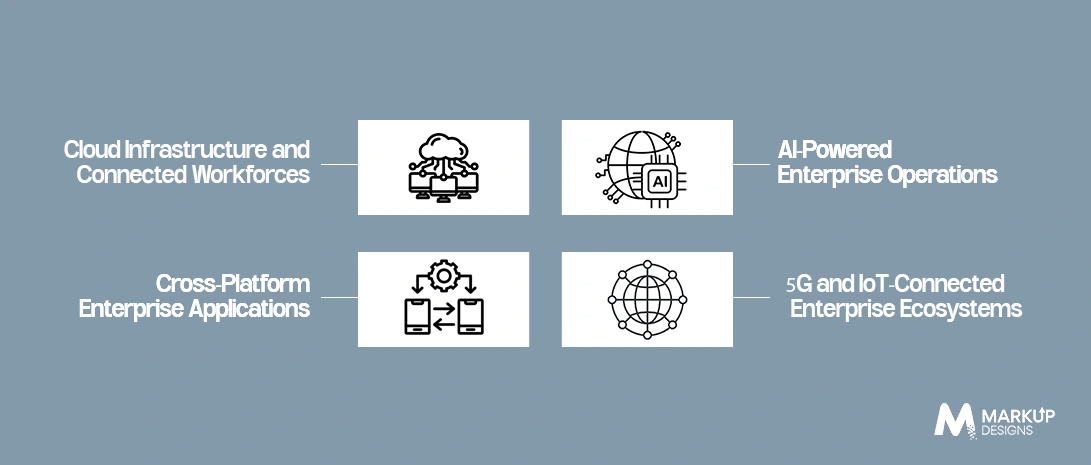
Enterprise mobility is no longer limited to mobile communication tools or remote accessibility features. Modern enterprise ecosystems increasingly rely on intelligent technologies capable of improving operational efficiency, scalability, automation, and connected business management.
Organizations across GCC economies are now combining artificial intelligence, cloud infrastructure, cross-platform development frameworks, and connected enterprise technologies to create more scalable and intelligent operational ecosystems.
1. AI-Powered Enterprise Operations
Artificial intelligence is becoming deeply integrated into enterprise mobility infrastructure. Modern enterprise systems are increasing the role of AI automation to repetitive workflows, optimize workforce coordination, improve operational reporting, and support predictive decision-making.
AI-powered enterprise mobility systems now support:
- Workflow automation
- Intelligent scheduling
- Predictive analytics
- Operational monitoring
- Real-time reporting
- Automated communication systems
- Resource allocation optimization
For example, logistics businesses can dynamically optimize delivery routes through AI-powered mobility platforms, while healthcare organizations can automate patient coordination and staff scheduling through connected enterprise systems. Construction companies are also increasingly relying on AI-enabled dashboards to monitor workforce activity, equipment allocation, and project performance across distributed sites.
Instead of relying entirely on reactive management models, businesses are steadily shifting toward predictive and data-driven enterprise ecosystems capable of improving operational responsiveness and scalability.
2. Cloud Infrastructure and Connected Workforces
As enterprise mobility ecosystems continue expanding, businesses also require infrastructure capable of supporting accessibility, synchronization, and operational continuity across multiple environments. This is why cloud-connected enterprise systems are becoming essential for modern organizations.
Custom enterprise software often struggles with scalability and remote accessibility. Cloud-native mobility ecosystems solve this challenge by enabling employees to securely access operational tools, workflows, applications, and reporting systems in real time, regardless of location.
Cloud-connected enterprise mobility systems improve:
- Operational scalability
- Remote collaboration
- Real-time synchronization
- Multi-device accessibility
- Business continuity
- Centralized operational visibility
For organizations managing distributed teams and multi-location operations across GCC economies, cloud infrastructure is becoming a critical component of long-term operational agility and digital scalability.
3. Cross-Platform Enterprise Applications
As enterprise ecosystems continue expanding, businesses are also facing growing complexity in managing applications across multiple operating systems and devices. Maintaining separate enterprise systems for Android, iOS, tablets, and enterprise hardware environments significantly increases development overhead, maintenance complexity, and operational costs.
This is one reason cross-platform app development is growing rapidly across the regional technology ecosystem. Frameworks such as Flutter, React Native, and Kotlin Multiplatform are helping organizations build scalable enterprise applications using shared codebases while maintaining consistent user experiences across devices.
Cross-platform enterprise systems improve:
- Accessibility
- Development efficiency
- Faster deployment
- Operational consistency
- Long-term scalability
- Maintenance management
For growing businesses, this approach creates stronger operational flexibility while reducing unnecessary technology complexity and long-term infrastructure costs.
4. 5G and IoT-Connected Enterprise Ecosystems
The expansion of 5G infrastructure across GCC economies is accelerating the next phase of enterprise mobility transformation. Faster connectivity, lower latency, and improved device synchronization are enabling businesses to operate more efficiently in real time.
This is creating opportunities for advanced enterprise technologies such as:
- IoT-connected operations
- Smart warehouses
- Connected monitoring systems
- Real-time analytics
- Intelligent workforce management
- AR-assisted field services
- Smart operational ecosystems
For example, field technicians may increasingly use augmented reality systems connected through enterprise mobility platforms for remote diagnostics and operational support. Warehouse operations may also rely heavily on IoT-enabled infrastructure capable of monitoring inventory movement and operational performance in real time.
Without advanced connectivity infrastructure, many next-generation enterprise technologies would struggle to operate efficiently at scale.
How Enterprise Mobility Is Transforming Industry Operations
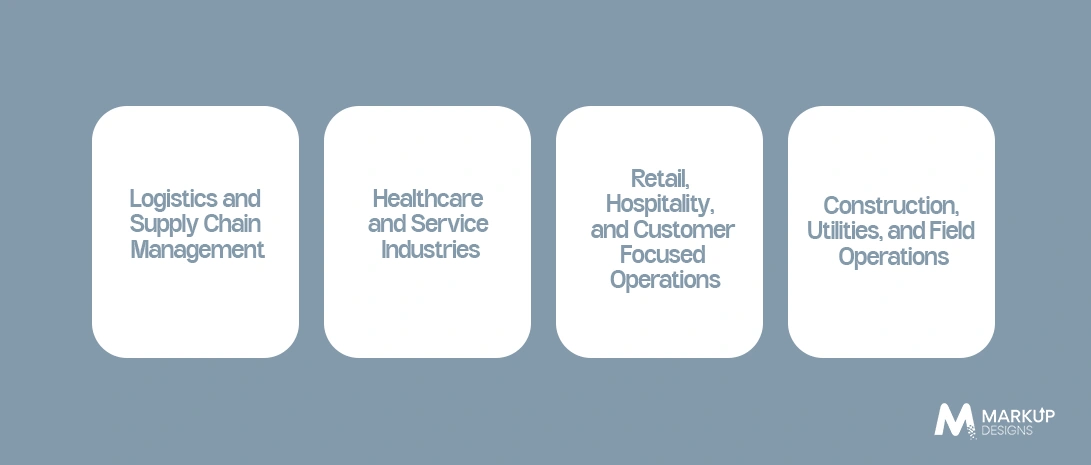
Enterprise mobility is no longer benefiting only technology-focused organizations. Businesses across logistics, healthcare, retail, hospitality, construction, and field-service industries are increasingly modernizing operations through connected enterprise ecosystems designed to improve operational visibility, workforce coordination, and customer responsiveness.
Logistics and Supply Chain Management
The logistics and transportation industry is becoming heavily dependent on enterprise mobility infrastructure. Businesses managing warehouses, delivery operations, transportation systems, and supply chains increasingly rely on connected mobility platforms for operational visibility and real-time coordination.
Enterprise mobility systems now help logistics businesses manage:
- Fleet tracking
- Inventory movement
- Warehouse coordination
- Route optimization
- Shipment monitoring
- Driver communication
- Delivery reporting
These connected systems significantly improve operational efficiency while reducing delays, communication gaps, and resource wastage.
As e-commerce and regional trade continue expanding rapidly across GCC economies, logistics businesses are under increasing pressure to improve supply-chain visibility and delivery responsiveness. Mobility-driven systems are becoming essential for meeting these expectations.
Healthcare and Service Industries
Enterprise mobility is also transforming service-focused industries where operational responsiveness and accessibility play a critical role in service delivery. Healthcare is becoming one of the strongest examples of this shift.
Hospitals, clinics, and healthcare providers are increasingly adopting connected mobility ecosystems to improve patient coordination, appointment scheduling, staff communication, emergency response management, and digital healthcare accessibility.
Healthcare mobility systems increasingly support:
- Digital patient records
- Telemedicine operations
- Appointment management
- Staff coordination
- Emergency communication systems
- Remote healthcare services
The healthcare sector is steadily shifting toward convenience-driven and technology-enabled operational models where enterprise mobility plays a central role in improving service accessibility and operational efficiency.
Retail, Hospitality, and Customer-Focused Operations
Retail and hospitality businesses are also rapidly modernizing operations through enterprise mobility ecosystems. Businesses increasingly rely on connected operational systems for workforce coordination, inventory visibility, reservations, customer engagement, reporting, and operational management.
Enterprise mobility platforms help businesses improve:
- Customer responsiveness
- Workforce communication
- Inventory management
- Operational coordination
- Service consistency
- Real-time reporting
As customer expectations continue evolving rapidly, customer-facing industries increasingly require mobility ecosystems capable of delivering faster, more responsive, and highly connected service experiences.
Construction, Utilities, and Field Operations
Many industries now depend heavily on distributed workforces operating outside traditional office environments. Construction firms, maintenance providers, utilities companies, logistics operators, and field-service businesses increasingly require real-time workforce coordination across multiple operational sites.
Enterprise mobility systems help organizations improve:
- Task coordination
- Attendance tracking
- Workflow approvals
- Operational reporting
- Real-time workforce visibility
- Communication across field operations
Instead of relying on fragmented communication structures, businesses can now manage workforce operations through centralized mobility ecosystems capable of supporting instant updates and real-time operational coordination.
The Growing Importance of Infrastructure, Security, and Accessibility
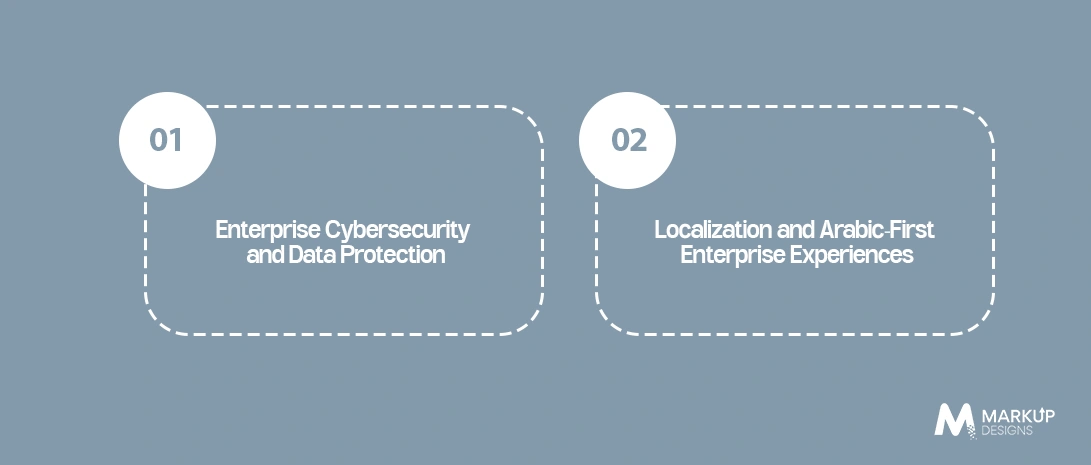
As enterprise mobility ecosystems continue expanding, businesses are also facing growing pressure to improve operational security, infrastructure scalability, and workforce accessibility. Enterprise mobility today requires far more than application deployment alone. Organizations increasingly need secure, scalable, and accessible ecosystems capable of supporting long-term digital operations.
1. Enterprise Cybersecurity and Data Protection
Modern enterprise mobility systems process large volumes of operational data, workforce information, customer records, financial systems, and cloud-based communications across connected environments. As a result, cybersecurity risks are increasing rapidly across enterprise ecosystems.
Weak security infrastructure can expose organizations to compliance risks, operational disruptions, financial losses, and reputational damage. This is why cybersecurity is becoming a core component of enterprise mobility architecture rather than a secondary operational layer.
Modern enterprise mobility systems increasingly require:
- Multi-factor authentication
- End-to-end encryption
- Device management systems
- Secure cloud infrastructure
- Access control frameworks
- AI-driven threat monitoring
Businesses that fail to prioritize enterprise security may increasingly struggle to maintain operational continuity and customer trust in highly connected digital environments.
2. Localization and Arabic-First Enterprise Experiences
Many businesses still underestimate the importance of localization inside enterprise ecosystems. However, enterprise systems designed only around English interfaces often create accessibility barriers across regional workforces.
Employees increasingly expect Arabic-first interfaces, right-to-left optimization, localized dashboards, and region-specific user experiences capable of improving workforce accessibility and platform usability. Localization today is not simply about translation. It directly influences workforce adoption, operational efficiency, and user engagement.
Organizations building enterprise mobility ecosystems for GCC markets increasingly need to prioritize localization during the earliest stages of platform architecture and experience design.
The Biggest Challenges Businesses Still Face
Despite the enormous advantages of enterprise mobility ecosystems, businesses still face several major implementation and scalability challenges.
One of the biggest challenges is integration complexity. Many organizations continue operating on fragmented legacy systems that are difficult to connect with modern mobility infrastructure. Poor integration often creates synchronization issues, operational inefficiencies, and limited scalability.
Technology investment is another major challenge. AI integration, cloud infrastructure, enterprise-grade cybersecurity, and IoT-connected systems significantly increase operational and development costs. Businesses must also continuously modernize infrastructure to remain competitive as enterprise technologies evolve rapidly.
Workforce adaptation can also slow implementation. Employees often require operational restructuring and training before organizations can fully transition into mobility-driven workflows. Businesses focusing only on technology deployment without workforce enablement frequently struggle with poor adoption and limited operational impact.
Why Strategic Enterprise Mobility Development Matters
Successful enterprise mobility ecosystems require far more than standalone mobile application development. Businesses increasingly need technology partners capable of understanding operational workflows, cloud infrastructure, enterprise security, scalability planning, integration architecture, and long-term digital transformation goals.
Poorly planned enterprise systems often struggle with weak architecture, cybersecurity vulnerabilities, fragmented operational integration, poor user adoption, and scalability limitations. Modern enterprise ecosystems require long-term planning focused on operational continuity, intelligent infrastructure, and workforce-centered experiences.
Markup Designs helps organizations develop scalable enterprise mobility ecosystems designed around operational efficiency, cloud scalability, workforce accessibility, intelligent automation, and future-ready enterprise infrastructure. By combining business-focused development strategies with modern mobility architecture, the company helps businesses build connected operational environments capable of adapting to rapidly evolving digital markets.
The Future of Enterprise Mobility Across GCC Economies
Enterprise mobility is evolving far beyond mobile communication and remote accessibility. Future enterprise ecosystems across GCC economies are expected to become significantly more intelligent, connected, and automation-driven over the coming years.
Emerging trends shaping the future of enterprise mobility include:
- AI-driven automation
- Predictive operational analytics
- Cloud-native enterprise ecosystems
- Intelligent workforce management
- IoT-connected infrastructure
- Real-time collaboration systems
- Advanced cybersecurity frameworks
- Connected operational intelligence
- 5G-powered enterprise environments
Enterprise mobility is no longer simply supporting business operations. It is becoming the operational foundation of modern digital enterprises. Organizations investing early in scalable, intelligent, and secure mobility ecosystems are likely to gain stronger operational resilience, workforce agility, scalability, and long-term digital competitiveness across rapidly evolving GCC markets.
Build Smarter Enterprise Mobility Systems
Enterprise mobility solutions help businesses improve workforce connectivity, operational efficiency, scalability, and real-time collaboration across modern digital environments.Markup Designs develops scalable mobility ecosystems designed for long-term business growth, operational flexibility, and connected enterprise infrastructure.
Conclusion
Enterprise mobility solutions are rapidly reshaping how businesses across the Gulf region operate, communicate, manage workforces, and deliver services. Organizations are no longer investing in mobility simply for convenience. They are building connected enterprise ecosystems capable of improving workforce productivity, operational visibility, scalability, customer responsiveness, and long-term business agility.
From logistics and healthcare to construction, hospitality, retail, and field operations, mobility-driven technologies are transforming nearly every industry across GCC economies. At the same time, AI integration, cloud scalability, cybersecurity, localization, and 5G connectivity are becoming essential components of modern enterprise mobility strategies.
The businesses most likely to succeed in the coming years will be those that treat enterprise mobility not as a temporary technology investment but as long-term operational infrastructure capable of driving resilience, innovation, scalability, and sustainable digital competitiveness.
FAQs
1. Why are enterprise mobility solutions growing rapidly across GCC countries?
Enterprise mobility solutions are growing rapidly due to increasing digital transformation initiatives, cloud adoption, distributed workforces, smart infrastructure investments, and rising demand for real-time operational accessibility. Businesses across GCC economies are modernizing operations to improve workforce productivity, operational efficiency, and scalability in increasingly connected markets.
2. What industries benefit most from enterprise mobility systems?
Industries such as logistics, healthcare, construction, retail, hospitality, banking, transportation, utilities, and field services benefit significantly from enterprise mobility ecosystems. These industries rely heavily on real-time communication, workforce coordination, operational visibility, and connected workflows across multiple locations.
3. How does AI improve enterprise mobility solutions?
AI helps enterprise mobility systems automate workflows, optimize scheduling, improve analytics, support predictive decision-making, enhance operational monitoring, and reduce manual coordination. AI-powered systems also help businesses identify inefficiencies, improve workforce management, and increase operational responsiveness.
4. Why is cloud infrastructure important for enterprise mobility?
Cloud infrastructure improves scalability, remote accessibility, business continuity, operational synchronization, and multi-device connectivity. Cloud-connected enterprise systems allow employees to securely access operational tools, reporting systems, and workflows in real time from different locations and devices.
5. Why is cybersecurity important in enterprise mobility ecosystems?
Enterprise mobility systems process sensitive operational, financial, workforce, and customer data across connected environments. Strong cybersecurity frameworks help businesses protect against data breaches, operational disruption, compliance risks, ransomware attacks, and unauthorized system access.
6. How is 5G influencing enterprise mobility growth?
5G improves connectivity speed, real-time responsiveness, IoT integration, low-latency communication, and connected enterprise operations. Faster network infrastructure allows businesses to support advanced technologies such as smart warehouses, connected field services, real-time analytics, and intelligent operational ecosystems more efficiently.
7. Why is localization important for enterprise mobility platforms in GCC markets?
Localization improves workforce accessibility, operational usability, and enterprise adoption across regional markets. Arabic-first interfaces, RTL optimization, and region-specific user experiences help businesses improve communication efficiency and platform accessibility for diverse workforce environments.
Author's Perspective
Many organizations across GCC economies still approach enterprise mobility as a convenience-focused operational upgrade instead of treating it as long-term business infrastructure. That mindset is increasingly becoming a strategic weakness. Modern enterprises now operate in highly connected environments where employees, operational systems, customers, and decision-making processes must remain accessible in real time across multiple devices and locations.
Businesses relying heavily on fragmented legacy infrastructure often struggle with slower coordination, limited operational visibility, inefficient workflows, and poor scalability. In contrast, organizations investing early in intelligent enterprise mobility ecosystems are building stronger operational resilience, workforce agility, automation capabilities, and long-term digital competitiveness.
The future of enterprise operations will not be defined simply by mobile accessibility. It will be shaped by how effectively businesses combine AI-driven automation, cloud scalability, cybersecurity, real-time collaboration, localization, and connected operational intelligence into unified enterprise ecosystems capable of adapting continuously to rapidly evolving digital markets.
Discuss Your Project NowJupinder Singh Arora
Founder and CEO
Related Posts
Digital Transformation for Government Services in Kuwait: Key...

Cost to Build a Mobile App in Qatar...

How Much Does It Cost to Build an...
Insights Are Valuable & Execution is Priceless
You’ve read about the digital future. Now, let’s build the infrastructure to take you there. Move your strategy from the page to the product.
Design Your Solution Now
Contact Us
Schedule The Appointment At Your Convenience Date And Time.
30 Min
Web Conference
Time Zone
Indian standard time (08:30pm)

Thanks For Getting In Touch!
You’ve Taken The First Step Toward Transforming Your Digital Presence. Our Experts Will Reach Out Shortly To Take It Forward.
Launch Your Dream Project
Provide a brief overview of your project, and our specialists will evaluate your requirements. We will connect with you to explore how the right digital solutions can help you launch faster.