
Custom Software Development Strategy for Middle East Business
In Brief
- Businesses across the Middle East are rapidly shifting from outdated systems to custom software solutions for better scalability and operational efficiency.
- Government initiatives like Saudi Vision 2030 and UAE digital transformation programs are accelerating enterprise technology adoption across industries.
- Custom software helps businesses overcome challenges like disconnected systems, manual workflows, poor integrations, and limited scalability.
- Industries such as healthcare, logistics, fintech, retail, and real estate are increasingly adopting custom software to modernize operations.
- Technologies like AI, cloud computing, automation, and advanced analytics are becoming major drivers of enterprise software development in the region.
- Scalable software architecture, cloud-native infrastructure, APIs, and DevOps practices play a critical role in long-term business growth.
- The cost of custom software development in the Middle East depends on project complexity, integrations, security, features, and scalability requirements.
A few years ago, many businesses across the Middle East viewed software as just another operational tool. But today, the demand for custom software development in the Middle East is growing rapidly, as companies continue to struggle with outdated systems, disconnected platforms, and generic software that slow down operations and limit growth.
Whether it’s a logistics company struggling with manual processes or a healthcare provider managing scattered data, organizations now need technology that fits their exact business model instead of forcing teams to adapt to rigid software.
More importantly, custom enterprise software development is no longer just an IT decision, it has become a core business strategy for companies aiming to improve operational efficiency, customer experience, and long-term scalability.
In this blog, we’ll explore why businesses in the Middle East are investing in custom software solutions, the challenges they are trying to solve, and the key strategies organizations are adopting to build scalable and future-ready digital operations.
Understanding Custom Software Development in Today’s Business Environment
Custom software development simply means building software that is designed specifically for a company’s operations, goals, and workflow requirements. Unlike generic off-the-shelf tools that are created for mass usage, custom-built solutions focus on solving specific business challenges more efficiently.
This is one of the main reasons why businesses are increasingly investing in enterprise software solutions that companies across the Middle East can scale and adapt according to evolving operational needs.
Today, many organizations struggle because their existing software cannot fully support their processes. Teams often end up adjusting operations to fit the software instead of using technology that works around the business itself.
Custom software helps eliminate this gap by offering better flexibility, smoother integrations, and improved control over business operations.
Some of the most common solutions businesses are building include:
- ERP systems for managing operations and resources
- CRM platforms for customer management
- Mobile applications for customer engagement
- Supply chain and logistics management systems
- AI-powered dashboards for analytics and reporting
- Customer portals for self-service experiences
What makes custom software more valuable today is its ability to scale as businesses grow. Companies now require systems that can integrate with multiple platforms, support cloud environments, manage large volumes of data, and adapt to future technologies without disrupting operations.
This is exactly why businesses in the Middle East are moving beyond basic development requirements and focusing more on long-term software strategy, scalability, and digital transformation planning.
Why Middle East Businesses Need a Strong Software Development Strategy
Across the Middle East, businesses are rapidly moving toward digital-first operations. What started as basic modernization has now become a long-term business priority driven by competition, customer expectations, and government-led transformation initiatives.
From UAE smart city programs and Saudi Vision 2030 to Qatar’s digital infrastructure expansion and Oman’s growing technology investments, companies across the region are under increasing pressure to operate faster, smarter, and more efficiently.
This shift is also accelerating the demand for custom software development services as businesses look for solutions that can support scalability, automation, and long-term operational growth.
According to Statista, the Middle East IT services market is expected to reach nearly US$32.48 billion with a CAGR of 5.85%, showing how rapidly enterprises are increasing their technology investments.
Additionally, reports suggest the SaaS industry in the Middle East is projected to exceed $282 billion by 2024 while continuing to grow steadily through 2030.
At the same time, competition across industries is becoming more technology-driven than ever before. Businesses are no longer competing only on pricing or products, they are competing on customer experience, operational speed, and digital efficiency. This is one of the biggest reasons why organizations are increasingly investing in AI-powered systems, automation platforms, and scalable enterprise software.
Some major trends currently shaping the regional market include:
- 93% of C-level executives in the Middle East are planning investments in Generative AI technologies
- Startups across the region raised over $35.6 million across 45 deals in a single month, highlighting growing digital innovation
- Cloud adoption and enterprise automation are increasing rapidly across healthcare, logistics, fintech, and retail sectors
- Businesses are prioritizing multilingual, multi-currency, and region-specific software capabilities
However, regional businesses also face several localization challenges that generic software often cannot solve effectively, such as:
- Arabic language support
- Regional compliance and data regulations
- Multi-location operations
- Integration with local payment and operational systems
Because of this, businesses today no longer just need software development support, they need a long-term technology strategy that aligns with future expansion, operational scalability, and digital transformation goals.
Now, let us dive deeper into the blog and learn about the benefits of software development for your business.
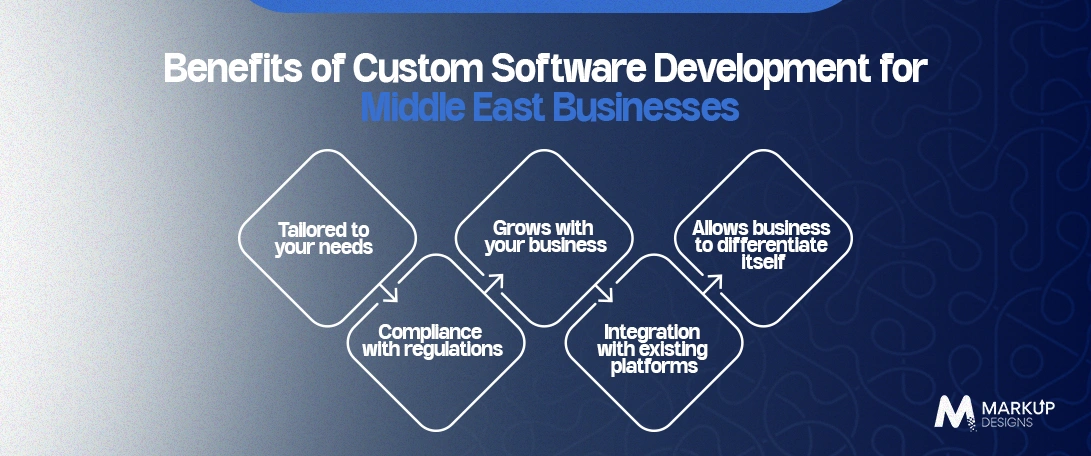
Benefits of Custom Software Development for Middle East Businesses
Whether it’s compliance issues, integration problems, or scalability constraints, an improper technology framework hampers growth. The right approach to overcoming such challenges is custom software development because it ensures that you get everything your business needs.
Commercial software packages fail when business processes are intricate, regional, or regulated. Custom software is built precisely to address such limitations, providing organizations with greater flexibility and scalability from day one.
- Tailored to your needs
Platforms created to meet your requirements regardless of the specific nature of your business, from working with distributed teams within GCC countries to providing bi-lingual interfaces or implementing automated approvals.
- Compliance with regulations
PDPL laws for UAE and NDMO of Saudi Arabia necessitate stringent data protection measures. Platforms made specifically for you, allow compliance to be ensured in your platform’s architecture.
- Grows with your business
As your organization grows with the addition of new locations, teams, or additional services, customized software platforms can adapt to your needs without needing significant modifications.
- Integration with existing platforms
As custom platforms are developed specifically for your company, they will integrate seamlessly with your current applications, such as ERP, CRM, POS, or any industry-specific platform.
- Allows business to differentiate itself
Software that reflects your unique business strategy will become a business asset. It allows you to provide services faster and automate processes more accurately, as per market demands.
These advantages are already helping multiple industries across the Middle East modernize operations more effectively
Key Industry Applications of Custom Software Solutions Across the Middle East
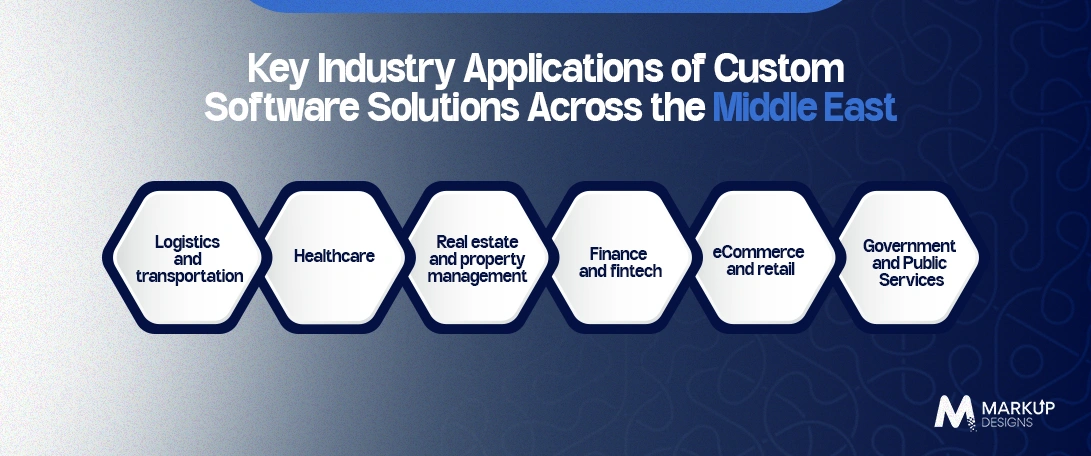
Here are six major industries in the Middle East where custom software solutions are making a measurable impact:
- Logistics and transportation
Regional logistics companies require more than GPS tracking alone. Custom software facilitates dynamic route planning, port management, customs processing, and bilingual driver interfaces-essential for cross-GCC logistics.
- Healthcare
Generic healthcare software may fail to capture emerging trends and healthcare-specific workflows. Custom EHR and telemedicine applications can confirm to PDPL, MOHAP, and Saudi NPHIES standards, providing safe, regionalized care delivery workflows.
- Real estate and property management
Handling rental and real estate assets within UAE or Saudi Arabia requires the capability to interface with platforms like Ejari and automate tenant lifecycles. Custom portals can automate rent payments, maintenance tasks, and tenant management in Arabic and English.
- Finance and fintech
KYC, AML, and data legislation necessitate custom fintech platforms that facilitate secure onboarding, real-time transaction surveillance, and integration with SAMA and UAE Central Bank regulations.
- eCommerce and retail
Customer expectations involve rapid, mobile-first interactions. Custom eCommerce solutions allow for unique user experiences, localized payment gateways (STC Pay, Tabby), and logistics integration.
- Government and Public Services
The government will require systems that comply with Vision 2030, SDAIA, and UAE Digital Government Strategy. The custom platforms allow for localized citizen services and data sovereignty within national systems.
Common Misconceptions about Custom Software
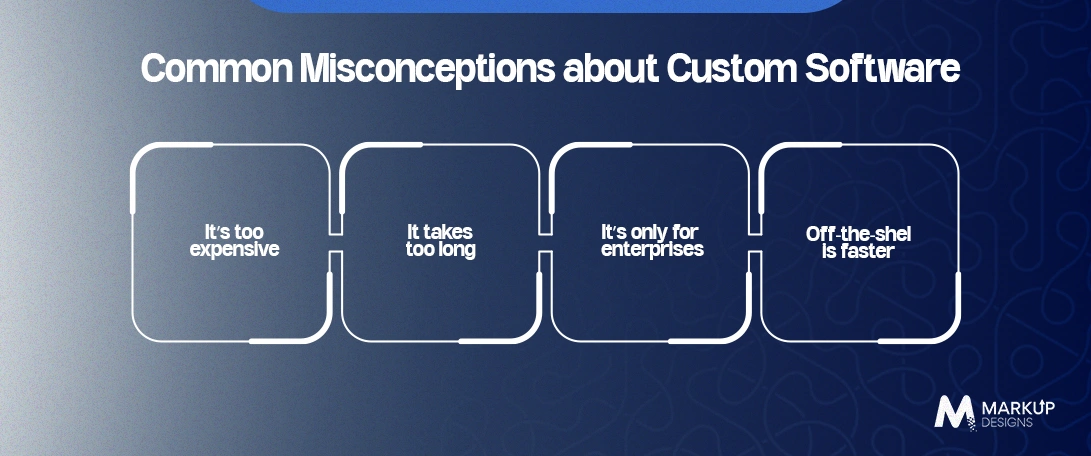
Custom software development often gets dismissed as too expensive, too complex, or too slow. But these are often myths & oversimplifications.
Let’s clear up the most common ones
1. It’s too expensive
The upfront cost is higher than SaaS, but there are no per-user license fees or rigid upgrade costs. Over time, it often costs less, especially when replacing multiple tools or manual work.
2. It takes too long
Not if you start with a focused MVP. Many solutions go live within 4-6 months. Delays usually come from unclear goals or trying to build everything at once.
3. It’s only for enterprises
SMBs across the Middle East use custom tools to streamline logistics, automate HR, or connect to local government systems. Tailored solutions often make the biggest difference for smaller, growing teams
4. Off-the-shelf is faster
Ready-made tools install quickly but modifying them to fit your business takes a lot of time. In contrast, a simple custom solution built only for your exact needs can be ready fast and works perfectly from day one.
What makes a custom software solution scalable?
- Modular architecture: Systems are built in components so features can be updated or expanded independently, without touching the entire codebase.
- Cloud-native infrastructure: Cloud service platforms like AWS, Azure, or GCP allow you to scale server resources up or down as user demand grows, without performance drops.
- Database design for scale: Scalable databases like- PostgreSQL, MongoDB are structured to handle more users, more data, and faster queries without lags or breakdowns.
- API-first approach: A strong API layer allows new features, mobile applications, and external platforms to integrate seamlessly, which is essential for businesses planning to expand into omnichannel operations.
- DevOps & CI/CD pipelines: Automated deployment and testing pipelines reduce downtime, speed up feature releases, and make it easier to adapt the product as needs change.
Behind every scalable software platform is a carefully selected technology stack.
Techstack Behind a Custom Software Solution
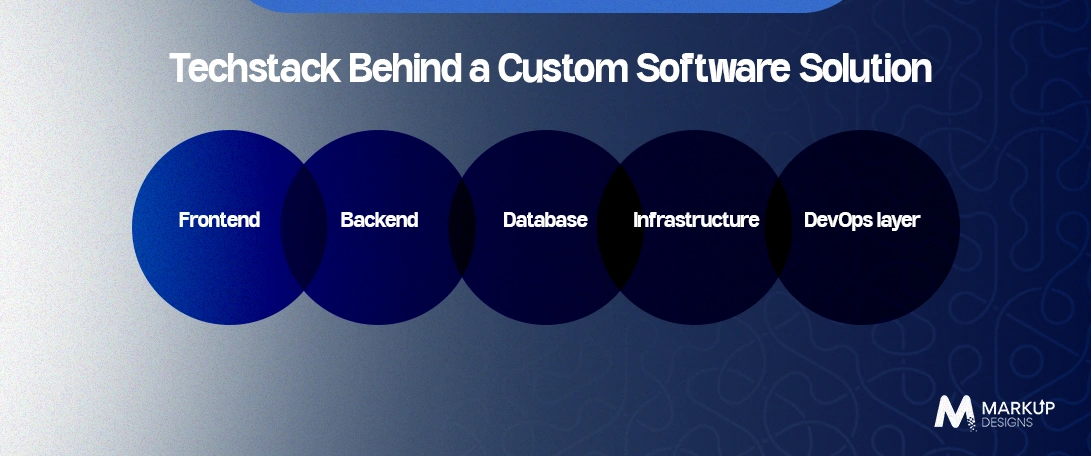
When building custom software solutions, the choice of a tech stack is a long-term decision. A typical custom software stack is built in layers.
- Frontend: The user interface (e.g., built with React, Angular, Vue)
- Backend: The server-side logic (e.g., Node.js, Java, .NET, Python)
- Database: Where your data is stored (e.g., PostgreSQL, MongoDB, MySQL)
- Infrastructure: Cloud platforms (AWS, Azure, GCP) or on-premise servers
- DevOps layer: CI/CD tools like Jenkins, GitLab, Docker, Kubernetes for deployment
Cost Breakdown of Custom Software Development in the Middle East
The cost of software development in the Middle East depends on several factors, including project complexity, features, integrations, technology stack, security requirements, and development timelines. Today, businesses are increasingly investing in scalable software solutions that support long-term growth instead of relying on short-term systems that require frequent upgrades and replacements.
Another major factor affecting pricing is whether businesses need web platforms, mobile applications, AI integrations, or cloud-based infrastructure. For example, cloud-based software development often requires an additional investment in security, scalability, and third-party integrations, but it also provides greater flexibility and long-term operational efficiency.
Here’s a general breakdown of software development costs in the region:
| Software Type | Estimated Cost Range | Development Timeline |
| Basic Business Software | $10,000 – $25,000 | 2–4 Months |
| Mobile Applications | $20,000 – $70,000 | 3–6 Months |
| CRM/ERP Systems | $30,000 – $80,000 | 4–8 Months |
| AI-Powered Platforms | $50,000 – $150,000+ | 6–12 Months |
| Enterprise-Level Platforms | $100,000+ | 8–15 Months |
Some additional factors influencing development costs include:
- UI/UX complexity
- API and third-party integrations
- Cybersecurity requirements
- AI or automation capabilities
- Multi-language and multi-currency support
- Post-launch maintenance and scaling
Businesses that approach development strategically often achieve long-term ROI compared to organizations that focus only on initial development costs.
How to Choose the Right Software Development Partner
Choosing the right development partner is one of the most important decisions businesses make during digital transformation. A reliable enterprise software development company does more than building applications, it helps organizations create systems that align with operational goals, customer expectations, and future growth plans.
Many businesses make the mistake of selecting vendors purely based on pricing. However, low-cost development often leads to scalability limitations, poor architecture, and expensive upgrades later. This is why companies should evaluate both technical expertise and strategic understanding before finalizing a technology partner.
Some key factors businesses should consider include:
- Experience in enterprise software projects
- Understanding of Middle East business ecosystems
- Expertise in cloud and AI technologies
- Agile development methodology
- Security and compliance standards
- Communication transparency
- Post-launch support and maintenance
A strong development partner also helps organizations build a long-term software development strategy rather than focusing only on short-term project delivery. This becomes especially important for organizations planning regional expansion or digital transformation initiatives.
Future of Custom Software Development in the Middle East
The future of technology in the Middle East is becoming increasingly focused on automation, AI-driven operations,cloud infrastructure and intelligent customer experiences. Businesses are moving beyond traditional software adoption and investing in digital platforms that improve decision-making, operational efficiency, and scalability.
As governments continue investing in smart infrastructure and AI initiatives, the demand for custom software development that enterprises across the Middle East can rely on will continue to grow across industries such as real estate, fintech, logistics, retail, and healthcare app development.
Several trends are expected to shape the future of enterprise technology in the region:
- AI-powered operational automation
- Smart city integrations
- Hyper-personalized customer experiences
- Advanced cybersecurity frameworks
- Data-driven decision-making systems
- Cross-platform enterprise ecosystems
Additionally, businesses are increasingly prioritizing digital transformation services offered by providers in the Middle East to modernize legacy systems and improve operational agility. Companies that invest early in scalable and future-ready software infrastructure are more likely to gain a strong competitive advantage in the coming years.
FAQs
1. What is custom software development?
Custom software development refers to building software solutions specifically designed for a company’s business processes, operational goals, and customer requirements instead of using generic software.
2. Why are Middle East businesses investing heavily in custom software?
Businesses across the region are focusing on automation, scalability, AI integration, and digital transformation to improve operational efficiency and remain competitive.
3. How much does custom enterprise software development cost?
The cost usually depends on project complexity, features, integrations, and technologies involved. Enterprise-level solutions can range from $30,000 to over $150,000.
4. Which industries benefit the most from custom software?
Industries such as healthcare, logistics, fintech, retail, education, and real estate benefit significantly from custom enterprise software development due to their complex operational needs.
5. Why is cloud-based software becoming popular?
Cloud-based systems provide better scalability, remote accessibility, data security, and easier integration with modern business tools.
Conclusion
Businesses across the Middle East are entering a phase where technology is becoming directly connected to operational success, customer experience, and long-term scalability. Companies can no longer depend on disconnected systems or outdated software if they want to compete in an increasingly digital business environment.
Today, organizations require scalable, secure, and intelligent systems that align with their operational workflows and future growth plans. This is exactly why businesses are increasingly investing in custom software development strategies that support automation, flexibility, and enterprise-wide efficiency.
As industries continue evolving through AI, cloud technologies, and digital transformation, companies that prioritize future-ready software infrastructure will be better positioned to adapt, innovate, and grow in the years ahead.
Author's Perspective
Businesses in the Middle East are becoming far more strategic about technology investments. Instead of focusing only on launching software quickly, companies now prioritize scalability, operational efficiency, and long-term business growth. Across industries like healthcare, logistics, fintech, and retail, organizations are adopting smarter and more connected digital systems that can evolve with changing business needs. This shift shows that software is no longer viewed as just a support tool – it has become a key driver of competitiveness, customer experience, and sustainable growth.
Discuss Your Project NowAjit Kumar Jha
VP - Business Operations
Related Posts

Software Companies in Kuwait: Smart Choices for Long-Term...
AI Software Development Cost in UAE: Complete Pricing...

How Much Does It Cost to Build CRM...
Insights Are Valuable & Execution is Priceless
You’ve read about the digital future. Now, let’s build the infrastructure to take you there. Move your strategy from the page to the product.
Design Your Solution Now
Contact Us
Schedule The Appointment At Your Convenience Date And Time.
30 Min
Web Conference
Time Zone
Indian standard time (08:30pm)

Thanks For Getting In Touch!
You’ve Taken The First Step Toward Transforming Your Digital Presence. Our Experts Will Reach Out Shortly To Take It Forward.
Launch Your Dream Project
Provide a brief overview of your project, and our specialists will evaluate your requirements. We will connect with you to explore how the right digital solutions can help you launch faster.