

In Brief
- Development of government software applications in Australia should be underpinned by data security, privacy, accessibility, transparency, integration with legacy systems, and sustainability.
- Selection of technology partners for a government project requires consideration of their experience in government projects, procurement, cybersecurity, data sovereignty, accessibility, responsible use of artificial intelligence, integration skills, project governance, and post-launch support.
- Government software development prices depend on project complexity, security requirements, number of integrations, and maintenance needs. Indicative price ranges are AUD $30,000 – AUD $80,000 for basic internal tools and AUD $200,000 – AUD $800,000+ for advanced government platforms.
- There are warning signs to look out for, including lack of experience, poor cybersecurity practices, unrealistically low prices, opaque data handling, vendor lock-in, and lack of support. A structured selection process, solid contractual terms, verifiable references, and a readiness checklist can mitigate potential risks.
- Markup Designs is a company that provides software development services tailored to the unique needs of businesses to help them automate workflows, manage data, integrate systems, and deliver services via the internet.
Modern government organizations in Australia tend to implement digital solutions in order to streamline public services, work with data, and increase the efficiency of their daily operations. From e-government projects to management systems, software becomes an essential tool for any government department aiming to adjust to new public demands. Nevertheless, the process of software development in the public sector involves such issues as security of the information, privacy of users, availability of the product, and integration with other systems.
The selection of the appropriate technology partner is one of the crucial steps in ensuring the success of such projects. The wrong partner may slow down the process, raise costs of implementation, pose certain security threats, and lead to a poorly maintained system.
In this blog post, we will examine why government software development requires another approach and what aspects should be taken into account while choosing the technology partner. Also, we will identify some red flags and analyze how costs should be evaluated.
Why Government Software Development Requires a Different Approach
Governments make use of software to assist their citizens, government workers, and various departments. Government software is very different from many other software applications that work in the private sector since it can involve confidential data and provide essential services.
Here are some key reasons why government software projects require a different approach:
- Protection of sensitive data: Government systems might contain personal, financial, health, or other confidential data that needs to be protected by effective security measures.
- Privacy and compliance: The application must be compliant with the relevant Australian privacy regulations and security policies, among other requirements set out by the government.
- Accessibility: Electronic services must be accessible to people with all capabilities and allow for inclusive access to government services.
- Compatibility with legacy systems: New systems might require integration into existing databases, platforms, and systems of departments without hindering daily activities.
- Reporting and accountability: There should be transparency in the project, clearly defined responsibilities, and reports about the progress and expenditure of the project.
- Long-term reliability: There should be software developed for government use that will be able to deliver secure, maintainable, and available public services.
Thus, software development in the public sector is a much more complex process than simply developing an application.
10 Factors to Consider When Choosing Government Software Development Partner in Australia
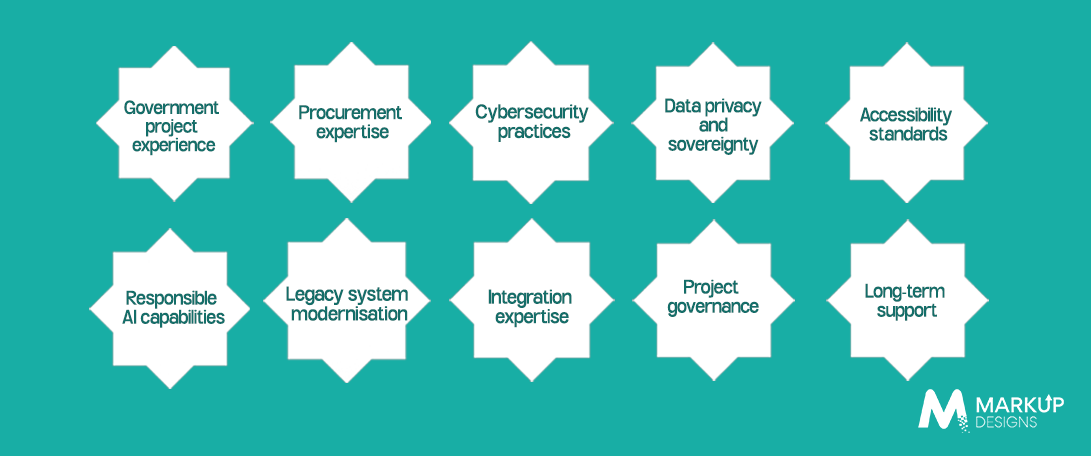
Selecting a technology partner for government-related projects needs proper evaluation. It is necessary to select such a company that knows the requirements of the public sector, develops software using security standards, and is capable of developing software that can sustain for long durations. The following points describe ten criteria for selecting a partner.
Government project experience
Ensure that your partner has experience in delivering complex software projects, especially in the government and/or regulated industries. This can be done by looking at past project deliveries and references.
Procurement expertise
Since most government projects have a unique procurement process, tender requirements, and even supplier assessment, it is important to ensure that your partner understands this process.
Cybersecurity practices
Ensure that your partner takes cybersecurity into consideration during development. Find out if the company has practices for vulnerability testing, access control, secure coding practices, and incident response practices.
Data privacy and sovereignty
Make sure that you know where your project data will be stored, processed, and accessible to the company.
Accessibility standards
Government digital services should cater to individuals with varying levels of capability. Partner with a company that incorporates accessibility into the design, development, and testing phases.
Responsible AI capabilities
Where AI is required in the project, find out about its data privacy measures, bias prevention, transparency, and human oversight when using AI. The AI capabilities must serve a specific purpose.
Legacy system modernisation
Most government departments use legacy systems. Find a partner that will be able to modernize existing applications, migrate data, and minimize disruption to critical services.
Integration expertise
Government software needs to be able to share data with other applications and platforms. Find out how good their experience is with APIs, databases, and third-party services.
Project governance
Good communication, realistic time frames, defined milestones, and status reports can keep things going smoothly on the project. Ensure that all roles and procedures have been clearly stated before beginning development.
Long-term support
After software is launched, it requires continual support, upgrading, and improvement to ensure its security. Make sure your partner provides good support and adequate knowledge transfer along with proper documentation and ownership planning.
How to Evaluate a Government Software Development Company’s Capabilities
Choosing a software development partner for the government requires a little bit more than browsing its website or listing of services. Australian government contracts require complicated specifications and high expectations in terms of security and accountability. It would be necessary to find out if the company can fulfill its obligations.
Here are a few practical ways to evaluate a potential partner:
- Previous project evaluation: Seek information on case studies, project history, and customer references to gauge the company’s familiarity with software solutions.
- Evaluation of the technical team: Consider the experience of the technical team with respect to technology, integration of systems, data migration, and security protocols.
- Security protocols: Inquire about the security process that includes vulnerability assessments, access control, data protection, and security issues.
- Delivery process: Examine the way in which the company deals with deadlines, risk management, quality assurance, and stakeholder communication.
- Documentation and support: Verify whether technical documentation, knowledge transfer, maintenance, and post-implementation support are provided by the partner.
- Validating their claims: Provide evidence for certifications and experience in government projects, if any.
In addition to that, think about kicking off your project with a discovery phase or a proof-of-concept first. This would help you ensure that the requirements are validated, technical risks are assessed, and realistic time frames and budgets are agreed upon. A proper evaluation will make it easier for you to choose the right partner for your project.
What Does Government Software Development Cost in Australia?
The cost of government software development in Australia is dependent on the size of the project, its complexity, the level of security required, and the need for integration. The initial cost of developing a small internal application would be lower compared to the cost of developing a major platform that will be used by several government agencies or thousands of users.
The development budget should cover more than coding. Planning, user experience design, testing, data migration, security reviews, deployment, and ongoing maintenance can all affect the final cost.
The following table provides indicative planning ranges for different types of projects. These are estimates for early budgeting, not fixed market prices or official government rates.
| Project type | Estimated cost (AUD) | Key cost factors |
| Basic internal tool or staff dashboard | $30,000–$80,000 | Core features, user roles, reporting |
| Citizen service portal | $50,000–$150,000+ | Accessibility, user accounts, document management |
| Departmental workflow management system | $80,000–$250,000 | Process automation, approvals, integrations |
| Legacy system modernisation | $150,000–$400,000+ | Data migration, system compatibility, testing |
| Complex government software platform | $200,000–$800,000+ | Security, multiple integrations, audit requirements, scalability |
Red Flags to Watch for When Selecting a Government Technology Partner
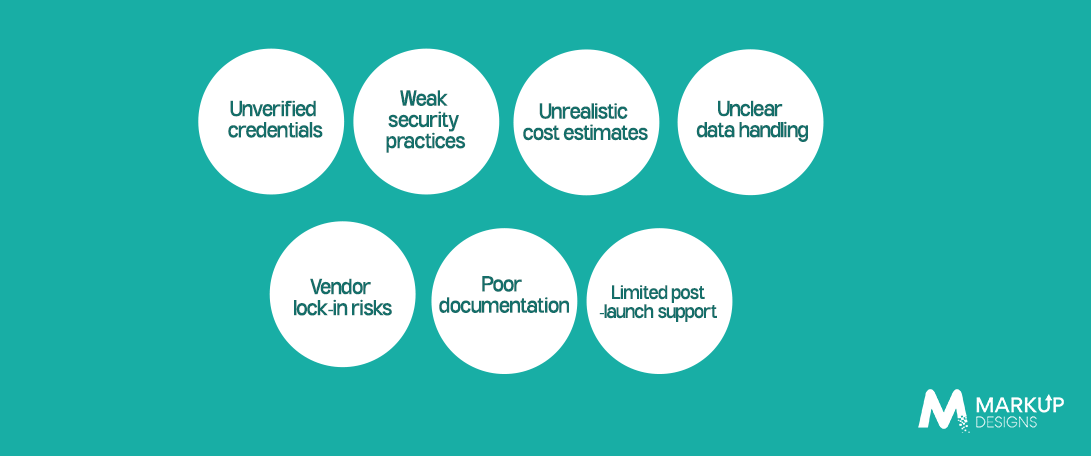
Not all software development companies are capable of dealing with the complexity that government projects bring. There are some red flags you should look out for before signing a contract that might lead to possible security concerns, budget overruns, and delays.
Unverified credentials
Beware of vendors claiming experience in government projects but unable to present any project examples or references.
Weak security practices
You should steer clear of organizations not able to outline their security controls, testing processes, and data protection strategies.
Unrealistic cost estimates
If the bid price seems unrealistically low, there will be a lot more to spend.
Unclear data handling
Your organization needs to know where your data is stored, who accesses it, and what measures are taken for its protection.
Vendor lock-in risks
If your potential partner lacks technical documentation, the further process of maintenance will suffer greatly.
Poor documentation
Make sure you will be able to get source code access and transfer the ownership if needed.
Limited post-launch support
Lack of maintenance and service agreements is a major problem.
Before taking any action, it is important to request data that will help you understand what the company is claiming and resolve any doubts in writing. A competent technology partner should always share their abilities, constraints, cost structure, and duties. This will help government organizations make sound decisions and develop secure software.
Questions to Ask Before Hiring a Government Software Development Partner
The government agency needs to ask specific questions to determine the provider’s technical skills, security measures, delivery system, and commitment before making a choice. Answering these questions will help you evaluate the options and know the possible challenges before entering into an agreement.
Technical and Integration Questions
- Have you delivered projects with similar technical requirements?
- How will you integrate the software with our existing systems?
- How will you manage data migration, testing, and future upgrades?
Security and Compliance Questions
- How will you protect sensitive government and citizen data?
- Which security standards and compliance requirements can you support?
- How do you identify vulnerabilities and respond to security incidents?
Delivery and Governance Questions
- How will you manage project milestones, risks, and budget changes?
- How often will we receive progress reports?
- Who will be responsible for delivery, testing, and quality assurance?
Commercial and Ownership Questions
- Who will own the source code and intellectual property?
- What costs are included in the proposal, and what could incur additional charges?
- What maintenance, training, and support will you provide after launch?
- How can we transition to another provider if required?
The answers should be specific, supported by evidence, and documented in the proposal or contract. Avoid relying on verbal assurances alone. A partner that communicates clearly and accepts accountability is better positioned to support a successful government software project.
A Step-by-Step Process for Selecting the Right Government Software Partner
The task of finding an appropriate technology partner is simplified once the government agency has established an evaluation process. The process provides a structure to define your project needs, evaluate providers objectively, and mitigate risks prior to developing the system.
Step 1: Establish your project objectives
Define the problem that needs to be solved, the target audience, and what benefits should be delivered by the product. Set quantifiable objectives for service quality, efficiency, and usability.
Step 2: List the technical and regulatory requirements
List your functional requirements, current systems, data security needs, accessibility needs, and government regulations.
Step 3: Shortlist suitable providers
Find partners that have the necessary technical expertise and capabilities to deliver according to your project needs.
Step 4: Compare proposals carefully
Compare proposals based on their performance against technical feasibility, schedule, skills of the team, security, price, and other factors.
Step 5: Validate the solution
Technical discovery and/or proof of concept, when needed, can be used to detect potential integration issues and validate key assumptions before proceeding to development.
Step 6: Agree on contract terms and governance process
Clarify milestones, roles and responsibilities, acceptance criteria, intellectual property rights, data management, change process, and escalation process.
Step 7: Monitor delivery and plan ahead
Keep track of progress, perform tests, train personnel, and plan further software evolution and upgrades.
Following these steps helps agencies choose a partner based on evidence, project suitability, and long-term value rather than price alone.
Government Software Development Readiness Checklist
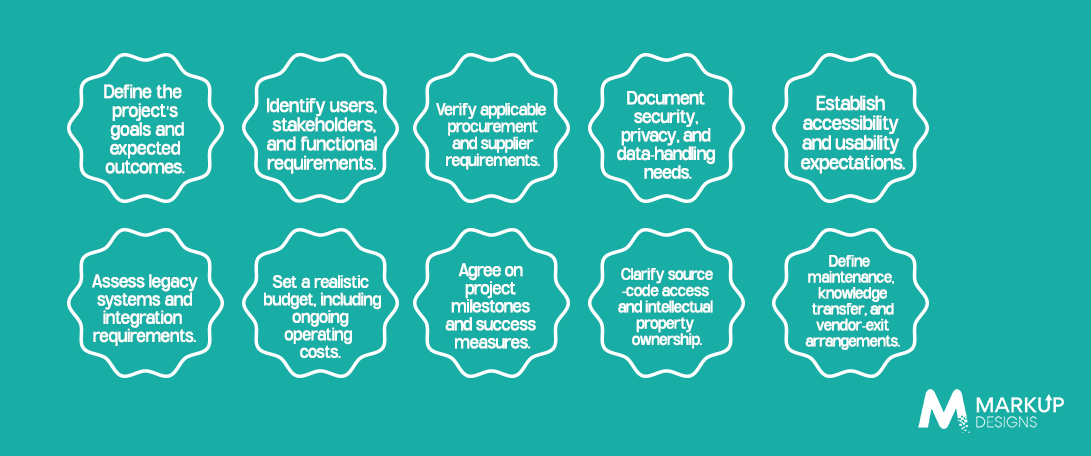
Government agencies need to make sure that there is clarity on the requirements, risks, and responsibilities in the project before selecting a technology partner. This checklist will help you to determine any missing areas.
- Define the project’s goals and expected outcomes.
- Identify users, stakeholders, and functional requirements.
- Verify applicable procurement and supplier requirements.
- Document security, privacy, and data-handling needs.
- Establish accessibility and usability expectations.
- Assess legacy systems and integration requirements.
- Set a realistic budget, including ongoing operating costs.
- Agree on project milestones and success measures.
- Clarify source-code access and intellectual property ownership.
- Define maintenance, knowledge transfer, and vendor-exit arrangements.
Completing this checklist will enable the agencies to create a more precise project brief, be able to compare proposals easily, and avoid forgetting critical information. The selected partner is also able to get a better understanding of the project.
Why Markup Designs is the Right Choice for Government Software Development in Australia
Markup Designs assists enterprises in the process of creating tailor-made software according to the organization’s needs and objectives of the project. If you are going to implement governmental software solutions in Australia, our company can assist in planning and developing applications aimed at workflow automation, data management, AI integration, and provision of digital services.
The development of software requires us to analyze project requirements, choose adequate technologies, and make solutions that will be able to evolve as required by circumstances. Our company realizes the significance of such factors as security, accessibility, documentation, and maintenance of software.
We strive to use efficient communication, organized software development, and suitable technologies to help organizations solve technical problems. Irrespective of whether your requirement concerns the creation of a new application or the reengineering of an existing one, we strive to provide solutions for the future.
Planning Your Next Government Software Project?
Discuss your project goals, system requirements, and integration needs with Markup Designs. Start with a clear understanding of what your software needs to achieve and how it can support your long-term objectives.

Conclusion
Technology partner selection is crucial to ensure the successful development of government software in Australia. The right partner assists agencies in improving the way they deliver services, manage information, and cater for their future needs.
Prior to selecting a provider, consider its technical competencies, security approach, procurement skills, delivery process, and post-delivery support. Consider the cost, review the experience, and specify the role in the agreement.
Government software should be secure, usable, and easily maintainable once it is released. Markup Designs assists organizations in discovering customized software products according to their operational goals. With specific requirements, appropriate technologies, and proper planning, agencies will be able to develop reliable digital products.
FAQs
1. What does a government software development company in Australia do?
A government software development company builds and maintains digital solutions for public-sector operations. These may include citizen service portals, internal management systems, workflow automation tools, data platforms, and applications that connect existing government systems.
2. How do you choose the right government software development partner?
Evaluate the company’s technical experience, relevant project references, security practices, procurement readiness, integration capabilities, and support services. Compare proposals against consistent criteria and verify important claims before signing a contract.
3. What security requirements apply to government software in Australia?
Requirements depend on the agency, the information being handled, and the project scope. Relevant considerations may include the Australian Privacy Principles, the Protective Security Policy Framework, the Information Security Manual, and agency-specific policies. Not every requirement applies to every project.
4. How much does government software development cost in Australia?
Costs depend on complexity, integrations, security requirements, data migration, and ongoing support. A smaller application may cost tens of thousands of Australian dollars, while a complex government platform can require hundreds of thousands or more. A detailed scope is needed for a reliable estimate.
5. How long does a government software development project take?
A smaller application may take a few months, while a complex platform involving multiple integrations, extensive testing, and procurement requirements may take a year or longer. Timelines depend on scope, approvals, technical complexity, and stakeholder availability.
Author's Perspective
Government software development is about more than adopting new technology. It means making public services accessible, reliable, and efficient while protecting sensitive information. Successful projects start with clear goals, an understanding of user needs, and the right technology partner. Beyond technical expertise, agencies should prioritize transparency, accountability, and long-term support. For Australian government agencies, carefully evaluating these factors helps reduce risks, improve decision-making, and build secure, adaptable digital solutions that meet changing public service needs.
Discuss Your Project NowJupinder Singh Arora
Founder and CEO
Related Posts
Embedded Software Development: Architecture, Process, Challenges & Cost
Enterprise Software Development Cost in Saudi Arabia: 2026...
How Much Does Software Development Cost in Australia...
Insights Are Valuable & Execution is Priceless
You’ve read about the digital future. Now, let’s build the infrastructure to take you there. Move your strategy from the page to the product.
Design Your Solution Now
Contact Us
Schedule The Appointment At Your Convenience Date And Time.
30 Min
Web Conference
Time Zone
Indian standard time (08:30pm)

Thanks For Getting In Touch!
You’ve Taken The First Step Toward Transforming Your Digital Presence. Our Experts Will Reach Out Shortly To Take It Forward.
Launch Your Dream Project
Provide a brief overview of your project, and our specialists will evaluate your requirements. We will connect with you to explore how the right digital solutions can help you launch faster.