
Key Facts Driving the Rise of Retail Mobile Apps in the Middle East
In Brief
- The Middle East retail market is rapidly shifting toward mobile-first shopping experiences, driven by high smartphone penetration.
- Mobile apps have become a primary sales and engagement channel, replacing traditional web-first strategies.
- Technologies like AI, 5G, AR, and integrated payments are shaping next-generation retail apps.
- Retailers face challenges such as inventory synchronization, omnichannel integration, and rising customer acquisition costs.
- Features like personalization, seamless checkout, and multi-language support are now essential for success.
- Investing in a well-designed retail mobile app helps businesses improve user experience, boost conversions, and stay competitive in 2026 and beyond.
Shopping in the Middle East has now become truly mobile-first. Today, most consumers naturally turn to their smartphones for everyday shopping, whether it’s browsing products, comparing prices, or making quick purchases. With high smartphone usage, easy internet access, and a digitally connected audience, the way people discover and buy products has completely evolved.
Mobile apps have evolved into a primary channel for retail businesses to market and sell their products directly to customers. Instead of relying on traditional touchpoints like websites, brands now use apps to create a more direct and controlled customer journey. From showcasing personalized product recommendations to enabling smooth checkouts, mobile apps help drive both engagement and conversions. This shift reflects a clear expectation from modern consumers, who prefer fast, intuitive, and convenient shopping experiences that align with their everyday digital behavior.
Why Mobile-First Commerce Is Taking Over the Retail Market in the Middle East?
- Mobile Traffic Is Leading E-commerce
If you look at how most e-commerce businesses in the Middle East are rapidly customer experience transformation, a large share of their traffic, often around 65–75%, comes from mobile devices. In industries like fashion, beauty, food delivery, and electronics, that number can go even higher.
So when the majority of your customers are visiting from their phones, designing for desktop first just doesn’t add up anymore.
A mobile-first e-commerce approach helps you:
- Reduce bounce rates
- Keep users engaged for longer
- Improve overall interaction
- Increase completed purchases
And ultimately, all of this leads to one thing: better revenue.
- Google Now Thinks Mobile-First Too
Google has shifted to mobile-first indexing, which means it primarily evaluates your website based on its mobile version, not the desktop one.
For e-commerce businesses targeting the specific search traffic, this is a big deal. A mobile-first website doesn’t just improve user experience; it directly impacts how well you rank.
It helps you:
- Perform better in local search results
- Improve Core Web Vitals
- Reduce technical SEO issues
- Deliver faster load times on mobile
In simple terms, strong SEO today goes hand in hand with a solid mobile experience.
- Middle East Shoppers Expect Speed and Simplicity
Consumers are used to fast, seamless digital experiences, whether it’s booking a ride or managing their finances through an app. Naturally, they expect the same level of ease when shopping online.
If your mobile site is slow, cluttered, or hard to navigate, users won’t wait—they’ll leave.
Things like:
- Slow loading pages
- Complicated navigation
- Too much zooming or scrolling
- Lengthy checkout processes
That’s where a mobile-first approach makes a difference. It removes friction by design, keeping everything clean, fast, and focused so users can make decisions quickly and effortlessly.
Read Also: Digital Transformation Framework for Enterprise Growth
Retail-Specific Challenges in Adopting Mobile Applications in the Middle East
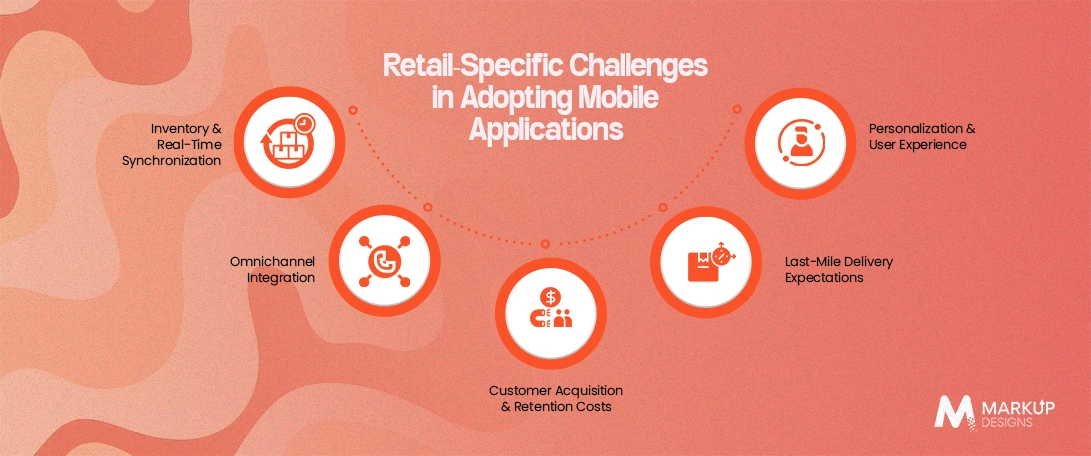
While mobile-first retail is driving growth, retailers face industry-specific challenges that directly impact operations, customer experience, and profitability.
1. Inventory & Real-Time Synchronization
Ensuring accurate, real-time inventory across warehouses and stores is critical. Any mismatch can lead to order cancellations and poor customer experience.
2. Omnichannel Integration
Integrating mobile apps with POS systems, inventory management, and logistics platforms can be complex, but it is essential for efficient retail operations and customer satisfaction.
3. Customer Acquisition & Retention Costs
High competition forces retailers to spend heavily on marketing, discounts, and loyalty programs to attract and retain users.
4. Last-Mile Delivery Expectations
Customers expect fast and reliable delivery. Managing logistics efficiently without increasing costs is a major challenge.
5. Personalization & User Experience
Delivering relevant recommendations and a smooth app experience requires strong data capabilities and continuous optimization.
Key Retail Mobile App Trends Driving Growth
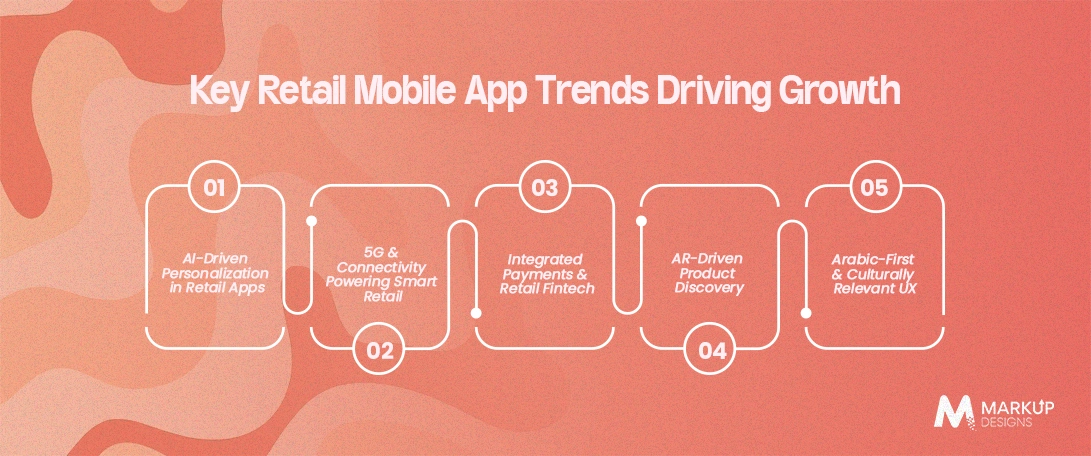
Retail mobile apps in 2026 are evolving beyond basic functionality to become intelligent, experience-driven platforms. Emerging technologies and changing consumer expectations are pushing retailers to adopt more personalized, fast, and immersive app experiences. These trends are not just enhancing user engagement but actively driving revenue growth and competitive advantage.
AI-Driven Personalization in Retail Apps
Modern retail apps use AI-driven customer experience strategies to understand user behavior and deliver real-time product recommendations. Instead of passive browsing, customers receive curated suggestions, improving engagement and conversions.
Key Tech: AI models, NLP (Arabic support), machine learning, on-device AI
Use Case: Retail apps personalize product discovery based on browsing and purchase patterns
5G & Connectivity Powering Smart Retail
Advanced connectivity enables faster, real-time retail experiences, from instant search results to live inventory updates. It also supports seamless omnichannel operations.
Key Tech: 5G, edge computing, IoT, real-time data processing
Use Case: Apps tracking orders provide real-time stock visibility and faster checkout.
Integrated Payments & Retail Fintech
Retail apps are evolving into financial ecosystems with built-in wallets, BNPL, and seamless checkout experiences, thereby reducing transaction friction.
Key Tech: API banking, tokenized payments, cloud payment systems, digital identity
Use Case: One-click checkout, in-app wallets, and flexible payment options.
AR-Driven Product Discovery
Immersive technologies like Augmented Reality (AR) and AI-powered retail apps are transforming how users explore products, allowing virtual try-ons and interactive previews before purchase.
Key Tech: AR engines, real-time rendering, spatial mapping
Use Case: Virtual try-ons for fashion, interactive product visualization.
Arabic-First & Culturally Relevant UX
Retail apps are increasingly designed with Arabic-first interfaces and culturally aligned experiences to improve usability and trust.
Key Tech: RTL design frameworks, localization tools, behavioral analytics
Use Case: Region-specific UI, localized offers, culturally relevant shopping journeys.
Read Also: Mobile App Development: Complete Guide for Businesses
Must-Have Feature of the Retail Mobile App
Mobile apps help retail businesses connect with customers and grow faster. They are not just tools for selling products, they also help promote your brand, build trust, and keep customers coming back. A good retail app should be easy to use and helpful for both customers and businesses. Here are some important features every retail app should include:
Seamless UI/UX
Delivering a clean, intuitive interface with fast load times (under 3 seconds) is critical to reducing user drop-offs and improving retention. A frictionless experience directly impacts customer satisfaction and long-term engagement.
AI-Driven Personalization & Recommendations
Modern consumers expect tailored experiences, over 70% prefer personalized interactions. Leveraging AI to analyze user behavior, location context (such as weather), and purchase history enables businesses to deliver highly relevant product recommendations and boost conversion rates.
Secure Payments & Digital Wallet Integration
Providing diverse payment options—including credit/debit cards, UPI, and digital wallets—combined with enterprise-grade security protocols helps build trust and ensures seamless transaction experiences across user segments.
Behavior-Based Push Notifications
Strategic, data-driven notifications such as cart abandonment reminders, dynamic pricing alerts, and geo-targeted offers, enable businesses to re-engage users effectively and drive higher lifetime value.
In-Store Experience Integration
Bridging digital and physical retail through features like Scan & Go, barcode-based product insights, and indoor navigation enhances in-store efficiency while delivering a connected omnichannel experience.
Loyalty Programs & Rewards Ecosystem
Integrating centralized loyalty systems allows customers to track and redeem rewards easily. Tiered membership structures further incentivize repeat purchases and strengthen brand loyalty.
Real-Time Order Tracking & Transparency
Providing end-to-end visibility into order status, from processing to final delivery, enhances customer trust, reduces support queries, and improves overall experience.
Benefits of Mobile Apps for Retail Businesses in the Middle East
Stronger Customer Engagement
Mobile applications create a direct and highly effective communication channel between retailers and customers. Businesses can deliver real-time, targeted notifications for promotions, product launches, and exclusive deals, ensuring higher engagement with active users.
Enhanced Convenience & User Experience
Built with a mobile-first approach, apps enable faster and more intuitive shopping journeys. Features such as saved preferences, order tracking, and integrated digital wallets streamline the purchasing process and improve overall user satisfaction.
Higher Customer Loyalty & Retention
Retail apps empower businesses to implement structured loyalty programs that incentivize repeat purchases. By nurturing long-term relationships, brands can significantly improve customer retention and lifetime value.
Actionable Data & Insights
Applications generate in-depth insights into user behavior, buying patterns, and preferences. These analytics allow retailers to refine strategies, optimize campaigns, and deliver highly personalized marketing experiences.
Increased Conversions & Revenue Growth
With simplified navigation and faster checkout experiences, mobile apps consistently drive higher conversion rates and larger basket sizes compared to traditional mobile websites.
Seamless Omnichannel Integration
Retail apps enable a unified shopping experience by connecting online and offline channels. Features like in-store product scanning, click-and-collect, and real-time inventory access are especially effective in digitally advanced markets such as the UAE and Saudi Arabia.
Read Also: Practical Guide to Developing Your First Mobile Apps
Cost of Retail Mobile App Development in the Middle East
| App Type | Features Included | Estimated Cost (USD) | Estimated Timeline |
| Basic Retail App | Product catalog, search, basic UI, simple checkout | $15,000 – $30,000 | 2 – 3 months |
| Mid-Level Retail App | User accounts, payment integration, push notifications, and order tracking | $30,000 – $70,000 | 3 – 6 months |
| Advanced Retail App | AI recommendations, AR features, multi-language (Arabic), analytics dashboard | $70,000 – $150,000 | 6 – 9 months |
| Enterprise Retail App | Omnichannel integration, ERP/CRM sync, real-time inventory, scalable architecture | $150,000 – $300,000+ | 9+ months |
Note: Costs may vary based on features, tech stack, region, and development team expertise.
Read Also: Ultimate Guide to the Cost of Developing a Mobile App in Dubai
Why Partner with Markup Designs for Retail Mobile App Development
At Markup Designs, we focus on building mobile apps that actually help retail businesses grow. We don’t just create apps, we create complete digital solutions that support your business goals and plans.
Our team understands both technology and the retail market in the Middle East. This helps us design apps that are fast, secure, and easy to use. We also make sure the experience feels smooth for your customers, which is important in a competitive market.
We work with modern technologies like AI features, omnichannel systems, and Arabic-friendly design. This ensures your app works well for different users and delivers a better shopping experience. Our goal is simple: to help you grow your business through smarter mobile solutions.
Conclusion
Retail mobile apps are no longer just an option; they are a must-have for businesses in the Middle East. Customer expectations are changing quickly, and companies need to keep up with mobile-first experiences to stay competitive.
Features like smart recommendations, easy navigation, and seamless shopping journeys help businesses connect better with their customers and improve sales. A well-built app can make a big difference in how a retail brand grows.
FAQs
1. Why are retail mobile apps becoming essential in the Middle East?
Retail mobile apps have become essential due to the region’s high smartphone penetration and growing preference for mobile-first shopping. Consumers expect fast, personalized, and seamless experiences, which apps can deliver better than traditional websites.
2. What are the key technologies shaping retail mobile apps in 2026?
Technologies like Artificial Intelligence (AI), 5G, Augmented Reality (AR), cloud computing, and integrated payment systems are transforming retail apps. These technologies enable faster performance, personalization, immersive experiences, and secure transactions.
3. How does AI improve retail mobile app performance?
AI helps analyze user behavior, preferences, and purchase history to deliver personalized recommendations, targeted offers, and smarter search results. This improves user engagement, increases conversions, and enhances overall customer experience.
4. What is omnichannel retail, and why is it important?
Omnichannel retail integrates online and offline shopping experiences into one seamless journey. It allows customers to browse online, purchase in-store, or opt for delivery, improving convenience and customer satisfaction.
5. What challenges do retailers face when developing mobile apps in the Middle East?
Retailers commonly face challenges such as Real-time inventory synchronization, complex omnichannel integrations, high customer acquisition costs, logistics and last-mile delivery issues.
6. What features should a successful retail mobile app include?
A successful retail app should include intuitive ui/ux design, ai-driven personalization, secure payment options, push notifications, loyalty programs, real-time order tracking, and multi-language (especially arabic) support.
7. How much does it cost to develop a retail mobile app in the Middle East?
The cost typically ranges from $15,000–$30,000 for basic apps, $30,000–$70,000 for mid-level apps, $70,000–$150,000 for advanced apps, and $150,000+ for enterprise-level solutions. The final cost depends on features, complexity, and integrations.
8. How does 5G impact retail mobile applications?
5G enables faster data speeds, lower latency, and real-time interactions. This improves app performance, enables AR features, enhances live tracking, and supports seamless omnichannel experiences.
9. Why is Arabic-first design important for retail apps in the Middle East?
Arabic-first design improves usability and builds trust among local users. It ensures better accessibility through right-to-left (RTL) layouts, localized content, and culturally relevant user experiences.
10. How do retail mobile apps improve customer retention?
Retail apps use personalized recommendations, loyalty programs, and targeted notifications to keep users engaged. These features encourage repeat purchases and help build long-term customer relationships.

Author's Perspective
The shift toward mobile-first retail is not just a passing trend; it’s a long-term change in how people shop. Businesses that see mobile apps as a key part of their growth strategy will stay ahead of the competition. The real success lies in keeping things simple, useful, and customer-focused. When technology is used in the right way, it helps businesses build stronger relationships with customers and grow in a meaningful way over time.
Discuss Your Project NowAjit Kumar Jha
VP - Business Operations
Insights Are Valuable & Execution is Priceless
You’ve read about the digital future. Now, let’s build the infrastructure to take you there. Move your strategy from the page to the product.
Design Your Solution Now
Contact Us
Schedule The Appointment At Your Convenience Date And Time.
30 Min
Web Conference
Time Zone
Indian standard time (08:30pm)

Thanks For Getting In Touch!
You’ve Taken The First Step Toward Transforming Your Digital Presence. Our Experts Will Reach Out Shortly To Take It Forward.
Launch Your Dream Project
Provide a brief overview of your project, and our specialists will evaluate your requirements. We will connect with you to explore how the right digital solutions can help you launch faster.