
In Brief
- Understanding the significance of the role played by AI scheduling assistants in the healthcare sector.
- Knowing the key features of AI scheduling systems in healthcare.
- Knowing the development process and system architecture in detail.
- Cost, technologies, and healthcare integration used in development.
- Benefits, challenges, and future scope of AI scheduling systems.
There are constant activities in terms of scheduling appointments and rescheduling of patients for healthcare providers that lead to scheduling conflicts. Manual handling of such tasks leads to administrative overload and affects the whole process of healthcare. The growing complexity of healthcare operations results in inefficient scheduling systems and the need for more innovative solutions that ensure quick and organized appointment management.
An AI scheduling assistant addresses this problem by using machine learning, predictive analytics, and natural language processing to automate and optimize scheduling activities. Such solutions include appointment booking, reminder sending, prediction of no-shows, and coordination of doctor availability. Healthcare organizations considering such technology need to understand the development process, architecture, cost, and benefits of the solution.
What Is an AI Scheduling Assistant for Healthcare?
The AI scheduling assistant for healthcare refers to an intelligent software application for automatic scheduling of appointments, availability of healthcare providers, and scheduling of patients. The software makes use of artificial intelligence (AI), machine learning (ML), and natural language processing (NLP) technologies to schedule appointments according to specific rules and the availability of doctors and patients.
Traditional systems have relied on extensive manual inputs for appointment management, analysis of booking patterns, dealing with cancellations, providing reminders, and predicting any scheduling conflicts. AI scheduling assistants can easily integrate with Electronic Health Records (EHR), Electronic Medical Records (EMR), and hospital management systems.
Why Are Healthcare Providers Adopting AI Scheduling Assistants?
The adoption of AI scheduling assistants is increasing in healthcare providers to cope with rising appointment numbers and to deal with scheduling problems. AI scheduling assistants assist healthcare providers in automating the appointment process through automation of manual tasks and making use of operational information.
Reducing Appointment Scheduling Conflicts
AI scheduling assistants will consider the availability of the doctors, appointment duration, type of consultations, and other bookings to determine the best time for appointment bookings. They can help to avoid overlapping appointments, consider limitations and scheduling rules, and offer alternative appointments in case of conflicts. It will allow healthcare facilities to keep their appointment schedules well-organised and avoid scheduling mistakes.
Minimising Patient No-Shows and Cancellations
Missed appointments may disrupt healthcare schedules and waste valuable consultation time slots. Artificial intelligence systems analyze the appointment history and behavior of patients in order to detect possible no-show risks. In this case, they can automatically send reminders, ask patients to confirm their appointments, and take certain follow-up actions in order to avoid appointment cancellations.
Improving Healthcare Staff and Resource Allocation
The process of scheduling in healthcare requires coordination of doctors, nurses, consultation rooms, medical devices, and other healthcare resources. Artificial intelligence assistants are capable of analyzing the availability and scheduling needs of these resources in order to distribute them effectively.
Enhancing Patient Access and Experience
With the help of artificial intelligence assistants, patients are able to schedule their appointments easily via web portals, mobile applications, chat services, and voice communications. Patients can check available appointment time slots, schedule and reschedule their consultations independently from administration. Automated responses and real-time availability updates also help create a more convenient booking experience.
Streamlining Administrative Workflows
Manual appointment management often requires staff to handle repetitive calls, booking confirmations, cancellations, and schedule updates. AI assistants automate these activities and synchronise appointment information across connected systems. This reduces routine administrative work and allows healthcare teams to focus more on patient coordination and essential operational responsibilities.
Key Features of an AI-Powered Healthcare Scheduling Assistant
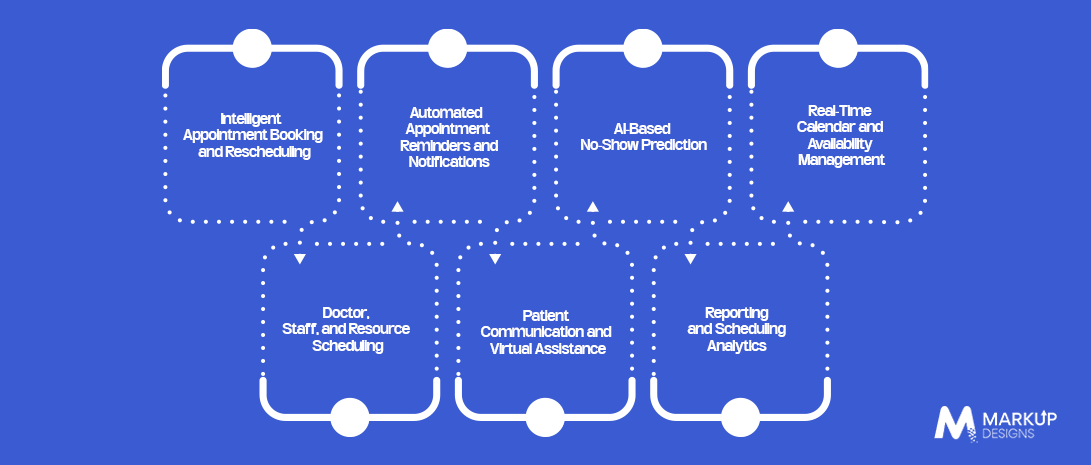
A healthcare scheduling assistant that works via AI technology will be able to manage appointment booking and scheduling, provide the possibility of making predictions, and automatically communicate and analyze operations. Features of the tool should meet the needs of patients, doctors, and administrative personnel.
Intelligent Appointment Booking and Rescheduling
Features of smart booking allow patients to book an appointment in regard to the doctor’s availability, type of consultation, location, and time slot preferences. The system analyses all possibilities and makes suggestions by considering some pre-set rules. Besides, the scheduling tool is able to handle appointment rescheduling and update all connected calendars accordingly.
Automated Appointment Reminders and Notifications
Notifications make patients aware of all scheduled consultations, bookings, cancellations, and changes in the schedule. Notifications may be sent via SMS, email, mobile notifications, etc. Healthcare providers have an opportunity to set reminder schedules for the purposes of appointment confirmations.
AI-Based No-Show Prediction
Via analysis of historical data on appointments, cancellations, booking timeline, etc., AI technology will be able to predict no-shows. These predictions may help healthcare providers in making their decisions regarding reminders and confirmation requests.
Real-Time Calendar and Availability Management
In real-time calendar management, the appointment information is kept in sync among the doctors, departments, and healthcare facilities. The assistant manages the availability in case of booking, cancelling, or rescheduling of appointments.
Doctor, Staff, and Resource Scheduling
The system manages the availability of healthcare professionals, consultation rooms, diagnostic machines, and other healthcare facility resources. It recommends scheduling allocations based on working hours, shift times, requirements for the appointments, and limitations of the resources.
Patient Communication and Virtual Assistance
Through conversational AI and NLP, patients communicate with the assistant using natural language in relation to appointment scheduling. They can ask about availability, book their appointments, and get information about the scheduling process.
Reporting and Scheduling Analytics
Report creation and scheduling analytics allow understanding the numbers of appointments, cancellation rates, no-shows, resource usage, and efficiency of the scheduling process. Healthcare administrators will be able to analyze and improve scheduling based on these reports.
How to Develop an AI Scheduling Assistant for Healthcare?
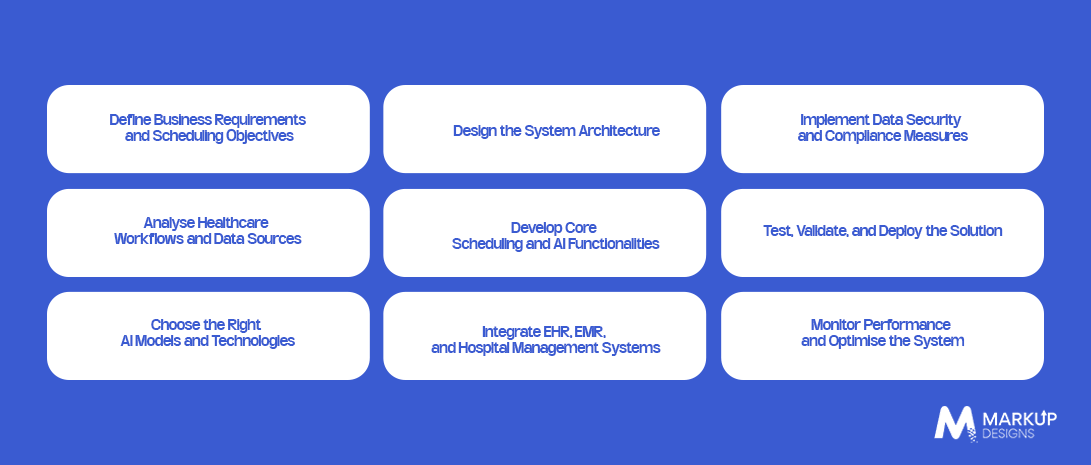
The development of the AI scheduling assistant requires a structured process of analyzing the workflow in the healthcare sector, developing the AI, integrating it with the system, and protecting sensitive data. Every phase of the development should be tailored to the needs of the organization and its patients.
Define Business Requirements and Scheduling Objectives
It is necessary to identify the problems that need to be addressed by the software. These can be conflicting appointment times, high no-show rates, a manual booking process, lack of doctors’ availability, or other issues. The objectives of the project, its users, functionalities needed, and its outcome should be specified.
Analyse Healthcare Workflows and Data Sources
It is necessary to analyze the current methods of appointment booking, cancellation, management of patient records, and managing the schedules of healthcare professionals. All data sources that would be used by AI in order to provide its functionality have to be defined.
Choose the Right AI Models and Technologies
It is necessary to select appropriate models and technologies depending on the intended capabilities of the assistant. Machine learning models can help with forecasting appointments and patients’ no-shows. NLP technology will enable the conversational interaction between the patient and the scheduling assistant. The selection should consider model accuracy, scalability, integration requirements, data availability, and the complexity of scheduling decisions.
Design the System Architecture
Specify the mechanism by which communication and information sharing will occur among the system components. The architecture should incorporate data handling, AI processing, scheduling logic, interfaces for integration, application layer, and monitoring functionality. A modular architecture will allow for more efficient maintenance of the components, addition of new features, and scalability of the solution as healthcare needs change.
Develop Core Scheduling and AI Functionalities
Develop the core functionalities, such as booking appointments, rescheduling them, calendar handling, automated reminders, and availability handling. Implement the AI capabilities necessary for predictive scheduling, identification of no-shows, and recommending slots. Make sure that the scheduling algorithm respects the constraints that are imposed, including consultation time, availability of professionals, and other factors.
Integrate EHR, EMR, and Hospital Management Systems
Enable communication with the current healthcare platforms that will make the transfer of information precise. Integration of EHR and EMR will give access to patient and appointment information, while hospital management systems will make coordination of resources possible. One of the solutions can be using API and HL7/FHIR standards for structured communication among connected systems.
Implement Data Security and Compliance Measures
As healthcare scheduling systems handle personal information, data security is an important part of development work. Identify applicable regulatory requirements, such as HIPAA, GDPR, or UK GDPR, depending on the markets and healthcare organisations the solution serves.
Test, Validate, and Deploy the Solution
Perform functional, integration, security, performance, and usability tests before implementing the solution. Verify AI predictions using historical data and evaluate how the assistant copes with conflicting appointments, cancellations, and unexpected scheduling. Start with the pilot program in a chosen department or health facility and fix discovered issues before a broader implementation.
Monitor System Performance and Optimize the Solution
Once deployed, constantly monitor appointment management, prediction accuracy, system availability, resource usage, and user feedback. Analyze performance trends and improve them by evaluating models and making necessary software updates and workflow adjustments to ensure proper functioning in changed circumstances.
What Is the Architecture of an AI Healthcare Scheduling Assistant?
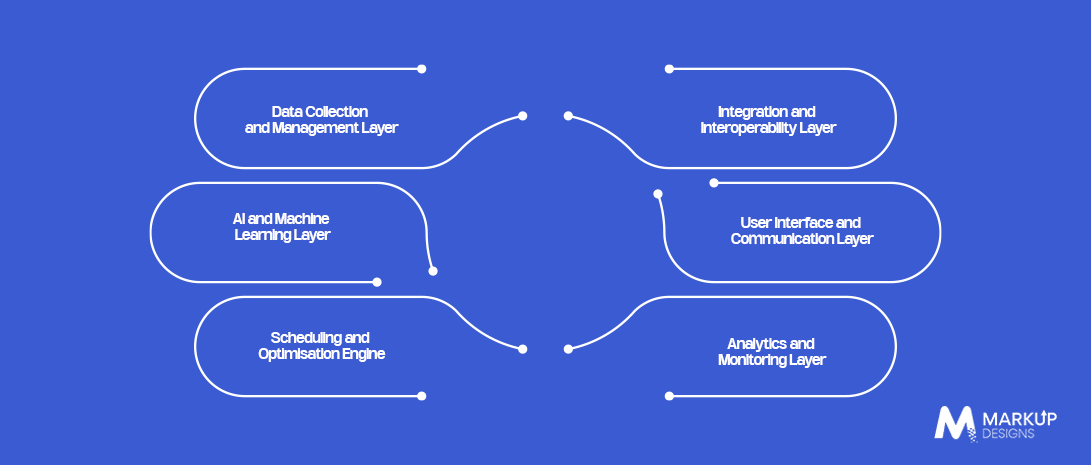
The architecture of an AI healthcare scheduling assistant is a set of connected layers that gather data about healthcare organizations, perform scheduling tasks, make predictions, and manage appointment workflows. Each layer carries out certain activities and interacts with other layers to provide accurate scheduling processes.
Data Gathering and Management Layer
This layer gathers and manages data provided by appointment databases, patient management software, calendars of providers, and other connected healthcare systems. It organizes gathered data and ensures its consistency, as well as makes it available to AI models and scheduling algorithms.
Database technologies such as PostgreSQL, MySQL, and MongoDB can support structured and semi-structured data management.
AI and Machine Learning Layer
This layer analyzes the information on healthcare scheduling and comes up with recommendations and predictions. The machine learning models are able to detect patterns, make forecasts regarding the need for appointments, and find out the best possible scheduling options. Natural Language Processing models help to interpret patient requests in order to give them scheduling information.
Scheduling and Optimization Engine
The scheduler is responsible for appointment scheduling, making decisions regarding available providers, consultation time, patient needs, and constraints. It uses business rules and optimization algorithms to offer possible appointment times to patients. It is also responsible for managing booking, cancellations, rescheduling, and conflicts.
Integration and Interoperability Layer
The integration layer provides the connections between the assistant and, EMR, hospital management, billing, and communication solutions. The API technology and healthcare interoperability standards, such as HL7 and FHIR, provide a way of exchanging data between different systems. Appointment information is synchronized with healthcare applications.
User Interface and Communication Layer
This layer includes means for patients and healthcare professionals to access the scheduling features. Such channels as web interfaces, mobile apps, chat interfaces, and voice assistants can be used. Patients can manage appointments, while healthcare staff can monitor schedules and review booking requests through dedicated interfaces.
Analytics and Monitoring Layer
The analytics layer tracks system performance, appointment trends, no-show rates, and resource utilisation. Monitoring tools help identify technical issues, evaluate AI model performance, and maintain operational visibility. These insights allow healthcare administrators to assess scheduling outcomes and make informed improvements.
Which Technologies Are Used to Build an AI Scheduling Assistant?
Construction of AI-assisted scheduling involves a mixture of intelligent processing technologies, backend architecture, data processing tools, and healthcare integration tools.
Artificial Intelligence and Machine Learning
This set of technologies allows the AI assistant to analyze scheduling patterns, predict appointment demand, and detect potential no-show cases. Platforms like TensorFlow, PyTorch, and Scikit-learn may be used for model development, training, and assessment. With their help, one may convert the history of scheduling into predictive insights.
Natural Language Processing and Conversational AI
NLP allows the system to comprehend the intent behind the patient’s message and recognize conversations related to scheduling appointments. Solutions such as spaCy, Hugging Face Transformers, as well as large language models may be applied for intent recognition, conversations with patients, and request handling. Voice-based applications should also incorporate speech-to-text and text-to-speech technologies.
Predictive Analytics and Recommendation Systems
Prediction of appointment trends, prediction of cancellation probabilities, and forecasting of the demand for healthcare services become possible with predictive analytics. Recommendation systems allow assessing the availability of slots according to patients’ preferences and scheduling constraints.
Cloud Computing and Database Technologies
Cloud platforms give an infrastructure needed to implement, manage and scale AI scheduling applications. Applications can be hosted and managed using services offered by AWS, Microsoft Azure and Google Cloud. Databases such as PostgreSQL, MySQL and MongoDB are used to store and retrieve the scheduling data.
APIs and Healthcare Interoperability Standards
APIs facilitate communication between the scheduling assistant and other healthcare applications. RESTful APIs, HL7 and FHIR allow for the exchange and integration of data with other healthcare applications. Choosing the right integration standard is crucial in order to keep the data consistent and avoid problems when integrating the assistant with various healthcare systems.
How Much Does It Cost to Develop an AI Scheduling Assistant for Healthcare?
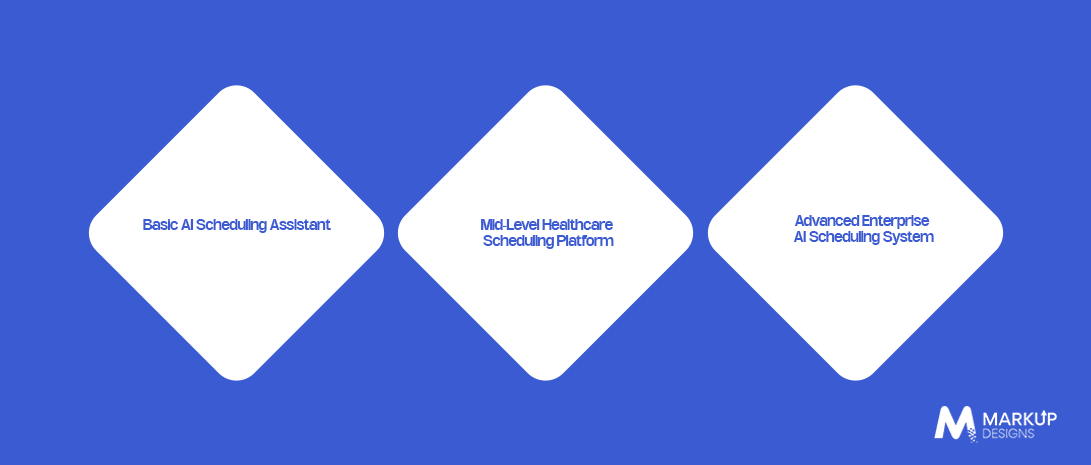
The price of developing an AI scheduling assistant for healthcare depends on its functional complexity, the use of AI technologies, and integration and deployment infrastructure. Development of a simpler solution with appointment booking and automatic reminders does not require the same amount of resources as development of an enterprise solution featuring analytics, conversational AI, and scheduling in multiple facilities.
The overall investment also varies based on whether healthcare providers choose to customise an existing scheduling platform or develop a solution from scratch. The following estimates provide an indicative cost range for different levels of development.
Basic AI Scheduling Assistant
The simple AI scheduling assistant will typically cost between $15,000 and $30,000 to build. This assistant includes basic functionality like appointment booking, rescheduling, automatic reminders, calendar management, and basic patient communication capabilities. The solution is applicable for smaller clinics and individual healthcare providers who want to automate their scheduling processes without implementing more complex AI functions.
Mid-Level Healthcare Scheduling Platform
The mid-level healthcare scheduling platform can be priced from $30,000 up to $70,000. The assistant has advanced functionality like no-show prediction, intelligent appointment suggestions, a chat-like user interface, and integration with an existing EHR/EMR system. Such a development level is appropriate for expanding healthcare providers and clinics with various specialties.
Advanced Enterprise AI Scheduling System
The enterprise AI scheduling assistant can have a price tag between $70,000 and $150,000. Advanced solutions include advanced predictive models, multi-location scheduling, workforce optimization, healthcare integration, real-time analytics, and customizable admin dashboards. Such assistants are needed by hospitals and large healthcare networks with a high number of appointments and complex operations.
What Are the Benefits of AI Scheduling Assistants in Healthcare?
AI scheduling assistants help healthcare organizations achieve better appointment management by automating repetitive tasks and scheduling decisions based on data. AI scheduling assistants’ abilities are not limited to booking appointments, but also involve patient interactions, resource coordination, and operational planning.
Improved Appointment Management and Efficiency
AI scheduling assistants book appointments, cancel, and reschedule them checking the availability of providers and other constraints in scheduling. They eliminate unnecessary manual coordination and help healthcare organizations deal with an increased number of appointments without additional burdens on administration. Automated calendar updates eliminate booking errors and scheduling conflicts.
Reduced Administrative Workload
Appointment booking, scheduling calls, reminders and other scheduling activities require significant amount of time and effort from healthcare organization’s employees. However, AI assistants automate all these repetitive actions and offer booking features to patients themselves. In this way, administrative staff have less time spent on routine scheduling procedures and can dedicate it to patient care.
Better Patient Engagement and Satisfaction
Patients are able to contact AI assistants via websites, applications, chat interface or voice interface. They can check their appointment availability, get confirmation and ask to change their schedule. Thus, effective communication and booking options make their experience more convenient.
Optimised Use of Healthcare Resources
The AI scheduling software system manages doctors’ availability, consultation rooms, diagnostic equipment, and other healthcare resources. Considering operational limitations and appointment requirements, it aids in minimising downtime and optimises the distribution of resources. This ensures efficient daily management in departments and at healthcare facilities.
Fewer Missed Appointments
Using predictive analytics, the system helps identify potential missed appointments. Healthcare professionals can use this information to send reminders and confirmations to patients and offer alternative scheduling options. Such approaches can contribute to increased attendance and less wasted consultation time.
Data-Driven Operational Management
Using the AI scheduling assistant, reports can be generated regarding appointment demands, cancellations, availability of healthcare providers, and resource usage. These data can be used by healthcare managers for scheduling bottleneck identification, forecasting of needs, and workflow optimisation.
What Are the Challenges of Developing an AI Healthcare Scheduling Assistant?
Although the operational benefits of AI healthcare scheduling assistants are obvious, there are several technical and regulatory difficulties associated with the development process. Considering these aspects during development will contribute to a more reliable solution.
Quality and Availability of Healthcare Data
AI algorithms rely on correct and relevant data to ensure proper predictions. Duplicates, missing appointments, lack of necessary data about patients, and database fragmentation can have a negative effect on the prediction results. Healthcare organizations need to have proper mechanisms for data cleansing, validation, and standardization before using historical data for the purposes of training AI models and scheduling.
Integration With Legacy Healthcare Systems
A lot of hospitals still use legacy EHR/EMR and hospital management systems that operate in different data formats and have various integration options. The connection of an AI scheduling assistant with such legacy systems may require the development of custom APIs and other integration solutions. Lack of proper integrations may cause problems like delays and inconsistent data.
Healthcare scheduling platforms deal with confidential data related to patients, consultations, and appointment history. Unauthorized access and data breaches can become a serious threat to the privacy of patients. Developers should ensure proper data handling, authentication, encryption, and access control measures in their system.
AI Predictions’ Accuracy and Reliability
AI models may generate inaccurate no-show predictions or appointment recommendations when trained on incomplete, outdated, or unrepresentative datasets.
Scheduling decisions based on unreliable predictions can affect provider availability and patient access. Regular model evaluation, performance monitoring, and human oversight are necessary to maintain dependable system behaviour.
User Adoption and Workflow Adaptation
Introducing AI scheduling tools can require healthcare professionals and administrative teams to adjust their existing processes. Limited technical familiarity, concerns about automated decisions, and resistance to workflow changes may affect adoption. User training, intuitive interfaces, and clear escalation mechanisms can help healthcare organisations integrate the solution into daily operations.
What Compliance and Security Standards Should an AI Scheduling Assistant Follow?
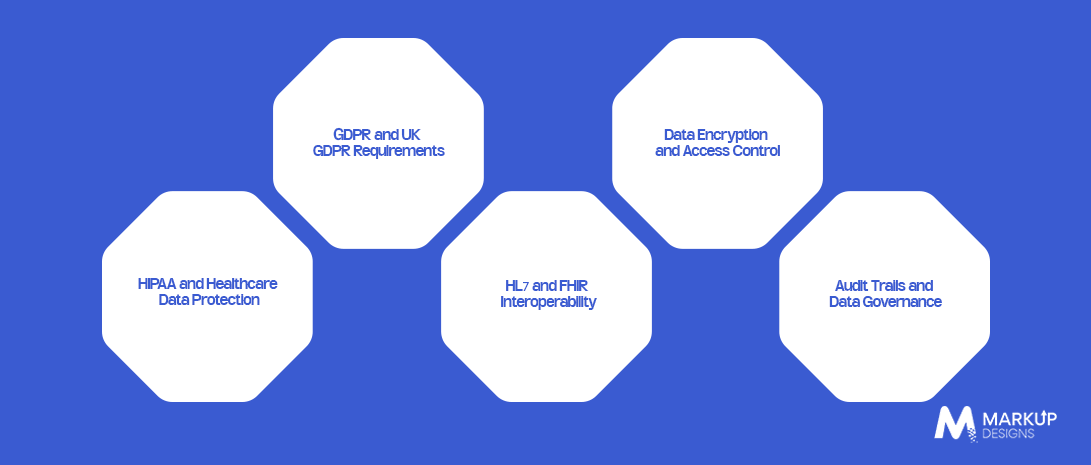
An AI scheduling assistant must follow applicable healthcare privacy, security, and interoperability requirements to protect patient information and support reliable data exchange. The specific obligations depend on the countries where the solution operates, the type of information it processes, and the role of the healthcare organisation.
HIPAA and Healthcare Data Protection
Healthcare scheduling assistants handling protected health information in the United States may fall under the Health Insurance Portability and Accountability Act (HIPAA). Applicable requirements address administrative, physical, and technical safeguards for protecting patient information. Developers should implement appropriate access controls, encryption, audit mechanisms, and business associate agreements where required.
GDPR and UK GDPR Requirements
Healthcare platforms processing personal data of individuals in the European Economic Area or the UK must consider applicable GDPR and UK GDPR requirements. These frameworks address lawful data processing, transparency, data minimisation, access rights, and protection of sensitive personal information. Healthcare providers must establish appropriate legal grounds and safeguards for processing patient data.
HL7 and FHIR Interoperability
Health Level Seven (HL7) and Fast Healthcare Interoperability Resources (FHIR) are standards that support structured healthcare information exchange. They help scheduling assistants communicate with EHR, EMR, and other healthcare applications using consistent data formats. Their implementation can improve interoperability and reduce integration complications across different systems.
Data Encryption and Access Control
Encryption protects patient information during transmission and storage, while role-based access control restricts system permissions according to user responsibilities. Secure authentication, session management, and controlled API access further reduce the risk of unauthorised data exposure. These safeguards should be incorporated into the system architecture from the beginning.
Audit Trails and Data Governance
Audit trails record important system activities, including appointment changes, data access, user actions, and administrative updates. Data governance policies define how information is collected, stored, accessed, retained, and deleted. Together, these measures improve accountability and help healthcare organisations monitor compliance and investigate security incidents.
What Is the Future of AI Scheduling Assistants in Healthcare?
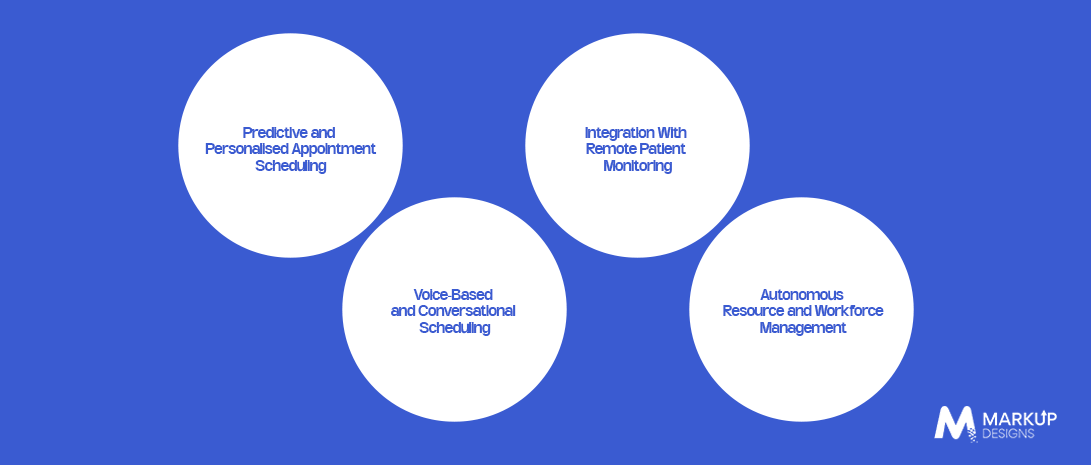
These assistants will develop from the existing appointment booking systems into advanced predictive and interconnected appointment coordinators. The advancements in artificial intelligence and conversational technologies, as well as in connected healthcare technology, will allow for improving the way appointments are scheduled and managed.
Predictive and Personalised Appointment Scheduling
In the future, more predictive analytics will be incorporated into the systems that will be able to assess such factors as appointment demand, preferences of patients, availability of medical providers, and historical data on attendance patterns. This will facilitate personalized appointment scheduling as well as the ability to forecast scheduling needs better.
Voice-Based and Conversational Scheduling
With the advancements in conversational technologies and speech recognition, scheduling by means of voice commands will become available. It will be possible for patients to schedule, confirm, and reschedule their appointments in a natural voice communication manner. Also, multilingual conversational technologies will make the process more user-friendly.
Integration With Remote Patient Monitoring
Integration with remote patient monitoring systems will enable scheduling assistants to make use of healthcare information and the need for follow-ups while scheduling consultations. For instance, changes in the monitored health metrics could lead to the need for a follow-up appointment.
Autonomous Resource and Workforce Management
In turn, AI-based scheduling tools can facilitate more dynamic scheduling of the workforce and other resources based on the analysis of appointment requests, staff availability, and other factors. The potential of such features can be useful for managing the shifts, consultation rooms, and diagnostic procedures in hospitals without undermining the decision-making regarding clinical and workforce management under human control.
How Markup Designs Can Assist in Creating AI-Based Scheduling Assistance in Healthcare?
Markup Designs assists healthcare institutions in transforming the scheduling requirements into a scalable and intelligent software solution. The process of development implies a thorough analysis of the current workflow and relevant AI features, as well as the design of a system that will be able to interact with the healthcare environment. Our team consists of specialists in the development of AI technologies, healthcare software development, cloud technologies, and API integrations.
Build an Intelligent AI Scheduling Assistant for Your Healthcare Organisation
Automate appointment management, optimise healthcare resources, and improve patient coordination with a custom AI-powered scheduling solution.

Conclusion
AI scheduling assistants are changing how healthcare organisations manage appointments, coordinate medical professionals, and handle administrative workflows. By combining machine learning, predictive analytics, and conversational AI, these solutions can simplify booking processes, improve resource utilisation, and support more accessible patient communication.
Healthcare providers must consider system architecture, data quality, interoperability, security, development costs, and user adoption. A well-planned development strategy helps ensure that the scheduling assistant meets operational requirements while remaining scalable and reliable as healthcare needs evolve.
FAQs
1. How long does it take to develop an AI scheduling assistant for healthcare?
Developing an AI scheduling assistant can take approximately 3–9 months, depending on its complexity, AI capabilities, third-party integrations, and security requirements. A basic scheduling solution may require less time, while an enterprise platform with custom AI models and multiple healthcare integrations may need a longer development cycle.
2. Can an AI scheduling assistant integrate with existing EHR and EMR systems?
Yes, an AI scheduling assistant can integrate with existing EHR and EMR systems through APIs and healthcare interoperability standards such as HL7 and FHIR. These integrations allow the assistant to access relevant appointment information, synchronise provider availability, and update scheduling records across connected platforms.
3. How does AI help reduce patient no-shows?
AI analyses historical appointment records, cancellation patterns, and other relevant scheduling data to identify potential no-show risks. Healthcare providers can use these predictions to send timely reminders, request appointment confirmations, and offer alternative slots to improve attendance.
4. Is an AI scheduling assistant suitable for small clinics and hospitals?
Yes, AI scheduling assistants can be developed for small clinics, independent practices, multi-specialty facilities, and large hospitals. The functionality and infrastructure can be customised according to appointment volumes, operational requirements, available resources, and budget.
5. What AI technologies are used in healthcare scheduling systems?
Healthcare scheduling assistants commonly use machine learning for no-show prediction and demand forecasting, NLP for conversational interactions, and optimisation algorithms for appointment and resource allocation. Cloud computing, databases, APIs, and healthcare interoperability standards support the overall system infrastructure.
Author's Perspective
AI scheduling assistants represent a practical application of artificial intelligence in healthcare, where automation can directly improve everyday operational workflows. However, their effectiveness depends on the quality of healthcare data, integration with existing systems, and the ability to accommodate real-world scheduling constraints. Healthcare organisations should prioritise reliable architecture, patient data protection, and human oversight when developing these solutions to ensure that automation supports both operational efficiency and patient needs.
Discuss Your Project NowJupinder Singh Arora
Founder and CEO
Related Posts

Government Software Development in Australia: How to Choose...
Embedded Software Development: Architecture, Process, Challenges & Cost

Enterprise Software Development Cost in Saudi Arabia: 2026...
Insights Are Valuable & Execution is Priceless
You’ve read about the digital future. Now, let’s build the infrastructure to take you there. Move your strategy from the page to the product.
Design Your Solution Now
Contact Us
Schedule The Appointment At Your Convenience Date And Time.
30 Min
Web Conference
Time Zone
Indian standard time (08:30pm)

Thanks For Getting In Touch!
You’ve Taken The First Step Toward Transforming Your Digital Presence. Our Experts Will Reach Out Shortly To Take It Forward.
Launch Your Dream Project
Provide a brief overview of your project, and our specialists will evaluate your requirements. We will connect with you to explore how the right digital solutions can help you launch faster.