

In Brief
- The MENA region is rapidly becoming a mobile-first digital market driven by high smartphone usage, 5G expansion, and strong government-backed digital transformation initiatives.
- In 2026, mobile apps are evolving from simple tools to intelligent ecosystems powered by AI, real-time connectivity, cloud computing, and personalized user experiences.
- Key mobile app development trends in MENA include AI-powered apps, super apps, Arabic-first UI/UX, cross-platform development, fintech growth, 5G adoption, and cloud-native architectures.
- Strong demand for mobile app development UAE and wider MENA solutions is driven by industries like fintech, ecommerce, healthcare, logistics, and government services.
- Future-ready apps will focus on scalability, security, localization, and seamless digital experiences, making innovation essential for success in the region.
Top Mobile App Development Trends in MENA for 2026
The Middle East and North Africa region is rapidly becoming one of the most exciting digital markets for mobile innovation. From smart banking platforms and ecommerce ecosystems to healthcare applications and government service portals, mobile technology is transforming how people interact with brands, services, and everyday experiences.
As smartphone usage continues to rise across UAE and wider MENA region, the demand for intelligent, fast, and highly personalized applications is growing at an impressive pace.
In 2026, the focus will no longer be limited to launching simple apps with standard functionality. Users now expect seamless digital journeys powered by AI, real-time connectivity, secure transactions, and localized experiences. This shift is pushing companies to rethink how mobile products are designed, developed, and scaled for modern users.
The rise of mobile app development trends in MENA is also being fueled by strong digital transformation initiatives across countries like UAE and Saudi Arabia. Governments are investing heavily in smart cities, digital infrastructure, cashless economies, and AI-driven services, creating massive opportunities for innovation in the app ecosystem.
At the same time, technologies like 5G, cloud computing, and generative AI are redefining user expectations. This is why UAE mobile app development companies are increasingly focusing on scalable architectures, intelligent automation, and advanced user experiences that align with regional digital growth.
In this blog, we will explore the biggest MENA app development trends in 2026, the technologies driving this evolution, expected development costs, market statistics, and the future of mobile applications across the Middle East.
Why Mobile App Market in MENA region is Growing Rapidly
The mobile app market in the Middle East is expanding at an exceptional pace, supported by strong digital infrastructure, government-backed innovation programs, and one of the world’s highest smartphone adoption rates. Countries like UAE and Saudi Arabia are actively investing in smart technologies, creating new opportunities for modern mobile ecosystems across industries.
One of the biggest reasons behind this growth is changing consumer behavior. Users across the region now rely on mobile apps for shopping, banking, healthcare consultations, food delivery, transportation, entertainment, and even government services. This shift toward app-first experiences is significantly increasing the demand for advanced digital platforms.
At the same time, initiatives such as UAE Digital Government strategies and Saudi Vision 2030 are accelerating regional transformation. These programs are encouraging organizations to invest in scalable digital products, cloud infrastructure, and AI-driven experiences that improve accessibility and operational efficiency.
Another major factor driving growth is the increasing demand for localized user experiences. Modern users expect platforms that support Arabic interfaces, regional payment systems, and culturally relevant interactions. This is why Arabic AI-powered mobile app development is becoming an essential part of modern app strategies across the region.
The rapid rise of fintech, ecommerce, logistics, and healthcare platforms is also creating strong demand for mobile app development services. As digital ecosystems continue to mature, the region is expected to remain one of the fastest-growing app markets globally.
Latest Mobile App Development Trends
The Middle East mobile ecosystem is evolving far beyond traditional app experiences. In 2026, the focus will shift toward intelligent automation, hyper-personalization, real-time connectivity, and scalable digital ecosystems. From fintech and ecommerce to healthcare and logistics, companies across the region are adopting modern technologies to meet rapidly changing user expectations.
Below are the biggest MENA app development trends expected to shape the future of the regional mobile industry.
- AI-Powered Mobile Applications
AI is becoming one of the most influential technologies in modern app development. From personalized recommendations and AI chatbots to predictive analytics and smart automation, apps are becoming more intelligent and user-focused.
Industries like fintech, healthcare, and ecommerce are already integrating AI to improve customer experiences and operational efficiency. The growing demand for AI mobile apps in the Gulf region is also encouraging developers to build solutions that deliver faster support, smarter interactions, and highly personalized user journeys.
- Super Apps Will Continue to Expand
Super apps are gaining massive popularity across the Middle East because users prefer platforms that combine multiple services in one place. Instead of downloading separate apps for payments, food delivery, transportation, and shopping, users now expect unified digital ecosystems.
This trend is pushing developers to build scalable architectures with seamless third-party integrations. As digital convenience becomes a priority, super apps are expected to become a major part of future mobile app development trends.
- Arabic-First UI/UX Design
Localization is becoming a critical success factor for mobile applications in the Middle East. Users increasingly prefer platforms that support Arabic interfaces, culturally relevant content, and Right-to-Left (RTL) design experiences.
Modern mobile app development strategies now focus on improving accessibility, personalization, and regional engagement. Voice search optimization in Arabic and multilingual experiences are also becoming important for apps targeting diverse audiences across UAE and wider MENA region.
- Cross-Platform App Development Will Dominate
Companies are increasingly adopting cross platform app development frameworks like Flutter and React Native to reduce development time and overall costs. These technologies allow developers to create Android and iOS apps using a single codebase while maintaining performance and scalability.
Faster deployment, easier maintenance, and improved flexibility make cross-platform development highly attractive for startups and enterprises looking to scale digital products quickly in competitive markets.
- 5G-Powered Real-Time Mobile Experiences
The expansion of 5G infrastructure across GCC countries is significantly improving mobile performance and connectivity. Faster internet speeds are enabling real-time app experiences such as live tracking, cloud gaming, video streaming, smart city services, and IoT-enabled applications.
This trend is encouraging developers to create more interactive and data-driven mobile ecosystems. As 5G adoption grows, user expectations for speed and seamless performance will continue to rise across the region.
- Fintech and Digital Payment Apps Will Surge
Digital banking and mobile payments are rapidly becoming mainstream across the Middle East. The increasing demand for contactless payments, digital wallets, embedded finance, and Buy Now Pay Later solutions is driving innovation in fintech app development in UAE markets.
Financial apps are also integrating AI-powered insights, fraud detection systems, and personalized financial management features. This trend is expected to accelerate further as governments continue promoting cashless economies and digital financial ecosystems.
- Cybersecurity and Data Privacy Will Become Core Priorities
As mobile applications handle larger volumes of sensitive user data, cybersecurity is becoming a major development priority. Modern apps now require advanced encryption, biometric authentication, secure APIs, and compliance-focused architecture.
Users are becoming more aware of data privacy risks, making trust and security essential factors for long-term engagement. This shift is encouraging companies to invest heavily in secure app ecosystems that protect both user information and digital transactions.
- Cloud-Native Mobile App Architecture
Cloud-based infrastructure is becoming increasingly important for modern mobile applications because it improves scalability, performance, and operational flexibility.
Many organizations are now investing in cloud based mobile app solutions to support real-time updates, remote accessibility, and faster deployment cycles. Cloud-native architecture also helps reduce infrastructure management challenges while enabling seamless integration with AI services, analytics tools, and enterprise systems.
Statistics Showing Mobile App Growth in MENA
The Middle East and North Africa region is experiencing rapid mobile-first digital adoption, driven by high smartphone penetration, 5G expansion, and increasing internet accessibility. These statistics clearly show how fast the mobile ecosystem is evolving and why app development demand continues to rise across the region.
- According to GSMA Intelligence, around 308 million people in MENA are connected to the mobile internet, showing the scale of digital connectivity across the region.
- Mobile technologies already contribute significantly to the regional economy, generating around $350 billion in economic value, highlighting the importance of mobile-driven services in industries like fintech, healthcare, and ecommerce.
- Internet penetration across the Middle East continues to grow rapidly, with several countries such as UAE and Saudi Arabia exceeding 90%+ internet usage rates, driven by strong telecom infrastructure and government-backed digital initiatives.
- Globally, more than 74% of the world’s population is now using the internet, with mobile devices being the primary access point for most users, reinforcing the mobile-first shift that is also strongly visible in MENA markets.
- Mobile data consumption is also increasing sharply, with users worldwide consuming over 21 GB per smartphone per month on average, a trend strongly reflected in high-usage GCC countries like UAE.
Mobile App Development Cost in MENA
The cost of developing a mobile application in the Middle East can vary significantly depending on the app’s complexity, features, technology stack, and scalability requirements. In 2026, development costs are expected to increase further as companies invest more in AI capabilities, cloud infrastructure, advanced security, and personalized user experiences.
Here is a general estimate of mobile app development cost in the MENA market:
| App Type | Estimated Cost |
| Basic Mobile App | $10,000 – $25,000 |
| Mid-Level Mobile App | $25,000 – $60,000 |
| Enterprise Mobile App | $60,000 – $150,000+ |
| AI-Powered Mobile App | $80,000 – $250,000+ |
Several factors directly influence overall development cost, including:
- App complexity and feature requirements
- Platform selection (iOS, Android, or both)
- AI and automation integrations
- UI/UX design quality
- Backend infrastructure and APIs
- Security and compliance requirements
- Cloud hosting and scalability needs
- Ongoing maintenance and updates
Many organizations are also shifting toward cross platform app development to reduce development timelines and maintenance costs. Frameworks like Flutter and React Native help developers launch applications faster while maintaining performance across multiple platforms.
At the same time, premium user experiences are becoming a major investment priority in the Middle East. Modern users expect visually refined interfaces, fast performance, Arabic localization, and secure transactions. As a result, companies increasingly focus on scalable architectures and advanced technologies rather than basic standalone applications.
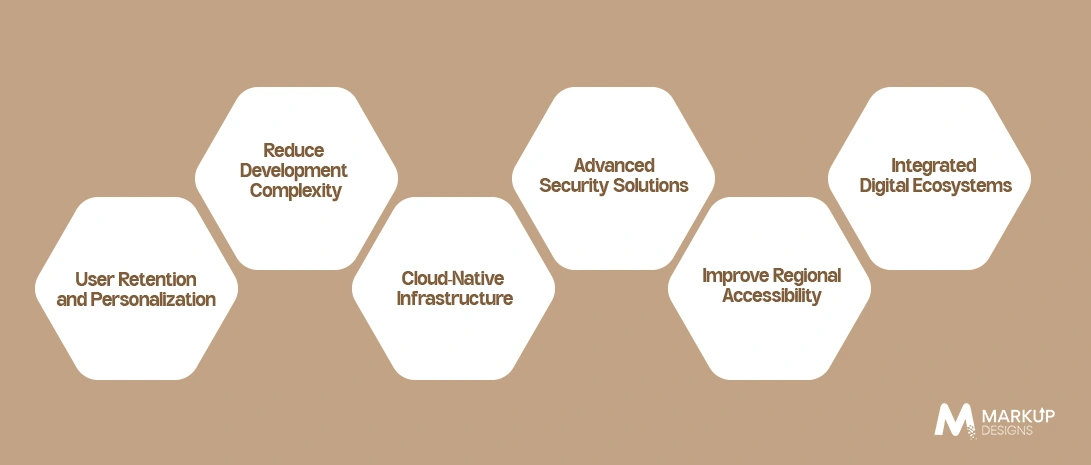
How Mobile App Trends in MENA are Transforming Challenges
As digital expectations continue to rise across the Middle East, modern technologies are helping companies overcome many long-standing mobile app development challenges. Here’s how emerging trends are reshaping the regional app ecosystem:
- AI Will Improve User Retention and Personalization
One of the biggest challenges for mobile apps is keeping users engaged. AI-powered recommendations, smart notifications, and predictive analytics are helping apps deliver more personalized experiences that improve long-term retention and engagement.
- Cross-Platform Development Will Reduce Development Complexity
Managing separate Android and iOS applications often increases development time and operational costs. Modern cross platform app development frameworks now allow faster deployment, easier maintenance, and better scalability using a single codebase.
- Cloud-Native Infrastructure Will Improve Scalability
Scaling applications during rapid user growth has traditionally been difficult for many organizations. Cloud-native architecture is helping companies build flexible ecosystems that support faster updates, real-time performance monitoring, and seamless scalability.
- Advanced Security Solutions Will Strengthen User Trust
Rising cybersecurity concerns remain a major challenge in modern app ecosystems. Technologies like biometric authentication, encrypted APIs, secure cloud environments, and AI-based threat detection are improving user data protection across industries.
- Arabic-First Experiences Will Improve Regional Accessibility
Many older applications struggled to connect with local audiences due to poor localization. Modern mobile app development strategies are solving this challenge through RTL design optimization, multilingual experiences, and culturally relevant interfaces.
- Integrated Digital Ecosystems Will Reduce Fragmentation
Users often dislike switching between multiple applications for different services. Super apps and integrated platforms are solving this issue by combining payments, shopping, messaging, booking, and support systems into unified ecosystems.
Why Markup Designs Should Be Your First Choice for Mobile App Development
Choosing the right development partner plays a major role in the long-term success of any mobile application. Here’s why Markup Designs stands out in the evolving Middle East app ecosystem:
- Strong Expertise in Modern Mobile Technologies
The team specializes in AI integrations, cloud-native infrastructure, scalable backend systems, and advanced mobile architectures aligned with modern mobile app development trends.
- Cross-Platform Development Capabilities
With expertise in cross platform app development technologies like Flutter and React Native, Markup Designs helps companies reduce development timelines while maintaining high performance across Android and iOS platforms.
- Regional Market Understanding
The company understands user behavior, Arabic-first experiences, and localization strategies required for successful digital products in UAE and wider MENA region.
- Scalable and Future-Ready Solutions
Applications are designed with long-term scalability in mind, allowing smooth expansion, feature upgrades, and integration with emerging technologies like AI and IoT.
- Focus on Security and Performance
Modern applications require strong data protection and seamless functionality. Markup Designs prioritizes secure architecture, optimized performance, and reliable user experiences.
- Industry-Wide Development Experience
The company develops solutions across fintech, ecommerce, healthcare, logistics, SaaS, and enterprise platforms, helping organizations adapt to rapidly evolving digital demands.
- User-Centric UI/UX Approach
Beyond development, the team focuses heavily on intuitive design, engagement optimization, and personalized user experiences that improve retention and usability.
- End-to-End Development Support
From strategy and UI/UX design to deployment and ongoing maintenance, Markup Designs provides complete mobile app development support for modern digital ecosystems.
Ready to build a future-ready mobile app for the MENA market?
Create scalable, AI-powered, and user-focused mobile experiences designed for long-term digital growth across the Middle East.

Conclusion
The Middle East is rapidly emerging as one of the world’s fastest-growing mobile innovation markets. Rising smartphone adoption, strong digital infrastructure, and government-led transformation initiatives are accelerating the demand for advanced mobile applications across industries.
Technologies such as AI, 5G, cloud computing, and AI automation are redefining how modern applications are designed and experienced. At the same time, users now expect faster, smarter, and highly personalized digital interactions that prioritize convenience, security, and seamless performance.
As these expectations continue to evolve, companies investing in mobile app development ecosystems must focus on scalable architecture, intelligent features, localization, and long-term adaptability. Trends like AI-powered experiences, and cloud-native infrastructure will continue shaping the future of digital products across the region.
Organizations that embrace innovation early and prioritize user-centric experiences will be better positioned to succeed in the rapidly evolving MENA mobile landscape.
FAQs
1. What are the top mobile app development trends in MENA for 2026?
Some of the biggest trends include AI-powered applications, super apps, cloud-native architecture, 5G-enabled experiences, Arabic-first UI/UX design, and cross platform app development. These technologies are transforming how users interact with digital platforms across the Middle East.
2. Why is UAE becoming a major hub for mobile app development?
UAE has strong digital infrastructure, high smartphone penetration, advanced 5G adoption, and government-backed innovation initiatives. These factors are accelerating investment in mobile app development ecosystems across fintech, healthcare, ecommerce, and logistics sectors.
3. How much does mobile app development cost in UAE?
The cost depends on app complexity, features, technology stack, and scalability requirements. A basic app may cost around $10,000–$25,000, while AI-powered enterprise applications can exceed $150,000.
4. Why are Arabic-first mobile apps important in the Middle East?
Localized experiences improve user engagement and accessibility. Modern Arabic mobile app development strategies focus on RTL design, multilingual support, culturally relevant experiences, and Arabic voice search optimization.
5. Which industries are investing the most in mobile apps in MENA?
Fintech, ecommerce, healthcare, logistics, education, travel, and smart government services are currently among the fastest-growing sectors investing heavily in mobile innovation across the region.
Author's Perspective
The MENA mobile ecosystem is evolving at an incredible pace, driven by rising digital adoption, strong government initiatives, and changing consumer expectations. What makes this region especially unique is the growing demand for intelligent, localized, and highly personalized mobile experiences. In 2026, successful applications will focus not only on functionality but also on scalability, AI integration, security, and Arabic-first experiences. Companies that invest early in innovation and user-centric development strategies will be better positioned for long-term digital growth across the Middle East.
Discuss Your Project NowAjit Kumar Jha
VP - Business Operations
Related Posts

Cost to Build a Mobile App in Qatar...

How Much Does It Cost to Build an...

How to Build a Car Wash App: Development...
Insights Are Valuable & Execution is Priceless
You’ve read about the digital future. Now, let’s build the infrastructure to take you there. Move your strategy from the page to the product.
Design Your Solution Now
Contact Us
Schedule The Appointment At Your Convenience Date And Time.
30 Min
Web Conference
Time Zone
Indian standard time (08:30pm)

Thanks For Getting In Touch!
You’ve Taken The First Step Toward Transforming Your Digital Presence. Our Experts Will Reach Out Shortly To Take It Forward.
Launch Your Dream Project
Provide a brief overview of your project, and our specialists will evaluate your requirements. We will connect with you to explore how the right digital solutions can help you launch faster.