

In Brief
- ML product development is the process whereby a company develops smart digital solutions using data, algorithms, and predictions to enhance automation, decision-making, and customer experience.
- ML product development costs vary depending on such aspects as the complexity of the product, data needs, type of the ML model, technology infrastructure, integration needs, and development skills, among others. The costs of ML product development range from simple to enterprise solutions.
- Developing a successful ML product involves undertaking a structured development process, which includes goal setting, preparation of data, creation of models and their training, implementation of ML solutions, testing, deployment, and optimization, among others.
- There are different types of ML products that companies may develop, such as recommendation engines, predictive analysis systems, NLP solutions, computer vision solutions, fraud detection solutions, and intelligent automation solutions.
- Planning, quality data, competent ML specialists, and a competent partner in ML product development are vital in developing future-proof ML products.
The use of machine learning is not only a technology but is also a way to create intelligent digital products that can bring great benefits for business. From personalized recommendations and predictive analytics to intelligent automation and fraud detection, the number of applications of machine learning products has increased dramatically in different fields of business.
However, developing a machine learning product needs more than just the selection of algorithms and training of a machine learning model. The development process of a machine learning solution involves many aspects like proper planning concerning data, technology, development process, budget, time, maintenance, etc. As opposed to traditional software development, machine learning solutions keep on evolving based on new data and user interaction.
In this blog post, we will discuss all the important things about machine learning product development, including its cost, development process timeline, development planning aspects, development process itself, challenges, and selection of the development company. If you want to learn how to develop a machine learning product, this guide will be useful for you.
What is Machine Learning Product Development?
Machine learning product development is the process of developing digital products that are capable of analyzing data, finding patterns, making predictions, and improving through machine learning algorithms. This technology allows the development of smart products that learn from user behavior, history, and other real-time inputs and do not follow predefined rules like traditional software.
The machine learning product development process includes several phases such as defining business requirements, gathering and preprocessing data, choosing appropriate machine learning algorithms, training, implementation, and improvement of performance.
Machine learning applications can be developed for various objectives, like recommendation engines, smart searching, prediction, automation, fraud prevention tools, and AI-enabled customer experience. Combining software engineering with data science and machine learning skills enables organizations to develop better and more advanced products that make decisions based on data.
Why Businesses are Investing in Machine Learning Products
Businesses in various industries are adopting machine learning technologies due to their ability to automate tasks, make better decisions, and enhance personalization of the user experience. With increasing customer demands, machine learning helps organizations process large volumes of data quickly and efficiently.
Some of the major reasons why companies have decided to use machine learning solutions are:
- Enhancing decision-making: ML solutions can analyze past and current data and help make accurate predictions and better decisions related to business.
- Personalized customer experience: Through recommendation systems, intelligent search engines, and other methods, companies can personalize the user experience.
- Process optimization: Through automation of processes, ML can save time, labor, and effort for companies.
- Improved predictions and analysis: Companies can leverage ML solutions for demand predictions, risk analysis, fraud detection, and analysis of customer behavior.
Across industries from healthcare and finance to retail and manufacturing, machine learning solutions have helped many companies develop their innovative products and gain a competitive edge.
Machine Learning Product Development Cost
The cost of developing machine learning application based solutions is determined by several parameters, such as the complexity of the product, data needs, type of models, technology stack used, and the skills of the development team. Unlike standard software solutions, ML projects might need more resources for data gathering, training, testing, and further optimization.
On average, the cost of building an ML product varies between $30,000 and $300,000+.
| Type of ML Product | Estimated Development Cost | Timeline |
| Basic ML-powered Product | $30,000 – $60,000 | 2 – 4 months |
| Medium Complexity ML Product | $60,000 – $150,000 | 4 – 8 months |
| Advanced ML Product | $150,000 – $300,000+ | 8 – 12+ months |
An ML solution that already has existing models and fewer integrations may prove less costly, but an enterprise-level ML solution will prove expensive due to custom models, real-time processes, larger datasets, and security needs.
Understanding the factors influencing cost before starting development helps businesses create realistic budgets and avoid unexpected expenses during the project lifecycle.
Factors Affecting Machine Learning Product Development Cost
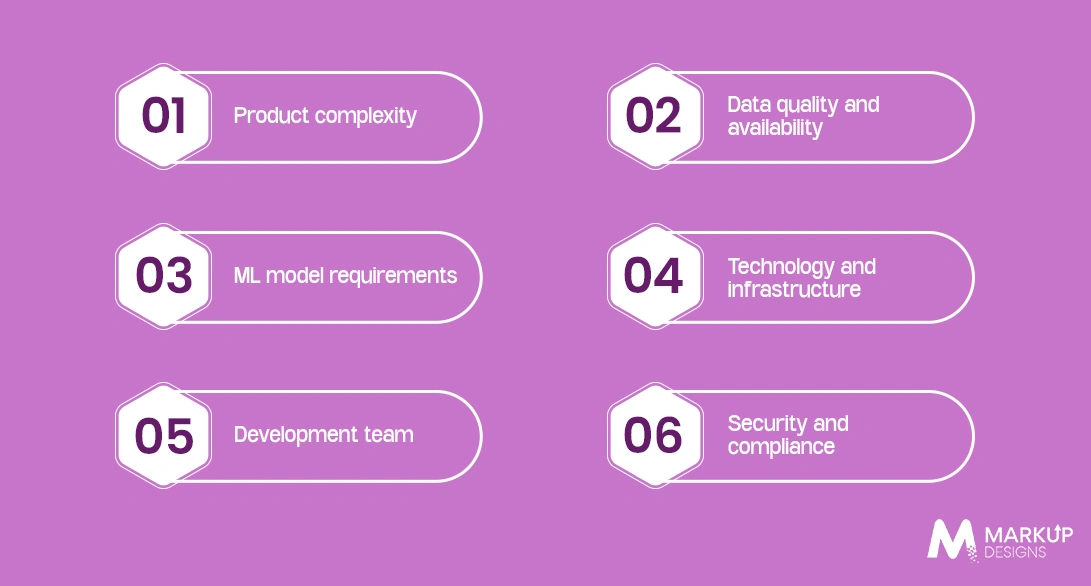
The cost of building an ML-based product is affected by different technical, business, and other considerations. This knowledge will help companies to understand their investment needs and plan development properly.
Product complexity
Product complexity plays an important role in defining development costs. If a business decides to create a product with advanced functionalities, real-time predictions, several integrations, or customized algorithms, the product will need more development time than an ordinary ML product.
Data quality and availability
Data is the basis for an ML product creation. Sometimes companies have to gather, clean, and organize data before they train their ML algorithms.
ML model requirements
Pre-designed models are less expensive, whereas designing and training of machine learning models take extra effort and money.
Technology and infrastructure
Cloud computing platforms, computing power, databases, ML frameworks, and deployment environment become a part of the overall cost of development, particularly for large projects.
Development team
Hiring qualified employees like ML engineers, data scientists, developers, and DevOps becomes a part of the budget according to the product needs.
Security and compliance
Products handling sensitive data may require additional investment in security measures, compliance standards, data protection, and continuous monitoring.
Build a Scalable Machine Learning Product with Expert Development Support
Transform your business idea into an intelligent ML-powered solution with a team experienced in data engineering, machine learning models, and scalable product development.

Machine Learning Product Development Timeline
The timeline required for creating an ML product varies according to variables such as the complexity of the product, availability of data, training of models, testing, etc. Unlike conventional software development, there is some extra time that goes into the creation of an ML product.
On average, development of a machine learning product takes between 3 to 12+ months, depending on the scope of work.
| Development Phase | Estimated Timeline | Key Activities |
| Discovery & Planning | 2–4 weeks | Define goals, use cases, requirements, and technical roadmap |
| Data Collection & Preparation | 4–8 weeks | Data gathering, cleaning, labeling, and validation |
| ML Model Development | 6–12 weeks | Model selection, training, testing, and optimization |
| Product Development & Integration | 8–16 weeks | Building application features and integrating ML capabilities |
| Testing & Deployment | 3–6 weeks | Performance testing, security checks, and production launch |
| Monitoring & Optimization | Ongoing | Model updates, performance tracking, and improvements |
Planning for a good development strategy assists businesses in minimizing any delays and ensuring that the resulting ML product is accurate and performs well. Prototype or proof of concept validation at an early stage can also assist in detecting potential problems during development.
Machine Learning Product Development Process
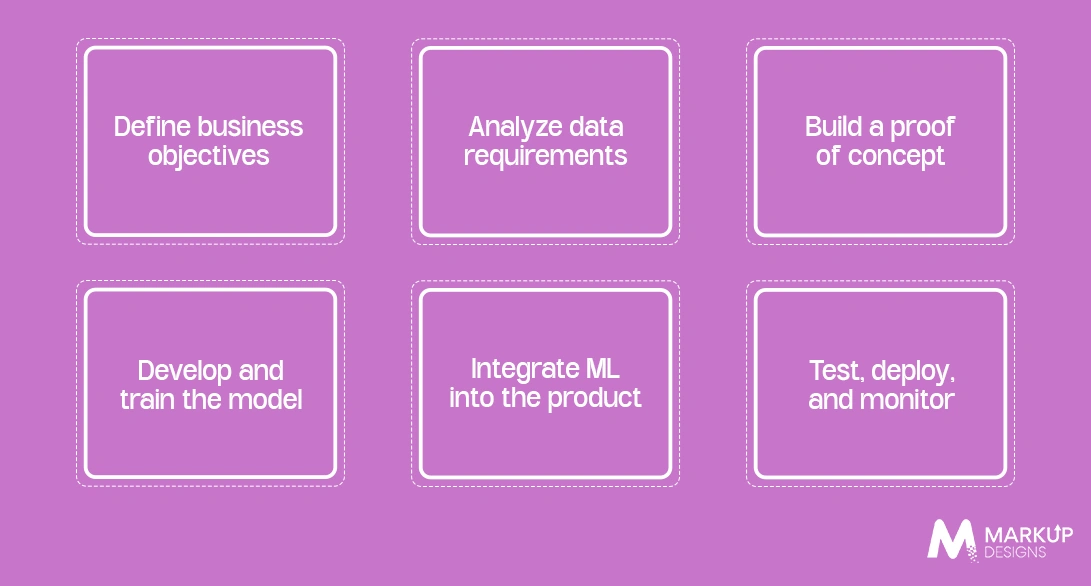
A successful machine learning solution involves a structured process that involves both business strategy and technical aspects such as data and model. All stages have their own roles in ensuring that the end product provides accurate solutions to the users.
Define business objectives
This involves knowing the problems that the machine learning product will help to solve for the businesses. The business goals, target audience, desired results, and KPIs should be determined.
Analyze data requirements
Data is an essential element for developing machine learning products. The development team assesses the existing data sources, analyzes data gaps and prepares data sets by collecting, cleansing, labeling, and processing them.
Build a proof of concept
A proof of concept (PoC) is necessary to confirm whether the chosen machine learning method will help achieve the expected outcomes.
Develop and train the model
In this stage, ML engineers will pick the right algorithms and train the model on the basis of the provided dataset.
Integrate ML into the product
After the development of the model, the integration process takes place using API’s, back-end systems, databases, and front-end systems to build an ML-driven product experience.
Test, deploy, and monitor
This last step entails testing of product functionality, model performance, security, and other parameters before its deployment. Once deployed, the product should be continuously monitored to maintain model reliability.
Types of Machine Learning Products You Can Build
Machine Learning can be used across different industries in order to develop intelligent products that help in automating processes and improving decision-making. Based on the business objectives and customer requirements, companies can develop multiple products using machine learning technology.
Recommendation Systems
Recommendation engines make use of user behavior, preferences, and interaction history in order to provide recommendations related to products, content, and services. Recommendation engines are used in the eCommerce industry, entertainment, and other industries.
Predictive Analytics Products
Predictive analytics solutions use historical and real-time data to forecast future trends and customer behavior.
NLP Products
The NLP-based products are aimed at enabling machines to understand human language. They can be AI chatbots, virtual assistants, sentiment analysis software, and intelligent searches.
Computer Vision Solutions
Computer vision-based products are able to detect patterns within pictures and videos and automate tasks in sectors like healthcare, manufacturing, and security.
Fraud Detection Software
Financial organizations and other firms make use of machine learning-based fraud detection software for identifying risks and threats.
Intelligent Automation Software
The intelligent automation software makes use of machine learning technology for automating different processes in business organizations.
Challenges in Machine Learning Product Development
Developing a machine learning product involves various hurdles that have to be handled during planning and execution of a business. Adequate planning and employing the right approach, team, and technology can help in overcoming these problems.
1. Availability and Quality of Data
There is a need for lots of relevant and quality data when developing ML models. Low-quality and incomplete data can negatively affect the results and development process.
2. ML Approach Selection
Choosing the right algorithm, model architecture, and development approach can be challenging. The wrong selection may impact accuracy, scalability, and overall product performance.
3. High Cost of Development
ML applications require investments in data preparation, computational power, specialized workforce, and optimization, which increases total costs.
4. Finding Skilled ML Experts
Development of machine learning solutions necessitates data scientists, artificial intelligence engineers, software engineers, and MLOps specialists.
5. Accuracy and Quality of Models
For models to produce accurate results, their constant testing and optimization is required due to new incoming data.
6. Product Launch and Beyond
Product launch is not the end of the development process. Further, there is a need for monitoring, updates, security maintenance, and performance enhancement.
How to Plan a Machine Learning Product Successfully
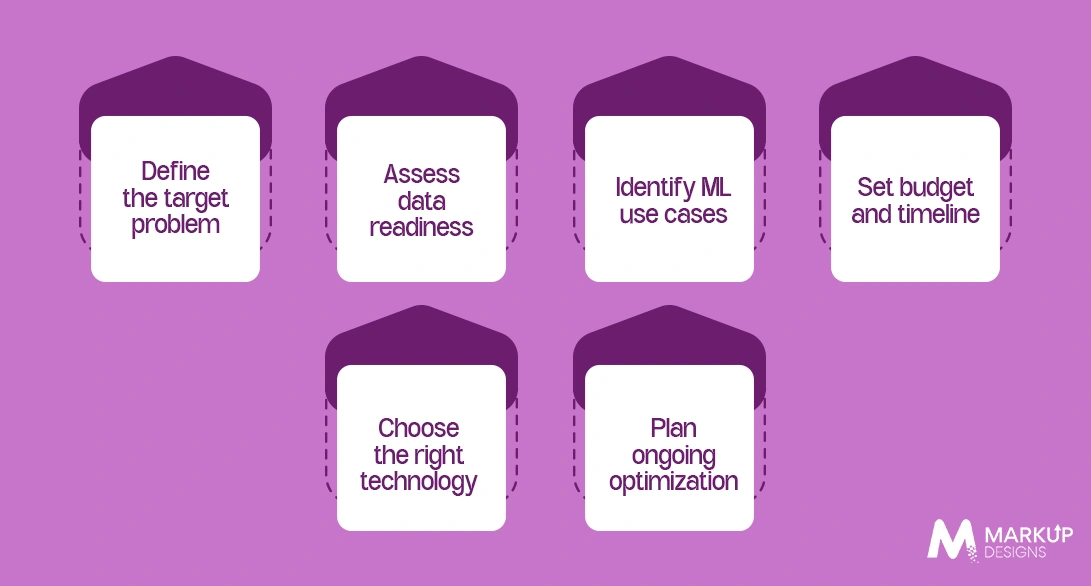
Before the development of machine learning products, there should be a proper strategy prepared. This strategy will enable businesses to control costs and risks and produce a product that will bring certain results.
Define the target problem
Define the problem that requires solving with the help of your machine learning product. It will help you determine what kind of technological solution to use.
Identify ML use cases
Identify the fields where machine learning technology will have the greatest effect – automation, prediction, personalization, decision-making, etc.
Assess data readiness
Before you start the process of training your model, ensure that you have considered the availability and readiness of the data.
Set budget and timeline
Assess how difficult your project would be, and determine the budget and timeline realistically based on that assessment.
Choose the right technology
Based on what your product is about and its requirements, choose suitable technologies, databases, and development frameworks.
Plan ongoing optimization
All ML products require continuous optimization. Consider how to achieve this during the planning phase.
Read Also: What Businesses Should Evaluate Before Hiring AI Consultants
How to Choose a Machine Learning Product Development Company
Selection of a suitable development partner is a critical aspect of implementing your machine learning product. The selected company must have technical expertise along with an understanding of the business objectives.
The following factors should be considered while choosing an ML development company:
Experience in ML Development
Look into the experience of the company in the development of machine learning-based apps, AI-driven solutions, and domain-specific products.
Robust Data Engineering Skills
An experienced company must have a good understanding of data collection, processing, management, and modeling approaches.
Skilled Technical Team
Ensure that the company has competent ML engineers, data scientists, software engineers, and cloud experts.
Good Development Approach
Select the company with a well-defined approach to discovery, prototyping, development, testing, launch, and support.
Security and Scalability of Solutions
The solutions developed by the developer should be secure, scalable, and accommodate any future expansion.
Post-Launch Support and Monitoring
Post-launch support and monitoring are key to the accuracy and efficiency of machine learning products.
Build Your Next Machine Learning Product With Experienced Developers
Turn your innovative idea into a scalable machine learning solution with expert guidance, advanced technologies, and a proven development approach. From ML strategy and model development to deployment and optimization, our team helps businesses create intelligent products that drive measurable results.

Conclusion
The development of Machine Learning products is the best investment that enterprises could make. However, in order to produce a successful machine learning product, there are many factors that must be taken into account, among which are budgeting, time, data, technology, and continuous development.
All stages, from setting the goals for the enterprise to preparing the right data, through modeling, feature integration, and tracking the performance of the product, are important for the success of the final product.
No matter whether you are creating a new machine learning product or you wish to make your existing product more intelligent with the use of machine learning, working with professionals in this area will certainly help you in turning your ideas into digital solutions.
FAQs
1. How much does it cost to develop a machine learning product?
The cost of developing a machine learning product generally ranges from $30,000 to $300,000+, depending on product complexity, data requirements, model type, integrations, and infrastructure needs.
2. How long does it take to build an ML product?
A machine learning product can take around 3 to 12+ months to develop. The timeline depends on factors such as data preparation, model complexity, testing requirements, and product features.
3. What factors influence machine learning product development costs?
Key factors include product complexity, data availability, ML model requirements, technology stack, development team expertise, security requirements, and ongoing maintenance.
4. What type of data is required for developing an ML product?
ML products require relevant, accurate, and properly prepared datasets. The amount and type of data depend on the specific use case, model requirements, and expected outcomes.
5. Should businesses build custom ML models or use existing models?
It depends on project requirements. Existing models can reduce development time and cost, while custom models provide more control and are better for unique business needs.
Author's Perspective
Machine learning product development is no longer exclusive to large technology companies. Businesses of all sizes can use ML to solve complex challenges, automate processes, and improve customer experiences. However, successful ML products require more than model development. They depend on clear business goals, quality data, technical expertise, and continuous optimization. A strategic approach helps control costs, reduce risks, support scalability, and turn machine learning into a foundation for sustainable innovation and growth.
Discuss Your Project NowAjit Kumar Jha
VP - Business Operations
Related Posts

How Artificial Intelligence Is Changing Mobile Game Development

How to Build Production-Ready Applications with AI Coding...

Cost, Benefits & Business Impact: Generative AI vs....
Insights Are Valuable & Execution is Priceless
You’ve read about the digital future. Now, let’s build the infrastructure to take you there. Move your strategy from the page to the product.
Design Your Solution Now
Contact Us
Schedule The Appointment At Your Convenience Date And Time.
30 Min
Web Conference
Time Zone
Indian standard time (08:30pm)

Thanks For Getting In Touch!
You’ve Taken The First Step Toward Transforming Your Digital Presence. Our Experts Will Reach Out Shortly To Take It Forward.
Launch Your Dream Project
Provide a brief overview of your project, and our specialists will evaluate your requirements. We will connect with you to explore how the right digital solutions can help you launch faster.