
In Brief
- Learn what digital product engineering is and how it differs from software engineering.
- Study the entire digital product engineering lifecycle, including product discovery, architecture planning, product deployment, and continuous improvement.
- Understand how AI, cloud technologies, DevSecOps, and modern engineering techniques are changing product engineering.
- Get to know the best approaches to choose a suitable architecture, operating model, technological stack, and product engineering partner to create efficient digital products.
- Understand how digital product engineering costs are estimated, how to measure ROI, what challenges can occur during the implementation process, and what innovations are being enacted in this sphere.
Digital products serve as the cornerstone of business advancement, customer relations, and operational excellence in all segments. In order for companies to launch products that meet customers’ needs, modernise obsolete systems, or make AI-based platforms, it is critical to build products that change according to the market requirements. Hence, digital product engineering becomes a competitive edge and a basis for business success, and not merely a standard IT service.
While customer needs change and are getting more complex, modern organisations must implement an efficient digital product engineering strategy capable of creating innovative products to deliver results promptly. In this blog, one would find all stages of the digital product engineering process, digital strategies, and modern methodologies describing the digital product engineering process.
This comprehensive guide explores the complete digital product engineering lifecycle, key strategies, modern architectures, AI-powered engineering practices, cost considerations, ROI metrics, and emerging trends for 2026. Whether you are planning a new digital product, modernising an existing platform, or evaluating digital product engineering services, this guide provides the insights needed to make informed business decisions and build future-ready digital products.
What Is Digital Product Engineering?
Digital product engineering is the complete process of development, designing, implementing, and improving digital products. Thus, it combines the strategy/engineering, cloud platform, usage of artificial intelligence, and UX designing in order to come up with a flexible and sustainable solution, which will provide the benefits both in the short and long run.
How Digital Product Engineering Has Evolved
Digital product engineering has transformed from the traditional delivery of products to the innovation process, which includes proper use of Agile, cloud computing technologies, automation, and AI-based systems.
Digital Product Engineering vs Traditional Software Development
The main distinction between the two processes lies in the fact that the traditional software development process is usually focused on creating a product, whereas digital product engineering encompasses the entire process with its continuous optimization.
Digital Product Engineering vs Product Development
Product development touches all aspects of the business process of the product, starting from the idea and ending with the product launch, whereas digital product engineering is primarily focused on the technical development of the product.
Digital Product Engineering vs Digital Engineering
Digital engineering helps to optimize engineering processes by means of digital technologies, while digital product engineering aims at creating and developing digital products only.
Digital Product Engineering vs Platform Engineering
Platform engineering focuses on building the technology foundation, tools, and infrastructure that enable efficient software development. Digital product engineering builds on that foundation to create customer-facing digital products, applications, and digital experiences.
Why Digital Product Engineering Matters for Modern Enterprises
Today’s modern markets require digital solutions that can develop in accordance with consumers’ preferences and changes in the marketplace. Digital product engineering makes it possible for businesses to become more innovative and efficient, which can help maintain their competitive edge based on technological advancement.
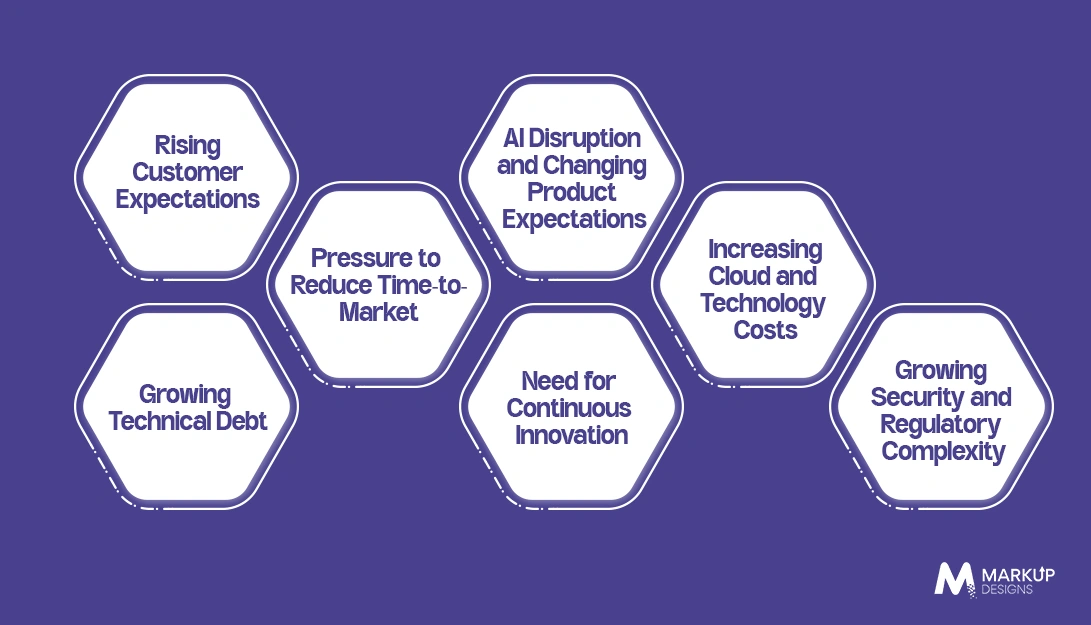
Rising Customer Expectations
Today’s customers expect digital products to be fast, intuitive, secure, and available across multiple devices. Businesses must continuously innovate and deliver seamless user experiences to meet these evolving expectations and stay ahead of the competition.
Pressure to Reduce Time-to-Market
Quick product release enables companies to respond to the changing needs of the market and consumers properly.
Growing Technical Debt
The influence of outdated technology forces many businesses to improve their traditional systems in order to optimise their expenses on maintenance and have a more solid base for advancement.
AI Disruption and Changing Product Expectations
The role of artificial intelligence has increased dramatically over the past few years. Automation of the business processes, individuals’ preferences, and decision-making enabled the development of intelligent solutions.
Need for Continuous Innovation
New regular updates and innovations make all digital products competitive and relevant.
Increasing Cloud and Technology Costs
The right management of cloud software and infrastructure contributes to the overall optimisation of technological calculations.
Growing Security and Regulatory Complexity
Embedding security and compliance throughout the engineering lifecycle helps protect data and meet regulatory requirements.
Is Your Business Ready for Digital Product Engineering?
Before utilizing digital product engineering offerings, companies should evaluate their strategy, technology, workforce, and processes. A readiness assessment allows for understanding of strengths, issues, and focus areas for successful product implementation.
Assess Product Strategy Maturity
You should ensure that product vision, goals, and roadmap comply with the business strategy and user requirements.
Evaluate Technology and Architecture Readiness
Determine whether existing technology is efficient enough to help in growing, scaling, and being flexible.
Review Data and AI Readiness
Check the quality of the data, AI capabilities, and governance policies before depending on intelligent solutions.
Measure Engineering and DevOps Maturity
You are required to analyze agile practices, automation, CI/CD process, and interaction within engineering teams.
Identify Skills and Talent Gaps
You should find out whether your personnel have the right skills in cloud, AI, security, and product engineering.
Assess Security and Compliance Readiness
Establish whether SEC, data protection, and regulatory needs are taken into consideration at all stages of the product life cycle.
Evaluate Product Governance and Funding Models
Determine all models of product ownership and decision-making needed to successfully manage products over the long term.
Digital Product Engineering Readiness Scorecard
| Assessment Area | Ready? |
| Product strategy and roadmap | ✓ / ✗ |
| Modern technology architecture | ✓ / ✗ |
| Data and AI capabilities | ✓ / ✗ |
| Agile and DevOps maturity | ✓ / ✗ |
| Skilled engineering teams | ✓ / ✗ |
| Security and compliance | ✓ / ✗ |
| Governance and funding model | ✓ / ✗ |
The Digital Product Engineering Lifecycle
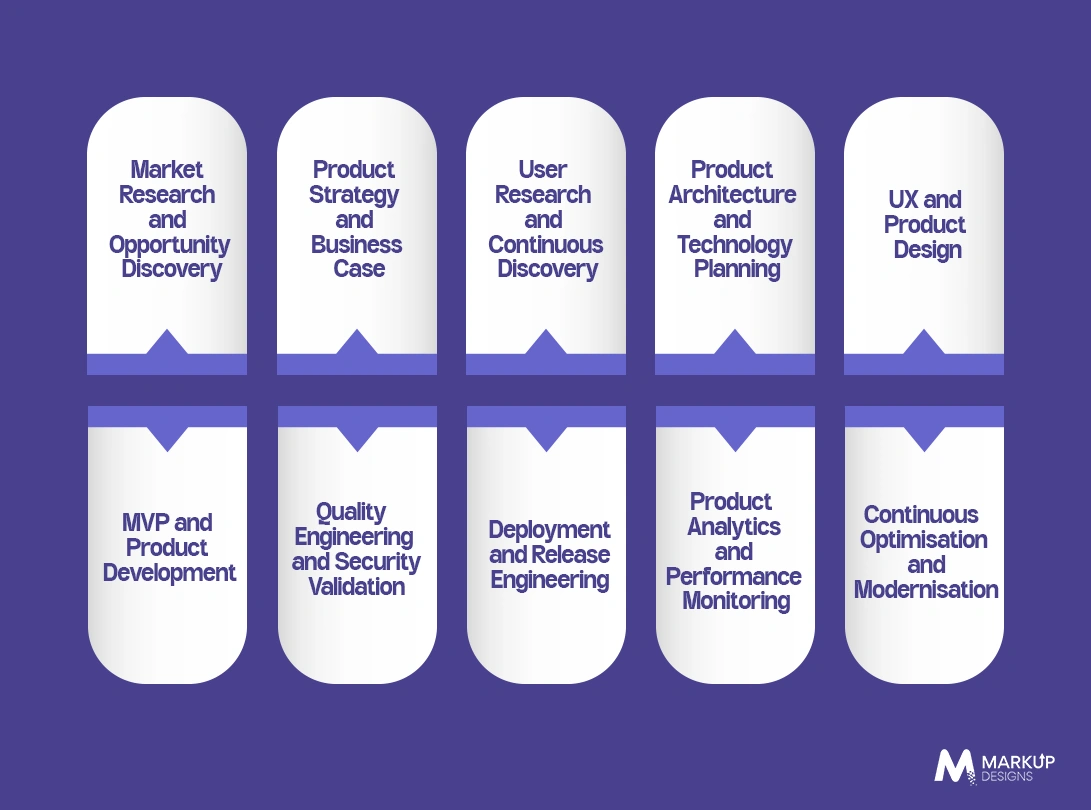
The digital product engineering lifecycle ensures that products always improve, starting from understanding the idea to improving the product after it has been launched.
Step 1: Market Research and Opportunity Discovery
The first step is to discover the opportunities that lie in the market.
Step 2: Product Strategy and Business Case
The next step is to formulate the product strategy and analyze the business requirements.
Step 3: User Research and Continuous Discovery
In this stage, a comprehensive study of the target audience is done.
Step 4: Product Architecture and Technology Planning
A few steps involved in this phase are the selection of the architecture and technology stack.
Step 5: UX and Product Design
It is necessary to get the UX design done that aligns perfectly with the business needs.
Step 6: MVP and Product Development
The next step includes the product development stage, in which the basic product will be launched.
Step 7: Quality Engineering and Security Validation
Quality testing involves testing on many parameters, including performance, security, and usability.
Step 8: Deployment and Release Engineering
In this stage, the product is deployed and released in the market.
Step 9: Product Analytics and Performance Monitoring
The real-time product analysis contains checking different aspects such as the usage, customer behavior, and product performance.
Step 10: Continuous Optimisation and Modernisation
The last stage deals with improving the product constantly and upgrading it.
How to Build a Digital Product Engineering Strategy
A good product engineering strategy will ensure that the product is in line with the company’s goals, its investments in technology, and the needs of its customers.
Clarifying Business Outcomes and Product KPIs
It is important to establish measurable targets and KPIs that can help measure how successfully a product will perform.
Prioritise the Right Product Opportunities
One has to focus on those initiatives that will bring the most value to the customers as well as the business.
Map Customer and Employee Journeys
The existing technology solution should be reviewed to identify areas for improvement.
Assess the Existing Technology Estate
It is important to determine the strategy that will allow scaling the product accordingly.
Define the Target Architecture
A good funding model for the product should be identified.
Making the Right Governance Decisions
It is necessary to determine ownership and responsibility.
Establishing a Roadmap for the Transformation Process
A roadmap with defined stages of development should be drawn up in order to achieve the main results of the transformation process.
Core Capabilities of Modern Digital Product Engineering
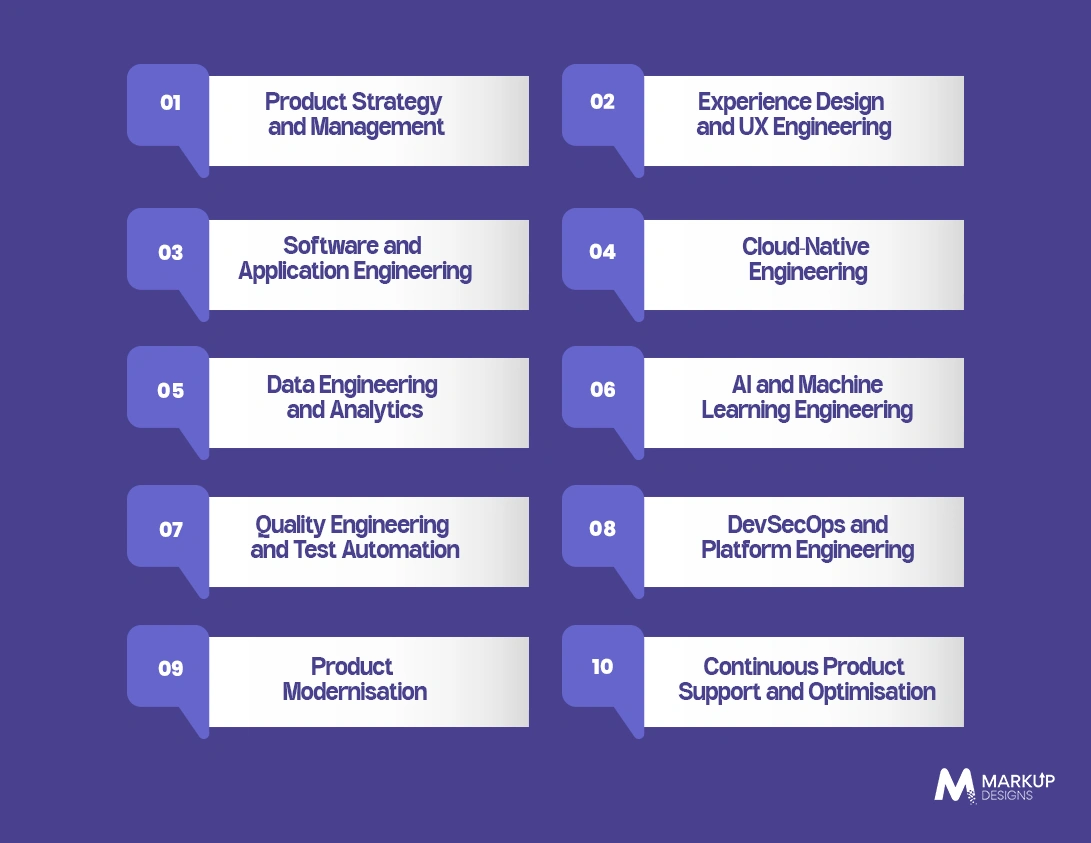
Digital product engineering is composed of different elements that make it possible for businesses to create, improve, and deliver products digitally.
Product Strategy and Management
Understanding the vision of the product that relates to the business strategy gives a nice view of what should be done first.
Experience Design and UX Engineering
Designing the interfaces of the products should be done in a way that leads to the best user experience possible.
Application and Software Engineering
Making sure about securing, scalable, and performant software
Cloud-Native Engineering
Creating applications on the cloud helps to create a smooth product.
Data Engineering and Analytics
Finding new ways of using data helps in decision-making and making money out of it.
Artificial Intelligence and Machine Learning
Including AI concepts in the product makes it possible for machines to learn new habits.
Quality Engineering and Test Automation
Ensuring that the product stays in good condition through feature-preventing techniques.
DevSecOps and Platform Engineering
Including security, automation, and continuous development into the product process.
Product Modernisation
Making upgrades to the complex product leads to the growth and development of the new product. Continuous Support and Optimization
Continuous Product Support and Optimisation
Monitor, enhance, and optimise products to deliver long-term business value.
Architecture Patterns for Scalable Digital Products
The right architectural decision will ensure that the digital product is scalable, secure, and maintainable as business requirements change over time.
Modular Monolith versus Microservices
There is a choice between picking a unified architecture or having deployable services depending on their complexity.
Composable Architecture
Applications are built out of reusable components, which improves their flexibility and speed.
API First Product Architecture
APIs are designed first in order to facilitate the integration of other platforms.
Event Driven Architecture
Communication between services is done in real-time using event-driven workflows.
Cloud Native Architecture
Applications are developed for cloud scalability, resilience, and automatic deployment.
Multi-Tenant SaaS Architecture
A single platform is used for many clients while maintaining separate databases.
Edge and IoT Architecture
Data must be processed close to selected devices so that performance can be improved.
AI Native Product Architecture
The product must be developed to accommodate AI-boosted features from scratch.
How to Choose the Right Architectural Pattern
Choose the right architecture in consideration of its scalability, the aims of your business, security, budget, and expected growth.
How AI Is Transforming Digital Product Engineering
AI is revolutionizing all stages of the digital product engineering process and enables companies to develop better products more quickly and efficiently.
AI for Product Discovery and Marketing Research
Study consumer behavior and market trends to discover new opportunities.
AI-Assisted UX and Prototyping
Create innovative design concepts and prototypes to speed up the design of a product.
AI-Copilots For Software Engineering
Support developers with programming, debugging, and documentation.
AI-Powered Quality Engineering
Use automation tools to enhance software quality and reduce releases.
AI for Product Analytics and Personalization
Create premium user experiences through real-time insights.
Generative AI in Digital Products
Develop intelligent functionalities like chatbots, automated content generation, and virtual assistants.
Agentic AI in Product Engineering
Use AI agents in complex workflows to automate the entire task.
AI Governance and Model Monitoring
Keep AI systems under strict control to ensure accuracy and fairness.
Human Oversight in AI-Assisted Engineering
Ensure human input in the process for the purpose of quality improvements and risk minimization.
The Modern Digital Product Engineering Technology Stack
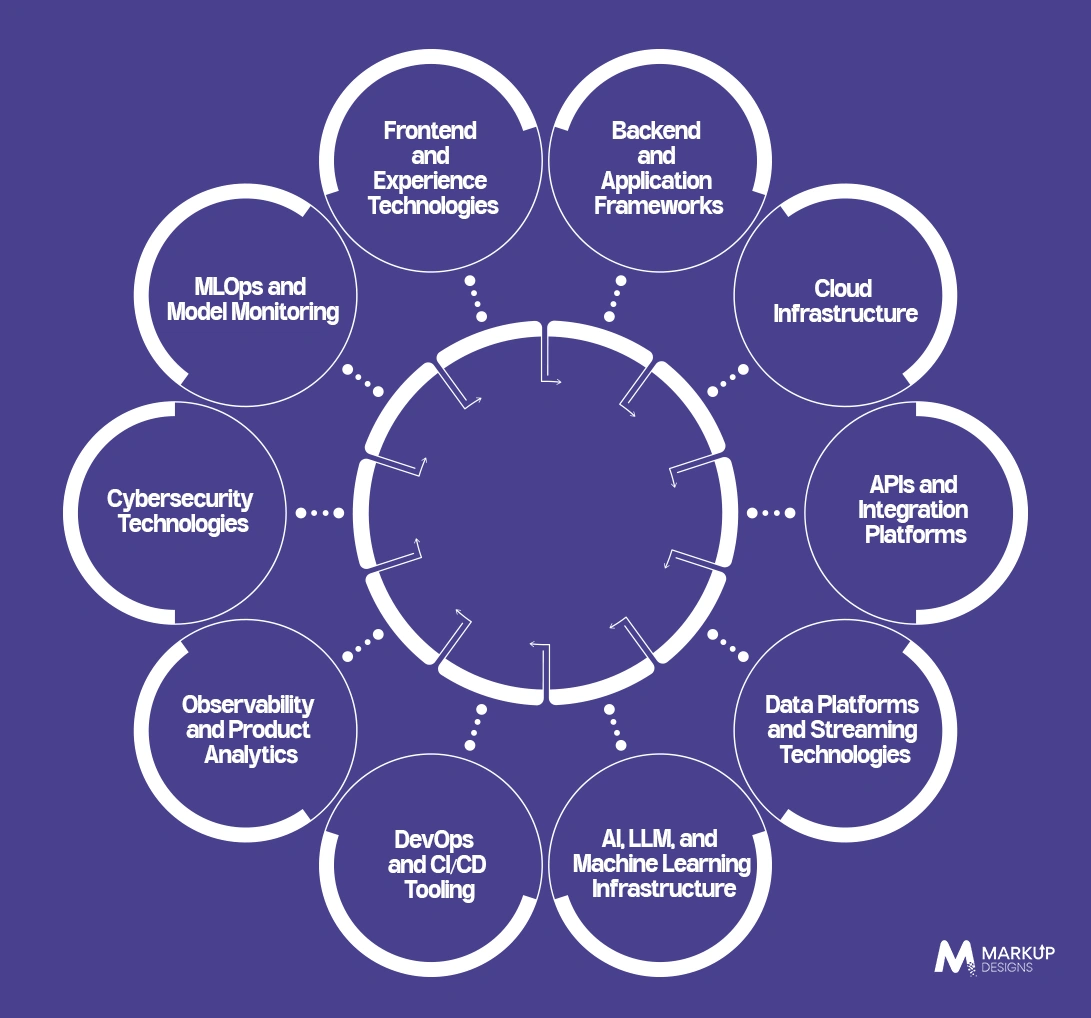
The technology stack is critical in offering in practice the abilities that support scalable and future-focused products.
Frontend and Experience Technologies
Achieve responsive interface solutions that offer a seamless user experience.
Backend and Application Frameworks
Create secure business logic that runs digital applications.
Cloud Infrastructure
Use of cloud technologies to enhance quality and scalability.
APIs and Integration Platforms
Make use of secure integration of applications and services through APIs.
Data Platforms and Streaming Technologies
Manage, process, and analyse real-time data streams to power faster decisions, personalised experiences, and intelligent business operations.
AI, LLM, and Machine Learning Infrastructure
Support artificial intelligence models based on the necessary infrastructure for both training and deployment.
DevOps and CI/CD Tooling
Automate processes of building, testing, and software delivery.
Observability and Product Analytics
Watch the performance and the system’s health.
CyberSecurity Technologies
Ensure confidence in application security through threat detection, identity management, etc.
MLOPS and Model Monitoring
Manage artificial intelligence models through their deployment process.
Product Modernisation as a Core Engineering Strategy
Modernisation of digital products leads to enhanced output, reduced technical debt, and supports innovation in the future.
When Should an Enterprise Modernise a Digital Product?
When the legacy systems hinder the performance, scalability, or growth of the business, then modernisation is required.
Rehost vs Replatform vs Refactor vs Rebuild
Assess your existing infrastructure, future goals, and operational requirements to determine whether rehosting, replatforming, refactoring, or rebuilding is the best option.
Breaking Down Monolithic Applications
If a monolithic application is broken into smaller applications, it would allow easier updating in the future.
Modernising Legacy Data and Integrations
Data and integration systems must be modernised in order to align with the current applications and analytics.
Reducing Technical Debt without Disrupting Operations
The process of modernisation should not interrupt the operations of the company and cause high risks.
Measuring Modernisation Success
The measurement of modernisation success is based on the fact that performance, cost, scalability, and customer satisfaction will improve.
Security, Privacy, and Compliance by Design
Security and compliance must be integrated into each stage of the digital product engineering lifecycle.
DevSecOps Across The Product Lifecycle
Incorporate security at the beginning of all product creation and deployment activities.
Secure Software Supply Chain
Protect products from security threats by securing the software supply chain process at every step.
Identity And Access Management
Manage user access for different levels of system functionality.
API And Cloud Security
Ensure that all applications and cloud infrastructure can withstand security threats and challenges.
Data Privacy By Design
Make sure that products are designed in a way that protects the user’s data privacy.
AI Security And Compliance
Provide for the security of AI systems by implementing all necessary security measures and principles.
Industry-Specific Compliance Management
Ensure that all compliance requirements related to the industry and region of operation are satisfied.
Digital Product Engineering Operating Models
Choose the right operating model to enable collaboration between different teams and speed up the work process.
Project-Focused Vs Product-Centric Operating Models
While a project-focused operating model relies solely on project completion and thus is limited in time and scope, the product-focused operating model is a long-term, oriented, and flexible option.
Cross-Functional Product Teams
Integrate different teams (product development, design, engineering, business) for better efficiency.
Platform Teams and Shared Engineering Capabilities
Make sure that you provide access to the necessary tools to all involved parties, helping them efficiently perform the task.
Product Funding vs Project Funding
Project funding ends when delivery is complete, whereas product funding supports continuous innovation, maintenance, and feature enhancements. This approach ensures digital products evolve with changing business and customer needs.
Centralised vs Federated Product Engineering
A centralised model provides consistent governance and standards, while a federated model gives individual teams greater flexibility. The right choice depends on organisational size, collaboration needs, and decision-making.
Internal Teams vs External Engineering Partners
Internal teams offer deeper business knowledge, while external partners provide specialised expertise and faster scalability. Many organisations combine both models to balance control, cost, and delivery speed.
Building a Product Engineering Centre of Excellence
A Product Engineering Centre of Excellence establishes common standards, governance, and best practices across teams. It improves collaboration, accelerates delivery, and drives continuous innovation across the organisation.
Choosing the Right Digital Product Engineering Approach
The right approach is determined by the goals of the business, its current systems and technologies, its budget, and plans for growth.
When to Develop Custom Products?
Choosing custom products is beneficial due to business specifications and functionalities.
When to Buy Existing Products?
Choosing buying existing products makes for a more rapid deployment and less economic investment.
When to Make Improvements to Existing Products?
Making improvements is necessary whenever there are limitations imposed by existing technologies.
When Should One Collaborate with Experts in Product Engineering?
Collaboration with experts helps the business shorten the time of delivery and obtain the needed professional knowledge and experience.
How Much Does Digital Product Engineering Cost?
The costs of digital product engineering depend on its requirements and modular structure, types of functionalities, and technologies. However, in the UAE, it can cost from AED 120 thousand (for the minimum viable product) to AED 3 million (for the enterprise), without consideration for optimization and maintenance costs.
The right investment depends on long-term business objectives rather than development alone.
Typical Cost by Product Complexity
- MVP: AED 120,000–350,000
- Mid-scale digital product: AED 350,000–900,000
- Enterprise digital platform: AED 900,000–3,000,000+
Expense Breakdown Across the Engineering Life Cycle
Elucidate how the discovery stage, UX, architecture, development phase, testing, deployment phase, and all cost drivers for the whole venture are taken into account.
Major Cost Drivers
Costs related to features, integrations, infrastructure, implementation of AI, security, compliance, and, of course, the size of the engineering team determine the cost in a significant way.
MVP vs Enterprise Product Cost
An MVP allows for testing the initial ideas with a smaller budget, while enterprise solutions demand higher costs due to their scalability, integration, governance, and security components.
New Product vs Modernisation Cost
The cost of modernising any existing product is usually 30-50% less than building it from the ground up, taking into account the age of legacy systems.
Cost of Integrating AI Technologies
Implementing AI technologies like chat-bots, recommendation engines, predictive analytics and LLM integrations can increase the cost of both development and infrastructure significantly.
Cloud Infrastructure and FinOps
Expenses on the cloud depend on hosting, storage, APIs, computing power, monitoring, and regular optimization.
Expenses on Security and Compliance
Any industry, including healthcare, financial, and governmental organizations, requires additional expenditure on safety, auditing, and regulatory hygiene and relevant compliance.
Ongoing Product Engineering Expense
Firms need to calculate 15-25% of the total amount of funds spent on creating the product for the maintenance, improvements, and optimizations in the process.
Total Cost of Ownership
Evaluate development, infrastructure, licensing, AI services, maintenance, security, and operational costs to understand the complete long-term investment.
How to Measure Digital Product Engineering ROI
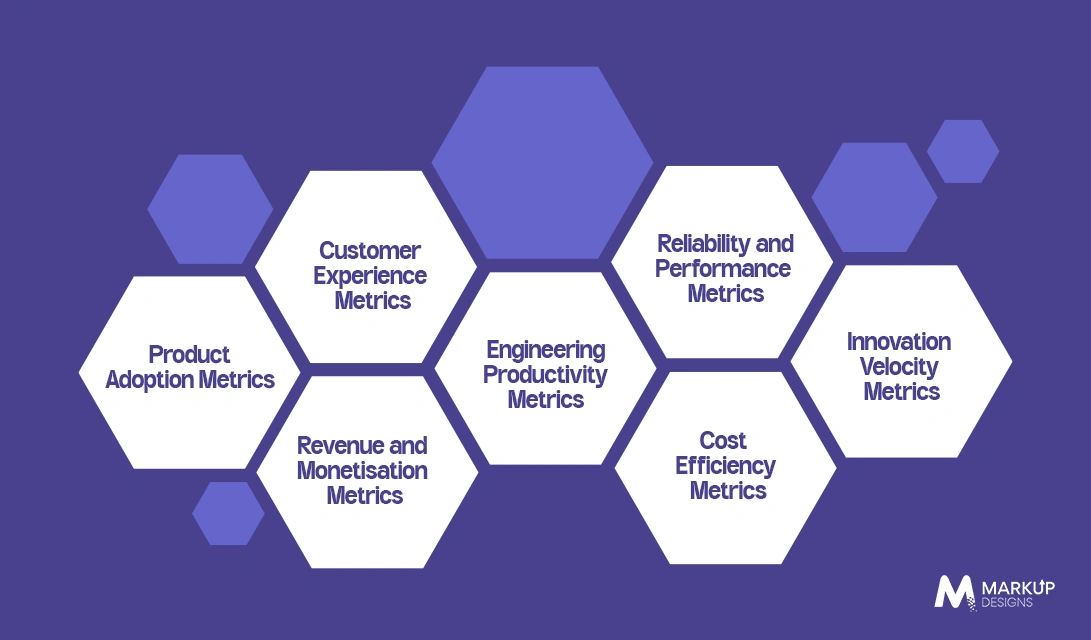
Measuring ROI helps businesses evaluate the success and long-term value of their digital product engineering investments.
Product Adoption Metrics
Measure user growth, engagement, and feature adoption.
Customer Experience Metrics
Track customer satisfaction, retention, and user feedback.
Revenue and Monetisation Metrics
Evaluate revenue growth and product profitability.
Engineering Productivity Metrics
Assess development speed, delivery efficiency, and team performance.
Reliability and Performance Metrics
Monitor uptime, response times, and system reliability.
Cost Efficiency Metrics
Measure infrastructure efficiency and operational savings.
Innovation Velocity Metrics
Track how quickly new features and improvements reach customers.
Recommended KPIs
- Time to market
- Deployment frequency
- Lead time for changes
- Change failure rate
- Product adoption
- Feature utilisation
- Customer retention
- Revenue per user
- Cloud cost per transaction
- Technical debt reduction
Common Digital Product Engineering Challenges and How to Solve Them
While digital product engineering offers significant business value, organisations often face challenges that can delay delivery and impact product success. Addressing these issues early helps improve outcomes and maximise ROI.
Unclear Product Strategy
Establish definitive corporate objectives, customer expectations, and a solid product development strategy.
Legacy Systems and Technical Debt
Renew obsolete software to enhance performance, scalability, and competitiveness.
Poor Data Readiness
Set up solid data pipelines for better decision-making.
Fragmented Product and Engineering Teams
Encourage collaboration between product and engineering teams.
Cloud Cost Overruns
Apply FinOps principles for better cloud management.
Talent and Skills Gap
Spend on training and recruiting qualified engineers.
AI Governance Risks
Create procedures for safe AI development.
Security and Compliance Complexity
Ensure security and compliance during the whole process of product development.
Low User Adoption
Lean towards a user-centric approach to design.
Struggle with Measuring Product ROI
Monitor key indicators to analyze product performance.
Digital Product Engineering Maturity Model
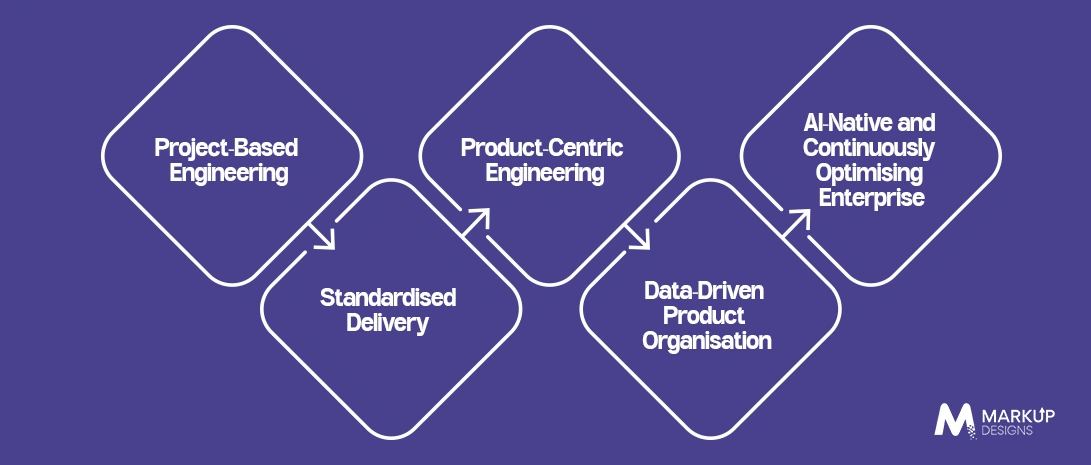
This model allows organizations to assess their current situation and define steps towards digital maturity.
Level 1: Project-Based Engineering
Software delivery is based on the realization of individual projects without long-term planning.
Level 2: Standardised Delivery Model
The teams work consistently with uniform processes, Agile methods, and product delivery standards.
Level 3: Product-Centric Engineering
Cross-functional teams keep improving the product in response to customer reviews.
Level 4: Data-Driven Product Organisation
The business decisions are dependent on analytics, automation, and customer observations.
Level 5: AI Native and Continuously Optimising Enterprise
The usage of Artificial Intelligence, automation, and continuous improvement of the processes drives the innovation development throughout the lifecycle.
Digital Product Engineering Implementation in Different Industries
The implementation of digital product engineering in business allows companies to boost innovative processes and enhance customer engagement in various industries.
Banking
Create digital banking services, internet banking solutions, and payment systems.
Healthcare
Create telemedicine platforms, customer portals, and healthcare applications based on Artificial Intelligence.
Retail
Create individualized shopping experiences and omnichannel commerce platforms.
Manufacturing
Create smart factories, predictive maintenance technologies, and connected devices.
Logistics
Optimize logistics fleet, warehouses, and transportation tracking.
Automotive
Create a connected vehicle platform and intelligent mobility solutions.
Energy
Build smart energy management systems and digital monitoring platforms.
Entertainment
Create streaming services and provide a personalized user experience.
How to Choose a Digital Product Engineering Partner
Choosing the ideal digital product engineering firm is imperative in developing a secure digital product meeting future requirements.
Evaluate Product Strategy Capabilities
Look for a partner who couples technology with your business objectives.
Review Architecture and Modernisation Expertise
Look for knowledge of large-scale architecture and legacy transitioning.
Assess AI and Data Engineering Skills
Use experience in AI, analytics, and modern data platforms.
Examine Industry Experience
Choose partners with experience and history in the industry.
Review Security and Compliance Maturity
Make sure there is no breach of privacy and that delivery is maximally compliant.
Evaluate Delivery and Governance Models
Assess project governance, communication, and standards in delivery.
Review IP Ownership and Knowledge Transfer
Ask who owns the rights of Intellectual Property and the knowledge transfer of the developed product.
Assess Post-Launch Engineering Capabilities
Choose a partner that aims to provide ongoing service improvement and a perfect product after launch.
Future Trends in Digital Product Engineering
Technology is advancing every day, and companies must adapt to the trends and deliver future products.
AI-Driven Product Architectures
From now on, new product development will involve establishing AI technology from the outset.
Internal Developer Platforms
With self-service capabilities built-in, developer platforms will provide an easier experience for developers in the world of software development.
Testing and Quality Control Automation
Automated testing solutions will help expedite production speed while improving quality in software.
Digital Twins for Product Development
Digital twinning will streamline the product design process through simulations and product deployment monitoring.
Composable Enterprise Platforms
Having modular capabilities will help make any business idea more robust by making it more flexible.
FinOps and Engineering Economics
Businesses will focus on maximizing their engineering resource use while reducing their cloud costs.
Green Software Development
Sustainable development practices will minimize energy consumption and environmental impact.
Convergence of Software, Data, and AI Roles
The use of software, data, and AI specialists in product development will be on the rise.
Why Choose Markup Designs for Digital Product Engineering?
Building an effective digital product requires the involvement of more than a skilled technical person. There is a requirement for competent partners who have a thorough understanding of the market business strategy, as well as user requirements and modern inventions. To keep the good name of Markup Designs, we provide our clients with a full range of digital product engineering services. These include the product development stage and UI/UX design, which together lead to the development of a modern digital product. The services are provided in a flexible way to meet the specific needs of the clients, which may vary according to the conditions of the company.
Make Your Digital Product Concept a Reality
Leverage Markup Designs’ expertise to create scalable, AI-based, and future-proof digital products. We assist organisations to enhance their innovations, revolutionise their old systems, and offer extraordinary digital solutions for driving the success of their business.

Conclusion
Digital product engineering has become an important means of business development. Modern technologies make it possible to develop more effective products of high quality with the help of special technologies.
Businesses can benefit from using contemporary engineering practices in combination with artificial intelligence, cloud technology, and data-guided decision-making for the purposes of delivering products promptly, augmenting customer satisfaction, and attaining sustainable growth in profit. Working with a qualified company that specializes in digital product engineering will guarantee that you make good use of the knowledge in keeping the business up-to-date, minimizing risks, and maximizing long-term profitability.
FAQs
1. What does digital product engineering mean?
Due to the popularity of digital products, digital product engineering has gained in relevance. Digital product engineering is a complex of processes which involves designing, developing, testing, and improving a product using modern tools and techniques.
2. What is the difference between digital product engineering and software development?
Software development has a narrower range of applications in comparison with digital product engineering. The latter refers to the management and planning of all activities related to the product’s development, starting from the work on its strategy and up to the promotion of its improvement.
3. What does the price for digital product engineering include?
The cost of digital products depends on various aspects like complexity of the product, functionality, use of AI, cloud infrastructure, and security requirements.
4. How much time is required to create a digital product?
The period of time for the digital product engineering process depends on certain factors. For instance, a minimal visa product can be made within three to four months, and the creation of a digital product for business use may take 6-18 months, depending on the scope and complexity of the work.
Author's Perspective
The process of digital product engineering is not limited anymore to creating software. Now it is about creating products that evolve continuously with clients’ demands, technological changes, and business objectives. Those companies that use AI, cloud computing technology, and product engineering will be able to implement their ideas faster and succeed in their business.
Organisations that embrace AI, cloud native engineering, modern architectures, and continuous product optimisation are better positioned to innovate faster and stay ahead of the competition. Investing in a well-defined product engineering strategy today lays the foundation for scalable growth, improved customer experiences, and long-term digital success.
Discuss Your Project NowJupinder Singh Arora
Founder and CEO
Related Posts

How to Build an Insurance Portal with CRM,...

Custom Software Development Services in Abu Dhabi for...

Custom Software Development Cost in Bahrain: Factors, Benefits,...
Insights Are Valuable & Execution is Priceless
You’ve read about the digital future. Now, let’s build the infrastructure to take you there. Move your strategy from the page to the product.
Design Your Solution Now
Contact Us
Schedule The Appointment At Your Convenience Date And Time.
30 Min
Web Conference
Time Zone
Indian standard time (08:30pm)

Thanks For Getting In Touch!
You’ve Taken The First Step Toward Transforming Your Digital Presence. Our Experts Will Reach Out Shortly To Take It Forward.
Launch Your Dream Project
Provide a brief overview of your project, and our specialists will evaluate your requirements. We will connect with you to explore how the right digital solutions can help you launch faster.