

In Brief
- In Abu Dhabi, custom software development helps businesses fulfil specific operational responsibilities, streamline processes, and enhance efficiency.
- Key options for custom software development are enterprise software, mobile apps, web apps, solutions applying artificial intelligence, software integration, and cloud tech.
- Various sectors may benefit from custom solutions, including oil and gas, healthcare, banking, real estate, retail, and logistics.
- The development process includes analysis of requirements, planning, software design, building, testing, deploying, and providing technical support.
- To select a relevant software partner for the development, one needs to check technology, experience in specific industries, level of security, scalability, and ongoing support.
Abu Dhabi businesses are increasingly implementing digital solutions to optimize business processes, tackle complicated workflows, and meet the requirements of customers. Nevertheless, ready-made software may not be perfectly suitable for individual business processes, integration issues, and long-term development plans. Custom software development solves the problem by making it possible for businesses to create products corresponding to specific business requirements, industry standards, and business needs.
Custom software comes in many forms, from management solutions and customer interfaces to cloud computing and AI technologies. The right custom software development strategy also means that integration with current business processes, enhanced security, and scalable applications are all part of the process. If you are in Abu Dhabi and are looking for the right partner in software development, you need to make sure you go for one with a record of success.
Why Do Businesses in Abu Dhabi Need Custom Software Development?
Companies in Abu Dhabi come from various industries and have different challenges to tackle, as they are subject to different requirements posed by regulatory bodies, workflow needs, and customer expectations. Custom software development means that businesses can focus on their unique requirements and boost their efficiency through the implementation of suitable digital tools.
Addressing Unique Business Requirements
Standard products may have many basic features, but they do not provide specific functions needed by the company to carry out all processes. Custom software development in Abu Dhabi means that you can get features, roles, reporting systems, and other processes that are in accordance with your needs, meaning that there will be no need to find alternatives.
Improving Operational Efficiency Through Automation
Manual processes can increase administrative workloads, delay decisions, and create inconsistencies across departments.
Custom software can automate repetitive tasks such as invoicing, inventory tracking, reporting, and approval workflows, allowing teams to focus on higher-value activities and improve productivity.
Integrating Existing Business Systems
Many businesses utilize different platforms for accounting, customer relationship management, enterprise resource planning, and inventory management. With custom software, integration can be implemented between the existing systems, optimizing data sharing and minimizing duplicate data submissions.
Supporting Business Growth and Scalability
Business processes develop and as such, software must accommodate an increasing number of transactions and users. Custom solutions can be developed using flexible architecture, scalable modules, as well as the integration of other systems to grow together with businesses without the need for replacing their software completely.
What Custom Software Development Services Do Businesses in Abu Dhabi Need?
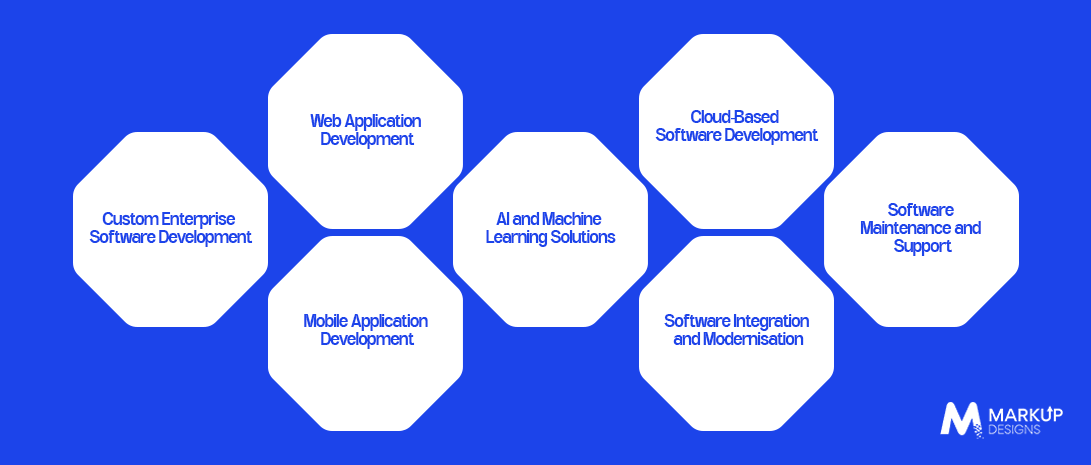
Custom software development includes many services to help businesses develop, integrate, and maintain their digital products. In general, the selection of services depends on specific goals of the company, availability of resources, users, and long-term technology plans.
Custom Enterprise Development
Enterprise software helps the company to manage complex business processes taking place within the organization. Therefore, it is possible to use software such as ERP, CRM, workflow management systems, and business intelligence dashboards, leading to centralization of processes and reporting.
Web Application Development
Custom web applications make it possible for companies to provide services and perform their business operations using browser-based technology for communication with customers. These applications can be represented by customer portals, booking systems, e-commerce platforms, and internal management systems tailored to specific business flows and user needs.
Mobile Application Development
Custom mobile apps give companies an opportunity to serve customers through mobile devices and employees using mobile phones and tablets. The developed applications can be used for making online payments, planning appointments, performing operations in the field, customer communication, and sending notifications.
AI and Machine Learning Solutions
AI and machine learning services allow businesses to perform data analysis and automate certain tasks, as well as provide pattern detection for making operational decisions. The applications are represented by predictive analytics, intelligent document processing, chatbots, recommendation engines, and demand forecasting.
Cloud-Based Software Development
Cloud-based software creates an opportunity for businesses to access applications in any geographical location and adapt infrastructure according to changing workloads. Custom-developed cloud solutions allow the companies to enable collaboration and remote access as well as ensure scalability in computing and the integration of already existing applications.
Software Integration and Modernisation
Legacy applications may limit performance, compatibility, and the adoption of newer technologies. Software integration and modernisation services help businesses connect existing systems, upgrade outdated components, improve system performance, and migrate selected workloads to modern architectures without unnecessarily disrupting operations.
Software Maintenance and Support
Software requires ongoing maintenance to remain secure, reliable, and compatible with changing business requirements. Maintenance services include bug fixes, security updates, performance optimisation, technical support, and feature enhancements that help organisations maintain software performance after deployment.
Which Industries Benefit From Custom Software Development in Abu Dhabi?
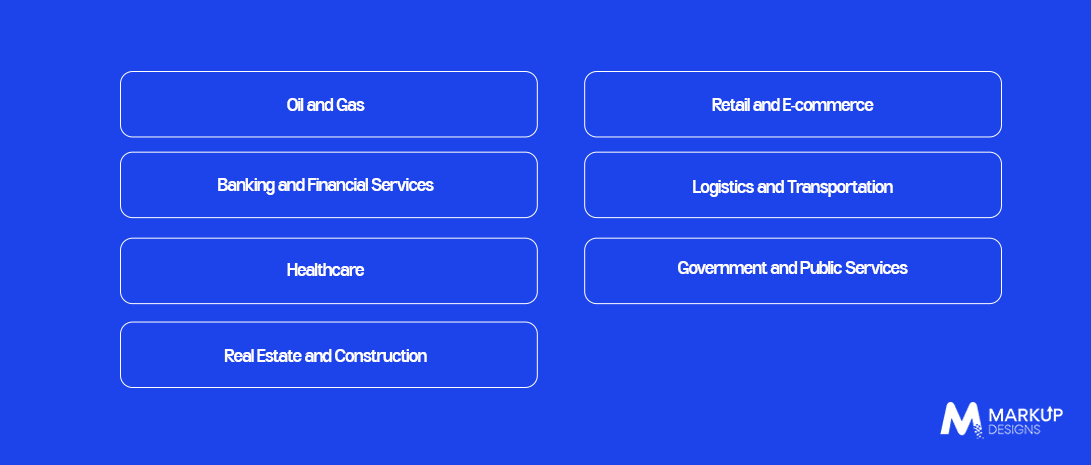
The demanding business environment of Abu Dhabi creates a great need for software that is customized for the specific needs and challenges of different industries. These custom applications may allow businesses to enhance their data management, automate processes, and deliver services.
Oil & Gas
Custom software can be used by oil and gas companies to monitor machinery, manage assets, track maintenance schedules, and analyze operational data. Predictive maintenance, supply chain management, and field services can minimize downtime and enhance resource planning.
Banking & Finance
Financial businesses require software that enables secure transactions and helps them manage customers, assess risks, and prepare reports required by regulators. Different banking systems, payment applications, fraud detection tools, and financial analysis applications can be used to improve services while providing the necessary security and compliance.
Healthcare
Healthcare companies may use customized software for managing patient records, appointments, billing, inventory, and administrative workflows. Healthcare software is also used for telemedicine, clinical coordination, and reporting while protecting sensitive and confidential information of patients and adhering to healthcare regulations.
Real Estate & Construction
Real estate and construction companies may benefit from software for the management of properties, scheduling, contractor coordination, and financial reporting. Custom platforms can centralise project information, track milestones, manage documentation, and improve visibility across property portfolios or construction sites.
Retail and E-Commerce
Retail businesses can implement custom software for their online stores, inventory management, order management, customer relationship management, and loyalty programs. Connecting sales channels and inventory management can enhance stock visibility, simplify order fulfillment, and bring greater consistency in customer experience.
Logistics and Transportation
Logistics companies can use custom software for fleet tracking, route planning, shipping management, warehouse management, and delivery coordination. The solutions can provide real-time operational visibility and improve resource allocation.
Government and Public Services
Government agencies can implement custom software for automating their administrative work, processing applications, improving paperwork, and providing services over the internet. Solutions should focus on accessibility, protection of data, security, and all requirements applicable to public service systems.
What Is the Custom Software Development Process?
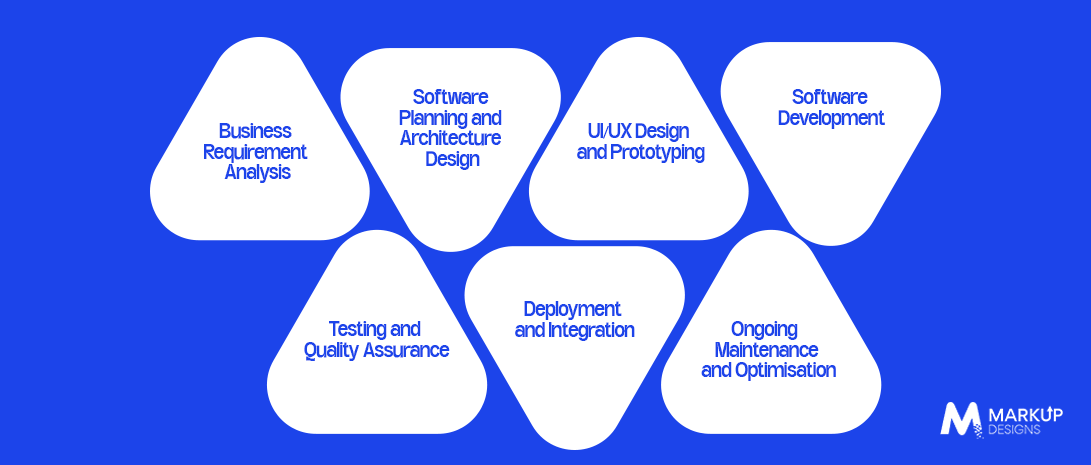
The structured process of development allows companies to get operational requirements transformed into working software. Each step should contain clear goals, stakeholder reviews of the stakeholders, and quality checks to lower risks and make sure that the implementation is aligned with business objectives.
Step 1: Business Requirement Analysis
The developers team collaborates with stakeholders to know business goals, user requirements, current processes, and technical limitations. At this point, the project scope, functional specifications, suggestions for integration, and success factors are determined.
Step 2: Software Planning and Architecture Design
The team chooses an appropriate technology stack and elaborates on the software architecture, system components, database structure, and integration methods. Planning also specifies the milestones, resources needed for development, security measures, and scalability options.
Step 3: UI/UX Design and Prototyping
Designers create user journeys, wireframes, and interactive prototypes that illustrate how the software works. This step gives stakeholders the opportunity to give feedback and clarify navigation, usability, and the main features of the software beforehand.
Step 4: Software Development
Developers create the front-end, back-end, database, and integrations according to the specifications provided. The work can be split into several iterations, giving stakeholders the opportunity to see the results, get feedback, and change requirements.
Step 5: Testing and Quality Assurance
The developed software goes through functional, integration, performance, security, and usability testing.
The team identifies and fixes defects, validates expected behaviour, and checks whether the application meets defined quality and acceptance criteria before release.
Step 6: Deployment and Integration
The application gets implemented successfully in the production setting once confirmation is received. The implementation includes aspects such as configuring of systems, transferring the data when needed, and verifying access. The agency takes care that processes are implemented with minimum disturbance to work.
Step 7: Ongoing Maintenance and Optimisation
Once the application gets deployed, the team in charge of development keeps an eye on how the software works. They solve any technical issues if they arise and make necessary software updates from time to time in order to ensure flawless work of the application.
How Much Does Custom Software Development Cost in Abu Dhabi?
Custom software development costs in Abu Dhabi depend on the project’s complexity, feature requirements, integrations, technology stack, and development team’s rates. A straightforward business application generally requires less investment than a large enterprise platform involving multiple systems, advanced analytics, or complex security requirements. Businesses should obtain a project-specific estimate based on a defined scope rather than rely on a single market-wide price.
Key Factors Affecting Software Development Costs
The primary cost factors include the number and complexity of features, UI/UX requirements, third-party integrations, data migration, security controls, and testing needs. Project duration, team composition, ongoing support, and changes to the original scope can also affect the final budget.
Custom Software Development Cost by Project Type
The following ranges are indicative planning estimates in AED, not verified quotations for the Abu Dhabi market. Actual costs vary by provider, scope, and project requirements.
| Project type | Indicative cost |
| Basic business application | AED 20,000–60,000 |
| Custom web application | AED 40,000–150,000 |
| Mobile application | AED 50,000–200,000+ |
| Enterprise software platform | AED 150,000–500,000+ |
| AI-powered software solution | AED 80,000–300,000+ |
These ranges are broad estimates intended for initial budgeting. AI systems and solutions, enterprise platforms, and applications requiring extensive integrations may exceed them considerably.
Ways to Optimise Your Software Development Budget
Businesses can manage development costs by defining a clear scope, prioritising essential features, and launching a minimum viable product (MVP) before investing in advanced functionality. Reusing suitable existing components, addressing integration requirements early, and agreeing on milestones and change-control procedures can also reduce avoidable expenses.
How to Choose the Right Custom Software Development Company in Abu Dhabi?
When selecting a software development partner, it is necessary to do more than just compare prices. It is also crucial to take into consideration the provider’s technical expertise, management skills, market proficiency, security procedures, and ability to provide post-launch maintenance.
Examine the Industry Knowledge of the Company
It is extremely important to check if the company has previously worked on a project similar to what your company is going to require. It should have sufficient expertise in relevant technologies, software architecture, various integrations, cloud infrastructure, and application development security.
Check the Profile of the Provider
It is advisable to refer to any case studies, portfolios, and references to see how the provider performs the requested services. Ideally, the functionality, technical difficulty, and the results of the work should be similar, and the company should be able to deliver services on time and within the agreed budget.
Evaluate Security and Compliance Policies
Ask the partner what methods they use to ensure the provision of services in terms of access control, encryption, secure development, vulnerability testing, and data protection processes. For projects such as those involving sensitive data, it is important to see how they are going to deal with specific
Understand Development Methodologies and Communication
Determine which development methodology is being utilized by the service provider (Agile, iterative, etc.) and how this provider manages stages of development, testing, updates, and changes in tasks. Providing frequent updates on progress will help all parties involved figure out any possible problems that may arise during the development process and ensure that everyone is on the same page.
Compare Pricing, Timelines, and Post-Launch Support
Examine contracts based on what deliverables are offered, what team involvement entails, how long it may take, when payments are supposed to be made, and what services are not included. Understand what post-implementation support will entail in terms of fixing bugs, implementing new security updates, providing further maintenance and support services, etc.
What Are the Key Challenges in Custom Software Development?
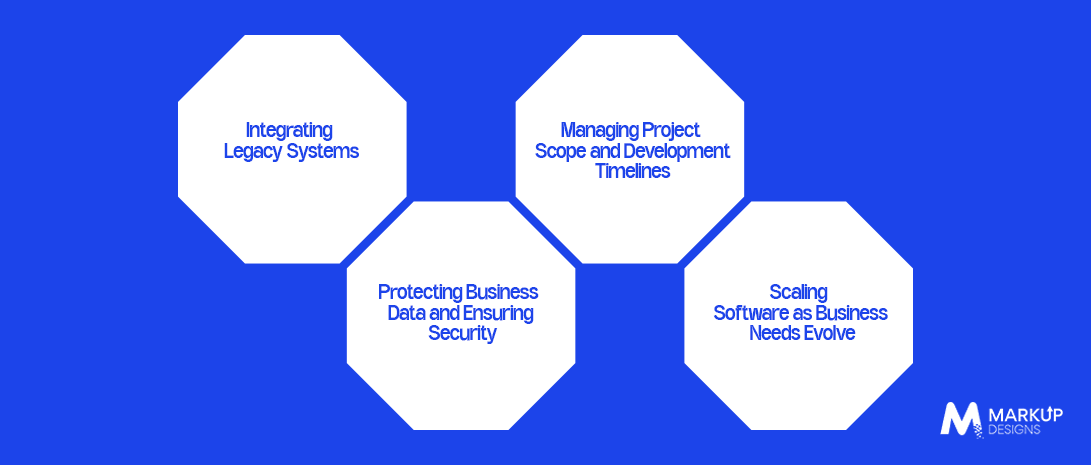
The process of developing custom software can involve a number of technical and operational problems, such as high costs, delays, and difficulties with final implementations, which should be gotten rid of as soon as possible to make the development successful.
Integrating Legacy Systems
Older business systems may use outdated technologies, incompatible data formats, or limited integration capabilities. Connecting them with modern applications requires careful assessment, API development, and data migration planning to maintain data consistency and minimise disruption to existing operations.
Protecting Business Data and Ensuring Security
Custom software may process sensitive customer information, financial records, or confidential business data, making security a critical consideration. Weak access controls, software vulnerabilities, and inadequate encryption can expose organisations to data breaches, so security testing and appropriate safeguards must be incorporated throughout development.
Managing Project Scope and Development Timelines
Unclear requirements, frequent feature changes, and delayed stakeholder decisions can increase development costs and extend delivery timelines. Businesses can minimise these risks by defining project scope, prioritising essential features, establishing milestones, and using a formal process to evaluate changes.
Scaling Software as Business Needs Evolve
Software that performs well initially may struggle as user numbers, transaction volumes, and data requirements increase. Choosing a scalable architecture, optimising databases, and testing performance under expected workloads helps businesses accommodate growth without requiring extensive system redesign.
What Are the Best Practices for Successful Custom Software Development?
Successful software projects require clear objectives, sound technical decisions, and consistent collaboration between business stakeholders and development teams. Following established practices helps organisations build reliable applications that meet current requirements and remain adaptable over time.
Define Clear Business Objectives and Requirements
Establish measurable goals before development begins, such as reducing manual work, improving reporting, or accelerating service delivery. Document functional requirements, user needs, integration dependencies, and acceptance criteria to help the development team maintain focus and evaluate project outcomes.
Prioritise Security From the Start
Incorporate security into software architecture, development standards, testing, and deployment rather than treating it as a final-stage task. Apply appropriate access controls, encryption, secure coding practices, vulnerability assessments, and data protection measures according to the application’s risks and requirements.
Choose a Scalable Technology Architecture
Select technologies and architectural patterns that suit the application’s complexity, expected workload, integration needs, and maintenance requirements. Modular components, well-designed APIs, and suitable cloud infrastructure can make it easier to introduce new features and support growth without unnecessary complexity.
Involve Stakeholders Throughout Development
Maintain regular communication between business owners, end users, designers, developers, and quality assurance teams. Demonstrations, feedback sessions, and milestone reviews help validate requirements, identify usability problems early, and prevent the final product from drifting away from business expectations.
Plan for Continuous Testing and Improvement
Test software throughout development and continue monitoring it after deployment to identify defects, security weaknesses, and performance issues. Use user feedback, application analytics, and scheduled maintenance to prioritise improvements and keep the solution aligned with changing business needs.
How Can Markup Designs Help Businesses in Abu Dhabi With Custom Software Development?
Markup Designs helps businesses turn operational requirements into tailored digital solutions through custom software development, web and mobile application development, AI integration, and software modernisation. Its development approach can support requirements analysis, solution architecture, application design, testing, and integration with existing systems. By aligning technical decisions with business objectives and future scalability requirements, Markup Designs can help organisations build software suited to their workflows and growth plans.
Turn your business requirements into scalable, secure, and high-performing software solutions with Markup Designs. Our experts help Abu Dhabi businesses streamline operations, integrate systems, and support long-term growth through tailored software development.

Conclusion
Custom software development enables businesses in Abu Dhabi to address specific operational challenges, automate workflows, integrate business systems, and support long-term growth. The right solution depends on clearly defined requirements, appropriate technology choices, effective security controls, and a structured development process.
Before starting a project, businesses should evaluate their operational needs, establish a realistic budget, and select a development partner with relevant technical expertise and ongoing support capabilities. A well-planned approach helps reduce implementation risks and ensures the software delivers practical value as business requirements evolve.
FAQs
1. What is the time needed to create bespoke software?
There are many factors including complexity, needs, number of features, integrations, and the way the programme is to be tested, which influence duration of the development process. Therefore, it may take from several days up to several months, depending on the type of application to be developed.
2. What is the average price for custom software development in Abu Dhabi?
Custom software development price would vary based on how sophisticated the software is, how many features it has, if integrations are needed, and the cost charged by developer. If the project is simple, it will be less expensive. However, the final price of more sophisticated software can be huge.
3. What are the main differences between custom software and off-the-shelf software?
Beside being cheaper and easier to implement, off-the-shelf software does not always answer a particular customer’s expectations. The client may understand that he/she should spend time learning how to use this software.
4. Which organizations benefit more from custom software development?
The number of industries using custom software is increasing because of various needs of companies. Custom software developers can identify their prospective clientele within specific business sectors such as oil and gas, banking, health care, real estate, retail, logistics, and government. Applications will be designed to meet the unique needs of the industry in question, such as asset management, financial operations, patient management, inventory monitoring, and provision of digital public services.
5. Is it possible for custom software to connect to previously implemented business systems?
Indeed, it is. Custom software can be connected to existing ERP, CRM, accounting, inventory, or other business systems by means of APIs, middleware, or other ways of integration. The viability of the connection depends on the specific features of the existing systems, data formats, access, and technical capabilities.
Author's Perspective
The value of custom software development is expressed when the software is able to cater to a specific business need instead of being just a tool for implementing modern technology. Companies in Abu Dhabi shall focus on actual business needs, device security, and the ability to integrate and scale in the process of choosing a vendor.
Discuss Your Project NowJupinder Singh Arora
Founder and CEO
Related Posts

Custom Software Development Cost in Bahrain: Factors, Benefits,...

How Much Does Healthcare Software Development Cost in...

How to Build Compliance Software for Australian Businesses:...
Insights Are Valuable & Execution is Priceless
You’ve read about the digital future. Now, let’s build the infrastructure to take you there. Move your strategy from the page to the product.
Design Your Solution Now
Contact Us
Schedule The Appointment At Your Convenience Date And Time.
30 Min
Web Conference
Time Zone
Indian standard time (08:30pm)

Thanks For Getting In Touch!
You’ve Taken The First Step Toward Transforming Your Digital Presence. Our Experts Will Reach Out Shortly To Take It Forward.
Launch Your Dream Project
Provide a brief overview of your project, and our specialists will evaluate your requirements. We will connect with you to explore how the right digital solutions can help you launch faster.