
In Brief
- AI prototypes often fail in production because of infrastructure, deployment, and scalability challenges
- Machine learning engineers help build stable, scalable, and production-ready AI systems
- Data scientists, ML engineers, and AI engineers each play different roles in AI development
- Strong ML engineers understand deployment, monitoring, cloud infrastructure, and MLOps practices
- Production AI requires automated pipelines, monitoring systems, and scalable cloud architecture
- Choosing the right AI talent or development partner is critical for long-term business success
Most organizations do not begin their AI journey with enterprise-wide deployments. Most of the time, it starts with a small proof of concept. A data scientist develops and tests a model on historical datasets, achieves promising results, and shows potential business value. When leadership sees those results, the focus quickly moves from experimentation to implementation.
And that’s when the real challenges often begin. A model that performs well in a supervised development setting is not the same as a model that performs well in actual production settings. Live data streams are not predictable, infrastructure needs are increasing, and concerns around scalability, security, compliance, and system integration become much more prominent. What seems to be a simple project can soon become a complex engineering project.
Most organizations do not begin their AI journey with enterprise-wide deployments. Most of the time, it starts with a small proof of concept. A data scientist builds and validates a model using historical data sets, shows promising results, and demonstrates potential business value. Once the leaders know the results, the focus shifts very quickly from experimentation to implementation.
This is where companies start to weigh up different hiring options, such as in-house recruitment, remote specialists, and technology partners, against machine learning engineers for hiring. The right talent is now a strategic business decision because the objective is no longer to build a successful prototype. The focus is on building AI systems that can be reliable, scalable, and add business value over time.
Building the Right Team for AI Systems
In the case of machine learning professionals being hired by companies to build enterprise-grade AI systems, the interview process is more reflective of real scenarios and not just model metrics or research-based discussions. When you start deploying AI into live environments, you start seeing issues of infrastructure, latency, monitoring, integrations, and the long-term stability of the system.
Today’s AI systems are rarely independent. They are experts in APIs, cloud platforms, databases, message queues, monitoring frameworks, and deployment pipelines. This is why machine learning engineers need to understand how AI fits into the larger software ecosystem, not just isolated development environments.
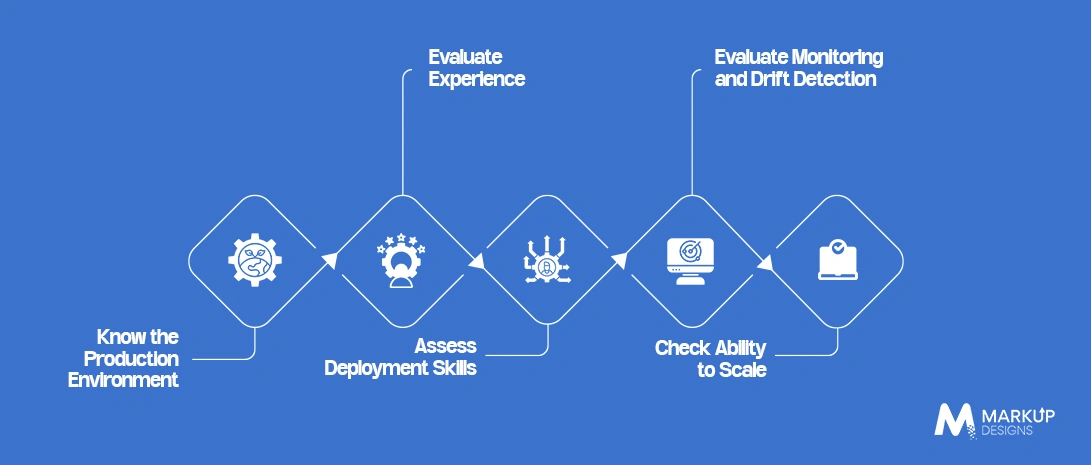
Below is a practical way to structure the hiring process.
Step 1: Know the Production Environment
Before you evaluate any candidate, you must first define the requirements of your AI system.
Ask questions like:
- Is the model going to be batch processed or run in real time?
- What are your latency and performance goals?
- How often does the model need to be retrained?
- Do you need audit logs or compliance tracking?
If you don’t understand these requirements, how do you know the candidate’s experience is truly aligned with your production requirements?
Step 2: Evaluate Experience With Full-Pipeline Development
Get candidate to describe the full ML pipeline development process they’ve been through.
Good candidate will be able to answer:
- Automated pipeline processes for ingesting data
- Any tools they’ve used for training, job management, and scheduling
- Business approach to version control for models and artifacts
- Testing and validation before deploying models
If they were merely involved with model training and handing the model off to another team, it may signal a lack of production experience.
Step 3: Assess Deployment Skills
Deploying machine learning production systems isn’t done straight out of notebook files.
The most experienced ML engineers will be proficient at:
- containing models using Docker
- deploying applications using Kubernetes
- scaling inference services depending on the traffic
- implementing rolling updates and rollbacks
A good example is that canary deploys of new model versions are widely used by many companies to minimize risks when releasing new versions of models. This is particularly important when building AI automation systems that generate revenue.
Step 4: Evaluate Monitoring and Drift Detection
AI models tend to drift and become inaccurate unless proper monitoring is applied.
Inquire about the monitoring processes related to:
- prediction latency
- changes in features and input data
- models’ performance over time
- data and concept drift
Seek solutions that involve alerts, monitoring, and model training instead of merely visualization. Continuous monitoring and proper maintenance make production AI models successful.
Step 5: Check Ability to Scale and Understand Costs
Operating machine learning models in the cloud involves both engineering skills and awareness of the costs involved.
Professional machine learning engineers will be able to answer questions related to:
- infrastructure sizing
- efficient use of batch inference vs. streaming inference
- Effects of autoscaling on cloud cost management
- differences between GPU and CPU jobs
Lack of proper knowledge may lead to increased expenses. A proper understanding of infrastructure helps to optimize models and reduce cloud costs.
This step also includes evaluating candidates for MLOps roles to maintain the proper performance of systems.
Reasons for AI Prototypes Being Unsuccessful Before Going Into Production
When developing an AI solution, many organizations experience a situation where the product shows outstanding performance at an early stage of its development but fails during the implementation process. In these conditions, the algorithm works fine because data scientists train it on historical data sets and achieve excellent accuracy results.
It normally starts when the model has to run in the actual corporate environment. There will be issues, including:
- existence of models in just a notebook without proper deployment
- lack of automated workflows for training and deployment
- data pipelines with inconsistent quality and reliability
- absence of any tool for tracking model drift due to data changes
- dependency on manual workflows in the machine learning process
It often happens that the model itself is not the problem. The real issue lies in the infrastructure that surrounds the model. Data pipelines do not work, deployment is unstable, and there is no proper tracking system. An excellent working model suddenly fails after being put into practice.
To overcome such problems, many firms recruit machine learning engineers who can take care of the operational aspect of AI applications. Machine learning engineers design automated training pipelines for the models, package them in containers, plug them into real-world data, and even design monitoring systems.
ML Engineers vs Data Scientists vs AI Engineers: What Sets Them Apart?
| Role | Main Focus | Key Responsibilities | Common Tools & Technologies |
| Data Scientist | Data analysis and model experimentation | Collecting and analyzing data, building predictive models, identifying trends, testing algorithms, generating insights | Python, R, Jupyter Notebook, Pandas, TensorFlow, Scikit-learn |
| Machine Learning Engineer | Deploying and scaling ML systems | Building ML pipelines, deploying models, automating training workflows, monitoring performance, optimizing infrastructure | Docker, Kubernetes, MLflow, AWS, Azure, CI/CD tools |
| AI Engineer | Developing intelligent AI applications | Integrating AI into software products, building AI-powered applications, working with LLMs, APIs, automation, and AI workflows | OpenAI APIs, LangChain, PyTorch, cloud AI services |
Data Scientists: Enhancing Model Accuracy and Efficiency
The job of a data scientist is concerned with developing and improving ML models. The main job of a data scientist is to check whether a particular business case can be resolved via machine learning.
A data scientist does the following:
- prepares and structures training data from unstructured raw business or system data
- creates features that are valuable based on business logic and understanding
- tests various ML models and architectures
- optimizes ML models
- evaluates results using various performance metrics like precision, recall, and ROC-AUC scores
The working environment of data scientists is usually flexible and can include notebook interfaces, local computers, or a cloud platform like SageMaker. In most cases, data scientists work with historical datasets to improve model performance.
Machine Learning (ML) Engineers: Designing the Systems that Enable AI Models to Work
Machine learning engineers specialize in developing systems based on machine learning models. This involves elements of software engineering, cloud computing infrastructure, and machine learning operations.
In cases where a company decides to employ machine learning engineers, there is always an underlying problem related to production.
- Automating Machine Learning Model Training Processes
To avoid manual retraining of models with every update in data, ML engineers design automatic workflows using platforms such as Airflow or Kubeflow, enabling the processes of data collection, data processing, training of models, validation, and saving of model artifacts to be performed automatically.
- Ensuring Feature Consistency
Another frequent challenge faced during production is that the data available at training time is different from the data available during the inference phase. The solution offered by machine learning engineers to this problem is to build feature stores to ensure that feature transformation and definition remain consistent between the two phases.
- Creating Inference Scales
Machine learning engineers containerize machine learning algorithms using Docker, among others, and then use platforms like Kubernetes to deploy them. This deployment system automatically scales depending on the traffic, and API calls can be made via REST/gRPC endpoints.
- Monitoring Production Performance
Monitoring in production involves more than model accuracy. ML engineers monitor performance characteristics such as latency, throughput, prediction performance, and data drift. They also implement logging, dashboards, and automated notifications to detect problems early before they affect users.
- Managing the Model Lifecycle
AI systems in production need correct versioning of their code and models. ML engineers make sure each version of a model can be traced back to its training data, hyperparameters, and evaluations. Some tools can assist in managing the entire lifecycle of a model effectively.
AI Engineers: Putting AI in Practical Uses
AI engineers concentrate on incorporating machine learning functionalities in software applications. This means that AI engineers have the responsibility of ensuring that AI runs properly in real-world situations and within the actual user experience flow.
Some of their duties may include:
- integrating AI and machine learning models to back-end applications and services
- optimization of the response time for real-time AI functionalities
- management of authentications, security, and communication among services
- matching AI outputs to the product flow
AI engineers ensure that applications can use the outputs of machine learning in a secure, effective, and scalable manner.
With advancements in AI technology, many companies often employ AI engineers as well as machine learning engineers who have specific roles within their teams. Such a division is important for ensuring a systematic process of development.
Key Skills To Look Out For When Hiring Machine Learning Engineers
Applied Machine Learning Expertise
For an AI application that is supposed to run in a true production setting, the knowledge of what machine learning applications do when actually running in the real world is key. Being accurate on a validation set may be essential, but ensuring that the system stays stable under real world load is critical too.
Although ML engineers don’t always need to develop novel AI architectures, they must be aware of the behavior of AI models in cases when data trends and users’ behavior change.
Typical problems in real-world applications emerge step-by-step, for instance:
- The model’s prediction certainty drops over time
- An increased class imbalance over time occurs
- The input data no longer matches the training data
Professional machine learning engineers have all the skills needed to recognize and address such issues:
- Develop feature pipelines that ensure that training and serving data are consistent
- Re-train and tune machine learning models and large language models via PyTorch or TensorFlow
- Diagnose the root cause of low performance due to data drift or other factors
- optimize inference through batching, quantization, etc.
Production Engineering Skills Are Essential
A deployed ML model becomes essentially an operational backend application, which requires consistent results to be produced, efficient handling of increasing load, and operation to proceed successfully even under partial system failures.
For all these reasons, ML engineers possess strong software engineering skills alongside a solid grasp of contemporary artificial intelligence technology stacks.
Tasks performed by ML engineers often include:
- developing an API for the models using libraries such as FastAPI;
- using Docker for containerization of their applications;
- deploying their services using Kubernetes with adequate autoscaling settings;
- developing inference systems meeting the requirements.
Cloud and Distributed Systems Knowledge
In modern enterprises, AI systems do not usually operate on one server. For instance, training large-scale machine learning models requires a distributed GPU cluster, whereas inference services require autoscaling based on user needs.
Thus, machine learning engineers should have profound knowledge about cloud services and distributed systems.
The following skills should be within an experienced ML engineer:
- to operate managed ML platforms (AWS SageMaker, Azure Machine Learning, Vertex AI)
- to minimize the costs of cloud infrastructure in case of heavy usage of GPUs
- to configure autoscaling and resource allocation for inference services
- capability to ensure secure connections between the AI system and enterprise databases/data platforms
A poor infrastructure design results in extremely expensive cloud bills and system instability. ML engineers know how to optimize the workloads, manage resources, and calculate the capacities of the infrastructure.
From Where Can Enterprises Hire Machine Learning Engineers?

Your choice of model for hiring can determine the speed at which your company will get to deploy AI and how safe this process is.
For companies that choose to hire Machine Learning developers, there are only two issues that they want to solve: the absence of experience in production or the absence of scalable infrastructure.
While selecting what works best for them, enterprises usually consider hiring an in-house ML developer over an external machine learning engineer hiring service. There are 3 basic ways of hiring ML developers:
In-House Hiring
Construction from scratch offers long-term control. The engineers become experts on the internal data structure, security practices, and architectural limitations. The more familiar you are with all this, the more value it holds.
The cost of such construction includes time and money. Fully skilled and experienced machine learning engineers are hard to find. The job is to hire people who understand distributed systems, Kubernetes management, MLOps automation, monitoring practices, and cloud optimizations, among other tasks.
Remote ML Engineers
Nowadays, several companies employ remote ML engineers to increase their pool of potential candidates. As a result, this increases the speed of the process and reduces the salary pressures.
The problem that arises here lies in the integration part. The production of an AI involves DevOps, data engineering, backend, and governance teams. Remote employees will be able to fix components, but fail at ensuring alignment.
Enterprise Machine Learning Development Partner
If the application involves essential processes like fraud detection, prediction, or personalization, then the production risks associated with that work are costly indeed.
But an enterprise machine learning development partner adds something else to the mix. The enterprise gets dedicated machine learning teams, MLOps professionals, cloud architects, and governance capabilities from the get-go.
The benefit is experience. Enterprises that want to bring in the best machine learning engineers for a project without going through a long hiring process are likely to favor this option.
How Markup Designs Helps Businesses Scale AI Systems Successfully?
While it may be simple for many companies to develop an AI model, making it ready for production usage poses several difficulties. Most often, it does not matter whether a certain AI model is inaccurate. The real problem lies in the integration of AI technologies into the current system without influencing its performance, security, compliance, and other aspects.
At Markup Designs, we consider creating AI production models an entire engineering process, and not merely an analytical activity. By ensuring proper data pipelines, deployment infrastructure, monitoring, and training processes before the scale-up, we help our customers avoid further problems in the future.
Are You Ready to Scale Your AI Initiative?
Implementing artificial intelligence (AI) is not just about exploring anymore. Organizations require systems with robust architecture capable of being put into action. Regardless of whether you plan on launching a new AI project or enhancing an existing one, the proper implementation technique can make all the difference.

Conclusion
The development of a prototype using AI is just the first step on your way to success. It becomes much harder to deal with challenges once an organization seeks to launch its AI into a real production environment where scalability, monitoring, security, and performance become important factors.
This is why the recruitment of good machine learning engineers becomes vital. Good ML engineers don’t simply develop models; they develop a reliable architecture for them, manage deployment pipelines, automate processes, monitor system performance, and make sure that all systems work well despite changing business needs.
With the increasing popularity of enterprise AI applications, companies need teams capable of managing both ML and production engineering. Irrespective of whether you recruit in-house employees, work remotely, or opt for partnering with a tech company, your ultimate aim will always be creating valuable AI systems.
FAQ’s
1. What does a machine learning engineer do?
A machine learning engineer builds and manages production-ready AI systems. Their responsibilities include deploying models, automating ML pipelines, monitoring performance, scaling infrastructure, and maintaining system reliability.
2. What is the difference between a data scientist and a machine learning engineer?
Data scientists mainly focus on analyzing data and building machine learning models, while machine learning engineers focus on deploying, scaling, and maintaining those models in production environments.
3. Why do AI projects fail during deployment?
Many AI projects fail because of issues related to infrastructure, unstable data pipelines, lack of monitoring, poor scalability, and missing MLOps processes rather than model accuracy itself.
4. What skills should businesses look for when hiring ML engineers?
Businesses should look for experience in Python, TensorFlow, PyTorch, Docker, Kubernetes, cloud platforms, MLOps, API development, monitoring systems, and scalable deployment architecture.
5. Why is MLOps important for enterprise AI?
MLOps helps automate model training, deployment, monitoring, and retraining processes. It improves system reliability, reduces manual effort, and ensures AI systems remain stable in production.
6. Should companies hire in-house ML engineers or outsource development?
It depends on business goals, timelines, and technical expertise. In-house teams provide long-term control, while outsourcing or partnering with AI development companies can accelerate deployment and provide access to experienced specialists.
Author's Perspective
Mobile application development has changed a lot over time. Businesses no longer compete only on faster app development. Today, success depends on better performance, stronger security, scalability, and continuous innovation. That is why DevOps has become so important in mobile application development. It is not only an effective technique in itself, but it is also the approach to developing mobile applications and fostering a culture of constant improvement.
Discuss Your Project NowJupinder Singh Arora
Founder and CEO
Related Posts

AI Diet Assistant App Development: Everything Businesses Need...
How to Choose the Right AI Chatbot Development...

How eCommerce AI Chatbots Turn Customer Conversations Into...
Insights Are Valuable & Execution is Priceless
You’ve read about the digital future. Now, let’s build the infrastructure to take you there. Move your strategy from the page to the product.
Design Your Solution Now
Contact Us
Schedule The Appointment At Your Convenience Date And Time.
30 Min
Web Conference
Time Zone
Indian standard time (08:30pm)

Thanks For Getting In Touch!
You’ve Taken The First Step Toward Transforming Your Digital Presence. Our Experts Will Reach Out Shortly To Take It Forward.
Launch Your Dream Project
Provide a brief overview of your project, and our specialists will evaluate your requirements. We will connect with you to explore how the right digital solutions can help you launch faster.