

In Brief
- A mobile app launch in the UK cannot be accomplished just by developing an app because businesses will have to know how to identify the target audience, validate the idea, select the platform, plan features, and scale and comply.
- A successful mobile app launch is characterized by a clear process that includes market research, feature planning, UX/UI design, development, testing, app store submission, marketing, and post-launch optimization.
- The cost of mobile app development services in the UK can vary between £25,000 for MVP apps and £100,000+ for complex apps due to the number of required features, platforms, integrations, security measures, and design & maintenance aspects.
- In addition to the above, UK businesses will have to deal with requirements and challenges related to data protection, privacy, consumer rights, accessibility, payment processing, digital security, and competition, among others.
- Long-term success of mobile apps is associated with solving a user problem, excellent experience & security, analytics, constant improvements, and collaboration with the right mobile app development partner.
Introducing a mobile application in the United Kingdom can be seen as a way of creating new possibilities for enterprises that want to interact with clients and develop digital strategies. However, developing a mobile application includes much more than just programming, because companies should take into account the potential audience of their application, technologies to use, development costs, and regular upgrades.
Moreover, it is essential to remember about data protection, consumer rights, digital security, and other issues, which should be taken care of while introducing a mobile application.
In this blog, we will take you through the process of developing a mobile app in the UK from the planning stage, app development and testing process, app store submission, and finally growing the mobile app after its launch. We will be discussing the important features of a mobile app, the cost required, common obstacles, and compliance issues to keep in mind while launching your app in the UK market.
Why Businesses are Launching Mobile Apps in the UK
Businesses in the UK have come to view the use of mobile applications as a digital marketing tool. Customers have grown to expect fast and convenient methods of engaging with a brand, making purchases, accessing services, and getting support. An app built correctly will be able to assist businesses in achieving this and create a link with the user.
Customer engagement is one of the main advantages that businesses can derive from having mobile applications. As opposed to web pages, mobile apps are able to use such tools as push notifications, personalization, loyalty, and in-app communication to create connections with a brand.
Another way for mobile apps to bring value to a business is through additional sources of income. There are several ways to earn money from mobile applications – subscriptions, in-app purchases, booking services, commissions, advertising, and direct sales. This tool can become a key element of a development strategy for any startup and established company.
It can also be a great source of customer insight. With the help of the appropriate analytics, one will be able to see how people use their application and which features are popular and which ones require some improvements.
In the case of UK businesses operating in a competitive environment, having a mobile app can also mean differentiation through improved customer experience. It can be used for a wide variety of industries – finance, retail, health care, tourism, education, and food delivery.
What to Consider Before Launching a Mobile App in the UK
A well-defined approach before development is needed to know what results the business wants from an application and who would use it. This approach helps avoid unnecessary elements, keep the development process within budget limits, and facilitates scalability. Spending time on planning at this stage could bring you good returns later.
- Know your UK audience: Analyze the needs and preferences of your target audience, how much money they can spend, and what problems the application would solve for them. The competitor analysis would be helpful in this case as well.
- Validate your app idea: Before moving forward with developing an app, you will need to see if there actually is any demand for such an application. This could be done through surveys, interviews, competitive research, and an MVP.
- Select the proper app features: The first features that need to be included in the application should have something to do with achieving your business goal. The number of features included in the application from the very start should not be numerous.
- Determine the right platform: It is important to choose whether your app will be released for iOS, Android, or both platforms. Such a choice will depend upon several factors.
- Prepare for technology and scalability: Technology, back end, databases, APIs, cloud computing, and security solutions must be chosen appropriately.
- Consider UK compliance: Consider privacy, data protection, payments, consumer rights, accessibility, and other relevant compliance aspects from the outset and not as an end-stage activity.
Read Also: Why iOS App Development Is a Smart Investment for UK Businesses
How to Launch a Mobile App in the UK: Step-by-Step Process
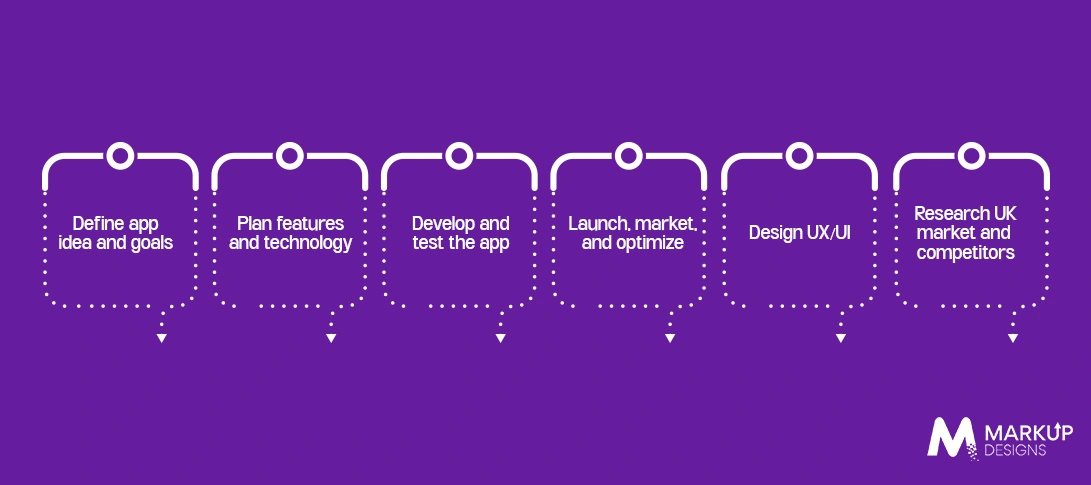
Launching a successful mobile app demands a well-defined procedure that links the business concept and the technical aspects of the application to the user’s need. Here are some of the processes that businesses need to undertake when creating their mobile applications:
1. Define app idea and goals
First of all, it is essential to define the problem the app is going to address as well as the desired business result. Having clearly defined goals helps identify necessary features, target audience, budget, and development process.
2. Research UK market and competitors
Investigate the target users, competitors, demand in the market, and other similar apps to understand what users expect.
3. Plan features and technology
Develop the roadmap and define the necessary features. It is time to select the development environment, technology stack, integrations, backend technologies, and security needs at this point.
4. Design UX/UI
Create user-friendly and easy-to-use screens that will facilitate the accomplishment of all actions by users. The design should take into account such aspects as accessibility, consistency, performance, and the needs of your audience.
5. Develop and test the app
Develop an application according to the design and product roadmap. Make sure to perform functional testing, performance testing, security testing, compatibility testing, and usability testing of the app.
6. Launch, market, and optimize
Prepare the app for the App Store and Google Play, develop a launch strategy, and promote the app via the most appropriate ways. After the launch, analyze the analytics, reviews, crashes, and user feedback.
Essential Features of a Successful UK Mobile App
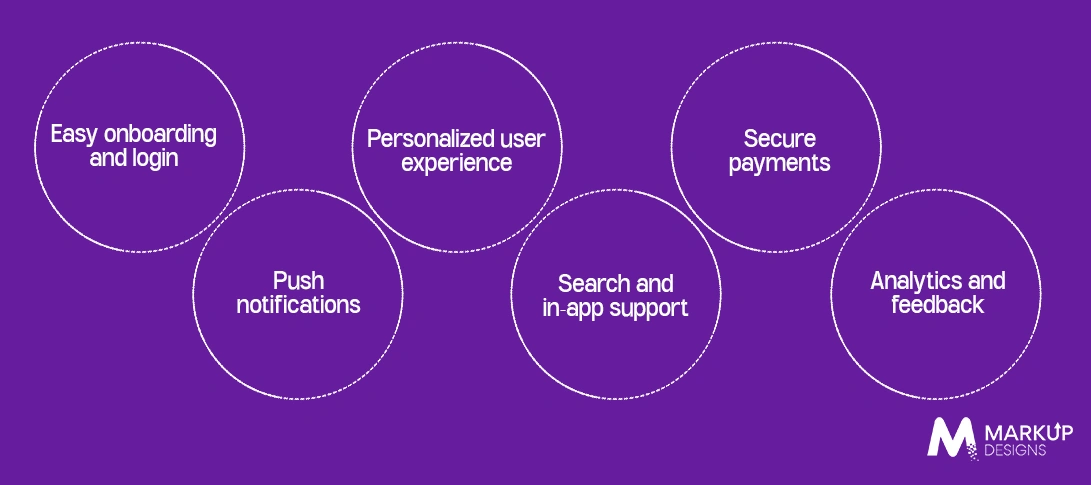
A successful mobile application should be user-friendly and provide the functionality that the users need. The appropriate features may differ according to the industry and the type of business, but there are some features that could add value to the application.
Easy onboarding and login
Keep the onboarding process smooth and easy. Options like email, phone number, or social logins might help users start using the application smoothly and quickly.
Personalized user experience
Offer a personalized experience by taking into account users’ preferences and behavior. Personalization is a good way to make the application more valuable and to increase users interest in using it.
Secure payments
Offer convenient and safe payment methods like cards and digital wallets if the application offers any transaction features. The payment process needs to be smooth and safe.
Push notifications
Send notifications related to orders, bookings, offers, reminders, and other account-related stuff. Notifications need to bring value to the user without being annoying.
Search and in-app support
It is important to have an effective search function to allow users to find products, services, or any other information easily. An in-app help center or chat could also help.
Analytics and feedback
Include analytics for understanding how users interact with the application, what they like, and what does not work properly. Feedback, ratings, and reviews could also be helpful.
How Much Does It Cost to Launch a Mobile App in the UK?
Depending on various factors such as complexity, functionality, design, platforms, and developers skill level, the cost of developing an application in the UK varies to a large extent. An MVP (minimum viable product) will cost relatively less than a fully fledged application with all the advanced features.
A basic mobile application can be developed for roughly between £25,000 and £50,000, whereas a moderately complicated application can cost between £50,000 and £100,000. More sophisticated applications can even cost more than £100,000.
Several factors can influence the overall budget:
- Application complexity: The more functions and flows an app has, the harder it is to develop.
- Platform selection: Developing an application for both iOS and Android increases costs.
- UI/UX design: Specific UI/UX requires extra design effort.
- Integration: Integration with payment systems, other software, maps, analytics, and other third-party services influences the cost of development.
- Security and compliance: If your app will handle sensitive or financial data, you will need extra security precautions.
Therefore, businesses must take into account not only initial development costs but also those connected with maintenance, marketing, infrastructure, and further enhancements.
App Store & Google Play Launch Checklist
Application preparation for launch is as essential as its development. For the publication of a mobile application in the UK market, enterprises should examine the following points:
- Testing Completion: Test the application for its functionality, performance, security, compatibility, and usability across various devices and operating systems.
- Application Store Assets Preparation: Produce the necessary store content like app icon, screenshots, description, and preview content.
- Privacy Requirements Evaluation: Make sure that your privacy policy, data collection practices, permissions, and all other disclosure-related issues reflect the nature of the application.
- Set up Application Analytics: Add analytical and monitoring services to gather data about downloads, usage, errors, and other aspects after the release of the application.
- App Store Listing Optimization: Optimize your listing with proper keywords, descriptive content, and images to increase visibility and downloads.
- Marketing Campaign Preparation: Get prepared with website, social network, email, advertising, and other marketing materials before the release of your application.
Even after launching the app, continue to monitor reviews, ratings, crashes, engagement, and user feedback.
Common Challenges When Launching a Mobile App in the UK
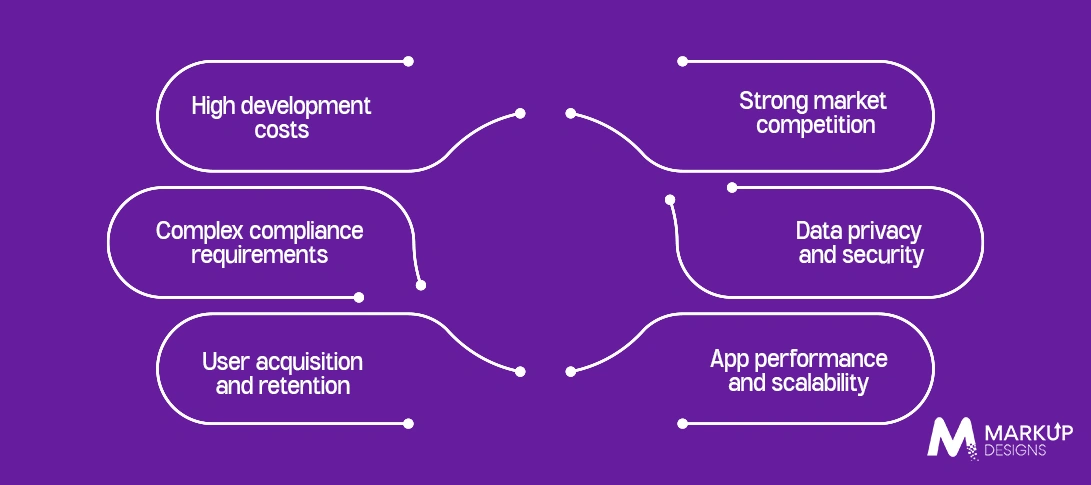
While releasing an application in the United Kingdom is highly profitable, it should not go without saying that companies also have to take into account certain obstacles. Recognizing these aspects in advance could facilitate faster and less costly development.
1. High development costs
Developing a good-quality mobile application presupposes several expenditures on the part of strategy, design, development, testing, infrastructure, and maintenance of the product.
2. Strong market competition
The UK digital market is very competitive, which makes it tough for a newcomer application to catch up with others. Companies will have to have a proper value proposition and experience that allows users to see a point in choosing an application.
3. Complex compliance requirements
Multiple regulatory requirements need to be addressed when creating a payment application or one working with private data. Delayed addressing of those requirements can cost additional changes later on.
4. Data privacy and security
Users trust that companies take care of their personal data. Bad authentication, API protection, and incorrect data management lead to security vulnerabilities.
5. User acquisition and retention
Downloading the application is not the main task to achieve. The company should make efforts in marketing, feature development, customization, and updates to maintain user interest.
6. App performance and scalability
When the app performs well under low load, it may perform badly under high load. Therefore, the application should be built and maintained in such a way that it could handle growth in the future.
Read Also: From Idea to Launch: Mobile App Development Process in the UK
How to Make Your UK Mobile App Successful
Getting the app off the ground is just the first step towards its long-lasting success, which will greatly depend on how well the application meets customer needs, market trends, and business goals. A couple of approaches can be used by businesses to improve their mobile footprint in the UK.
- Focus on a Real User Problem: The purpose of your app should be to solve a problem or make users’ tasks simpler to meet their true needs.
- Go for MVP: An MVP release will help the company try out the idea among real customers without making too many investments in the advanced product.
- Prioritize User Experience: Keep in mind that the application should have an easy-to-navigate interface, minimize the clicks wherever possible, and all the functionalities must be easy to find. This may help engage and retain users.
- Ensure Security and Privacy: The user data should be secured using appropriate methods of authentication, encryption, data handling, and security testing. A good privacy policy can also help build user confidence.
- Use Analytics and Feedback: Gather analytics such as download numbers, user engagement, retention, frequency of crashes, and feature usage. This information should be used along with feedback from users to make changes as required.
- Continue to Improve Post-launch: Your application will remain relevant through continuous improvements such as updates, bug fixes, performance optimizations, new features, and security enhancements.
Markup Designs: Your First Choice for a Mobile App Development Company
The choice of the right development partner will make a big difference when it comes to how successful your mobile application will be. Here at Markup Designs, we provide you with all the needed assistance to turn your ideas for a mobile app into an efficient, scalable, and user-friendly application.
Through the use of the latest technologies in mobile app development that meet the needs of the company and the changing needs of customers, we develop applications that will be developed in the future.
Our services in developing mobile applications include strategy & consulting, UI/UX design, iOS & Android app development, cross-platform app development, backend/API development, third-party integrations, QA & after-launch support.
Ready to Turn Your App Idea Into a UK-Ready Product?
From initial strategy and UX/UI design to development, testing, and launch, Markup Designs helps businesses build mobile apps that are secure, scalable, and designed around real user needs.

Conclusion
A good idea is not the only thing that is needed when developing a mobile application in the UK. Companies should know their target audience, check the validity of the project, choose technologies, design an intuitive user interface, and consider security and scalability.
Choosing features and development approaches, preparing to submit applications to the App Store and Google Play, and all stages may affect the future result. At the same time, it is necessary to take into account that it is not enough just to implement and launch the product; regular updates, analytics, and other factors must be taken into account to stay competitive on the market.
Both startups working on the first MVP and businesses that already have some experience in the field will benefit from an adequate strategy and professional development of the mobile app.
FAQs
1. What is the cost of launching a mobile application in the UK?
The price ranges from about £25,000 for an MVP up to £100,000 or even higher for a more advanced application. All the factors mentioned above will influence the final cost.
2. How much time does it take to develop a mobile application in the UK?
It takes 3-6 months to develop an MVP, but it can take more time for more complex applications.
3. What are the most important compliance considerations for UK mobile applications?
In accordance with the type of application and the industry it falls into, companies should be aware of issues such as UK GDPR, Data Protection Act 2018, PECR, consumer protection, and others.
4. Should I develop my app for iOS or Android first?
This decision would be based on the target user, business objective, budget, and projected usage of the application. Conducting research prior to development would assist in making this decision.
5. Is cross-platform mobile app development relevant to UK businesses?
Yes. With cross-platform development using frameworks like Flutter and React Native, UK businesses may have the ability to create apps for several different platforms using a single codebase.
Author's Perspective
Launching a mobile app in the UK is more than a technology project; it is a business investment. Start with a clear customer problem, focused MVP, and the right technology. Consider privacy, security, accessibility, and compliance from the beginning. Use real user feedback to improve the product after launch. With proper planning and a long-term strategy, businesses can build secure, useful mobile experiences that support sustainable digital growth.
Discuss Your Project NowGaurav Goyal
Global Sales- VP
Related Posts

Cost to Build a Mobile App in Qatar...

How Much Does It Cost to Build an...
How to Build a Car Wash App: Development...
Insights Are Valuable & Execution is Priceless
You’ve read about the digital future. Now, let’s build the infrastructure to take you there. Move your strategy from the page to the product.
Design Your Solution Now
Contact Us
Schedule The Appointment At Your Convenience Date And Time.
30 Min
Web Conference
Time Zone
Indian standard time (08:30pm)

Thanks For Getting In Touch!
You’ve Taken The First Step Toward Transforming Your Digital Presence. Our Experts Will Reach Out Shortly To Take It Forward.
Launch Your Dream Project
Provide a brief overview of your project, and our specialists will evaluate your requirements. We will connect with you to explore how the right digital solutions can help you launch faster.