
In Brief
- Enterprise AI agents can go beyond answering queries to reason, use tools, access data, and execute multi-step business workflows.
- LangChain provides a flexible framework for connecting AI models with enterprise systems, APIs, knowledge sources, and external tools.
- A robust enterprise AI agent architecture requires carefully designed layers for reasoning, memory, retrieval, orchestration, security, and observability.
- Controlled autonomy, clear workflow boundaries, and human oversight are critical for deploying AI agents reliably in business environments.
- Successful enterprise AI agent development depends on continuous testing, monitoring, and optimisation to improve performance at scale.
Enterprise AI is moving beyond chatbots that simply respond to prompts. Businesses are now exploring AI agents that can understand objectives, retrieve relevant information, interact with internal systems, use external tools, and complete multi-step tasks with varying levels of autonomy. However, connecting an LLM to a few APIs does not automatically create an enterprise-ready AI agent. Real-world deployments require a well-structured architecture that can manage context, control tool access, maintain workflow state, and operate reliably across complex business environments.
LangChain provides a practical foundation for building these agentic systems by bringing together LLMs, tools, memory, retrieval, and workflow components within a modular framework. With the right architecture and engineering practices, it can help enterprises develop AI agents that integrate with existing data and business systems while maintaining control, security, and scalability. This guide explores how to build enterprise AI agents with LangChain, the architecture behind them, and the best practices needed to move from experimentation to dependable production deployment.
Building Enterprise AI Agents with LangChain: Architecture & Best Practices
What Are Enterprise AI Agents?
Enterprise AI agents are AI-powered systems designed to do more than generate responses. They can analyse objectives, reason through tasks, access enterprise knowledge, interact with business tools, and take actions across connected workflows. Unlike standalone AI models, agents combine intelligence with execution capabilities.
How Enterprise AI Agents Differ from Traditional Chatbots
Traditional chatbots primarily follow a conversational request-response model. Enterprise AI agents can determine the steps required to complete a task, select relevant tools, retrieve data, and adapt their actions based on the outcome. They are built to support workflows rather than simply answer questions.
Core Capabilities of an Enterprise AI Agent
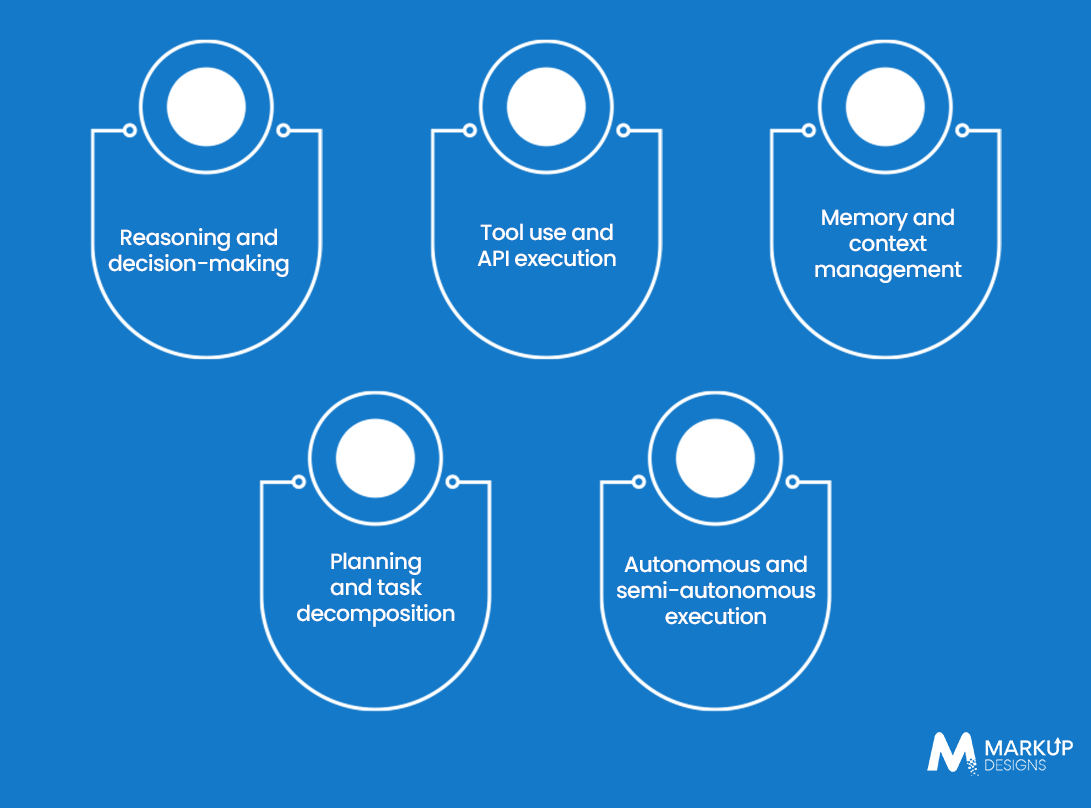
An enterprise AI agent typically combines several capabilities:
- Reasoning and decision-making: Evaluates information and determines the next appropriate action.
- Tool use and API execution: Connects with enterprise applications, databases, and external services.
- Memory and context management: Maintains relevant information across interactions and longer workflows.
- Planning and task decomposition: Breaks complex objectives into smaller executable steps.
- Autonomous and semi-autonomous execution: Completes defined tasks independently while allowing human approval where required.
Why Use LangChain for Enterprise AI Agent Development?
LangChain provides a flexible framework for combining language models and AI agent development with tools, data sources, and workflow components. Its modular approach allows businesses to design agents around specific operational requirements instead of relying on a fixed, one-size-fits-all architecture.
Modular Architecture for Building Flexible AI Agents
LangChain enables developers to combine components such as prompts, models, tools, retrievers and memory based on the requirements of each workflow. This modularity makes it easier to update individual parts of an AI agent without rebuilding the entire system.
Integration with LLMs, Tools and Enterprise Data
Enterprise agents often need access to multiple systems. LangChain helps connect LLMs with APIs, databases, internal applications, and knowledge sources, allowing agents to move from understanding a request to retrieving information or triggering an action.
Support for Agentic Workflows and Multi-Step Execution
Complex business tasks rarely involve a single action. LangChain can support workflows where agentic AI evaluates a goal, performs multiple steps, and uses different tools as the task progresses.
Memory and Stateful Context Management
Agents handling ongoing tasks need more than the latest prompt. Memory and state management help preserve relevant context, track progress, and support workflows that continue across multiple interactions.
Flexibility for Custom Enterprise Use Cases
Different organisations have different systems, rules, and workflow requirements. LangChain provides the flexibility to build custom agent architectures for use cases ranging from customer operations and research to IT workflows and internal process automation.
Enterprise AI Agent Architecture with LangChain
A production-ready enterprise AI agent requires more than LLM development and a tool list. Its architecture should separate reasoning, execution, data access, workflow control and governance to improve reliability and maintain control as the system scales.
Read Also: How Agentic AI is Transforming Modern Enterprise Data Engineering
The Core Layers of an Enterprise AI Agent Architecture
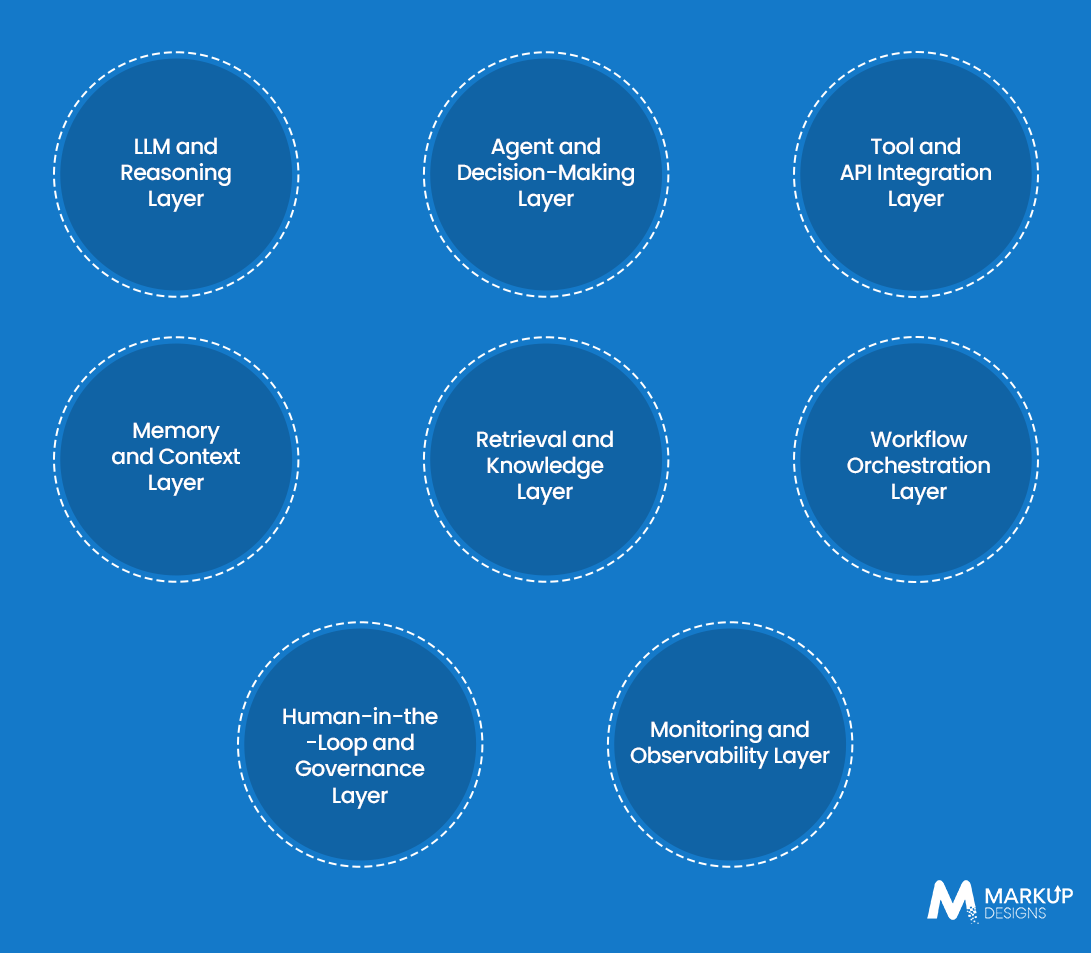
LLM and Reasoning Layer
This layer interprets requests, analyses available information, and generates reasoning for the next action. The selected model should align with the complexity, latency, and cost requirements of the workflow.
Agent and Decision-Making Layer
The agent layer determines what the system should do next. It evaluates the task, selects appropriate tools, and decides whether to continue, request additional information or escalate the task.
Tool and API Integration Layer
This layer connects the agent with enterprise applications and external services. Clear permissions and structured inputs are essential to prevent incorrect or unauthorised actions.
Memory and Context Layer
The memory layer stores relevant conversational, task and workflow information. It helps agents maintain continuity without repeatedly processing unnecessary context.
Retrieval and Knowledge Layer
Enterprise agents often need access to internal documents, databases and knowledge repositories. Retrieval mechanisms supply relevant information to the agent when required, rather than relying solely on the LLM’s training data.
Workflow Orchestration Layer
Orchestration manages how tasks move between different steps, tools and agents. It becomes particularly important for long-running workflows that require state tracking, retries or conditional actions.
Human-in-the-Loop and Governance Layer
Not every decision should be fully automated. This layer introduces approval checkpoints, policy controls and escalation mechanisms for sensitive or high-impact actions.
Monitoring and Observability Layer
Observability helps teams understand how an agent is performing in production. Monitoring model outputs, tool calls, workflow failures and execution patterns makes it easier to identify issues and continuously improve reliability.
How Enterprise AI Agents Execute End-to-End Workflows
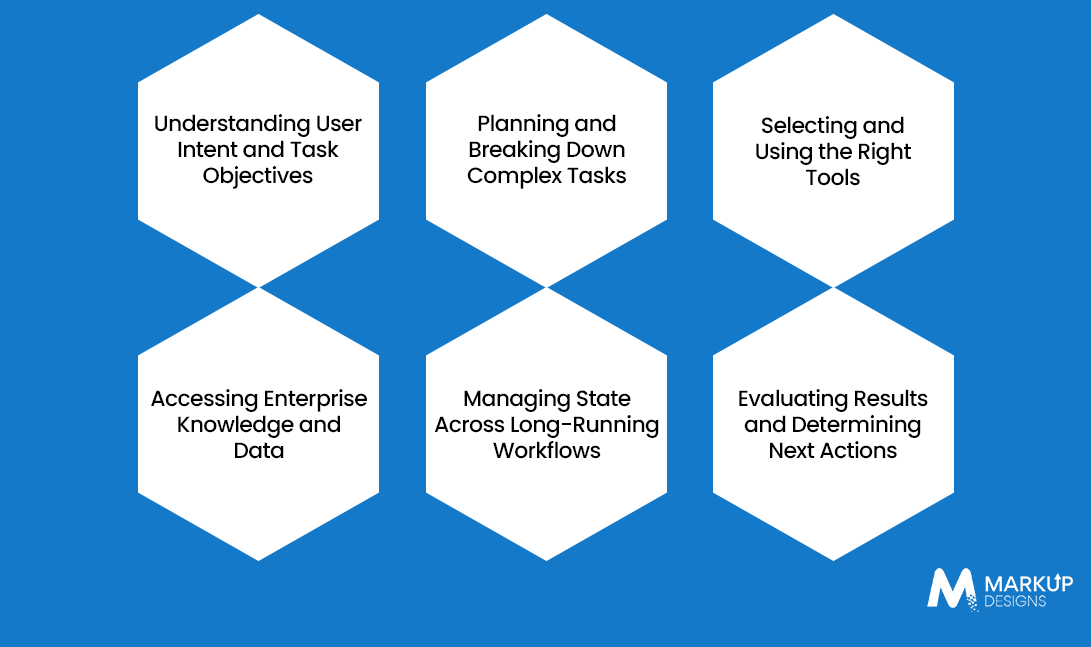
Enterprise AI agents typically follow a continuous execution loop rather than a simple input-output process. They understand the objective, plan the required actions, interact with relevant systems and evaluate results before deciding what to do next.
Understanding User Intent and Task Objectives
The agent first interprets the request and identifies the intended outcome. Clear objectives and defined boundaries help prevent the system from taking unnecessary or irrelevant actions.
Planning and Breaking Down Complex Tasks
For complex requests, the agent can divide the objective into smaller steps. This allows it to handle multi-stage workflows more systematically and determine dependencies between actions.
Selecting and Using the Right Tools
Based on the task, the agent chooses from available tools such as APIs, databases, search systems or enterprise applications. Each tool should have a clearly defined purpose and controlled access.
Accessing Enterprise Knowledge and Data
When additional information is required, the agent retrieves relevant data from approved knowledge sources. This enables decisions based on current enterprise information rather than relying only on model knowledge.
Managing State Across Long-Running Workflows
State management helps the agent track completed actions, current progress, and relevant context. This is essential when workflows continue across multiple steps, sessions, or systems.
Evaluating Results and Determining Next Actions
After completing an action, the agent evaluates the outcome and decides whether to continue, retry, use another tool, or escalate the task. This feedback loop makes workflows more adaptive and reliable.
How to Build Enterprise AI Agents with LangChain Step by Step
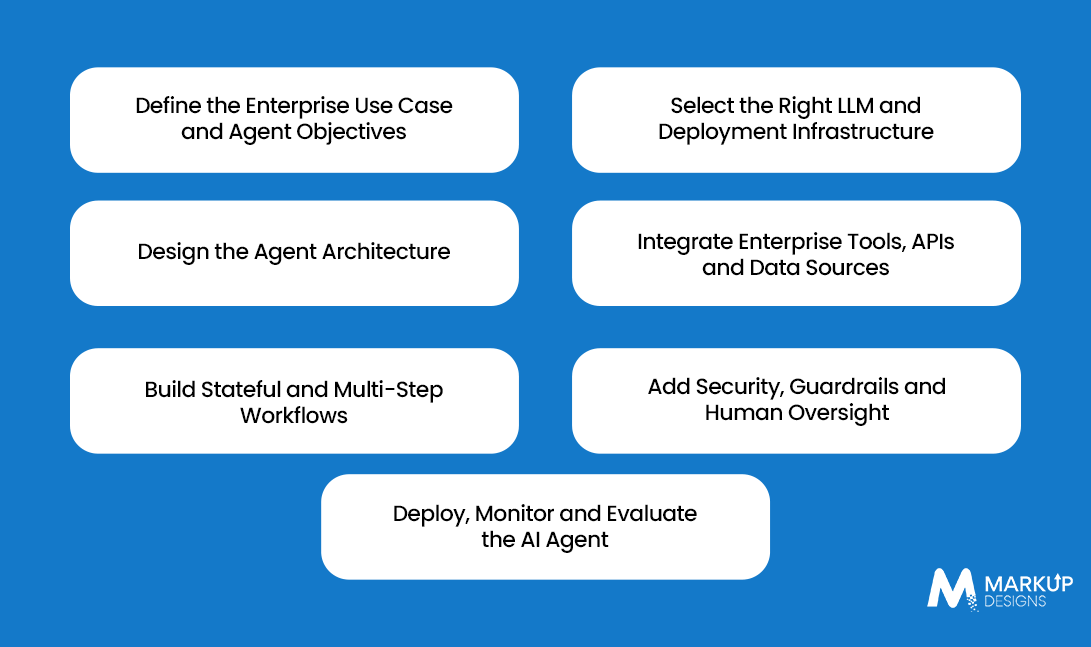
Building an enterprise AI agent requires structured planning before implementation. Each stage should focus on creating a system that is useful, controlled, and capable of operating reliably within existing business environments.
Step 1: Define the Enterprise Use Case and Agent Objectives
Identify Workflow Bottlenecks
Start with workflows where repetitive decisions, fragmented data, or manual coordination create measurable inefficiencies. The agent should solve a specific operational problem rather than automate a process without a clear business need.
Define Agent Autonomy Levels
Decide what the agent can do independently and when it needs human approval. Low-risk tasks may be automated, while financial, legal, or sensitive actions should include stricter controls.
Establish Success Metrics
Define measurable outcomes such as task completion rate, response accuracy, execution time, cost reduction, or reduction in manual intervention. Without clear metrics, agent performance becomes difficult to evaluate.
Step 2: Select the Right LLM and Deployment Infrastructure
Choosing Models Based on Task Complexity
Select models according to reasoning requirements, response quality, latency and cost. Not every workflow requires the largest or most expensive model.
Cloud vs Private Deployment Considerations
Deployment choices depend on security, compliance and data requirements. Cloud infrastructure may offer faster scalability, while private or controlled environments can provide greater control over sensitive information.
Managing Cost, Latency and Scalability
Enterprise deployments should balance model performance with operational costs. Caching, model routing and efficient tool execution can help control expenses as usage grows.
Step 3: Design the Agent Architecture
Define Agent Responsibilities
Give each agent or component a clear responsibility. Narrower responsibilities reduce unnecessary complexity and make failures easier to identify.
Design Agent Decision Flows
Define how the agent moves from understanding a task to selecting actions and evaluating outcomes. Clear decision paths help control behaviour and improve consistency.
Determine Tool and Data Access
Agents should only access systems and information required for their responsibilities. Applying least-privilege access reduces security risks and limits the impact of errors.
Step 4: Integrate Enterprise Tools, APIs and Data Sources
Connecting Business Applications
Connect the agent with relevant CRM, ERP, support, analytics or internal systems through secure APIs. Enterprise AI Integration should focus on business actions that the agent can perform reliably.
Implementing RAG for Enterprise Knowledge
Retrieval-Augmented Generation allows agents to access current internal documents and knowledge bases when needed. This can improve relevance and reduce dependence on outdated model knowledge.
Managing Structured and Unstructured Data
Enterprise information exists across databases, documents, emails and other formats. A well-designed data layer helps the agent retrieve and interpret relevant information consistently.
Step 5: Build Stateful and Multi-Step Workflows
Managing Conversation and Task State
The agent should retain only the context required to continue the task. Separating temporary conversation context from persistent workflow state helps keep execution manageable.
Handling Long-Running Processes
Some workflows involve delays, external approvals or asynchronous events. The architecture should allow tasks to pause and resume without losing progress.
Implementing Workflow Checkpoints and Recovery
Checkpoints preserve workflow progress at critical stages. If a failure occurs, the system can resume from the last reliable state instead of restarting the entire process.
Step 6: Add Security, Guardrails and Human Oversight
Access Control and Permissions
Use role-based permissions and authentication to control which systems, tools, and data an agent can access.
Preventing Unsafe Tool Execution
Validate tool inputs and define execution boundaries before allowing the agent to trigger external actions. Guardrails should prevent unintended or high-risk operations.
Human Approval for High-Risk Actions
Introduce approval steps for actions with financial, legal, operational, or customer impact. Human oversight should be based on risk rather than applied uniformly to every task.
Compliance and Data Governance
Enterprise agents must follow internal policies and relevant data protection requirements. Logging and audit trails are important for understanding how decisions and actions were made.
Step 7: Deploy, Monitor and Evaluate the AI Agent
Tracking Agent Performance
Monitor metrics such as task completion, accuracy, latency, and cost to understand whether the agent is delivering measurable value.
Monitoring Tool Calls and Failures
Track which tools are used, how often they fail and where execution breaks down. This helps teams identify integration and workflow issues quickly.
Evaluating Agent Outputs
Regularly test agent responses and actions against expected outcomes. Evaluation should include both model quality and the correctness of the overall workflow.
Improving Agent Behaviour Over Time
Production monitoring should inform prompt improvements, workflow updates, tool changes and model selection. Enterprise agents require ongoing optimisation rather than one-time deployment.
Best Practices for Building Enterprise AI Agents with LangChain
Start with Clearly Defined Workflow Boundaries
Define what the agent should and should not do. Clear boundaries reduce unpredictable behaviour and make performance easier to measure.
Keep Agent Architectures Modular
Separate reasoning, tools, retrieval, memory and workflow logic. Modular architectures are easier to test, update and scale.
Limit Tool Access Based on Agent Responsibilities
Do not give every agent unrestricted access to enterprise systems. Restrict permissions to the minimum required for each task.
Use Structured Outputs for Reliable Execution
Structured outputs reduce ambiguity when agents pass information between models, tools and systems. This improves consistency and lowers the risk of execution errors.
Implement Memory Strategically
Store information based on its operational value. Excessive memory can increase cost, complexity and the risk of irrelevant context affecting decisions.
Build Human Oversight into Critical Workflows
Require human approval where the consequences of an incorrect action are significant. Autonomy should increase only when reliability is proven.
Design for Failure and Recovery
Tool failures, incomplete data and model errors are inevitable. Build retries, fallback paths and checkpoints into critical workflows.
Prioritise Observability from Day One
Capture agent decisions, tool calls, failures, and workflow states from the beginning. Debugging becomes far more difficult when these capabilities are added after deployment.
Continuously Test and Evaluate Agent Performance
Test agents against realistic scenarios and edge cases. Ongoing evaluation is necessary as models, tools, enterprise data, and workflows change.
Common Challenges in Enterprise AI Agent Development
Hallucinations and Unreliable Decision-Making
LLMs can generate incorrect information or make poor assumptions. Grounding agents with enterprise data, validation, and clear execution rules can reduce these risks.
Tool Invocation Failures
APIs may fail, return incomplete data, or behave unexpectedly. Agents need validation, retries, and fallback mechanisms rather than assuming every tool call will succeed.
Memory and Context Management Complexity
Long-running workflows can accumulate large amounts of context. Teams need clear strategies for deciding what to retain, summarise or discard.
Integration with Legacy Enterprise Systems
Older systems may lack modern APIs or consistent data structures. Integration layers and custom connectors may be required to make them usable by AI agents.
Security and Data Privacy Risks
Agents can access sensitive information and trigger business actions, creating significant security risks. Strong authentication, permissions, and audit controls are essential.
Controlling Autonomous Agent Behaviour
Greater autonomy can increase efficiency but also increases the impact of mistakes. Workflow boundaries, guardrails and escalation paths are necessary to keep behaviour predictable.
Scaling Multi-Agent Systems
As more agents interact, coordination becomes more complex. Clear responsibilities, shared state controls, and orchestration mechanisms are needed to prevent duplication and conflicting actions.
Enterprise Use Cases for LangChain AI Agents
LangChain AI agents can support enterprise workflows where tasks require reasoning, information retrieval, system interaction and multi-step execution. The most valuable use cases are those with clear processes, reliable data sources and measurable business outcomes.
Intelligent Customer Support Agents
AI agents can analyse customer queries, retrieve relevant information from knowledge bases, check account or order details and take actions through connected support systems. Complex cases can be escalated to human teams with the relevant context already available.
IT Operations and Incident Management Agents
IT agents can monitor alerts, investigate incidents, retrieve system information and perform predefined troubleshooting actions. They can also coordinate workflows across monitoring, ticketing and communication platforms to reduce manual investigation time.
Enterprise Knowledge and Research Agents
Knowledge agents can search internal documents, databases and approved external sources to answer business questions or prepare research summaries. They help employees access fragmented organisational knowledge through a single conversational interface.
Finance and Compliance Automation Agents
AI agents can support document reviews, data validation, compliance checks and reporting workflows. For sensitive decisions, they can identify issues and prepare recommendations while keeping final approvals under human control.
Healthcare Workflow Automation Agents
Healthcare agents can assist with administrative workflows such as document processing, information retrieval and care coordination. Enterprise deployments require strict controls around data access, privacy and human oversight.
Sales and Business Operations Agents
Sales and operations agents can retrieve customer information, update CRM records, prepare follow-ups and coordinate routine tasks across business systems. This reduces repetitive administrative work and allows teams to focus on higher-value activities.
Future of Enterprise AI Agents with LangChain
Enterprise AI agents are likely to become more interconnected, stateful and embedded within everyday business workflows. The focus will increasingly shift from standalone agents to governed systems capable of coordinating complex actions across multiple platforms.
Multi-Agent Enterprise Systems
Specialised agents will increasingly work together, with each handling a defined responsibility such as research, planning, execution or validation. This can improve scalability but requires stronger coordination.
More Advanced Stateful Orchestration
Future agents will better manage workflows that pause, resume and evolve over time. Stateful orchestration will become increasingly important for processes involving multiple systems, approvals and dependencies.
Agent Interoperability and MCP
Standards such as the Model Context Protocol can make it easier for AI systems to connect with tools and data sources through more consistent interfaces. Greater interoperability could reduce the need for custom integrations across every workflow.
Greater Human and AI Collaboration
The goal is not to remove humans from every process. More enterprise workflows will combine autonomous execution with human review, allowing people to focus on decisions that require judgement, accountability or domain expertise.
Event-Driven Autonomous Workflows
Instead of waiting for direct user prompts, agents will increasingly respond to events such as system alerts, customer actions or changes in business data. This can enable more proactive and automated operations.
Stronger Governance and Observability
As agents gain access to more systems and responsibilities, enterprises will require deeper visibility into their actions. Monitoring, audit trails, evaluation and policy enforcement will become core architectural requirements.
How Markup Designs Helps Build Enterprise AI Agents
Markup Designs helps businesses design and develop custom enterprise AI agents using LangChain and LangGraph architectures. Our capabilities span RAG and enterprise knowledge integration, API and business system connectivity, secure and scalable deployment, and workflow monitoring and governance. We focus on building AI agent systems that align with real business processes while providing the control, observability and ongoing optimisation needed for reliable production use.
Build Enterprise AI Agents That Do More Than Respond
Transform complex business workflows into intelligent, connected AI systems with LangChain, enterprise data and controlled automation.

Conclusion
Building enterprise AI agents requires far more than connecting an LLM to a few tools. Reliable systems depend on a well-designed architecture that separates reasoning, data access, tool execution and workflow orchestration while maintaining clear boundaries around autonomy. Security, human oversight and state management must also be considered from the beginning.
LangChain provides a flexible foundation for assembling these components, but the framework alone does not determine whether an agent succeeds in production. The strongest enterprise AI agents are built around clearly defined workflows, controlled access and continuous evaluation. As agentic systems become more capable, businesses that treat architecture, orchestration and monitoring as core requirements will be better positioned to deploy AI that delivers measurable operational value.
FAQs
1. What is an enterprise AI agent?
An enterprise AI agent is an AI-powered system that can understand objectives, reason through tasks, access enterprise knowledge, use connected tools and execute defined workflows. Unlike traditional chatbots, it can take actions across business systems with varying levels of autonomy.
2. How does LangChain help in building enterprise AI agents?
LangChain provides modular components for connecting LLMs with tools, APIs, data sources, retrieval systems, and memory. This allows developers to build agent workflows that can be adapted to specific enterprise requirements.
3. What is the architecture of an enterprise AI agent?
A typical architecture includes an LLM and reasoning layer, agent decision layer, tool and API integration layer, memory and context management, retrieval and knowledge systems, workflow orchestration, governance controls, and monitoring.
4. How do enterprise AI agents integrate with existing business systems?
AI agents can connect with existing systems through APIs, databases, connectors, and custom integration layers. Depending on the use case, they can interact with platforms such as CRMs, ERPs, knowledge bases, support systems, and analytics tools.
5. What are the best practices for building AI agents with LangChain?
Key practices include defining clear workflow boundaries, keeping the architecture modular, restricting tool access, using structured outputs, managing memory strategically, and implementing guardrails. Teams should also build for failures, monitor agent behaviour, and continuously evaluate performance in production.
Author's Perspective
Enterprise AI agents are easy to demonstrate and much harder to deploy reliably. The real challenge is not making an LLM call a tool; it is designing the architecture around what happens when tools fail, data changes, workflows pause, or the agent makes a poor decision. Businesses should therefore stop treating AI agents as standalone chat interfaces and start treating them as software systems that require architecture, governance, testing, and continuous monitoring. LangChain can provide the building blocks, but the quality of the final solution depends on how intelligently those blocks are designed and orchestrated.
Discuss Your Project NowJupinder Singh Arora
Founder and CEO
Related Posts
How Artificial Intelligence Is Changing Mobile Game Development
How to Build Production-Ready Applications with AI Coding...
Cost, Benefits & Business Impact: Generative AI vs....
Insights Are Valuable & Execution is Priceless
You’ve read about the digital future. Now, let’s build the infrastructure to take you there. Move your strategy from the page to the product.
Design Your Solution Now
Contact Us
Schedule The Appointment At Your Convenience Date And Time.
30 Min
Web Conference
Time Zone
Indian standard time (08:30pm)

Thanks For Getting In Touch!
You’ve Taken The First Step Toward Transforming Your Digital Presence. Our Experts Will Reach Out Shortly To Take It Forward.
Launch Your Dream Project
Provide a brief overview of your project, and our specialists will evaluate your requirements. We will connect with you to explore how the right digital solutions can help you launch faster.