
In Brief
- AI revolutionizes the retail sector in Australia because of its ability to comprehend consumer behavior, automate business processes, manage inventory, predict demand, and improve shopping experiences in physical and online retail locations.
- Some of the key AI trends include generative AI, agentic AI, hyper-personalization, visual search, predictive analysis, dynamic pricing, conversational AI, computer vision, warehouse automation, and retail media powered by AI.
- The examples of retailers that use AI in Australia are Coles, Woolworths, THE ICONIC, and T2 who apply AI in assisting customers, predicting demand, inventory management, making recommendations on products, managing logistics, and managing stores.
- There are many advantages of AI in retail, including customer experience improvements, better inventory management, decreased operational costs, quicker decision-making, increased sales, efficient logistics, and fraud detection. The success of AI implementation depends on analysis of the needs of the business, preparation of data, selection of technology, integration, and performance measurement.
- Challenges associated with AI usage in retail include data privacy, cybersecurity issues, implementation costs, integration, data quality, and customer trust. Markup Designs supports Australian retailers in implementing AI through customized solutions, chatbots, predictive analysis, workflow automation, and integration with retail systems.
The retail industry in Australia continues to change as the expectations, shopping behaviors, and operational procedures keep on evolving. There are rising customer expectations for personalized recommendations, quick services, convenient payment methods, and an overall good shopping experience in both online and offline stores. In order to satisfy these demands, the retail sector in Australia is turning to Artificial Intelligence (AI).
Artificial Intelligence has enabled retailers to analyze customer behavior, forecast demand, control stock, automate routine operations, and make better business decisions. There is no shortage of innovative ways to implement artificial intelligence in the retail industry – be it supermarket chains, fashion retailers, or ecommerce businesses.
Implementing AI solutions comes with a number of difficulties, including those associated with data protection, costs of implementation, integration issues, and customer relations.
In this blog, we will explore the major AI trends, real-world applications, Australian retail examples, benefits, implementation steps, and challenges shaping the future of the Australian retail industry.
Understanding the Role of AI in the Australian Retail Industry
Artificial Intelligence (AI) in the retail sector involves the utilization of advanced intelligent technology that facilitates analysis of data, understanding of consumer behaviour, automation of processes, and informed decision-making. Through AI, retailers are able to undertake various business activities faster and more accurately.
In Australia, there are applications of Artificial Intelligence in retail in both online and brick-and-mortar stores. The technologies include machine learning to predict product demand, a recommendation engine to offer appropriate product recommendations, a chatbot for answering customer inquiries, and computer vision to track activities in the store.
Artificial Intelligence brings together all areas in retail, including sales, inventory, supply chain management, marketing, and customer service. In a case where there is increased demand for a certain product, through AI, the retailer is able to detect the trend and then adjust the inventory levels.
Artificial intelligence does not aim to substitute the activities of humans in every aspect, but enables the retail staff members to save time and concentrate on other aspects.
Why are Australian Retailers Investing in AI?
Australian retail businesses are increasingly incorporating AI technologies in response to shifting consumer expectations, rising operational challenges, and better business efficiency. With increased competition in both brick-and-mortar retail and e-commerce environments, it has become important for retailers to develop new strategies for managing the processes involved and meeting customers’ needs.
The main factors that influence the increasing use of AI in retail businesses may be highlighted as follows:
- Changing Customer Expectations: Consumers demand personalized recommendations and faster customer service, and it is easier for retailers to understand their preferences thanks to AI technologies.
- Increased Operational Costs: Labor, logistics, and inventory costs may have negative effects on the profitability of retail businesses. However, automation of routine activities becomes possible with the help of AI technologies.
- Improved Inventory Management: AI-powered forecasting helps retailers gain deeper insights into customer preferences while maintaining optimal inventory levels.
- Growing E-commerce Competition: Retailers use AI to enhance product discovery, personalise their e-stores, and offer a better shopping experience for customers.
- Informed Decisions from Data: AI evaluates data on sales and customer behavior, enabling retailers to make informed decisions regarding price, promotions, and products.
These factors are making AI an important part of retail growth and long-term business planning in Australia.
Top AI Trends Transforming the Australian Retail Industry
AI is presenting some new methods for managing operations, engaging with consumers, and improving shopping experiences for Australian retailers. As the technological world continues to develop, a number of AI trends have emerged that are becoming popular in the retail industry.
Some key trends include:
- Generative AI: Generative AI helps retailers in the creation of product descriptions, marketing content, and personalised shopping recommendations.
- Agentic AI: Multi-step operations are being done by AI agents, including customer assistance, product searches, and purchasing guidance.
- Hyper-Personalisation: AI uses consumer preferences and purchase history to present relevant product suggestions.
- Visual Search: Consumers can simply upload images to search for similar products without using any keywords.
- Predictive Analytics: With the help of AI, retailers can make predictions about demand, sales patterns, and inventory planning.
- AI-powered Dynamic Pricing: AI can be used to change product prices depending on demand, competition, and market conditions.
10 Real-World Applications of AI in Australian Retail
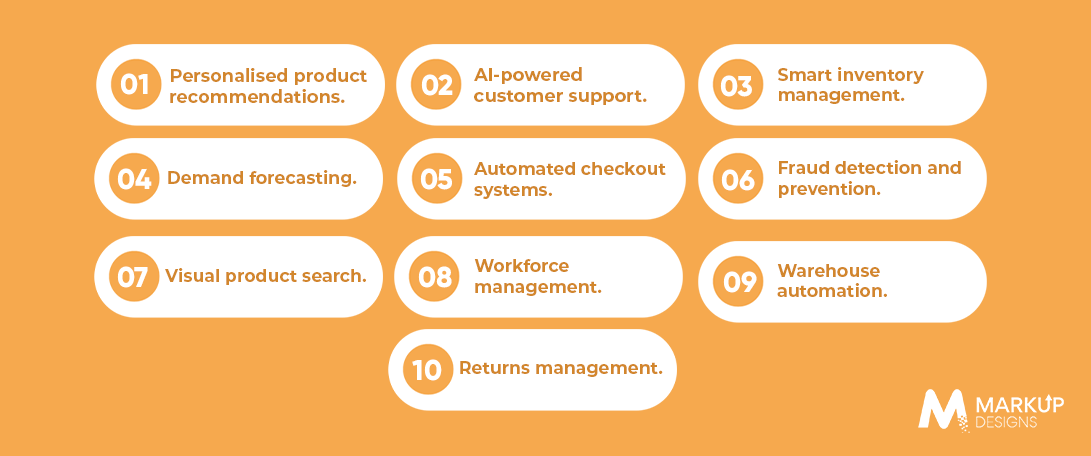
AI is assisting retailers in Australia in improving their processes and providing a great shopping experience for consumers. AI can be used by businesses during various stages in the retail industry.
Here are 10 practical applications of AI in retail:
Personalised product recommendations.
Based on the analysis of consumer preferences, browsing behaviour, and past purchase records, the AI recommends products according to their interests.
AI-powered customer support.
Chatbots and virtual assistants handle general customer queries, provide information about products, and assist in order tracking.
Smart inventory management.
AI technology monitors inventory stocks and identifies products with low stock, helping retailers manage inventories properly.
Demand forecasting.
The machine learning technology analyses sales history, seasonality, and market trends and predicts future demand for products.
Automated checkout systems.
AI checkout technologies identify products and facilitate purchasing for customers by requiring less manual effort from them.
Fraud detection and prevention.
AI detects unusual activities and transactions and assists retailers in preventing retail fraud.
Visual product search.
With image recognition technology, customers can use iEfforto to search for products instead of textual descriptions.
Workforce management.
AI technologies forecast staffing needs, generate staff schedules, and optimize resource management for retailers.
Warehouse automation.
Robots and automated systems help in sorting, picking, packing, and shipping of orders.
Returns management.
AI technology analyzes return patterns and helps improve return management processes.
These applications allow retailers to use business data more effectively, reduce manual effort, and improve customer experiences across online and offline channels.
Real-World Examples of AI Adoption in Australian Retail
There are also several Australian companies that currently implement AI into their business processes to enhance customer experience, control their supply chains, and optimize everyday operations. In these examples, we see how artificial intelligence shifts from experiments to practical use cases in the sphere of retail.
1. Coles: AI in Store Operations and Customer Experience
This company has been using AI for demand forecasting, replenishing inventory, workforce rostering, and product ranging. It uses computer vision for fresh produce stock monitoring and store operations.
In October 2025, Coles announced a partnership with OpenAI to launch ChatGPT Enterprise in the corporate workforce of the company. This project should assist employees with research, administration, data insights, and generating ideas.
2. Woolworths: Shop Assistant with AI Capabilities
Currently, Woolworths is experimenting with AI to create more convenient online shopping experience for customers. Its AI-powered shopping assistant called Olive suggests customers meals, alternative products ,and performs other shopping-related activities.
The company was also able to showcase AI applications in catalogue planning and employee assistance. Woolworths presented its results for 2026 and reported more than a million unique users of its agentic shopping tools.
3. THE ICONIC: AI in Fashion Product Recommendations & Inventory Management
THE ICONIC has leveraged the power of AI to better understand customer behavior patterns to predict return rates and manage inventory levels of products, including their sizes.
The company has even made use of visual search technology to recommend substitute products when certain sizes of particular garments are not available.
4. T2: AI in Pricing Strategy, Demand Forecasting & Inventory Management
T2 has leveraged AI and optimization algorithms to enhance its pricing strategy and promotions and to predict demand. The company has used AI to synchronize financial and supply chain forecasts, thus making inventory management more effective.
5. AI has helped the retailer forecast the number of employees that will be required based on store demand.
As seen from these examples, AI can be used for more than just interacting with customers. Retailers in Australia are leveraging AI for inventory planning, supply chain management, supporting their employees, product discovery, and shopping help. The choice of appropriate AI tools will depend on the requirements of each retail company.
Key Benefits of AI for Australian Retail Businesses
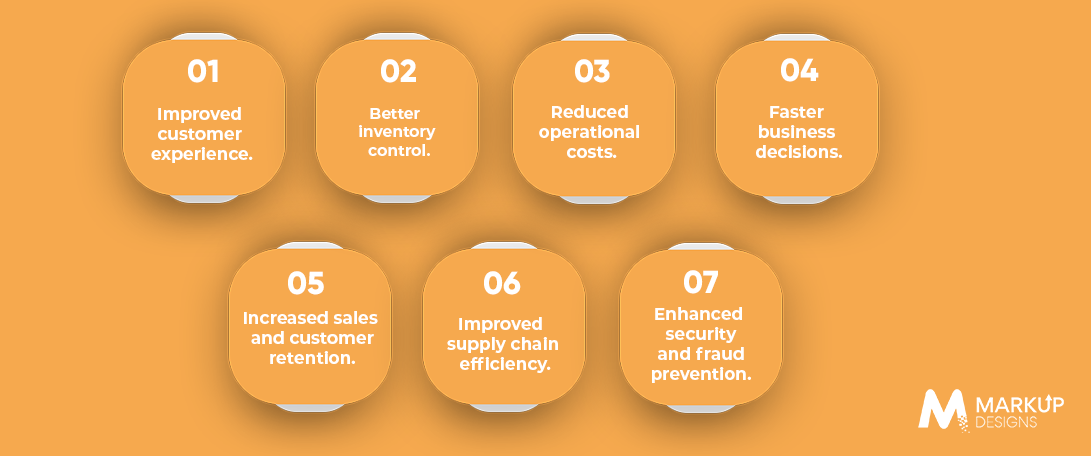
AI presents a number of advantages for Australian retailers since it allows them to optimize customer interactions, streamline processes, and make sound business decisions. If properly used, AI can ensure both short-term success and long-term development for a business.
Here are some advantages of using AI in retail businesses:
Improved customer experience.
With the help of AI, retailers get a deeper understanding of customer needs and are able to deliver personalized recommendations, deals, and support.
Better inventory control.
AI-based software systems monitor stock availability, foresee demand for various products, and prevent overstocking and lack of popular items.
Reduced operational costs.
Automation of routine tasks (order processing, stock management, customer support) results in less manual work and lower operating costs.
Faster business decisions.
Analysis of a vast amount of information related to a retail business gives valuable insights about sales, customer behavior, and market tendencies.
Increased sales and customer retention.
Individualized product recommendations and targeted marketing help to attract more clients and retain them.
Improved supply chain efficiency.
AI aids in demand planning, warehouse management, and logistics management; therefore, it helps retailers handle their supply chain in an effective manner.
Enhanced security and fraud prevention.
AI detects any fraudulent activity by looking for unusual transaction patterns, thus reducing financial risks.
In general, AI assists Australian retailers in increasing operational efficiency, customer understanding, and market response capability.
How to Implement AI in an Australian Retail Business: A Step-by-Step Approach
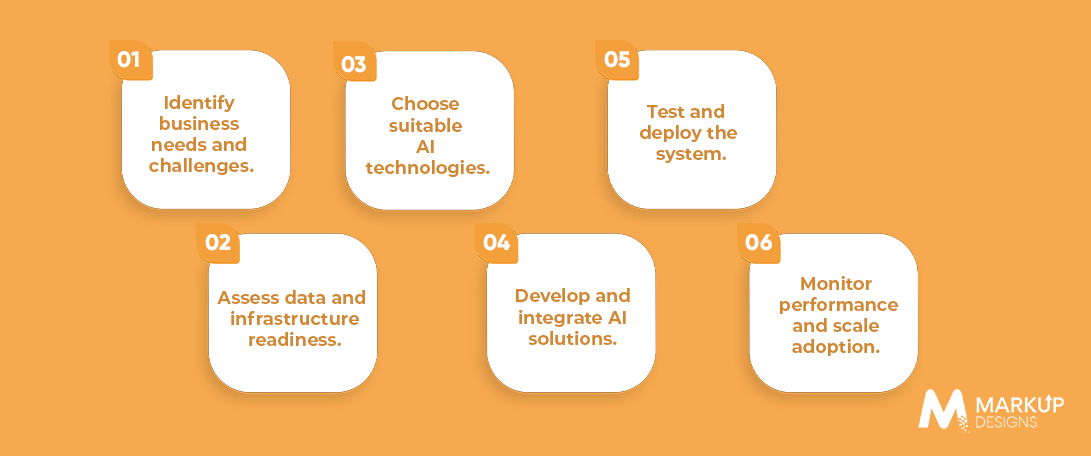
Incorporating AI into the retail business process does not only mean finding the most suitable solution for your business needs. You will have to understand your needs and challenges, get ready with your data, and select the appropriate solutions that could integrate well into your current business operation.
Here are the important steps you need to take:
Step 1: Identify business needs and challenges.
Identify the problems you could solve with the implementation of AI. It could be anything from inventory management, customer service, demand forecasting, pricing, or supply chain operations.
Step 2: Assess data and infrastructure readiness.
Evaluate your data, retail software, databases, and IT infrastructure to check whether everything is ready for your future AI integration efforts.
Step 3: Choose suitable AI technologies.
Find solutions that suit your business needs best. Possible AI technologies include machine learning, generative AI, computer vision, predictive analytics, and conversational AI.
Step 4: Develop and integrate AI solutions.
Cooperate with a skilled technology partner to develop AI solutions and integrate them with your current POS, e-commerce, CRM, and inventory management systems.
Step 5: Test and deploy the system.
Test the system using the real-world business processes prior to deployment. Ensure that it performs well in terms of accuracy, performance, security, and meeting the needs of both customers and operations.
Step 6: Monitor performance and scale adoption.
Monitor the key performance indicators, including inventory accuracy, customer satisfaction levels, conversion rates, and operational costs, to further develop the system and implement AI in other areas.
The implementation plan allows for implementing AI technologies by Australian retailers with more confidence.
How Much Does It Cost to Implement AI in the Australian Retail Industry?
The cost of AI implementation in the retail sector of Australia varies depending on the type of AI technology used, business needs, complexity of its deployment, and extent of system integration.
Factors that need to be considered while making estimates for AI development costs in the retail sector:
- Type of AI Solution: The development process for chatbots, recommendation engines, predictive analytics, computer vision, and other types of AI technologies is different.
- Data Collection: Data collection and preparation can be included in the cost of implementation.
- System Integration: System integration with the current Point of Sale (POS), Customer Relationship Management (CRM), Enterprise Resource Planning (ERP), and e-commerce systems increases development costs.
- Infrastructure: Hosting of cloud infrastructure, computer resources, data storage, and security impacts the cost of AI.
- Customisation: Specific custom solutions tailored for retail processes can require additional development and testing.
- Maintenance and Support: Improvement of models, performance monitoring, technical support, and security are also part of the cost.
How Markup Designs Helps Australian Retail Businesses Adopt AI
AI integration should be done through the proper technology, industry understanding, and development process. Markup Designs assists retailers in Australia in implementing AI solutions that can solve any operational problems and provide an improved customer experience. The company’s services include an AI-enabled retail website and mobile application, chatbot and virtual assistance, predictive analytics, and order management and customer communication automation.
AI integration with ecommerce platforms, CRM systems, inventory management, and other enterprise software is also provided by Markup Designs. Customized AI development services can help to implement a tailored solution for companies with special needs.
With expertise in software engineering and new technology, Markup Designs is geared toward developing digital products that are secure, scalable, and business-focused. This allows retailers to consider any AI possibilities, optimize processes, become more efficient, and create enhanced shopping experiences for their customers.
Ready to Bring AI into Your Retail Business?
Build customized AI solutions that improve retail operations, simplify customer interactions, and help your business prepare for the future.

Conclusion
With the advent of AI, the retail industry in Australia is going through a transformation in the form of more personalized experiences for customers and more efficient processes within business operations. Some of the areas that retailers can use intelligent technology include predictive analytics, smart inventory management, conversational AI, and automated fulfillment.
But there are some things, like choosing the right technology, managing the data effectively, taking care of the security issues, and integrating AI solutions into business processes, that need to be considered in order to successfully adopt AI. It is better if retailers concentrate on the business needs and do not use AI just because it is a technology trend.
In the changing environment of retailing, those who will make the right investments in AI will enhance their customer relationships and business operations and remain ahead of their competitors.
FAQs
1. How is AI being used in the Australian retail industry?
AI is used for personalised product recommendations, customer support, inventory management, demand forecasting, fraud detection, dynamic pricing, and warehouse automation. It helps retailers improve customer experiences and manage operations more efficiently.
2. What are the latest AI trends in Australian retail?
Some emerging trends include generative AI, agentic AI, hyper-personalisation, visual search, predictive analytics, conversational AI, computer vision, and automated fulfilment systems.
3. Which Australian retailers are using AI?
Retailers such as Coles, Woolworths, THE ICONIC, and T2 have explored or implemented AI applications across areas such as customer experience, demand forecasting, inventory planning, and retail operations.
4. How does AI improve customer experience in retail?
AI analyses customer preferences, browsing behaviour, and purchase history to provide relevant recommendations, personalised offers, faster customer support, and improved product discovery.
5. What are the biggest challenges of AI adoption in retail?
Major challenges include data privacy, cybersecurity, integration with legacy systems, implementation costs, data quality, limited technical expertise, and customer trust.
Author's Perspective
AI is creating new opportunities for Australian retailers, but its real value lies in solving everyday business challenges. From reducing inventory waste and improving customer support to creating convenient shopping experiences, successful AI adoption should focus on delivering measurable business outcomes.
The future of retail will depend on how effectively businesses combine AI technologies with human expertise. Retailers that invest in reliable data, customer trust, and practical AI strategies will be better positioned to adapt to changing market demands. Rather than automating every process, the focus should be on using AI where it can create meaningful value for customers, employees, and business operations.
Discuss Your Project NowJupinder Singh Arora
Founder and CEO
Related Posts

How AI is Transforming Real Estate in Australia:...
How Much Does Custom AI Accounting Software Cost...
How to Build an App With Claude Code:...
Insights Are Valuable & Execution is Priceless
You’ve read about the digital future. Now, let’s build the infrastructure to take you there. Move your strategy from the page to the product.
Design Your Solution Now
Contact Us
Schedule The Appointment At Your Convenience Date And Time.
30 Min
Web Conference
Time Zone
Indian standard time (08:30pm)

Thanks For Getting In Touch!
You’ve Taken The First Step Toward Transforming Your Digital Presence. Our Experts Will Reach Out Shortly To Take It Forward.
Launch Your Dream Project
Provide a brief overview of your project, and our specialists will evaluate your requirements. We will connect with you to explore how the right digital solutions can help you launch faster.