

In Brief
- Green cloud computing helps companies in reducing energy usage, cloud waste, and carbon emissions by improving cloud resource, infrastructure, application, and storage usage without compromising on performance and scalability.
- Some of the key strategies for achieving sustainability include right-sizing resources, eliminating idle infrastructure, containerization and serverless architectures, application modernization, minimizing unnecessary data transfers, and utilizing low-carbon or renewable energy-driven cloud regions where possible.
- AI can enable green cloud computing to be intelligent through forecasting workloads, optimizing resource allocation, carbon-aware scheduling, application inefficiency detection, predictive maintenance, and cloud monitoring.
- Green cloud computing can have some environmental as well as business advantages, which can include reduced cloud computing costs, increased resource optimization, increased application efficiency, lowered carbon emissions, enhanced ESG (environmental, social, governance), and sustainability-driven scalability. Progress toward these goals must be measured through metrics like carbon emissions, resource utilization, idle resources, data transfer efficiency, and cloud cost per workload.
- Companies can adopt the practice of green cloud computing through a roadmap involving assessing the existing environment, identifying cloud waste, prioritizing impactful workloads, infrastructure and application optimization, carbon awareness, and continuous monitoring of performance, cost, and sustainability. GreenOps and FinOps together can be used by enterprises to develop effective cloud operations.
Nowadays, cloud technologies are one of the main components of any business when it comes to running applications, storing data, having remote infrastructure, etc. However, as workloads on the cloud continue to increase, the amount of energy needed to support the infrastructure becomes greater. Thus, sustainability becomes an important element in the cloud strategy of any enterprise.
Green cloud computing focuses on cloud resource management that is aimed at minimizing the energy usage, carbon footprint, as well as unnecessary infrastructure waste. It unites such elements as efficient resource management, energy-efficient infrastructure, use of renewable energy sources, application optimization, and monitoring.
Moreover, becoming green does not mean only following environmental standards but also minimizing costs for clouds, increasing the efficiency of resource usage, etc.
In this blog post, we will try to understand what green cloud computing means, its significance in the contemporary business world, the sustainable cloud practices that companies can implement, the use of artificial intelligence, and many more such aspects.
What is Green Cloud Computing?
Green cloud computing stands for the implementation of cloud infrastructure, technologies, and methods that minimize energy usage, waste generation, and ecological footprint. Instead of simply relocating computing loads to the cloud environment, corporations evaluate the efficiency with which such loads use various computing, storage, network, and other resources.
This approach considers not only the cloud infrastructure but also the applications used in the corporate environment. In practice, organizations can minimize waste generation through automatic load balancing, cloud instance removal, data optimization, and the use of the most energy-efficient infrastructure.
Other examples of green cloud computing include the usage of cloud regions with renewable energy, the implementation of serverless and containerized environments, and the analysis of the carbon footprint of applications.
In simple terms, it means achieving greater efficiency in using resources without losing performance, reliability, and scalability expected from cloud computing systems.
Why Green Cloud Computing Matters for Modern Enterprises
Adoption of cloud services is increasing due to the dependence of businesses on digital applications, artificial intelligence (AI), analytics, remote operations, and processing large volumes of data. Although cloud technology provides flexibility and scalability, inefficient workload management may result in resource overconsumption and wasteful spending.
Modern enterprises need green cloud computing since it allows combining sustainability and efficiency. Enterprises are able to minimize the damage to the environment as well as optimize the cloud resources already paid for by the enterprise.
- Increasing cloud workloads: An increased number of applications and data implies higher demand for computing resources.
- Increasing sustainability expectations: Environmental sustainability of an enterprise is expected by customers, investors, and stakeholders.
- Cloud waste: Unnecessary cloud waste such as idle servers, empty storage, and oversizing of resources can cause higher emissions and costs.
- Environmental and corporate sustainability commitments: Green cloud practices can help achieve ESG goals.
Therefore, green cloud strategies enable enterprises to create scalable cloud environments at the same time.
Key Principles of Green Cloud Computing
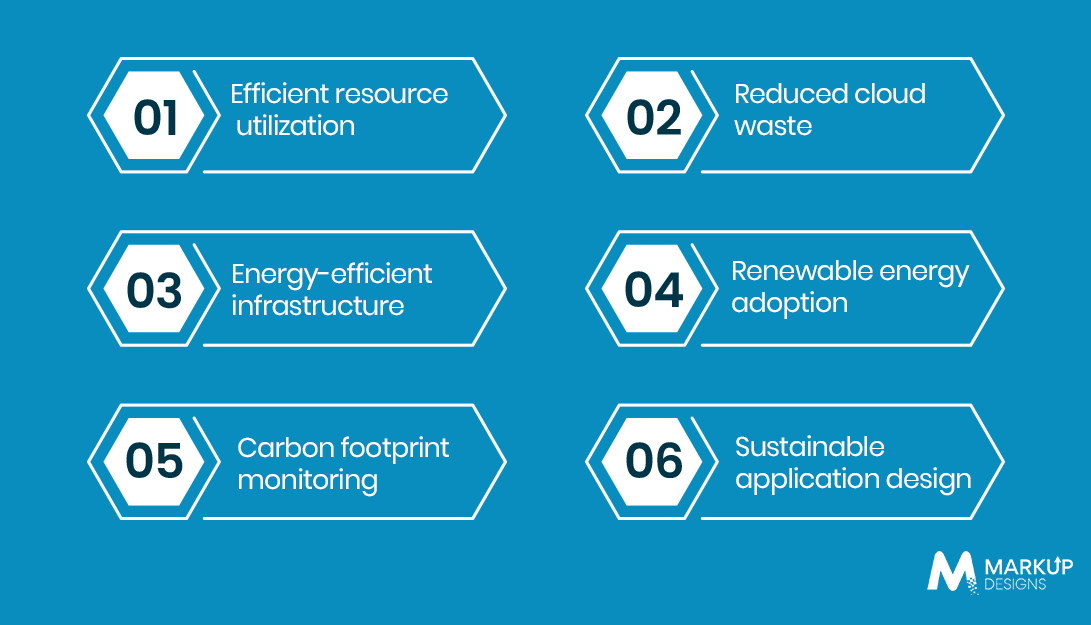
Green cloud computing is built around a few practical principles that help enterprises reduce waste and make their cloud environments more sustainable.
1. Efficient resource utilization
Utilize computing, storage, and network resources based on real business needs.
2. Reduced cloud waste
Detect and get rid of inactive, unused, and redundant resources.
3. Energy-efficient infrastructure
Choose infrastructure and architecture that require fewer resources to perform efficiently.
4. Renewable energy adoption
Whenever possible, use regions and providers that utilize renewable or lower-carbon energy.
5. Carbon footprint monitoring
Monitor carbon footprint and resource consumption associated with cloud services.
6. Sustainable application design
Design and modernize software architecture in a sustainable way.
These principles help enterprises incorporate sustainability into cloud computing continuously rather than doing it once.
Sustainable Cloud Strategies for Modern Enterprises
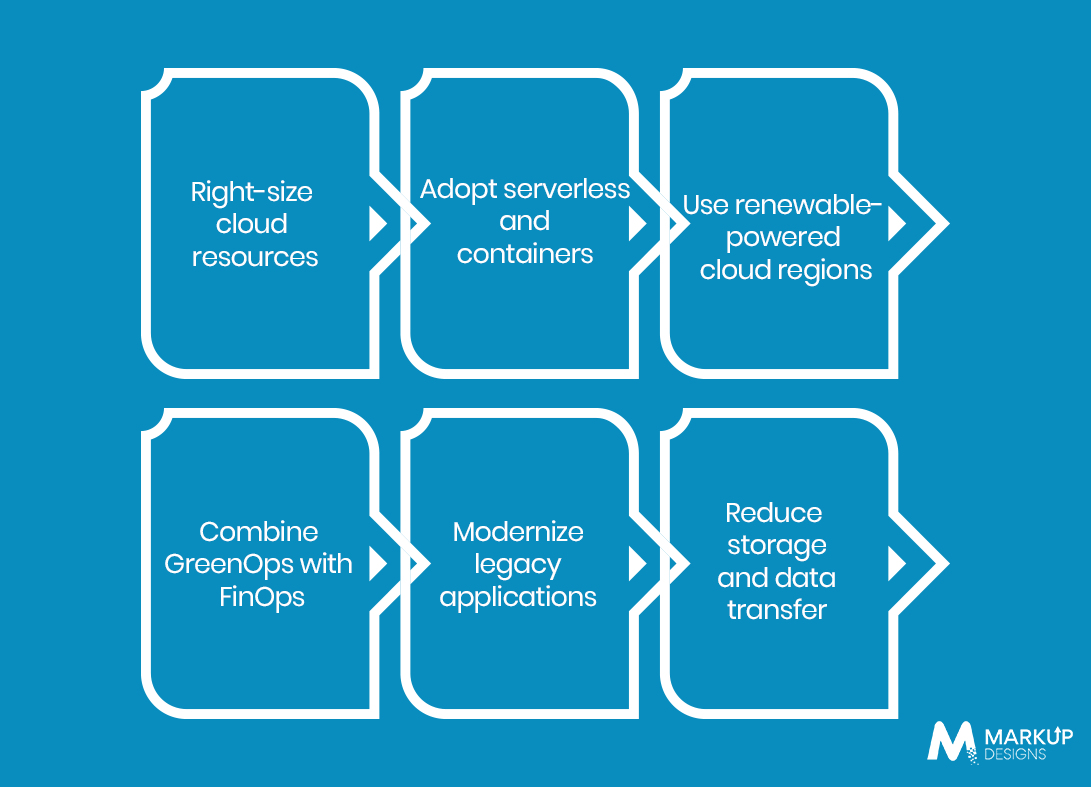
There are various ways that organizations may make their cloud operations sustainable. The most appropriate methods depend on the workloads, architecture, business needs, and current infrastructure.
Right-size cloud resources
Ensuring that the amount of computing and storage is just enough for the workload.
Adopt serverless and containers
These methods may optimize resource usage and decrease unnecessary always-on infrastructure.
Use renewable-powered cloud regions
Workloads may be moved to regions that use cleaner sources of energy where appropriate.
Combine GreenOps with FinOps
Optimizing cloud resources with regard to costs as well as environmental impact allows businesses to spot inefficient resources earlier.
Modernize legacy applications
Updating older applications may lower resource usage.
Reduce storage and data transfer
Proper data lifecycle policies and architecture can help reduce unnecessary resource usage.
It is important to consider sustainability when developing cloud architecture and managing it.
Make Your Cloud Infrastructure More Sustainable
Reduce cloud waste, improve resource efficiency, and build a greener infrastructure with practical cloud strategies designed around your enterprise goals and sustainability priorities.

Role of AI in Green Cloud Computing
AI is increasingly used as a mechanism to assist enterprises in running cloud environments effectively. Enterprises will no longer rely only on human supervision but will be able to use AI to analyze workload dynamics, estimate demand, and cut down on resource consumption.
- Intelligent resource optimization: AI is capable of analyzing workloads and optimizing resource allocation by considering real demand.
- Predictive workload management: Enterprises will be able to predict traffic and adjust the computing capacity prior to changes in demand.
- Carbon-aware scheduling: Enterprises will be able to schedule flexible workloads when the carbon intensity is lower.
- Predictive maintenance: AI can detect problems with the infrastructure in advance and prevent unnecessary resource utilization.
- Application optimization: AI can detect resource-intensive operations and facilitate their improvement.
- Automated monitoring: AI-powered systems will be constantly monitoring cloud activities and detecting unused and overutilized resources.
However, enterprises need to remember the energy demands of AI workloads. Sustainable AI infrastructure becomes an integral part of the green cloud strategy.
Benefits of Green Cloud Computing for Enterprises
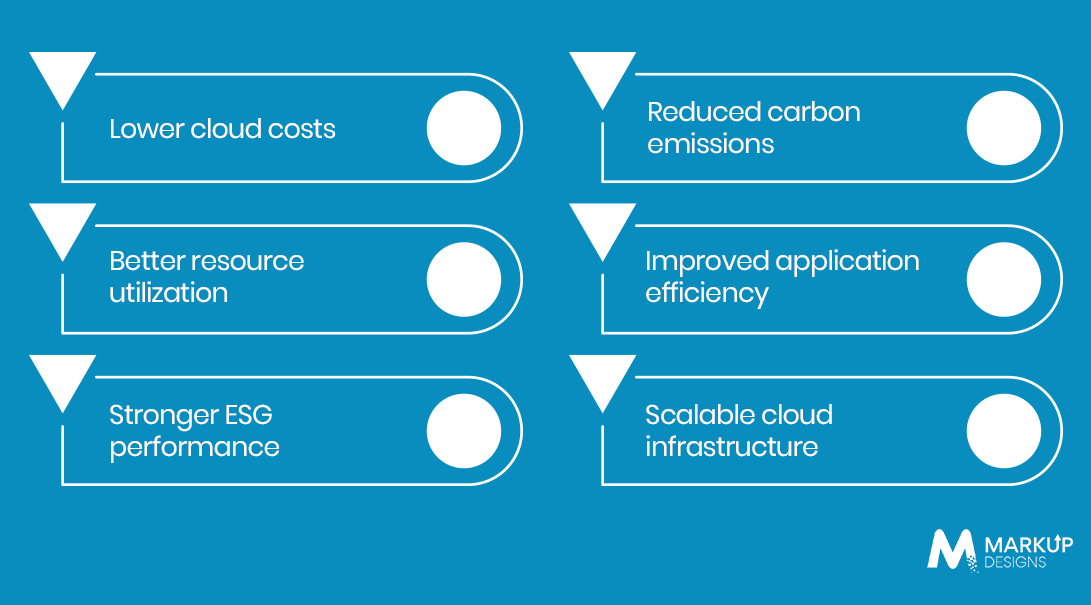
Green cloud computing will not only bring environmental benefits but also help enterprises improve how they manage their technology investments. If cloud computing resources are utilized more efficiently, enterprises can get better results and minimize waste.
1. Lower cloud costs
Eliminating unnecessary resources and optimizing workload will minimize infrastructure costs.
2. Reduced carbon emissions
Efficient workload and using environmentally friendly power sources will minimize the impact of cloud computing on the environment.
3. Better resource utilization
Enterprises will be able to derive more value from existing computing and storage resources.
4. Improved application efficiency
Upgrading and optimizing applications will provide better results with less resource consumption.
5. Stronger ESG performance
Green practices will help in achieving sustainable development objectives.
6. Scalable cloud infrastructure
An efficient cloud environment will help to scale operations while avoiding waste of resources.
Thus, green cloud computing will help enterprises link business efficiency and environmental responsibility.
Read Also: Why Enterprises Are Adopting Cloud and DevOps to Accelerate Digital Transformation
How to Measure Cloud Sustainability
The execution of the green cloud strategy has to have measurable effects. Moving workloads to cloud platforms alone doesn’t necessarily lead to increased sustainability in organizations. There is a need for monitoring resource usage, emissions, and efficiency trends.
Some of the useful indicators include:
- Carbon emissions of the cloud: Monitoring the number of estimated emissions related to cloud-based workloads.
- Software Carbon Intensity (SCI): Measuring the amount of carbon emitted through the use of the software.
- Efficiency of resource usage: Monitoring the efficiency of the utilization of computing, storage, and network resources.
- Percentage of idle resources: Estimating the proportion of unused or underused infrastructure.
- Efficiency of data transfer: Estimating the number of unnecessary data transfers across systems and geographical areas.
- Cost of cloud per workload: Comparing the infrastructure costs against the output of businesses or applications.
Monitoring of such indicators will help enterprises to find waste, measure improvements, and make decisions regarding cloud architecture. It will also allow enterprises to transform sustainability into a tangible concept.
Green Cloud Computing Implementation Roadmap
The adoption of green cloud computing does not have to entail a total restructuring of all infrastructure systems of the enterprise. This process can be broken down into smaller steps that will help to carry out a smooth transition.+
- Evaluate the existing state of the cloud infrastructure: Analyze the current workloads, infrastructure, storage, resource usage, and cloud emissions.
- Detect areas of waste: Identify wasted idle instances, unneeded storage space, over-provisioned infrastructure, and inefficient workloads.
- Choose high-priority workloads: These are those applications and services that use more computing resources and have a higher operational cost.
- Implement optimizations and improvements: Scale infrastructure appropriately, apply containerization or serverless architecture where possible, and optimize inefficient workloads.
- Include carbon-aware considerations: Take into account such parameters as energy efficiency and carbon intensity in choosing the appropriate region for the cloud.
- Monitor constantly: Evaluate sustainability, performance, and cost metrics on a regular basis.
Such an incremental method will make the transition towards cloud sustainability a regular part of the operations.
How Markup Designs Can Help Enterprises Build a Sustainable Cloud Strategy
Creating a sustainable cloud computing infrastructure is not only about choosing the right cloud service provider. Companies require efficient cloud architecture, resource optimization, constant monitoring, and effective governance. Markup Designs assists companies in achieving more sustainable cloud computing by providing cloud consulting, cloud migration and modernization, infrastructure optimization, AI-enabled resource management, and cloud computing monitoring.
GreenOps and FinOps solutions that we provide assist companies in creating a cloud solution that is sustainable from both environmental and economic perspectives. This includes spotting idle, over-provisioned, and inefficient resources, which will help to enhance their utilization and reduce excessive cloud consumption. With the right approach in place, enterprises can build a scalable, efficient, and responsible cloud infrastructure.
Ready to Build a Greener Cloud Strategy?
From cloud optimization to AI-driven resource management, Markup Designs can help your enterprise move toward more efficient and sustainable cloud operations.

Conclusion
As cloud computing becomes a fundamental component of business technology strategies, green cloud computing becomes a major topic for modern businesses. In parallel with the increasing use of cloud native applications, artificial intelligence, analytics, and data-intensive workloads, it becomes increasingly important to manage cloud power usage and waste.
A sustainable cloud strategy does not involve any sacrifices in terms of performance and scalability. Resource optimization, application modernization, architecture, renewable energy, carbon-aware approaches, and constant monitoring are some ways to build efficient and sustainable cloud environments.
In addition to this, AI can help businesses to forecast their cloud workload, optimize resources, and manage their cloud operations. However, in order to measure sustainable development, organizations require certain cloud sustainability metrics.
As cloud computing is developing, its future will be more and more associated with finding the right balance between performance, cost-effectiveness, scalability, and ecological impact.
FAQs
1. What is green cloud computing?
Green cloud computing is the practice of using cloud infrastructure, applications, and resources more efficiently to reduce energy consumption, cloud waste, and carbon emissions.
2. Why is green cloud computing important for enterprises?
It can help enterprises reduce cloud waste and costs while supporting sustainability and ESG objectives.
3. How can businesses reduce their cloud carbon footprint?
Businesses can right-size resources, remove idle workloads, optimize applications, reduce unnecessary data transfers, and consider lower-carbon cloud regions.
4. Can AI support green cloud computing?
Yes. AI can help predict workloads, optimize resource allocation, identify inefficiencies, automate monitoring, and support carbon-aware workload scheduling.
5. What is GreenOps?
GreenOps is an approach to managing cloud operations with environmental sustainability in mind. It focuses on monitoring and reducing the environmental impact of cloud workloads.
Author's Perspective
Green cloud computing is more than an environmental initiative; it is a smarter way to manage enterprise technology. Businesses can optimize cloud environments for performance, cost, and sustainability together. The practical approach is to identify resource waste, measure environmental impact, and improve infrastructure gradually. As AI, analytics, and cloud-native applications grow, combining cloud efficiency, automation, cost optimization, and sustainability will help enterprises build resilient and responsible digital operations.
Discuss Your Project NowGaurav Goyal
Global Sales- VP
Related Posts

Cloud Computing in Logistics: Building Smarter, Faster, and...

Cloud-Based App Development: Features, Benefits, and Cost Breakdown

Why Cloud is Essential for Successful Digital Transformation
Insights Are Valuable & Execution is Priceless
You’ve read about the digital future. Now, let’s build the infrastructure to take you there. Move your strategy from the page to the product.
Design Your Solution Now
Contact Us
Schedule The Appointment At Your Convenience Date And Time.
30 Min
Web Conference
Time Zone
Indian standard time (08:30pm)

Thanks For Getting In Touch!
You’ve Taken The First Step Toward Transforming Your Digital Presence. Our Experts Will Reach Out Shortly To Take It Forward.
Launch Your Dream Project
Provide a brief overview of your project, and our specialists will evaluate your requirements. We will connect with you to explore how the right digital solutions can help you launch faster.