
In Brief
- Companies are able to create, test, and launch digital products through cloud technology.
- Continuous integration techniques make it possible for teams to shorten product delivery time.
- Cloud platforms eliminate the need for costly initial investments, allowing companies to adapt their infrastructure to their needs.
- Cloud technology also allows innovating products thanks to AI solutions and real-time updates.
- A successful approach to cloud product development comprises good architecture, quality cost management, security, and tracking of performance.
Organizations require the development of products that will remain relevant in light of changing customer expectations and the emergence of new technology.
While conventional product development makes use of outdated infrastructure and time-consuming testing processes, cloud solutions allow organizations to get needed resources and tools to launch products on the market more flexibly.
Traditional development approaches can slow this process when teams depend on fixed infrastructure, manual deployment procedures, and lengthy testing cycles. Cloud product development offers a more flexible alternative by providing on-demand computing resources, managed services, and development tools that help teams build, test, and launch products more efficiently.
However, moving product development to the cloud involves more than hosting an application on a remote server. Businesses need to select suitable cloud technologies, design scalable architectures, automate development workflows, and establish effective security and cost management practices. When implemented strategically, cloud product development helps organisations accelerate delivery, improve collaboration, and adapt their products as requirements evolve. Understanding its benefits, applications, lifecycle, and challenges can help businesses make informed decisions about their product development investments.
What Is Cloud Product Development and How Does It Work?
Cloud product development is the process of designing, building, testing, deploying, and maintaining digital products using cloud-based infrastructure, platforms, and services. Instead of relying entirely on locally hosted servers and fixed computing resources, development teams can access on-demand infrastructure, managed databases, development tools, and deployment services through cloud platforms such as AWS, Microsoft Azure, and Google Cloud.
The process typically begins with defining product requirements and selecting an appropriate cloud architecture. Developers then build application features, connect databases and external services, and use cloud-based environments to test and deploy the product. After launch, monitoring and analytics tools help teams track performance, identify issues, and optimise resources. This approach allows businesses to develop products in stages, respond to user feedback, and adjust infrastructure as product requirements evolve.
How Does Cloud Product Development Help Businesses Build Products Faster?
The development of products in the cloud enables businesses to cut down on delays brought about by the need to set up infrastructure physically, carry out a manual deployment, and work with a broken development workflow system. Teams can leverage on-demand resources in combination with automation and collaboration tools to quickly and successfully reach all the stages of product creation and deployment without sacrificing quality and performance.
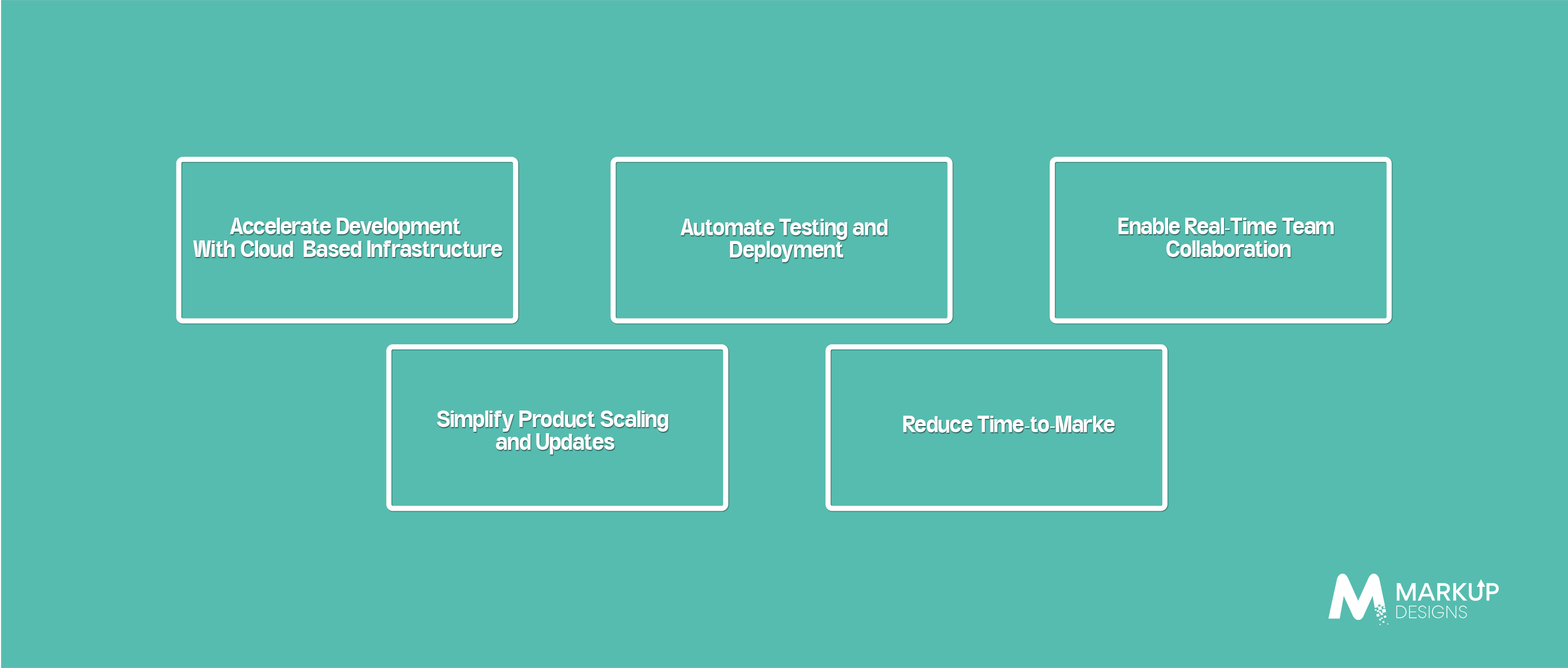
Accelerate Development With Cloud-Based Infrastructure
Implementing traditional infrastructure development usually entails buying hardware, configuring servers, and creating testing ecosystems so that coding can be done. However, cloud infrastructure enables computing resources, data storage, databases, and development environments to be available on-demand. That allows teams to create a resource provision instantaneously and not waste time on physical equipment.
Automate Testing and Deployment
Manual app testing and deployment processes are usually time-consuming and introduce mistakes. Cloud-based development workflows allow the teams to apply automation through continuous integration and continuous deployment (CI/CD). Thus, CI/CD processes enable code automatic building, testing, and approved code deployment into specified environments.
Enable Real-Time Team Collaboration
Cloud-based development environments make it possible for developers, designers, QA professionals, and product managers to share resources and collaborate regardless of their location. Using project management systems, version control, shared testing environments, and centralized documentation, teams work closely together. This minimizes delays caused by a lack of unified setups or disconnected workflow and facilitates the review of changes and solution of development issues.
Simplify Product Scaling and Updates
Products experience changing loads when their audience increases, or they receive new functionalities. Cloud solutions give businesses an opportunity to allocate computing resources and apply managed services according to their needs. Developers can also automatically push updates into an application, thus getting rid of the necessity to change the whole system. However, despite the improvements simplicity might bring, scaling and upgrading a product is still associated with comprehensive testing, monitoring, and resource allocation.
Reduce Time-to-Market
Faster infrastructure provision, automated workflows, and collaborative development allow businesses to minimize the gap between the idea and a working product. Companies can launch an MVP, collect the early users’ feedback, and implement modifications that are based on the real users’ needs.
What Are the Key Business Benefits of Cloud Product Development?
In addition to speed of development, cloud product development also helps businesses cut costs, become more flexible in their operations, and make their products more reliable. The level of these advantages will depend on the type of architecture chosen, resources used, security practices, and the capability of the team to run cloud systems.
Reduce Infrastructure and Development Costs
With the help of cloud product development, businesses do not have to invest large money in physical servers, network devices, and special infrastructure. Businesses will use consumption-based pricing or proper subscriptions for products needed for development and implementation. Various managed databases, testing services, and development tools will also lessen maintenance costs of the infrastructure. At the same time, costs may grow if companies do not monitor the current usage of resources.
Improve Product Flexibility and Scalability
Cloud systems allow adjusting computing power, storage, and application resources when the demands for the product changes. This feature is very useful both in terms of startups and launches of the products and the number of consumers using the application for the first time. Teams are also able to test new features or services without making any investment into the infrastructure.
Enhance Reliability and Performance’
Cloud services boast features such as load balancing, monitoring, distributed architecture, and managed services that can help in ensuring the accessibility and efficaciousness of applications. Firms may leverage these features to share heavy workloads, detect problems, and recover from infrastructural disturbances. However, obtaining reliability requires the proper architecture of the application as well as redundancy, monitoring, and tested procedure for recovering after the software malfunction.
Strengthen Data Security and Disaster Recovery
Cloud services have provisions like encryption, user management, logging, and backup functionalities to protect data. Developers can embed these features into the software development cycle in order to protect the information and minimize vulnerabilities to possible threats. The firms can use aspects of cloud-based disaster recovery system to restore services after failures. However, they have to deploy these functionalities effectively and check recovery efforts and ensure meeting the requirements regarding IT compliance and security.
Support Continuous Innovation
Cloud service ensures access to external artificial intelligence systems, analytics, serverless technologies, and application integration features. All these technologies help developers test their ideas and utilize upgraded functionalities. The opportunities offered by these solutions allow businesses to try new functionalities and check how users behave.
Innovation is most effective when technology investments are guided by customer needs and measurable product goals.
What Are the Key Use Cases of Cloud Product Development?
Development in cloud services encompasses a plethora of digital options ranging from launching a new app to revamping an existing one. Businesses have the option of choosing the kind of cloud services required in relation to a product’s objective, expected workload, integration needs, and future development plans.
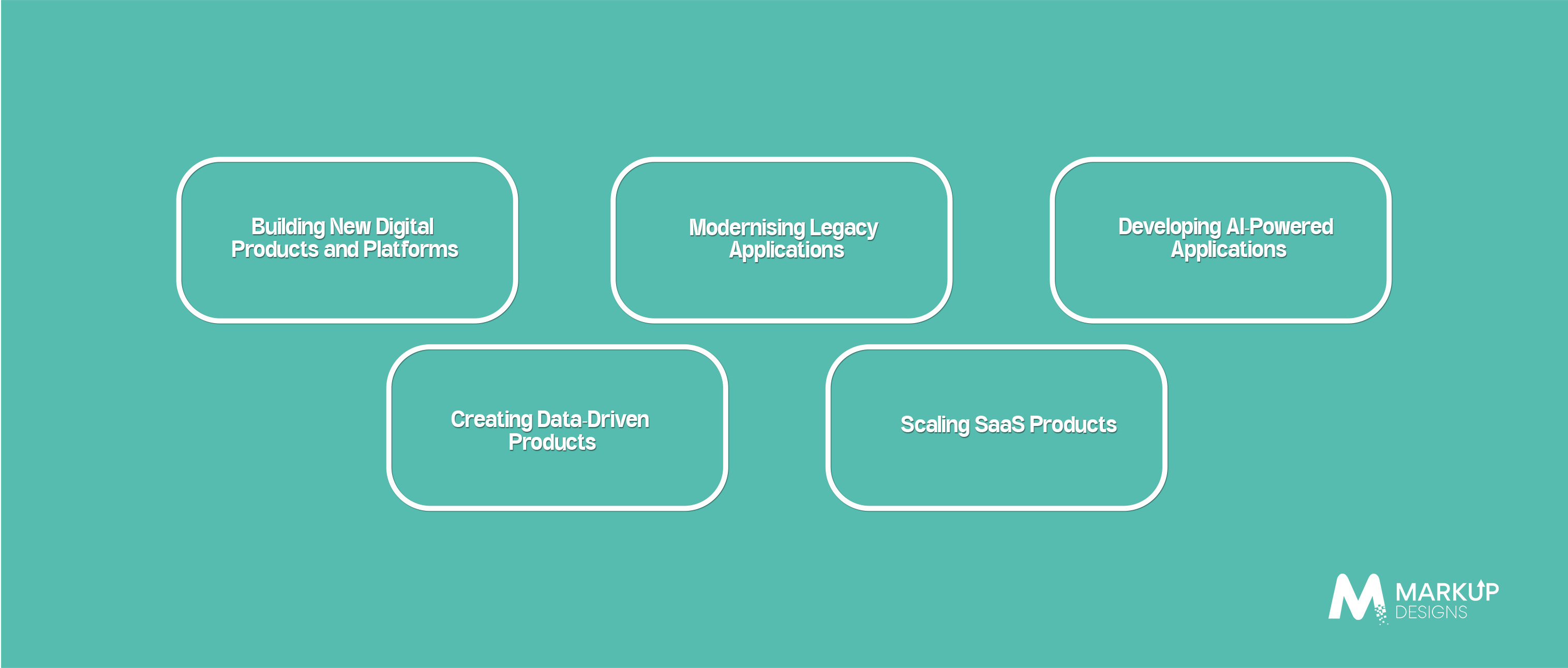
Building New Digital Products and Platforms
Through cloud technology, companies can create web applications, mobile backends, customer portals, digital marketplaces, and more. Cloud development provides development platforms that companies can depend on during development and testing stages before deployment. As development progresses, new technologies can be added or modified without going back to the drawing board.
Modernising Legacy Applications
Old applications are often based on obsolete infrastructure, poor integration options, or systems that are not scalable. Cloud modernization is about migrating these applications or updating its functions that made use of traditional technologies. Depending on the system, companies can move their applications with little or no changes or implement new technologies gradually. What the approach is going to be is influenced by many factors including technical complexity, operational risks and modernization goals.
Developing AI-Powered Applications
Cloud platforms help businesses reach out to cloud computing resources and services in order to create machine learning applications.
Businesses can integrate capabilities such as intelligent search, personalised recommendations, automated document processing, and conversational interfaces. Cloud infrastructure can also support model deployment and monitoring. Teams should evaluate data privacy, model performance, usage costs, and potential security risks before launching AI-enabled features.
Data-Driven Products
Data-intensive applications take advantage of cloud databases and processing services in order to receive useful insights. Examples of such applications are business intelligence dashboards, platforms for analyzing customers, tools for predictive maintenance, and real-time reporting applications. Cloud-based data technology enhances the efficiency of processes in teams with the condition that data quality, data access, and processing characteristics are set correctly.
Scaling Up SaaS Products
SaaS companies market software applications through the internet using the subscription pricing method. Cloud-based technology helps to develop SaaS products through infrastructure sharing, automated deployment, and resource allocation. Increasing customer demand allows for getting more scalability for software applications and delivering new features. However, the introduction of SaaS applications requires the attention of developers to such matters as tenant isolation, access information, and costs.
What Is the Cloud Product Development Process?
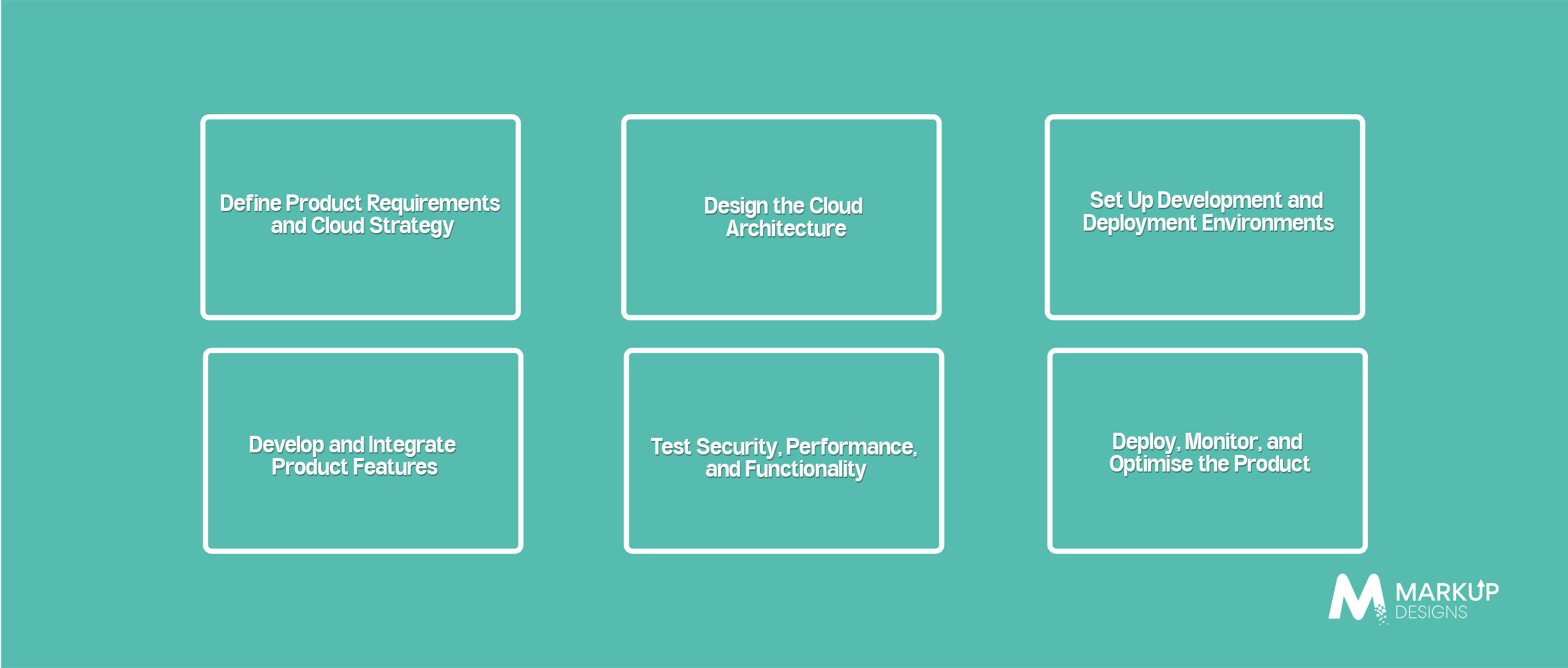
The cloud product development process consists of a number of steps connected with developing, launching, and supporting a digital product. While the process may be different for a particular product and organisation, it is a structured process that helps companies achieve business goals and make careful decisions at the earliest stage of product development.
Define Product Requirements and Cloud Strategy
The first step is to set up the purpose of the product, users, main functions, expected performance and budget. Teams identify functional (what it does) and non-functional (what is expected) requirements related to data volume, number of users, time of operation, privacy and security of the product and much more. After the requirements are determined, businesses can choose from public, private and hybrid approaches.
Design the Cloud Architecture
Cloud architecture is the system of the product components interconnected with one another and functioning properly together. Design should contain important criteria of the cloud architecture such as scalability, availability, efficiency and operating costs. Depending on business requirements, teams can select among virtual machines, containerized applications and other technologies. Formation of architecture at an early stage significantly impacts on avoiding redesigns in the future.
Set Up Development and Deployment Environments
Development teams need environments to code, test and deploy applications. It can be done by using cloud technology and infrastructure as a code. Different environments such as development, testing and production can be set up. Access to environments should be limited from the very beginning.
Develop and Integrate Product Characteristics
After creating the environments, the developers create the app components and integrate them into the necessary tools such as databases, APIs, authentication services, payment systems, etc. With the help of version control and CI/CD processes, the team is capable of correcting mistakes effectively and executing consistent processes. Regular integration will help find compatibility errors early and meet the requirements of the product development.
Test Security, Performance, and Functionality
Testing aims to check whether the product is operational and has the ability to manage its expected load. Functional testing checks the ability of certain features to perform the expected functions while performance testing assesses their performance in the face of different traffic. Security testing aims to detect flaws in the system, while integration testing makes sure that the two systems can communicate effectively.
Deploy, Monitor, and Improve Product
Once the product has been tested, it is deployed into the production environment. Teams can use a wide spectrum of tools to track the state of their applications in terms of availability, time of response and failure, etc. The information received from the users can help produce similar products in the future.
What Challenges Can Businesses Face in Cloud Product Development?
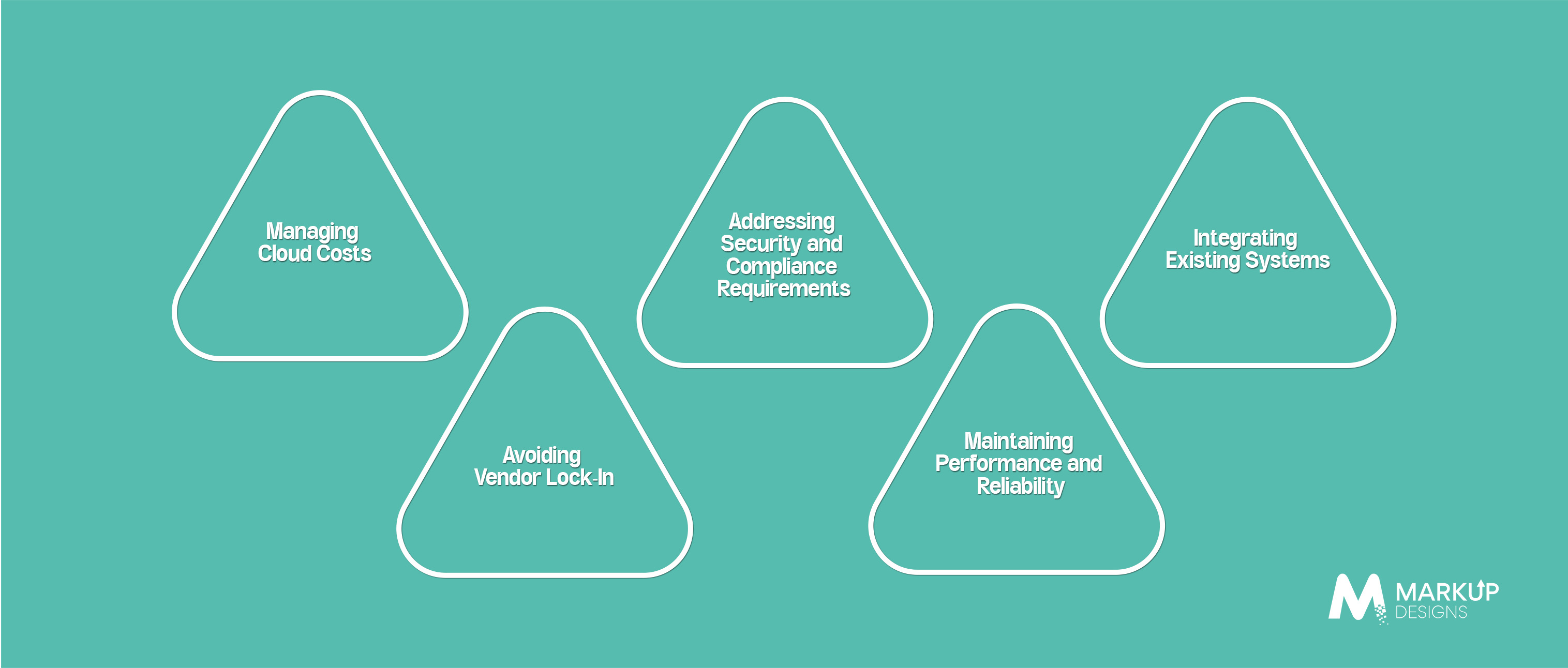
Although cloud product development offers flexibility and faster deployment, businesses must address technical, financial, and operational challenges to achieve the expected results. Understanding these risks early helps teams make informed architectural decisions, allocate resources effectively, and avoid problems that can affect product quality or long-term costs.
Managing Cloud Costs
Cloud infrastructure allows businesses to pay for the resources they use, but poorly managed consumption can lead to unexpected expenses. Idle development environments, oversized computing resources, excessive data transfers, and unnecessary storage can increase monthly bills. Businesses should establish budgets, configure usage alerts, and review resource consumption regularly. Cost estimates should also account for development, testing, deployment, monitoring, and ongoing maintenance.
Addressing Security and Compliance Requirements
Cloud-based products may handle personal information, financial records, and other sensitive data that require appropriate protection. Misconfigured storage, excessive user permissions, exposed credentials, and vulnerable application components can create security risks. Businesses should implement encryption, identity and access management, secure coding practices, and continuous vulnerability testing. They must also identify applicable data protection and industry-specific compliance obligations before choosing where and how to host their products.
Integrating Existing Systems
New cloud-based products often need to exchange information with legacy applications, internal databases, payment gateways, or third-party platforms. Differences in data formats, authentication methods, and system architecture can complicate integration and increase development time. Teams should assess existing dependencies, document integration requirements, and use suitable APIs or middleware to connect systems. A phased integration strategy can help reduce disruption while allowing teams to test data accuracy and system compatibility.
Avoiding Vendor Lock-In
Relying heavily on a cloud provider’s proprietary services can make it difficult or expensive to move applications to another platform later. Differences in databases, deployment tools, APIs, and pricing models can create additional migration work. Businesses should evaluate portability requirements before selecting technologies and use standard interfaces where practical. However, avoiding every provider-specific service is not always sensible; the decision should balance flexibility against the benefits of specialised managed services.
Maintaining Performance and Reliability
Cloud-hosted products must deliver consistent performance as traffic, data volumes, and user expectations change. Poor architecture, database bottlenecks, inefficient code, or insufficient capacity planning can cause slow response times and service interruptions. Businesses should implement application monitoring, load testing, automated scaling where appropriate, and resilient infrastructure designs. Regular performance reviews and tested recovery procedures help teams identify weaknesses before they significantly affect users.
What Are the Best Practices for Successful Cloud Product Development?
Successful cloud product development requires more than choosing a cloud platform. Businesses need a clear product strategy, a suitable technical architecture, consistent engineering practices, and ongoing operational oversight. Applying the following best practices can help teams build products that remain secure, maintainable, and cost-effective as requirements evolve.
Choose the Right Cloud Service Model
Businesses should evaluate Infrastructure as a Service (IaaS), Platform as a Service (PaaS), and Software as a Service (SaaS) according to their product requirements and technical capabilities. IaaS offers greater infrastructure control, while PaaS reduces the need to manage underlying systems. SaaS provides ready-to-use software rather than a development infrastructure model for building custom products. The right choice depends on the required level of control, development speed, integration needs, and available expertise.
Adopt DevOps and CI/CD Practices
DevOps encourages collaboration between development and operations teams, while continuous integration and continuous deployment (CI/CD) automate key stages of software delivery. Automated build processes, testing pipelines, and controlled deployments help teams release changes consistently and identify defects earlier. Businesses should also maintain version control, use repeatable deployment procedures, and define approval requirements for production releases to reduce avoidable errors.
Design for Scalability From the Start
Cloud architecture should account for expected user demand, workload patterns, data growth, and future product requirements. Modular components, suitable database designs, caching, and load balancing can help applications handle increasing demand. Teams should avoid adding unnecessary complexity before it is needed, but they should ensure that important components can expand without requiring a complete architectural redesign.
Implement Security Throughout Development
Security should be integrated into planning, coding, testing, deployment, and maintenance rather than treated as a final checkpoint. Businesses can adopt secure coding standards, automated dependency scanning, secrets management, encryption, and least-privilege access controls. Regular security assessments and timely patching help reduce exposure to vulnerabilities. Teams should also document security responsibilities and ensure that their controls reflect the product’s data sensitivity and compliance requirements.
Monitor Performance and Cloud Spending
Continuous monitoring helps teams understand application health, infrastructure utilisation, response times, and operating costs. Businesses should define measurable indicators, configure alerts for unusual activity, and review application logs to identify recurring issues. Cloud cost dashboards and resource tagging can help attribute spending to projects or environments. Combining operational monitoring with regular cost reviews allows teams to improve performance without allowing infrastructure expenses to grow unchecked.
How Much Does Cloud Product Development Cost?
Cloud product development costs vary depending on the product’s complexity, required features, architecture, integrations, security requirements, and the development team’s location and experience. A simple cloud-based application may require substantially less investment than a multi-tenant SaaS platform or an enterprise product involving AI, real-time data processing, and complex integrations.
It is also important to distinguish product development costs from ongoing cloud operating costs. Development expenses cover activities such as planning, design, engineering, testing, and deployment. Recurring expenses may include computing resources, storage, databases, monitoring, security tools, software licences, maintenance, and technical support.
Key Factors That Influence Development Costs
- Product complexity: Products with advanced workflows, multiple user roles, and extensive functionality require more design, development, and testing.
- Cloud architecture: Infrastructure choices, managed services, redundancy requirements, and deployment environments influence implementation and operating costs.
- Third-party integrations: Connecting payment gateways, enterprise systems, external APIs, and data platforms can add development and testing effort.
- Security and compliance: Products handling sensitive information may require additional controls, audits, monitoring, and compliance-related work.
- Team expertise and project duration: Developer rates, team composition, project management, and the time required to deliver the product affect the overall budget.
- Ongoing operations: Hosting, data transfer, backups, monitoring, support, and maintenance contribute to the total cost of ownership.
Ways to Optimise Cloud Product Development Costs
Businesses can control expenses by prioritising essential features and launching a minimum viable product (MVP) before investing in a broader feature set. Selecting managed services can reduce infrastructure administration, while automated testing and deployment can help limit repetitive engineering work.
Teams should also right-size computing resources, shut down non-production environments when they are not needed, and configure automatic scaling where appropriate. Regular cost reviews can identify unused storage, idle services, and inefficient workloads. These measures help businesses balance product performance and development speed with their available budget.
What Are the Emerging Trends in Cloud Product Development for 2026?
The development of cloud products is in constant flux due to businesses making use of AI-empowered engineering, adaptable application architectures, distributed computing, and the automated operation process. All trends enable product development teams to enhance productivity and create more reactive products. On the one hand, these technologies are effective; on the other hand, they have their importance depending on the specific business requirements.
AI-Assisted Product Development
Artificially generated tools are beneficial since they may help in the generation of the code, making documentation, producing tests, debugging the process, and reviewing the code. Cloud-based solutions also provide teams with the opportunity to integrate intelligent search systems, recommendations, and chatting services into the online products. These features will help reduce repetitive tasks; however, the codes generated still need to be verified by a person, gone through the security processes, and done functional testing prior to being implemented.
Serverless Computing and Cloud-Native Architecture
Serverless computing provides developers with the opportunity to run application functions without the necessity of managing servers being used. Cloud-native technologies go under different names that include microservices and containers.
Cloud-native approaches, including containers and microservices, support modular development and flexible deployment. These technologies can reduce infrastructure administration and help teams scale individual components, although architecture complexity, service limits, and usage-based charges need careful consideration.
Hybrid and Multi-Cloud Strategies
Hybrid and multi-cloud strategies include the merging of public and private digital infrastructures. Businesses utilize hybrid and multi-cloud strategies to obtain services with specific security needs, maintain legacy systems, as well as to receive high-quality services from different cloud providers. Policy adherence and enforcement across all platforms is critical for the success of hybrid and multi-cloud adoption.
Edge Computing and Real-time Processing
Edge computing allows for the analysis of data in proximity to its source. This results in less latency for connected devices, industrial systems, video analytics, etc. Cloud services function as support to edge computing systems through the provision of centralized analysis tools. Such support is determined in order to achieve an appropriate balance between the edge and the cloud in the systems of the necessary connectivity level and processing needs.
Automated Security in the Cloud
The cloud continues to expand the use of automation technologies for carrying out infrastructures configuration, identifying suspicious behavior, applying the security policy, and reacting to the operational activities. Use of code infrastructure and compliance automation helps to create unified systems.
Businesses should retain appropriate human oversight, validate automated actions, and regularly review permissions to avoid introducing new operational or security risks.
How Can Markup Designs Aid in Developing Cloud Products?
Markup Designs is a software development firm that offers its clients tailored solutions that transform products into scalable services by employing cloud solutions in development, software development, and system integration. Our team works on synchronising business objectives, functional needs of products, and technical choices to achieve efficient application development as well as long-term success.
No matter whether you need to bring a brand new product on the market or improve an existing application and include new functions, we are ready to meet your needs for planning and developing necessary application solutions. Markup Designs can assist one in providing sustainable architectural solutions, employing reliable integration and ensuring future possibilities of growth.
Build and Scale Your Next Digital Product With Confidence
Develop scalable, secure, and high-performing digital products with technology solutions tailored to your business goals.

Conclusion
Cloud product development enables the companies to create, evaluate, and apply their e-products using flexible infrastructure, automated systems as well as managed cloud services. By enhancing development cycles and managing costs of infrastructure, it enables companies to comply with important premises of the lifecycle.
However, achieving these benefits requires careful planning, suitable cloud architecture, effective security controls, and continuous cost and performance monitoring. Businesses should select technologies based on their product requirements rather than adopting cloud services without a clear strategy. With the right development approach, organisations can build adaptable digital products that support changing customer needs and long-term business growth.
FAQ
1. In which way cloud product development differs from standard product development?
While traditional product development relies on local infrastructure and manual configurations, cloud development utilizes on-demand services, management services, and automation. Thus, development teams can create infrastructure quicker, collaborate seamlessly, and scale their products immediately.
2. What is the typical time needed for cloud product development?
A cloud product can take some weeks to a few months, while very complex products may take six months or longer. The timing depends on the complexity of features, amount of integrations, security needs, testing, and the size and experience of the development engineers.
3. Which cloud platform is the best for product creation?
AWS, Microsoft Azure, and Google Cloud present a range of development services. The choice of the platform depends on product architecture, technology stack, the need for scalability, and budget.
4. Is cloud product development affordable for startup businesses?
Cloud product development can be affordable for startup businesses as it lowers upfront hardware costs allowing the business to start with limited resources. Moreover, the startup can implement the minimum viable product (MVP) and better understand demands on the market.
However, cloud usage, development, security, and maintenance costs still require careful budgeting.
5. How can businesses secure cloud-based products?
Businesses can secure cloud-based products through encryption, strong authentication, least-privilege access controls, secure coding, vulnerability testing, monitoring, and regular software updates. They should also configure backups, test recovery procedures, and meet applicable data protection and compliance requirements.
6. Can existing products be migrated to the cloud?
Yes. Existing products can be migrated by moving applications and data to cloud infrastructure, modernising selected components, or rebuilding parts of the system using cloud-native technologies. The right approach depends on the product’s architecture, dependencies, performance requirements, budget, and acceptable downtime.
Author's Perspective
Cloud product development is most effective when cloud technology supports a clearly defined product strategy. Businesses should focus on building the right features, choosing an architecture that fits their requirements, and establishing processes for security, cost management, and continuous improvement. Rather than prioritising technology adoption alone, the goal should be to create reliable digital products that can adapt to user feedback and evolving business needs.
Discuss Your Project NowAjit Kumar Jha
VP - Business Operations
Related Posts
Cloud Services Company in Kuwait: Benefits, Solutions &...
How is DevOps Charting a New Model for...

Green Cloud Computing: Sustainable Cloud Strategies for Modern...
Insights Are Valuable & Execution is Priceless
You’ve read about the digital future. Now, let’s build the infrastructure to take you there. Move your strategy from the page to the product.
Design Your Solution Now
Contact Us
Schedule The Appointment At Your Convenience Date And Time.
30 Min
Web Conference
Time Zone
Indian standard time (08:30pm)

Thanks For Getting In Touch!
You’ve Taken The First Step Toward Transforming Your Digital Presence. Our Experts Will Reach Out Shortly To Take It Forward.
Launch Your Dream Project
Provide a brief overview of your project, and our specialists will evaluate your requirements. We will connect with you to explore how the right digital solutions can help you launch faster.