
In Brief
- Cloud-based application development enables businesses to build secure, scalable, and high-performance applications hosted on remote cloud infrastructure, reducing hardware costs while improving flexibility, accessibility, and operational efficiency.
- Businesses across industries are increasingly adopting cloud applications to support digital transformation, remote collaboration, data security, business continuity, and seamless integration with advanced technologies like AI, analytics, and IoT.
- A successful cloud app development process includes requirement analysis, selecting the right cloud platform, designing scalable architecture, choosing the appropriate tech stack, development, testing, deployment, and ongoing maintenance.
- The cost of cloud-based app development typically ranges from $15,000 to $300,000+, depending on application complexity, features, cloud platform, integrations, security requirements, and long-term maintenance needs.
- Investing in cloud-first application development helps organizations improve scalability, optimize costs, accelerate innovation, and build future-ready digital solutions that support sustainable business growth.
Cloud computing has redefined the process through which companies create, operate, and expand their applications. Instead of using costly on-site servers, businesses can now rely on cloud applications that give them higher performance, greater collaboration capabilities, and lower expenses. It applies both to small startups with the launch of their first application or big corporations dealing with huge numbers of users and in need of scalable cloud applications.
Digital transformation makes it clear that companies from various industries such as healthcare, retail, financial services, logistics, education and others have to implement cloud applications for maintaining competitiveness in their business environment. Cloud applications will help to get access to all necessary data and easily update them.
In this blog, we will learn about what cloud app development means, more about its features and advantages that this technology provides to businesses, understand the process of developing an application using the cloud technology, calculate the cost and find out the factors that affect the cost of such development.
What is cloud-based application development?
The popularity of cloud-based services and cloud-based application development is driven by the ability of cloud-based applications to provide flexible resources at minimal operational costs. The wide popularity enjoyed by cloud-based applications of cloud app development is pretty evident in its widespread adoption across industries and sectors.
Now let’s try to understand what is cloud-based application development :
Cloud based apps and cloud-based development are applications that are hosted on the cloud which eliminates the need for a local hosting server. The “cloud” consists of remote servers; and cloud-based apps are run via the internet using a web browser or a mobile application regardless of their physical location. All you need is a stable internet connection, it offers easy accessibility, scalability and flexibility compared to traditional on campus software, along with data security and periodic checks, fixes and updates.
Why Businesses are Investing in Cloud-Based Applications
Businesses are investing in cloud-based applications because it offers a faster, more flexible, and cost-effective way to support digital growth. Unlike traditional applications that require expensive hardware and ongoing maintenance, cloud-based solutions allow companies to access computing resources on demand and pay only for what they use. This helps businesses reduce upfront costs while improving operational efficiency.
Another major reason is scalability. As a business grows, cloud applications can easily handle increasing numbers of users, transactions, and data without requiring major infrastructure upgrades. This makes it an ideal choice for startups, growing businesses, and large enterprises alike.
Cloud-based applications also improve collaboration by allowing employees to securely access data and business tools from anywhere using an internet connection. This supports remote and hybrid work environments while helping teams stay productive.
Security and business continuity are also important factors. Most cloud platforms provide advanced security features, regular backups, disaster recovery options, and compliance with industry standards, helping businesses protect sensitive information and minimize downtime.
In addition, cloud applications make it easier to integrate technologies such as artificial intelligence (AI), machine learning, data analytics, and the Internet of Things (IoT). These capabilities enable businesses to automate processes, gain valuable insights, improve customer experiences, and respond quickly to changing market demands, making cloud-based app development a long-term investment.
Read Also: What Is Cloud Computing? Every Business Should Know Cloud Computing in 2026
Key Features of Cloud-Based Applications
Simplicity
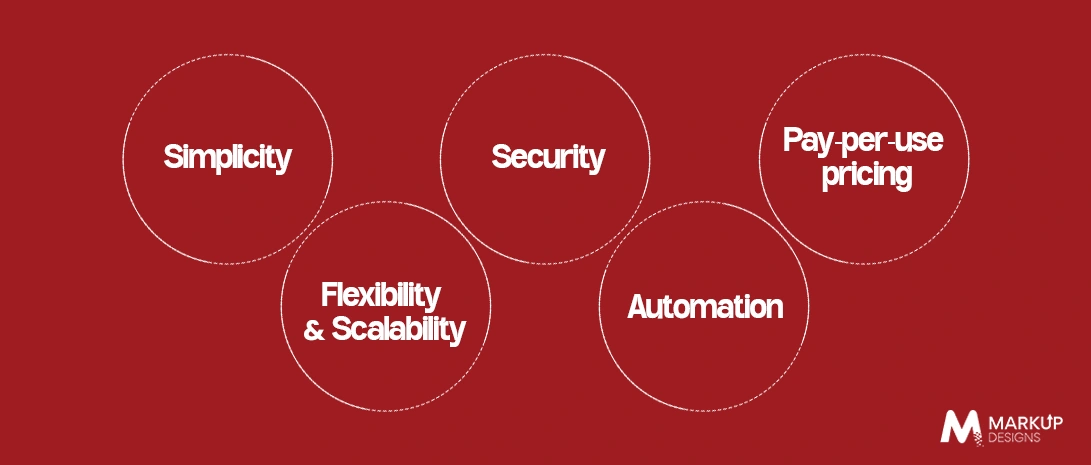
Cloud platforms should make cloud app development faster and simpler. They should simplify the architectural decision-making process, making it easy to solve cloud application development issues. A sound cloud application development platforms enables easier deployment of software across numerous IT environments.
Flexibility & Scalability
Users should be able to add or remove computing, storage, networking, and other assets as needed, making it easy to modify or scale your cloud services. Cloud platforms offer automation software to handle dynamic scaling for users. Users can optimize cloud-hosted workloads and avoid bottlenecks. Flexibility is an essential feature in cloud-based application development. When demand goes up, properly configured cloud platforms automatically add resources to handle the load. And when demand goes down, services return to normal.
Security
Cloud application development platforms employ some of the best security experts worldwide and are more skilled in handling threats than most in-house IT teams. The development platforms follow common security protocols, so your data won’t be accessible to hackers. Your organization will also be able to meet government regulations.
Automation
Cloud application development tools are designed to be programmatically managed, delivering value by providing support for continuous integration, resource orchestration, and capacity management, decreasing operational burdens.
Pay-per-use pricing
Most cloud application development platforms offer pay-per-use pricing. This model reduces IT costs on a large scale, and the user only pays for the service or the space they utilize. There are no hidden or extra charges, and oftentimes, some space is allotted for free. Resource utilization can be optimized by leveraging charge-per-use capabilities.
Types of Cloud Based Applications
Before you dive into learning about how you can develop cloud-based applications, you need to be aware of types of cloud services. So, there are three types of cloud-based services :
IaaS (Infrastructure – as – a – services)
In this type of cloud-based service, the service provider manages the infrastructure which includes network, servers and data storage. The user of the IaaS basically rents the infrastructure and uses a dashboard or API (application programming Interface) to access the application. An example of cloud-based services in IaaS is “Microsoft Azure”
PaaS (Platform – as – a – Service)
In Platform-as-a-Service, the cloud services provider provides the software platform and the hardware, but user can manage the application and the data it utilizes. The service is used mostly by developers who don’t need to worry about maintaining the infrastructure. An example of Platform-as-a-Services is “Google App Engine”.
SaaS (Software-as-a-Services)
Software-as-a-Service is a type of cloud service which is responsible for managing and running a product entirely by the cloud service provider. Software-as-a-Service providers handle all maintenance, bugs and carry out regular updates. Examples of such SaaS software are e-mail marketing software and customer relationship management software (CRMs).
Turn Your Cloud App Idea Into Reality
From strategy and development to deployment and support, Markup Designs delivers cloud applications that enhance performance, reduce costs, and scale with your growing business.

Benefits of Cloud-Based App Development for Businesses
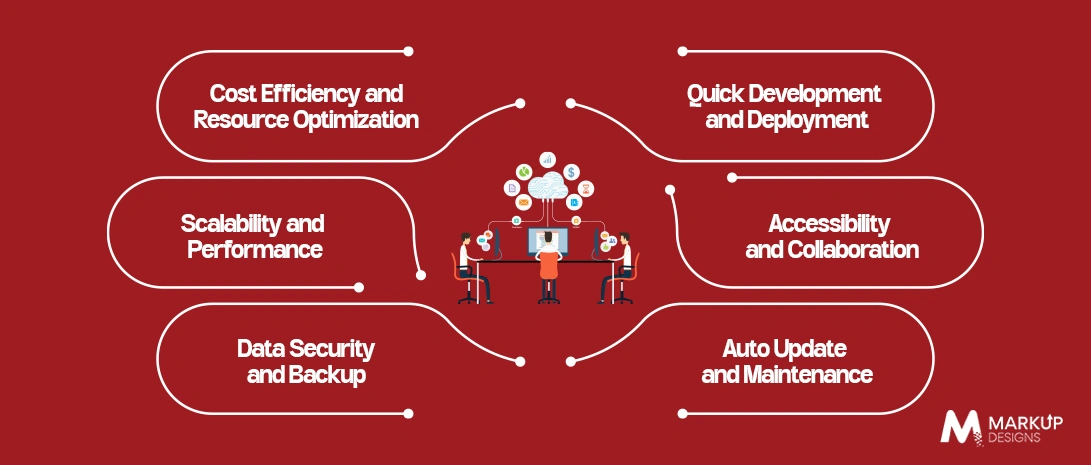
The following benefits clarify why businesses nowadays need to invest in cloud app development services and get agility, long-term savings, and operational efficiency for their business.
Cost Efficiency and Resource Optimization
By investing in cloud-based software development, businesses can avoid expensive infrastructure investment. Moreover, the pay-as-you-go model ensures users pay only for the resources they use. The cloud-based app development ensures this flexibility, which actually allows startups and enterprises to manage budgets effectively and get robust performance.
Scalability and Performance
The cloud platforms are actually built to scale the business. If the user base increases, you naturally require more storage for data. Here, cloud development services automatically allocate additional resources without affecting the website’s performance.
Data Security and Backup
Leading cloud service providers offer advanced encryption, identity management, and end-to-end monitoring of data to ensure maximum data security. They also offer built-in backup and recovery tools, so in case of a system failure, they can ensure protection of the data.
Quick Development and Deployment
The application development for the cloud offers pre-built frameworks and automation tools that shorten time-to-market. Professionals can easily test, deploy, and update applications using the pre-built CI/CD pipelines.
Accessibility and Collaboration
The cloud-based apps ensure easy accessibility anytime and anywhere; hence, teams can collaborate with each other across the globe. This is actually important for companies having remote teams.
Auto Update and Maintenance
The cloud apps offer auto-patching, updates, and version management that reduce downtime and IT overhead. Businesses can focus on other things while leaving the maintenance task to the cloud apps.
Read Also: Why Cloud is Essential for Successful Digital Transformation
Cloud-Based App Development Process: Step-by-Step
Requirement Analysis and Strategy Planning
Before starting the app development process, you first need to understand the client’s goals, target audience, and key functionalities that you want in your cloud app. The requirement analysis helps you to understand whether the app needs a public, private, or hybrid cloud setup and which cloud (SaaS, PaaS, or IaaS) will fit best.
Selecting the Right Cloud Platform
In the second step, you need to choose between AWS, Microsoft Azure, or Google Cloud, whatever, depending on your technical requirements, region, and budget. Each platform offers unique pros for application development cloud computing, including serverless architecture, AI-powered tools, scalable storage, seamless data migration, and more.
Designing the Architecture
After choosing the platform, it is now time to design a complete, unique architecture that supports modular functionalities. There are many tools available for containerization, like Docker and Kubernetes for orchestration, for cloud-based app development that ensures flexibility and scalability.
Choose the Right Tech Stack
The choice of technology stack significantly influences development costs. Factors such as programming languages, frameworks, databases, cloud platforms, and third-party integrations affect development complexity, scalability, performance, and long-term maintenance expenses.
Development and Third-party App Integration
This is the stage where professionals start actual coding and integrate 3rd-party apps and tools, including payment gateways, CRMs, and analytics platforms.
Testing and Quality Assurance
After completing the development process, the quality assurance engineers will test the app’s performance, scalability, and security using advanced cloud testing services to ensure that the app works smoothly across distributed environments, scalability, and security. This assessment checks app’s functionality across different environments.
Deployment and Monitoring
After the quality testing, the app is now ready for deployment on the chosen platform and continuously monitored using real-time analytics tools. A CI/CD pipeline enables automatic updates and reliability.
Post-launch Maintenance and Support
A leading cloud app development company offers post-launch maintenance and support. These services include updates, performance improvements, troubleshooting, and more.
Cost of Cloud-Based App Development
The cost of developing a cloud-based application depends on the project’s complexity, required features, technology stack, and business goals. A simple cloud application with basic features will cost much less than an enterprise-grade platform with AI, real-time analytics, and advanced security.
Here’s a general cost estimate:
| Project Type | Estimated Cost |
| Basic Cloud App | $15,000 – $40,000 |
| Medium Complexity App | $40,000 – $100,000 |
| Enterprise Cloud Solution | $100,000 – $300,000+ |
Besides development, businesses should also budget for cloud hosting, API integrations, third-party services, testing, maintenance, monitoring, and regular updates. Investing in a scalable cloud architecture from the beginning can reduce long-term operational costs and support future business growth.
Factors Affecting Cloud App Development Cost
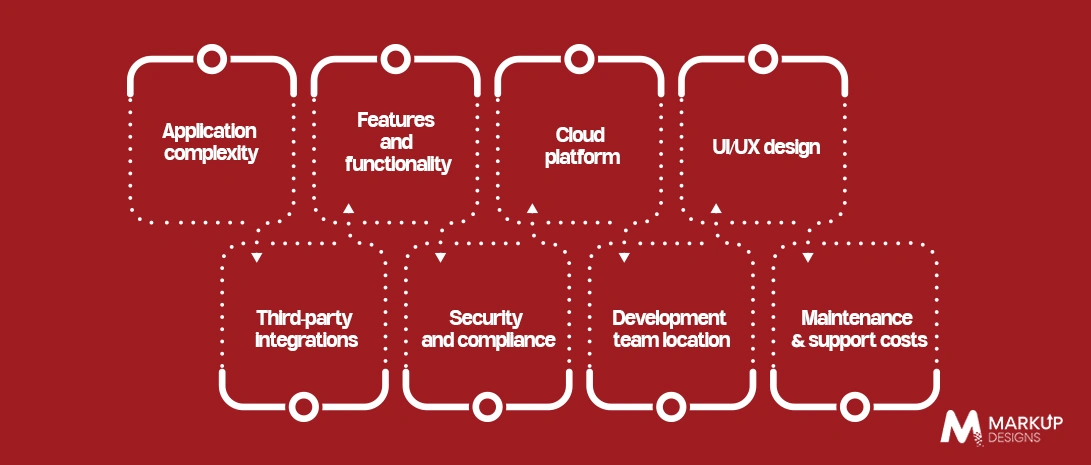
Several factors influence the overall cost of cloud application development, including:
Application complexity
More advanced features require additional development time, efforts & ultimately cost.
Features and functionality
AI, real-time collaboration, analytics, and automation increase the end cost.
Cloud platform
AWS, Microsoft Azure, and Google Cloud offer different pricing models and services, affecting hosting, scalability, performance, and overall operational costs.
UI/UX design
Custom, user-friendly interfaces require more design effort.
Third-party integrations
Payment gateways, CRM, ERP, and external APIs add complexity.
Security and compliance
Industries like healthcare and finance require additional security measures.
Development team location
The experience, geographic location, and team size of your development partner significantly influence project costs and overall software quality.
Maintenance & support costs
Ongoing updates, monitoring, and cloud optimization are important components of the overall project cost.
Common Challenges in Cloud-Based App Development and Their Solutions
Although cloud-based applications offer many advantages, businesses often face several implementation challenges.
| Challenge | Solution |
| Data security concerns | Implement encryption, identity management, and regular security audits. |
| Cloud migration complexity | Use a phased migration strategy with proper planning and testing. |
| Vendor lock-in | Design applications using cloud-native and portable architectures. |
| Performance issues | Optimize application architecture and use auto-scaling features. |
| Compliance requirements | Follow industry regulations and implement governance policies. |
| Cost management | Continuously monitor cloud usage and optimize resource allocation. |
| Integration challenges | Use standardized APIs and middleware for smooth connectivity. |
With the right development partner and strategy, these challenges can be effectively managed while maximizing cloud performance.
Why Choose Markup Designs for Cloud-Based App Development
At Markup Designs, we develop scalable, robust, and performant cloud applications that will enable organizations to fast-track their digital transformation. Our team combines technical proficiency and industry expertise to offer cloud application solutions that meet your business objectives.
We offer a range of cloud application development services, including consulting, architecture design, development, deployment, migration, integration, and support.
The team of our developers is having hands-on experience with the latest cloud technologies, development tools, and DevOps methods to guarantee speed and reliability. In addition, we assist companies in implementing AI, automation, analytics, and enterprise solutions in their cloud environment to improve efficiency and innovation.
By choosing Markup Designs as your partner, you choose a team that strives to provide you with future-proof cloud solutions for your business growth.
Ready to build a secure and scalable cloud application for your business?
Markup Designs helps startups, SMEs, and enterprises develop cloud-based applications that improve performance, reduce infrastructure costs, and support long-term growth.

Conclusion
Cloud-based application development has become one of the major sources of business innovation and digitalization in the modern business world. In the process of utilizing cloud computing technologies, enterprises can create flexible, safe, and scalable software solutions and avoid costly infrastructures.
With a clear understanding of the key features, benefits, development process, and cost considerations of cloud application development, businesses can make informed investment decisions and build effective cloud adoption strategies. Cloud technologies are constantly developing; therefore, businesses that rely on cloud-first application development will have opportunities to innovate and succeed in the future.
FAQs
1. What is cloud-based app development?
Cloud-based app development is the process of building applications that use cloud infrastructure for hosting, storage, computing, and data management instead of relying solely on local servers.
2. How much does cloud app development cost?
The cost typically ranges from $15,000 to $300,000+, depending on the application’s complexity, features, cloud platform, and integration requirements.
3. Which cloud platform is best for application development?
Popular choices include Amazon Web Services (AWS), Microsoft Azure, and Google Cloud Platform (GCP). The best option depends on your business requirements, budget, and scalability needs.
4. Are cloud-based applications secure?
Yes. When developed using industry best practices, cloud applications include encryption, access controls, regular backups, monitoring, and compliance measures to protect sensitive data.
5. Can existing applications be migrated to the cloud?
Yes. Most legacy applications can be migrated through a structured cloud migration strategy that minimizes downtime while improving scalability and performance.
Author's Perspective
Cloud computing is no longer just an infrastructure upgrade-it has become a business strategy for innovation and long-term growth. Organizations that invest in cloud-based applications gain the flexibility to scale quickly, adopt emerging technologies, and respond faster to changing customer expectations.
However, successful cloud adoption requires more than choosing a cloud provider. It involves careful planning, selecting the right architecture, implementing strong security practices, and working with an experienced development partner. Businesses that approach cloud development strategically will achieve better performance, improved resilience, and a stronger competitive advantage in the years ahead.
Discuss Your Project NowGaurav Goyal
Global Sales- VP
Related Posts
How is DevOps Charting a New Model for...
Green Cloud Computing: Sustainable Cloud Strategies for Modern...

Cloud Computing in Logistics: Building Smarter, Faster, and...
Insights Are Valuable & Execution is Priceless
You’ve read about the digital future. Now, let’s build the infrastructure to take you there. Move your strategy from the page to the product.
Design Your Solution Now
Contact Us
Schedule The Appointment At Your Convenience Date And Time.
30 Min
Web Conference
Time Zone
Indian standard time (08:30pm)

Thanks For Getting In Touch!
You’ve Taken The First Step Toward Transforming Your Digital Presence. Our Experts Will Reach Out Shortly To Take It Forward.
Launch Your Dream Project
Provide a brief overview of your project, and our specialists will evaluate your requirements. We will connect with you to explore how the right digital solutions can help you launch faster.