
In Brief
- Crypto trading bots automate predefined trading strategies based on market data, technical indicators, and programmed rules.
- A reliable trading bot requires a structured architecture covering market data, strategy logic, execution, risk management, and monitoring.
- Essential features include automated order execution, real-time market data, portfolio tracking, risk controls, backtesting, and performance analytics.
- Development costs vary based on the bot’s complexity, supported exchanges, trading strategies, integrations, security requirements, and technology stack.
- Scalability, API security, fault tolerance, monitoring, and regulatory considerations should be addressed from the beginning of development.
Crypto trading operates in a highly dynamic market where prices, trading volumes, liquidity, and market conditions can change rapidly. Crypto trading bot development enables businesses and traders to build software that automatically monitors market data and executes predefined strategies without requiring every trading action to be performed manually. Depending on the use case, a bot can support activities ranging from rule-based trading and portfolio rebalancing to more advanced algorithmic strategies.
Developing a crypto trading bot involves more than connecting an application to an exchange API. The system needs a reliable architecture for processing real-time market data, evaluating trading signals, executing orders, managing risk, and tracking performance. This guide explores the architecture and core components of crypto trading bots, essential and advanced features, development considerations, technology choices, and the factors that influence overall development cost.
What Is a Crypto Trading Bot and How Does It Work?
A crypto trading bot is software that monitors cryptocurrency markets and automatically executes trades according to predefined rules or algorithmic strategies. It connects to one or more exchanges through APIs, processes market information, generates trading signals, and places orders based on configured conditions.
What Is a Crypto Trading Bot?
A crypto trading bot is an automated trading application designed to execute predefined strategies with limited manual intervention. Depending on its design, the bot can analyse price movements, trading volume, technical indicators, order-book data, or other market signals before deciding whether to place, modify, or cancel an order.
How Does Automated Crypto Trading Work?
Automated crypto trading typically begins with the bot collecting real-time market data from connected exchanges. The strategy engine evaluates this information against predefined rules or models, generates a trading signal, and sends an order to the exchange when the required conditions are met. Risk controls are applied before and after execution, while portfolio and performance data are continuously updated.
Key Components of a Trading Bot
- Market data: Collects prices, trading volumes, order-book information, and other relevant market signals.
- Trading strategy: Defines the conditions and rules that determine when and how trades should be considered.
- Signal generation: Converts market data and strategy conditions into actionable buy, sell, or hold signals.
- Risk management: Applies position limits, exposure controls, stop-loss rules, and other safeguards.
- Order execution: Connects with exchange APIs to place, modify, and cancel orders.
- Portfolio management: Tracks balances, positions, allocations, realised and unrealised performance.
- Monitoring: Tracks system health, trading activity, API connectivity, errors, and strategy performance.
Crypto Trading Bot vs Manual Trading
| Aspect | Crypto Trading Bot | Manual Trading |
| Execution | Automatically executes predefined rules | Requires manual order placement |
| Speed | Can react to defined market conditions quickly | Depends on trader response time |
| Consistency | Follows programmed strategy rules consistently | Decisions may vary between trades |
| Monitoring | Can monitor markets continuously | Requires active trader involvement |
| Scalability | Can monitor multiple assets or markets based on system capacity | Limited by the trader’s ability to monitor markets |
| Risk Controls | Can automatically enforce configured limits | Depends on manual discipline and platform controls |
What Types of Crypto Trading Bots Can You Build?
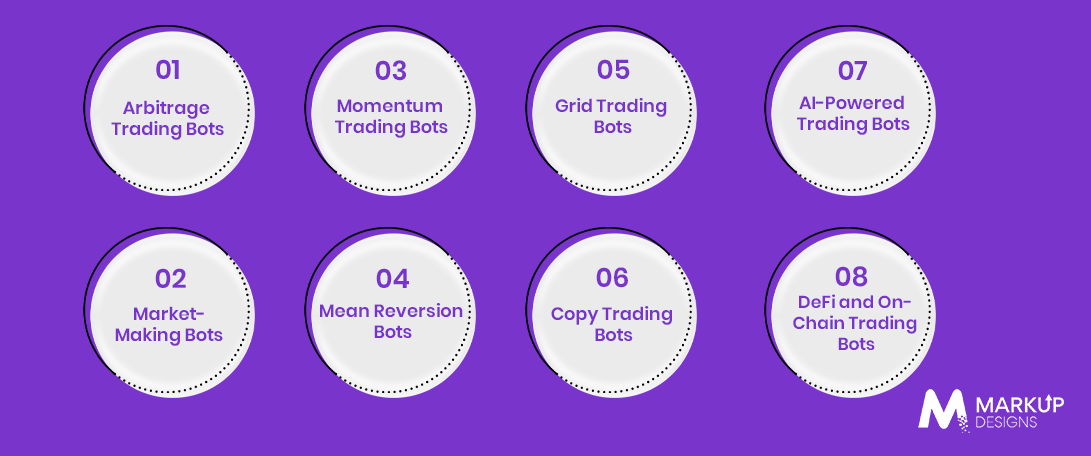
Different trading strategies require different bot architectures, data inputs, execution logic, and risk controls. The appropriate bot type depends on the trading objective, market conditions, supported exchanges, and level of automation required.
Arbitrage Trading Bots
Arbitrage bots identify price differences for the same asset across exchanges or trading pairs and attempt to execute trades based on those differences. The system needs fast market-data processing, exchange connectivity, fee calculations, and execution controls.
Market-Making Bots
Market-making bots place buy and sell orders around a market price to provide liquidity and attempt to capture the spread. They require order-book monitoring, inventory management, pricing logic, and strong risk controls.
Momentum Trading Bots
Momentum bots identify price or volume movements that meet predefined conditions and execute trades based on the selected momentum strategy. They commonly use technical indicators, price trends, and volume data as inputs.
Mean Reversion Bots
Mean reversion bots operate on the assumption that certain market conditions may move back toward an established average or reference range. The bot identifies deviations based on configured indicators and executes trades when predefined conditions are met.
Grid Trading Bots
Grid bots place multiple buy and sell orders at predetermined price intervals. As the market moves through the configured grid, the bot automatically manages orders according to its strategy parameters.
Copy Trading Bots
Copy trading bots replicate selected trading activity from another trader, strategy, or signal source according to configured rules. The system requires position-sizing controls, execution logic, and safeguards to prevent unsuitable or excessive exposure.
AI-Powered Trading Bots
AI-powered bots use machine learning or other AI techniques to analyse market data, generate signals, classify patterns, or support strategy optimisation. Their architecture generally requires additional data pipelines, model infrastructure, monitoring, and validation mechanisms.
DeFi and On-Chain Trading Bots
DeFi trading bots interact with decentralised protocols and blockchain-based applications through smart contracts and blockchain infrastructure. They may support activities such as on-chain arbitrage, liquidity management, and automated protocol interactions, with additional considerations around transaction costs, network conditions, smart-contract risk, and transaction execution.
What Features Should a Crypto Trading Bot Have?
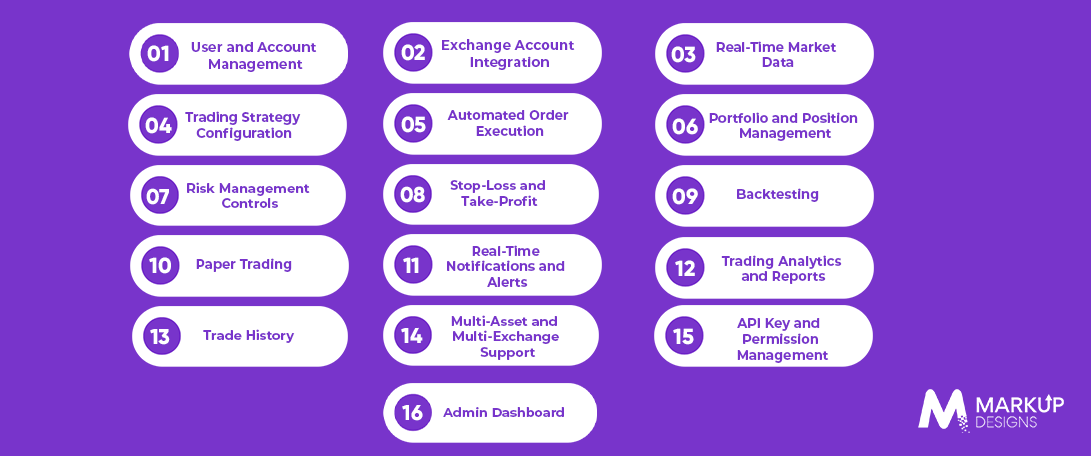
A production-ready crypto trading bot requires more than automated order placement. It should provide secure exchange connectivity, strategy controls, risk management, monitoring, and clear visibility into trading activity.
User and Account Management
Provide secure registration, authentication, user profiles, account settings, and role-based access where required.
Exchange Account Integration
Connect the bot with supported cryptocurrency exchanges through secure APIs for accessing market data and executing authorised trading operations.
Real-Time Market Data
Collect and process live prices, trading volumes, order-book data, and other market information required by the selected strategies.
Trading Strategy Configuration
Allow users or administrators to configure strategy parameters, trading pairs, indicators, thresholds, timeframes, and other supported rules.
Automated Order Execution
Automatically place, modify, and cancel orders when strategy conditions are met while handling exchange responses and execution errors.
Portfolio and Position Management
Track balances, open positions, asset allocation, entry prices, realised and unrealised performance, and other portfolio information.
Risk Management Controls
Include configurable controls such as position limits, maximum exposure, trading limits, order-size restrictions, and emergency trading controls.
Stop-Loss and Take-Profit
Enable predefined exit conditions that can automatically close or reduce positions when configured price or strategy conditions are reached.
Backtesting
Allow strategies to be tested against historical market data before being deployed in live trading environments. Backtesting results should account for relevant assumptions such as fees and execution limitations where supported.
Paper Trading
Provide a simulated trading environment where strategies can be tested without placing live orders. This helps validate trading logic and workflows before deployment.
Real-Time Notifications and Alerts
Send alerts for executed trades, failed orders, strategy events, risk-limit triggers, connectivity issues, and other important system events.
Trading Analytics and Reports
Provide dashboards and reports covering trading activity, strategy performance, portfolio metrics, execution data, and other relevant indicators.
Trade History
Maintain a searchable record of orders, executions, trading pairs, timestamps, quantities, prices, fees, and transaction status.
Multi-Asset and Multi-Exchange Support
Support multiple cryptocurrencies and exchanges through a modular integration architecture, allowing trading operations to expand without redesigning the entire system.
API Key and Permission Management
Securely manage exchange credentials and apply appropriate API permissions. Trading software systems should avoid unnecessary account permissions and protect credentials throughout storage and use.
Admin Dashboard
Provide administrators with visibility into users, exchange connections, strategies, system activity, trading events, errors, risk controls, and platform performance.
Read Also: Cost to Develop a Cryptocurrency Exchange App Like Coinbase
Advanced Features for a Crypto Trading Bot
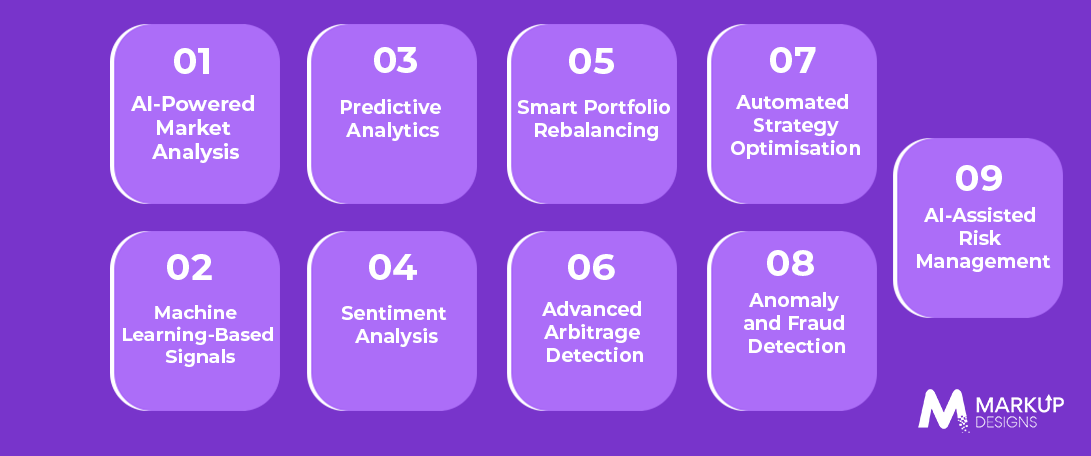
Advanced capabilities can extend a trading bot from basic rule-based automation into a more data-intensive and adaptive trading platform. These features require additional infrastructure, testing, monitoring, and governance.
AI-Powered Market Analysis
AI models can process large volumes of market information to identify patterns, classify market conditions, and generate additional insights for supported trading strategies.
Machine Learning-Based Signals
Machine learning models can generate trading signals from historical and real-time datasets based on trained patterns and selected features. Models require appropriate validation and continuous monitoring to assess performance.
Predictive Analytics
Predictive analytics can analyse historical market data and other relevant variables to estimate potential market scenarios or risk indicators. These outputs should be treated as model-based estimates rather than guaranteed predictions.
Sentiment Analysis
Natural language processing can analyse selected news, social media, or other textual sources to identify sentiment-related signals. Data quality, source reliability, and noise management are important considerations.
Smart Portfolio Rebalancing
Automated rebalancing can adjust asset allocations according to predefined portfolio targets, risk parameters, market conditions, or strategy rules.
Advanced Arbitrage Detection
Advanced arbitrage systems can monitor multiple exchanges, trading pairs, liquidity levels, fees, and transaction costs to identify potential price discrepancies across markets.
Automated Strategy Optimisation
Optimisation tools can evaluate strategy parameters against historical or simulated data to identify configurations that meet predefined performance criteria. Robust validation is important to reduce overfitting.
Anomaly and Fraud Detection
Monitoring models can identify unusual trading patterns, account activity, API behaviour, or transaction characteristics that may require investigation or intervention.
AI-Assisted Risk Management
AI-based systems can analyse portfolio exposure, market conditions, trading behaviour, and other signals to support dynamic risk monitoring and alerting alongside predefined risk controls.
Crypto Trading Bot Architecture
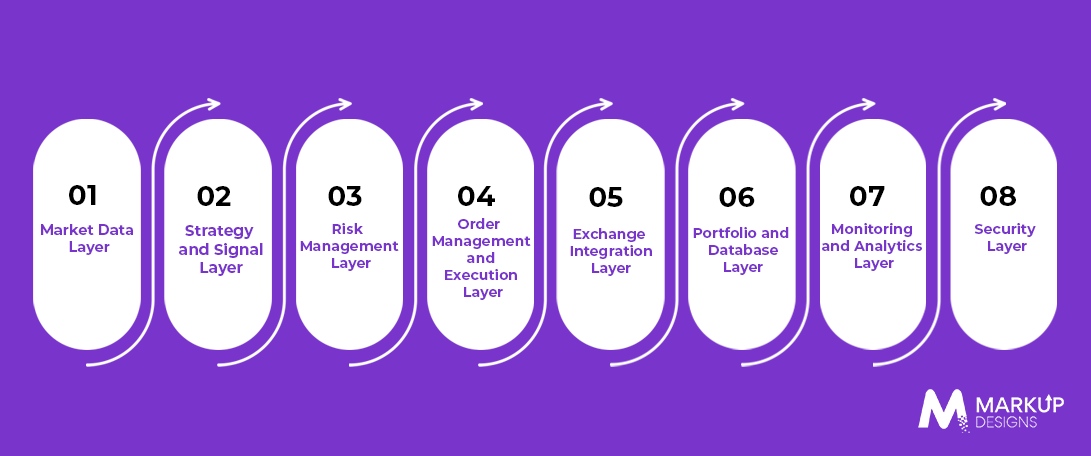
A crypto trading bot typically follows a layered architecture in which market data flows into the strategy engine, signals pass through risk controls, and approved orders are sent to connected exchanges. Supporting layers handle portfolio data, monitoring, security, and system operations. A modular architecture makes it easier to add exchanges, introduce new strategies, scale data processing, and maintain individual components without affecting the entire platform.
Market Data Layer
The market data layer collects real-time and historical information required by the trading strategies.
- REST APIs: Retrieve account information, historical data, market information, and other exchange resources.
- WebSocket feeds: Stream real-time prices, trades, order-book updates, and account events.
- Order books: Provide bid and ask information used by execution and market-analysis logic.
- Price and volume data: Supply the core market inputs required by trading strategies and analytics.
Strategy and Signal Layer
This layer evaluates incoming market data against configured trading logic and generates signals.
- Trading algorithms: Execute predefined rules or algorithmic strategies.
- Technical indicators: Analyse metrics such as moving averages, volatility, volume, or momentum.
- Signal generation: Converts strategy conditions into actionable trading signals.
- Strategy configuration: Allows parameters, trading pairs, timeframes, and other strategy settings to be managed.
Risk Management Layer
The risk layer evaluates proposed trades before execution and applies predefined safeguards.
- Position limits: Restrict the size of individual positions.
- Exposure controls: Manage overall exposure across assets, strategies, or exchanges.
- Stop-loss rules: Trigger predefined exit actions when configured conditions are reached.
- Trading limits: Control order sizes, frequency, daily exposure, or other defined parameters.
- Emergency shutdown: Provides a mechanism to stop trading when critical ai in stock trading enterprise applications risks or system conditions occur.
Order Management and Execution Layer
The execution layer translates approved trading signals into exchange orders and manages their lifecycle.
- Order placement: Sends buy or sell orders to connected exchanges.
- Order cancellation: Cancels open orders when strategy or risk conditions change.
- Partial fills: Tracks orders that are executed only in part and manages their remaining quantity.
- Retry mechanisms: Handles suitable temporary failures and connection issues.
- Execution tracking: Records order status, execution price, quantity, fees, and timestamps.
Exchange Integration Layer
This layer manages communication between the trading system and external cryptocurrency exchanges.
- Exchange APIs: Connect the bot to supported trading platforms.
- Authentication: Verifies authorised access to exchange accounts.
- API signing: Applies the authentication and signing mechanisms required by supported exchanges.
- Rate-limit management: Controls API requests to remain within exchange limits.
- WebSocket connections: Maintain real-time market and account data streams where supported.
Portfolio and Database Layer
The portfolio and database layer stores information required for account management, reporting, and trading operations.
- Balances: Tracks available and allocated assets.
- Positions: Records active positions and related information.
- Transactions: Stores deposits, withdrawals, trades, and other relevant activities.
- Trade history: Maintains records of executed orders and trading activity.
- Performance data: Stores information used for portfolio and strategy analysis.
Monitoring and Analytics Layer
Monitoring systems provide visibility into both trading performance and technical health.
- Performance monitoring: Tracks strategy and portfolio metrics.
- System health: Monitors services, infrastructure, connectivity, and resource usage.
- Trade alerts: Notifies users or administrators about important trading events.
- Error tracking: Captures failed requests, execution errors, and system exceptions.
- Audit logs: Maintain records of relevant system and user activities.
Security Layer
Security controls protect user accounts, API credentials, trading operations, and sensitive data.
- Encryption: Protects sensitive data during storage and transmission.
- API key protection: Secures exchange credentials and limits unnecessary permissions.
- Access controls: Restricts sensitive functions to authorised users and roles.
- Authentication: Protects user and administrative access.
- Activity logging: Records security-sensitive actions for monitoring and investigation.
Technology Stack for Crypto Trading Bot Development
The technology stack depends on the bot’s trading logic, performance requirements, exchange integrations, user interface, and deployment model.
| Development Layer | Technologies |
| Frontend | React, Angular, Vue |
| Mobile | Flutter, React Native |
| Backend | Node.js, Python, Java |
| Database | PostgreSQL, MongoDB, Redis |
| APIs | REST, WebSocket |
| Cloud | AWS, Google Cloud, Azure |
| AI/ML | Python, TensorFlow, PyTorch |
| Containers | Docker, Kubernetes |
| Monitoring | Prometheus, Grafana |
| Security | OAuth, MFA, encryption |
How to Build a Crypto Trading Bot?
1. Define the Trading Strategy and Requirements
Start by defining the target users, trading objectives, supported assets, exchanges, strategies, risk parameters, and performance requirements. These decisions establish the functional and technical scope of the bot.
2. Conduct Market and Technical Research
Evaluate suitable exchanges, API capabilities, liquidity, market-data sources, infrastructure requirements, competing solutions, and applicable regulatory or operational considerations.
3. Design the Trading Bot Architecture
Define the market-data, strategy, risk-management, execution, exchange-integration, database, security, and monitoring layers. The architecture should support the required trading volume and future expansion.
4. Design the User Interface and Dashboard
Create interfaces for account management, strategy configuration, portfolio monitoring, trade history, analytics, alerts, and system activity. The dashboard should make complex trading information easy to monitor.
5. Develop the Trading Engine
Build the core strategy engine, signal-generation logic, order management, portfolio tracking, and risk controls. Each component should be independently testable and designed for reliable communication.
6. Integrate Crypto Exchanges
Connect supported exchanges through their APIs and implement authentication, market-data feeds, order management, request handling, and rate-limit controls.
7. Implement Security and Risk Controls
Protect API credentials, enforce trading and exposure limits, secure communication, implement access controls, and provide emergency mechanisms for stopping or restricting trading activity.
8. Backtest the Trading Strategies
Test strategies against historical market data to evaluate how they would have performed under defined assumptions. Testing should consider factors such as trading fees, slippage, latency, liquidity, and order execution limitations where relevant.
9. Conduct Paper Trading and Stress Testing
Run strategies in simulated environments before connecting them to live capital. Stress testing can also evaluate system behaviour under high market activity, API failures, connectivity issues, and increased trading volumes.
10. Deploy and Monitor the Bot
Deploy the system on appropriate cloud or infrastructure environments and establish continuous monitoring for execution, latency, errors, connectivity, resource usage, and trading activity.
11. Optimise and Maintain the Trading System
Regularly review system performance, exchange integrations, security controls, infrastructure, and strategy behaviour. Updates may be required as exchanges change their APIs, market conditions evolve, or new requirements emerge.
Read Also: How Much Does It Cost to Build a Crypto Exchange App Like BitOasis in 2026?
Security and Risk Management in Crypto Trading Bots
Security and risk controls should be incorporated throughout the trading bot architecture rather than added after development.
Secure API Key Management
Store exchange credentials using secure secret-management mechanisms and grant only the permissions required for the bot’s functions.
Multi-Factor Authentication
Use MFA to strengthen access to user and administrative accounts, particularly for sensitive account and trading operations.
Role-Based Access Control
Define permissions according to user roles so that administrative, configuration, monitoring, and trading functions are accessible only to authorised users.
Encryption and Secure Communication
Use encryption to protect sensitive information during transmission and storage, with secure communication protocols for system and API interactions.
Trading Limits and Exposure Controls
Set configurable limits for order sizes, positions, account exposure, trading frequency, and other risk parameters.
Stop-Loss and Emergency Shutdown
Provide predefined exit controls and an emergency shutdown mechanism that can suspend automated trading when specified conditions or critical issues occur.
Transaction and Activity Monitoring
Monitor trading activity, account changes, API interactions, and unusual system behaviour to identify events that require attention.
Audit Logs
Maintain tamper-resistant records of relevant user, system, configuration, and trading activities to support investigation, monitoring, and operational accountability.
Regular Security Testing
Conduct vulnerability assessments, penetration testing, dependency reviews, and security checks throughout the application’s lifecycle.
How Much Does It Cost to Develop a Crypto Trading Bot?
The development cost depends heavily on the bot’s trading logic, number of exchanges, execution requirements, security architecture, and use of advanced technologies. As a planning benchmark, development can be structured into the following ranges:
| Bot Type | Estimated Development Cost | Estimated Timeline |
| Basic Trading Bot | $25,000–$50,000 | 3–5 months |
| Mid-Level Trading Bot | $50,000–$100,000 | 5–8 months |
| Advanced AI-Powered Bot | $100,000–$250,000+ | 8–12+ months |
These are indicative development estimates, not fixed quotes. The final cost can vary based on the trading strategies, number of exchange integrations, architecture, AI capabilities, security requirements, testing scope, supported assets, and expected scale.
Factors Affecting Crypto Trading Bot Development Cost
Number of Trading Strategies
Each additional strategy can require separate logic, market inputs, configuration options, testing, and monitoring, increasing development effort.
Exchange and API Integrations
Integrating multiple exchanges increases the work involved in authentication, API handling, market-data processing, order execution, error handling, and ongoing maintenance.
Architecture Complexity
A simple rule-based bot requires less infrastructure than a high-volume, multi-exchange platform with distributed services, advanced analytics, and AI capabilities.
Real-Time Data Requirements
High-frequency market data and real-time execution require suitable data-processing, caching, networking, and infrastructure capabilities.
AI and Machine Learning Integration
AI-based signals, sentiment analysis, predictive models, and automated optimisation require additional data pipelines, model development, validation, infrastructure, and monitoring.
Security Requirements
Advanced authentication, credential management, encryption, access controls, monitoring, audits, and security testing add to the overall development scope.
Backtesting and Simulation Infrastructure
Sophisticated backtesting requires historical datasets, simulation engines, strategy evaluation tools, and infrastructure capable of processing large volumes of data.
Trading Dashboard Complexity
A dashboard with basic portfolio information has a different development scope from one offering advanced strategy configuration, analytics, alerts, reporting, and multi-account management.
Cloud and Infrastructure Requirements
Infrastructure costs increase with trading volume, market-data throughput, storage, processing requirements, availability targets, and geographic distribution.
Testing and Quality Assurance
Financial applications require extensive functional, integration, performance, security, and failure-condition testing to validate critical trading workflows.
Development Team Expertise
The required expertise across backend development, exchange APIs, cloud infrastructure, security, agentic ai data engineering, AI/ML, and trading systems can influence development costs.
Post-Launch Maintenance
Ongoing maintenance includes exchange API updates, security patches, infrastructure management, bug fixes, performance optimisation, and new feature development.
Ongoing Costs of Running a Crypto Trading Bot
The initial development budget is only part of the total cost of operating a trading bot.
Cloud Infrastructure
Servers, databases, storage, networking, caching, and other infrastructure generate recurring costs based on usage and deployment requirements.
Market Data and API Fees
Some market-data providers or specialised API services may charge subscription or usage-based fees.
Exchange Fees
Exchanges may charge trading, withdrawal, or other transaction-related fees according to their applicable fee structures.
Security Audits
Periodic security assessments and audits may be required to identify vulnerabilities and maintain appropriate security controls.
Monitoring and Infrastructure
Monitoring, logging, alerting, backup, observability, and infrastructure-management services contribute to ongoing operating costs.
Maintenance and Updates
The bot may require continuous updates to maintain compatibility with exchanges, libraries, operating environments, and infrastructure.
Strategy Optimisation
Strategies may require periodic review, testing, recalibration, and optimisation as market conditions and trading requirements change.
Compliance and Operational Costs
Depending on the business model and jurisdiction, legal, compliance, governance, and operational requirements can create additional costs.
Challenges in Crypto Trading Bot Development
Market Volatility
Rapid market movements can affect order execution, portfolio exposure, and strategy performance.
Approach: Use configurable risk controls, exposure limits, position sizing, stop-loss mechanisms, and emergency shutdown capabilities.
Exchange API Limitations
Exchanges can impose request limits, connection constraints, API changes, or temporary service disruptions.
Approach: Implement rate-limit management, retry mechanisms, connection monitoring, error handling, and exchange-specific integration modules.
Slippage and Liquidity
The requested price may differ from the actual execution price, particularly when liquidity is limited or market conditions change rapidly.
Approach: Incorporate liquidity analysis, execution controls, order-size limits, and appropriate order-management strategies.
Security Threats
Trading bots handle valuable accounts, API credentials, and sensitive information, making them potential targets for attacks.
Approach: Apply secure credential management, encryption, access controls, monitoring, vulnerability testing, and regular security reviews.
Scalability
Increasing users, assets, exchanges, market-data streams, or trading activity can place additional demands on system infrastructure.
Approach: Use scalable cloud infrastructure, caching, modular services, efficient data processing, and appropriate horizontal scaling mechanisms.
Strategy Overfitting
A strategy that performs well on historical data may not perform similarly under future market conditions if it has been excessively optimised for past data.
Approach: Use robust backtesting, out-of-sample validation, paper trading, sensitivity testing, and continuous performance monitoring.
How to Make a Crypto Trading Bot Scalable and Production-Ready
Build a Modular Architecture
Separate market data, strategy, risk, execution, exchange integrations, storage, and monitoring so individual components can be upgraded or scaled independently.
Use Scalable Cloud Infrastructure
Choose infrastructure that can accommodate changing workloads, real-time data processing, storage requirements, and increased trading activity.
Separate Strategy and Execution Layers
Keep strategy logic independent from exchange-specific execution logic. This makes it easier to introduce new strategies and support additional exchanges.
Implement Automated Monitoring
Monitor trading performance, API connectivity, latency, system health, errors, resource usage, and critical security events.
Design for Multiple Exchanges
Use modular exchange adapters so new exchange integrations can be added without changing the core trading engine.
Maintain Comprehensive Audit Logs
Record relevant trading, configuration, user, system, and security events to improve traceability and operational visibility.
Use CI/CD and Automated Testing
Automate code testing, integration testing, deployment processes, and quality checks to reduce deployment risks and maintain development consistency.
Establish Clear Go-Live Criteria
Define requirements for security, testing, performance, strategy validation, monitoring, incident response, and operational readiness before connecting the system to live trading environments.
How Can Markup Designs Help You Build a Crypto Trading Bot?
Markup Designs can support the development of custom crypto trading platforms by combining product strategy, software engineering, integrations, AI capabilities, security, and cloud infrastructure.
Product Discovery and Strategy Planning
Translate the trading concept into defined requirements, workflows, user roles, technical specifications, and an implementation roadmap.
UI/UX Design
Design intuitive dashboards for strategy configuration, portfolio tracking, trading activity, analytics, alerts, and account management.
Custom Trading Bot Development
Develop the core trading engine, strategy management, portfolio services, order processing, and supporting platform components.
Exchange API Integration
Integrate supported exchanges for market-data access, account connectivity, order execution, authentication, and real-time updates.
AI and Machine Learning Integration
Implement suitable AI/ML capabilities for market analysis, signal generation, sentiment analysis, predictive analytics, and risk-support functions.
Backend and Cloud Development
Build scalable backend services, databases, APIs, real-time processing systems, and cloud infrastructure for production environments.
Security and Testing
Implement authentication, access controls, API credential protection, encryption, risk controls, functional testing, performance testing, and security validation.
Deployment and Post-Launch Support
Support cloud deployment, monitoring, troubleshooting, infrastructure optimisation, exchange integration updates, maintenance, and future platform enhancements.
Build a Secure and Scalable Crypto Trading Bot
Develop a custom trading bot with robust exchange integrations, automated strategies, risk controls, real-time monitoring, and a scalable architecture.

Conclusion
Crypto trading bot development combines automated trading strategies with real-time market data, exchange integrations, risk management, order execution, portfolio tracking, and system monitoring. A well-structured architecture helps ensure that these components work together reliably while supporting scalability and future enhancements.
The development cost depends on factors such as strategy complexity, number of exchange integrations, security requirements, AI/ML capabilities, testing, and infrastructure. Beyond initial development, production-ready bots require continuous monitoring, maintenance, security updates, and strategy optimisation. Building with a modular architecture, strong risk controls, and secure API management can provide a more reliable foundation for long-term operation.
FAQ
1. How much does it cost to develop a crypto trading bot?
A crypto trading bot can range from approximately $25,000 for a basic solution to $250,000+ for an advanced AI-powered platform. The final cost depends on strategy complexity, exchange integrations, security, AI capabilities, architecture, testing, and scale.
2. How long does it take to build a crypto trading bot?
A basic trading bot may take around 3–5 months, while a mid-level solution can require 5–8 months. Advanced platforms with multiple integrations, sophisticated strategies, and AI capabilities may take 8–12+ months.
3. What features should a crypto trading bot have?
Core features typically include exchange integration, real-time market data, strategy configuration, automated order execution, portfolio management, risk controls, stop-loss and take-profit, backtesting, paper trading, alerts, analytics, trade history, and secure API-key management.
4. Which programming languages are used to build crypto trading bots?
Python, Node.js, and Java are commonly suitable for backend and trading-system development. Python is particularly useful for data analysis and AI/ML, while Node.js can support real-time applications and API-driven architectures. The appropriate choice depends on the system requirements and development architecture.
5. Which crypto exchanges can be integrated with a trading bot?
The bot can generally integrate with exchanges that provide suitable APIs for market-data access and trading operations. The exact integrations depend on the exchange’s API capabilities, authentication requirements, supported order types, rate limits, and the bot’s intended functionality.
6. Can AI and machine learning be integrated into a crypto trading bot?
Yes. AI and machine learning can be integrated for market analysis, signal generation, sentiment analysis, predictive modelling, strategy optimisation, anomaly detection, and risk monitoring. These capabilities require appropriate datasets, model validation, monitoring, and safeguards because model outputs do not guarantee trading performance.
Author's Perspective
A crypto trading bot should be designed around more than automated order execution. The underlying architecture, exchange connectivity, security controls, risk management, and monitoring capabilities are equally important for building a dependable system. Thorough backtesting and paper trading can also help validate strategies before live deployment.
For businesses developing a custom trading bot, the focus should remain on building a secure, scalable, and maintainable platform that can adapt to changing market conditions, exchange requirements, and evolving trading strategies.
Discuss Your Project NowJupinder Singh Arora
Founder and CEO
Related Posts

Cost to Develop a Cryptocurrency Exchange App Like...

How to Build a Secure Crypto Payment Gateway...

How Much Does It Cost to Build a...
Insights Are Valuable & Execution is Priceless
You’ve read about the digital future. Now, let’s build the infrastructure to take you there. Move your strategy from the page to the product.
Design Your Solution Now
Contact Us
Schedule The Appointment At Your Convenience Date And Time.
30 Min
Web Conference
Time Zone
Indian standard time (08:30pm)

Thanks For Getting In Touch!
You’ve Taken The First Step Toward Transforming Your Digital Presence. Our Experts Will Reach Out Shortly To Take It Forward.
Launch Your Dream Project
Provide a brief overview of your project, and our specialists will evaluate your requirements. We will connect with you to explore how the right digital solutions can help you launch faster.