
In Brief
- UAE is leading the way when it comes to blockchain innovation and digital finance through the use of modern, forward-thinking regulation, a strong focus on Government-led digital transformation, and increased adoption of both traditional and digital institutions.
- UAE has built a highly developed regulatory framework through which crypto payment gateways can be developed in a safe and secure manner.
- Regulatory compliance is one of the key aspects of designing a crypto payment gateway and should be considered as part of the platform architecture from the beginning of development process.
- Once established, crypto payment gateways will be able to support various types of cryptocurrencies (Bitcoin and Ethereum), stablecoins, tokenized assets, and facilitate payment processing across multiple blockchains.
- At a minimum, enterprise-level crypto payment gateways must include the following components: banking integrations; Anti-Money Laundering (AML)/Know Your Customer (KYC) verification; fraud monitoring; and custody management.
Within the following industries, crypto payment solutions are already being used: luxury real estate, tourism, retail, logistics, and cross-border B2B commerce, and more organizations are now starting to look at the potential benefits associated with adopting cryptographic payment methods.
As a result of their relatively lower volatility, stablecoins are increasingly becoming the preferred method of digital payment for commercial transactions.
As the security of customer assets will be one of the prime considerations when designing any enterprise-grade crypto payment gateway, it is critical that security-first design practices (i.e., smart contract auditing, penetration testing, encryption, and real-time monitoring) are employed throughout the development process.
In order to meet the long-term scalability of an enterprise-grade crypto payment gateway, partnering with a reputable crypto development company will reduce the risk of the implementation of an enterprise-grade crypto payment gateway and allow for continued growth and scalability of the crypto payment gateway.
Cryptocurrency payment gateways are being embraced by businesses in numerous fields, including real estate, hospitality, e-commerce, and international trade, as an option for making fast, safe, and integrated digital payments.
There are many areas where legislation around crypto remains unclear or unsettled; however, the United Arab Emirates (UAE) is not one of those places. The UAE has a well-defined regulatory environment that includes the Central Bank of the UAE (CBUAE), the Dubai Virtual Assets Regulatory Authority (VARA), and the Abu Dhabi Global Market (ADGM). These regulatory frameworks make it easy for businesses to create compliant and scalable solutions for handling payments using digital assets.
The implementation of the CBUAE Payment Token Services Regulations, along with the partnership of Emirates and Crypto.com, are both steps towards moving from testing blockchains to utilizing blockchains on a commercial basis.
In addition to creating a way to accept digital asset payments via a crypto payment gateway, there are different components that are needed to create a safe and effective crypto payment gateway. They include security, integrating with the blockchain, anti-money laundering and know your customer compliance, banking connectivity, and scalable infrastructure. This guide will help you understand the most important regulations, architectural phases, types of use cases, and best practices that need to be considered when building a secure crypto payment gateway in UAE.
Move From Infrastructure to Institutional Adoption
In the last few years, UAE has moved away from simply allowing experimentation with blockchain technologies. Institutional adoption of blockchain payment systems by regulated banks, airlines, retailers, developers, and multinationals is now the primary focus of the nation.
As an example of this trend, Emirates has recently partnered with Crypto.com to allow customers to pay for plane tickets using digital currency, which indicates that the airline industry is now looking to expand its ability to accept cryptocurrency as a form of payment. Partnerships like these demonstrate the growing confidence of established companies in being able to accept cryptocurrency alongside the traditional financial systems.
UAE has also developed regulations for both payment tokens and cryptocurrency. Regulators no longer see cryptocurrency as a speculative asset and are now treating it as part of the future of payment systems.
Regulatory certainty has increased institutional confidence in using cryptocurrencies, as companies know exactly what the licensing, customer protection, financial crime, and operational governance requirements are to comply with when developing blockchain payment systems in UAE. The combination of innovation-friendly regulation, advanced financial infrastructure and connectivity to global businesses will continue to establish UAE as a regional hub for businesses wanting to create crypto-enabled transactions in the Middle East and beyond.
Why UAE Has Become a Key Market for Crypto Payment Gateway Development
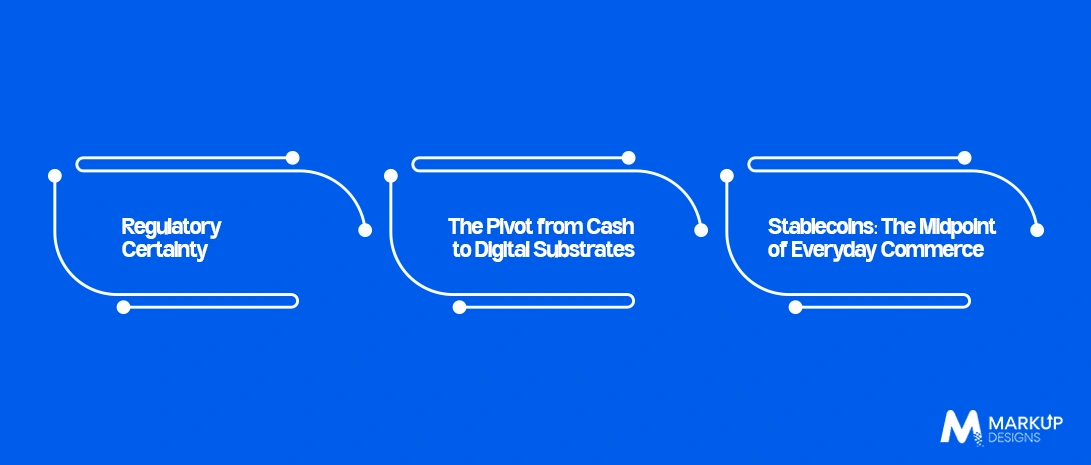
The development of UAE into a global blockchain centre is due to combined and collaborative efforts between all regulators, financial institutions, technology providers, and the government. There are several reasons, UAE is on the cutting edge of crypto payments.
Regulatory Certainty as a Competitive Advantage
The clarity of regulation in UAE is one of the major advantages that come with working within the blockchain space. Work is being done to create very clear commercial licensing frameworks and compliance standards for all companies, which allows companies to operate with certainty and have less risk due to their ability to innovate, time to market, and attract institutional partnerships; thus, facilitating their international expansion. The regulatory certainty surrounding the operation of crypto payment gateways will provide the foundation for secure, scalable, and sustainable long-term growth.
The Pivot from Cash to Digital Substrates
Consumer spending habits in UAE have transitioned rapidly from using cash to now using contactless payments, digital wallets, mobile banking, and online transactions. These rapidly growing consumer spending behaviors provide a strong impetus for creating a new digital-first consumer payment experience, which includes using crypto as a means of payment. Cryptocurrencies already provide a natural extension to traditional banking as a result of an increasing prevalence of use of smartphones, increased use of e-commerce, a proliferation of government-led digital initiatives, and a growing demand for faster, more efficient cross-border transactions.
Stablecoins: The Midpoint of Everyday Commerce
Stablecoins are a great way to do business, given their advantages (price stability, quicker settlement, lower transaction fees, and ease of accounting) over traditional cryptocurrencies. Stablecoins are quickly becoming the standard for doing business outside of regulated markets due to the fact that they can provide businesses with the benefits of both traditional cryptocurrencies (speed) and traditional fiat currencies (predictable value). Some industries, such as retail, hospitality, B2B trade, and global supply chains, are particularly well-suited to benefit from using stablecoins.
Navigating UAE and Middle East Legal Landscape
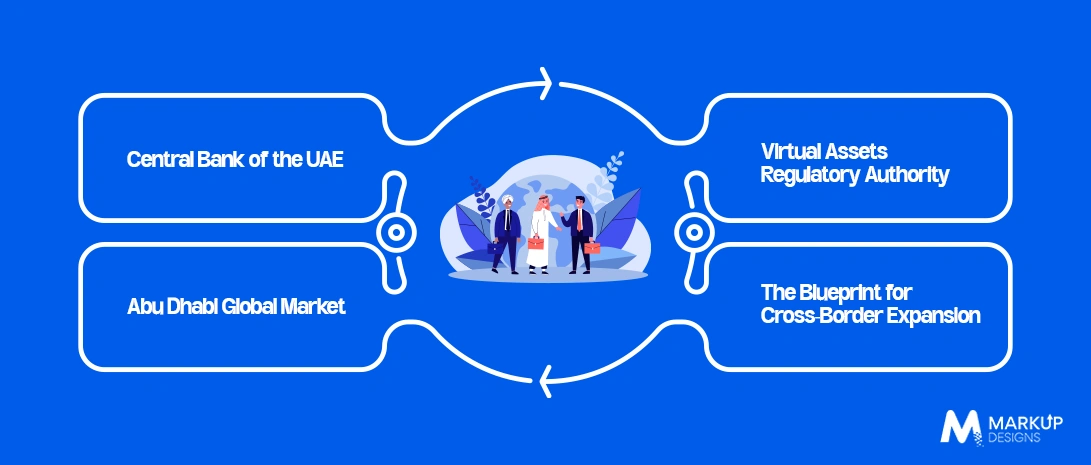
Regulatory compliance is a fundamental feature of the design of a crypto payment gateway; therefore, crypto payment gateways must adhere to the regulations of various regulatory authorities in UAE. All aspects of the crypto payment gateway like customer onboarding, transaction monitoring, and asset custody, must comply with applicable laws and standards.
Central Bank of UAE (CBUAE): The Payment Token Services Regulation
The Central Bank of United Arab Emirates (CBUAE) is the principal regulator for the payment ecosystem in UAE by way of the Payment Token Services Regulation. This regulation establishes the framework for the issuance, custody, settlement, and other services related to payment tokens.
The regulatory framework focuses on ensuring financial stability, consumer protection, secure means of making payments, and managing risk effectively. In order for cryptocurrency payment gateways to operate legally, they will need to have an internal controls that are strong enough to ensure the safety of transactions and customer information, processes to handle detailed reporting, and the ability to integrate seamlessly with traditional banking systems (where appropriate).
Virtual Assets Regulatory Authority (VARA): Dubai’s Dedicated Supervision
Dubai’s Virtual Assets Regulatory Authority (VARA): Dubai’s Specialized Regulatory Authority
Dubai’s VARA is responsible for regulating businesses involved in virtual assets, which include businesses that develop, operate, or provide services related to virtual assets, such as exchanges, custody services, broker-dealer operations, advisory services, and payments. Any business developing cryptocurrency payment gateways in Dubai must comply with VARA’s regulations on licensing, cybersecurity, money laundering/anti-money laundering (AML/KYC), and monitoring transactions. VARA has established a framework for firms developing blockchain app businesses to grow by balancing innovation with the protection of investors’ interests while helping to maintain the integrity of the markets.
Abu Dhabi Global Market (ADGM) & FSRA: The Institutional Sandbox
ADGM has emerged as the leading region for developing and regulating financial technology and blockchain innovation through its Financial Services Regulatory Authority (FSRA). With an extensive set of rules relating to virtual assets, an innovative licensing regime focused on promoting innovation, and a thorough level of regulatory support, businesses have access to the tools they need to successfully launch compliant financial products. As a result, many blockchain startups and financial technology companies use ADGM as a springboard to expand into new geographic markets – both within the region and globally – while remaining compliant with high levels of regulatory oversight.
The Blueprint for Cross-Border Expansion Across the Middle East
Due to UAE’s geographic position, located at the intersection of Asia, Europe and Africa there are a number of reasons to use it as a springboard to roll out crypto payment services throughout the Middle East. However, companies need to understand that each jurisdiction has different licensing requirements, anti-money laundering requirements, data protection laws, multi-currency settlement requirements, tax liabilities, bank partnerships, and sanctions screening. Companies that build compliance into their platforms from the beginning lay the foundations for future regional expansion while reducing their operational and compliance risk.
Crypto Payments in Action: Use Cases and Industry Examples
Until recently, crypto payment gateways defined the cryptocurrency industry for digital assets and blockchain-related businesses. However, as UAE continues to mature its economy with emerging technologies, these payment options are increasingly being adopted by a growing number of businesses in different sectors across the country.
Luxury Real Estate and High-Value Property Transactions
Dubai’s luxury property market has been at the forefront of incorporating cryptocurrency payments into its business model. Wealthy global individuals and international investors are looking for flexible ways to make cross-border real estate purchases.
With a regulated crypto payment gateway, property developers and real estate agents can easily accept various digital assets in compliance with regulations, maintain an audit trail of the transaction, and convert any digital asset to AED if necessary.
This method is making it easier to settle international payments, reducing the need for various intermediaries and improving the global purchasing experience for investors.
E-commerce and retail
The e-commerce industry in the UAE is rapidly growing, and businesses are beginning to accept cryptocurrencies for international consumers. By utilizing crypto payment gateways, merchants can accept a variety of cryptocurrencies and stablecoins. Crypto payment gateways offer merchants the ability to:
- Securely accept various cryptocurrencies and stablecoins,
- Convert their digital assets into AED or any other fiat currency automatically,
- Have faster settlements,
- Reduce the risk of chargebacks, and
- Simplify international transactions.
By offering multiple payment methods, customers will be able to make purchases with greater flexibility, and merchants will receive payments faster, incur lower processing fees and gain increased access to global markets.
Hospitality, Tourism & Leisure
UAE is becoming one of the premier tourist destinations in the world, resulting in a growing interest in the acceptance of cryptocurrencies for payment within the hospitality industry. Hotels, airlines, restaurants, entertainment venues, and travel companies are now utilizing crypto payment gateways for transactions, including hotel bookings, airline ticket purchases, luxury experiences, event tickets, restaurant payments, and travel packages. By accepting both digital asset payments and traditional payment methods, these businesses can create a better experience for consumers and reach a much larger target audience.
B2B Settlement and Cross-Border Corporate Trade
When companies conduct international business, they usually deal with a number of different parties (intermediaries), face lengthy settlement timeframes and incur significant foreign exchange fees.
A crypto payment gateway will streamline these tasks to help speed up international transactions using the blockchain. Crypto payment gateways can be an asset to companies involved in import/export, logistics, manufacturing, and professional services by allowing for supplier payments, international invoicing, trade settlements, treasury management, and global procurement. When combined with stablecoins, a crypto payment gateway will allow for quicker and more predictable settlements while limiting the use of traditional banking channels.
How to Create a Crypto Payment Gateway in the UAE
Creating a crypto payment gateway that is secure involves much more than the integration of blockchain technology. To create a trustworthy payment ecosystem, a company needs to integrate secure and scalable technological solutions, regulatory compliance, and cybersecurity into its payment gateway solution.
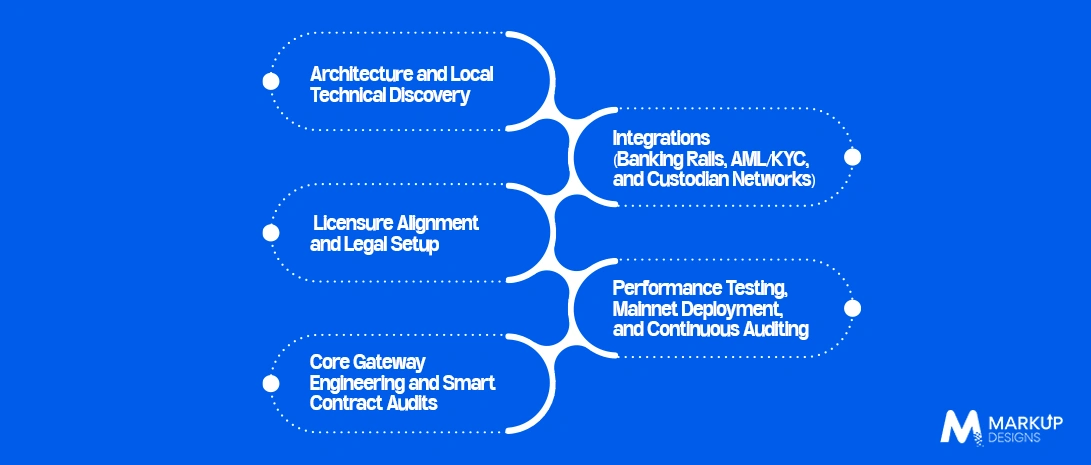
The following are the phases of creating a crypto payment gateway
Phase 1: Architecture and Local Technical Discovery
During this phase of the project, a company should determine its business goals, target users, and technical requirements, such as what cryptocurrencies it will accept and which blockchain networks it will connect to, what type of wallet architecture to use, how payment flows will be processed, what specific APIs will be available for implementing the payment solution, and how to settle payments in fiat currency. Security measures, such as encryption, secure key management, and fraud prevention systems, should always be planned into the project from its inception.
Phase 2: Licensure Alignment and Legal Setup
Regulatory compliance should proceed in conjunction with developmental efforts. Therefore, businesses should obtain any and all necessary licenses to operate as a crypto payment gateway (including any operating licenses, AML & KYC procedures), complete all compliance documentation, and develop and implement governance and risk management frameworks that will aid in ensuring compliance with regulatory requirements.
Phase 3: Core Gateway Engineering and Smart Contract Audits
The third step in the process of developing the payment gateway is to develop the core functionalities of the payment gateway (wallet infrastructure, payment processing, merchant dashboard, API, and smart contracts), and before launch, all smart contracts need to be audited for security, so that any potential issues with them can be fixed.
Phase 4: Integrations (Banking Rails, AML/KYC, and Custodian Networks)
The payment gateway will integrate with Banks, AML/KYC providers, and custodians to facilitate the ability to support Fiat currency settlements, customer ID verification, transaction monitoring, and securely storing digital assets.
Phase 5: Performance Testing, Mainnet Deployment, and Continuous Auditing
Once the platform has developed and is fully functional, it will be tested for functionality, performance & security prior to being deployed on the mainnet. In addition to being maintained through continuous monitoring, the platform will receive regular updates in the form of security audits or software patches, and be subject to ongoing compliance reviews to ensure its security, reliability, and readiness to operate with the relevant regulatory requirements.
Read Also: How Blockchain Apps Are Transforming Businesses in the Middle East
What are the costs associated with developing a Crypto Payment Gateway in the UAE?
The development of a crypto payment gateway can vary depending on the features of the platform, the regulatory compliance requirements of the platform, the degree of security measures implemented, and the difficulty of the integrations required. Each project itself entails its own costs; the factors set forth above are all major influences on the total amount of investment needed for creating the platform.
Regulatory Licensing Costs
Licensing, legal consultations, compliance documentation, and regulatory approvals are essential expenses that vary based on the jurisdiction and business model.
Technical Complexity
The more advanced the platform, such as support for multiple blockchains, smart contracts, automated settlements, and merchant management, the higher the development cost.
Security Infrastructure
Enterprise-grade security, including encryption, multi-factor authentication, secure key management, smart contract audits, and continuous monitoring, is critical for protecting digital assets and ensuring compliance.
Third-Party Integrations
Integrating banking systems, blockchain networks, AML/KYC solutions, payment processors, and custody providers adds to the overall development effort and cost.
Development Team Expertise
Building a secure payment gateway requires experienced blockchain developers, cybersecurity specialists, compliance professionals, UI/UX designers, and QA engineers, making team expertise another key cost factor.
Typical Enterprise Budget
Although every project has unique requirements, businesses should plan for a significant investment to build a secure, compliant, and scalable crypto payment gateway. Focusing on long-term reliability and regulatory readiness delivers greater value than minimizing upfront costs.
How Much Does It Cost to Develop a Blockchain App in UAE?
Planning a blockchain app in the UAE? Understand the detailed insights that influence blockchain app development pricing, features, and timelines.

Future Outlook: What’s Next for Crypto Payments in the UAE?
The UAE continues to lead financial innovation, and as blockchain technology evolves, crypto payment gateways are expected to become an integral part of the country’s digital economy.
The Deepening Integration of Central Bank Digital Currencies (CBDCs)
Central Bank Digital Currencies (CBDCs) are likely to play a significant role in the future of digital payments by enabling faster settlements, improved payment efficiency, greater regulatory oversight, and seamless integration with existing banking systems. As adoption grows, future payment gateways may support both cryptocurrencies and CBDCs within a unified payment ecosystem.
Programmable Corporate Payments and Decentralized Finance (DeFi) Touchpoints
Smart contracts and blockchain technology are paving the way for programmable payments, automated supplier settlements, tokenized invoices, escrow services, and more efficient cross-border transactions. As the regulatory landscape matures, selected DeFi capabilities are expected to complement traditional payment infrastructure, offering businesses greater automation and operational efficiency.
Build a Future-Ready Crypto Payment Gateway with Markup Designs in Middle East
Building a secure crypto payment gateway requires expertise in blockchain development, cybersecurity, financial technology, and regulatory compliance. At Markup Designs, we help businesses develop scalable, secure, and compliant payment solutions tailored to the Middle East market.
From custom crypto payment gateways and multi-chain blockchain integration to secure wallet development, smart contract auditing, AML/KYC implementation, API integrations, and enterprise-grade security, our team delivers end-to-end blockchain solutions that support long-term business growth. Whether you’re launching a new fintech platform or upgrading an existing payment ecosystem, we build future-ready solutions designed for performance, security, and compliance.
Ready to Launch a Secure Crypto Payment Gateway?
Transform your payment infrastructure with a secure, scalable, and regulation-ready crypto payment gateway built for the UAE and Middle East markets. From blockchain integration to compliance and enterprise security, Markup Designs helps you bring your vision to life with confidence.

Conclusion
The UAE has emerged as one of the most attractive markets for crypto payment gateway development, offering a unique combination of progressive regulation, advanced financial infrastructure, and growing institutional adoption. Businesses that invest in secure, compliant, and scalable payment platforms today will be well-positioned to capitalize on the increasing demand for digital asset transactions across industries.
Success, however, depends on much more than integrating blockchain technology. Organizations must prioritize regulatory compliance, robust cybersecurity, seamless banking connectivity, and a user-centric payment experience from the outset. By partnering with experienced blockchain development specialists, businesses can navigate technical and legal complexities while building payment gateways that are resilient, future-ready, and capable of supporting the next generation of digital commerce in the UAE and the wider Middle East.
FAQs
1. Which regulatory body governs crypto payment gateways in Dubai vs. Abu Dhabi?
Crypto payment gateways operating in Dubai generally fall under the supervision of VARA for virtual asset activities, while businesses established within Abu Dhabi Global Market are regulated by the FSRA. The Central Bank of the UAE also oversees payment-related regulations that may apply depending on the business model.
2. Can a UAE crypto payment gateway support both stablecoins and volatile assets like Bitcoin?
Yes. Modern payment gateways can support multiple cryptocurrencies, including Bitcoin, Ethereum, and stablecoins. Businesses can also offer automatic conversion into AED or other fiat currencies to reduce exposure to market volatility.
3. How long does it take to secure a crypto payment license in the UAE?
The timeline depends on the regulatory authority, the complexity of the business model, the quality of documentation, and the licensing requirements. Businesses should plan for several months to complete regulatory approvals before commercial launch.
4. What are the main security requirements for a Middle East crypto gateway?
Enterprise-grade security typically includes encryption, multi-factor authentication, secure private key management, AML and KYC compliance, smart contract audits, penetration testing, transaction monitoring, and continuous security assessments.
5. How do crypto payment gateways settle transactions into local fiat currency (AED)?
Many gateways integrate with banking partners or licensed liquidity providers to convert cryptocurrency into AED. Once converted, funds can be transferred directly to the merchant’s local bank account according to the settlement schedule.
Author's Perspective
The UAE’s crypto ecosystem is entering a new phase where enterprise adoption is driven by regulatory clarity rather than speculation. Businesses that view compliance, cybersecurity, and interoperability as strategic investments, not regulatory hurdles, will be best positioned to lead this transformation. As digital assets become increasingly integrated into mainstream commerce, secure crypto payment gateways will play a central role in enabling trusted, efficient, and scalable financial transactions across the Middle East.
Discuss Your Project NowGaurav Goyal
Global Sales- VP
Related Posts

Crypto Trading Bot Development: Architecture, Features & Cost...

Cost to Develop a Cryptocurrency Exchange App Like...

How Much Does It Cost to Build a...
Insights Are Valuable & Execution is Priceless
You’ve read about the digital future. Now, let’s build the infrastructure to take you there. Move your strategy from the page to the product.
Design Your Solution Now
Contact Us
Schedule The Appointment At Your Convenience Date And Time.
30 Min
Web Conference
Time Zone
Indian standard time (08:30pm)

Thanks For Getting In Touch!
You’ve Taken The First Step Toward Transforming Your Digital Presence. Our Experts Will Reach Out Shortly To Take It Forward.
Launch Your Dream Project
Provide a brief overview of your project, and our specialists will evaluate your requirements. We will connect with you to explore how the right digital solutions can help you launch faster.